


If you only have a day or two in Costa Rica’s Central Valley, choosing between Poás Volcano and Irazú Volcano can feel like a high-stakes decision. Both are easy day trips from San José and Juan Santamaría International Airport (SJO), both sit high above the clouds, and both now require advance reservations through Costa Rica’s national park booking system. Yet the on-the-ground experience at each peak is surprisingly different. This guide breaks down those differences so you can decide which volcano deserves your limited time, or whether it is worth squeezing in both.
Crater Views and Overall Scenery
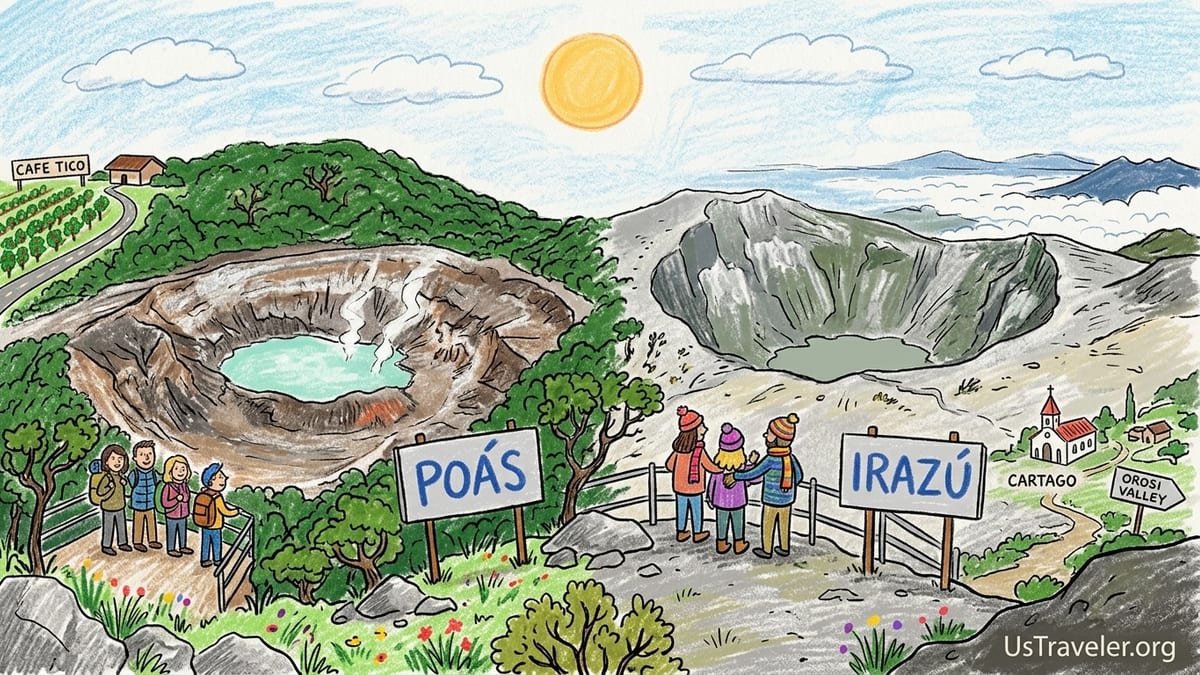
Poás and Irazú both deliver that classic “stand on the rim of a volcanic crater” moment, but the feel of each landscape is distinct. Poás Volcano’s main crater is a dramatic bowl of bare rock and ash, often streaked with sulfur stains, with a milky turquoise lake at the bottom when conditions cooperate. From the main viewing platform you look almost straight down into the pit, giving a strong sense of scale and activity. Even on days when the crater lake looks subdued, the surrounding dwarf cloud forest and steaming fumaroles remind you this is a live system.
Irazú Volcano, at higher elevation, offers a more expansive, almost lunar panorama. On clear days, the main crater and the Diego de la Haya crater appear as huge, grey-green amphitheaters edged by cliffs. Vegetation is sparse inside the crater area, and the windswept plateau around the parking lot can feel otherworldly. Many visitors comment that the broad open vistas here are just as memorable as the craters themselves, especially if you walk to the various lookouts within the crater sector of Irazú Volcano National Park.
If your dream is a textbook photo of a turquoise crater lake, Poás has the edge, though that color can vary with rainfall and volcanic activity. If you picture yourself wandering a bleak, high-altitude volcanic plateau with sweeping views all around, Irazú is more likely to match your imagination. Travelers who have done both in a single trip often describe Poás as more intimate and Irazú as more grand and stark.
Both parks have well-built viewpoints close to the parking areas, so you do not need to be a serious hiker to reach the main crater overlooks. The main difference in scenery is really about mood: Poás wraps its crater in misty forest, while Irazú opens it up to the sky.
Altitude, Weather, and Cloud Risk
Altitude and weather are two of the biggest practical differences between these volcanoes, and they should strongly influence your choice. Poás Volcano sits at about 2,697 meters above sea level, while Irazú rises to roughly 3,432 meters, making it the highest active volcano in Costa Rica. That extra 700 meters matters. Temperatures at Irazú can be several degrees cooler than Poás on the same morning, and the wind on the Irazú plateau is often much stronger.
In everyday terms, Poás usually feels like a brisk mountain destination where a fleece and rain jacket are enough. Irazú can feel wintry by tropical standards. It is common to see visitors at Irazú wearing hats, gloves, and multiple layers, especially between December and February. Those prone to shortness of breath at altitude may also notice the thinner air at Irazú more than at Poás. Most reasonably fit travelers manage fine, but if you know you are sensitive to altitude, Poás is the gentler choice.
Cloud cover is another key issue. Both peaks are frequently shrouded, especially during the rainy season from roughly May to November, but their patterns differ. Poás, wrapped in cloud forest, often sees fast-moving mist that can open and close windows of visibility within minutes. It is not unusual for visitors to arrive to a white-out at the crater platform, only to have the clouds part briefly and reveal the crater for five or ten minutes.
Irazú, by contrast, can either be gloriously clear, with views down to the Central Valley and sometimes both the Pacific and Caribbean on the same day, or socked in with a dense, unbroken cloud layer. Mornings tend to be clearer at both volcanoes, but at Irazú the difference between a clear 8 a.m. and a foggy 10 a.m. can be dramatic. If you are traveling in the wet season and can only do one, Poás gives slightly better odds of catching at least a brief glimpse, simply because the mist tends to shift more quickly.
Walking Effort and Accessibility
Neither Poás nor Irazú requires strenuous hiking to reach the signature views, which is why both are popular day trips. At Poás, once you park, a short paved path of roughly 10 to 15 minutes leads from the visitor facilities to the main crater viewpoint. The walk is gently uphill but not steep, with railings and rest spots along the way. Many families with young children and older travelers manage it without trouble, assuming they go slowly and are not rushing for a time slot.
Irazú is even more straightforward in some respects. In the crater sector, the parking lot sits very close to the broad main viewing area. You walk a few minutes over packed dirt or pavement to reach the railings that look into the crater. There are some gentle slopes, but no sections most visitors would classify as a hike. People with limited mobility often find Irazú’s wide, open terrain easier to manage than Poás’ slightly longer forested approach, although the cold wind can be challenging for some.
If you want more walking, both parks offer optional trails. Around Poás, short loops wind through the high-altitude forest, with interpretive signs that explain the unique plants adapted to the volcanic environment. At Irazú, the separate Prusia sector, reached by car from lower down the volcano, has around 16 kilometers of trails through a reforested landscape of pines and native species. This area appeals to travelers who want a proper half-day walk rather than just a viewpoint stop.
For visitors with only a few hours and a rental car, both parks function almost like drive-up viewpoints. You can be at the crater overlooks within half an hour of arriving at the gate, spend your limited time on photography and soaking in the views, and then move on to your next stop.
Reservations, Tickets, and Time Slots
Both Poás Volcano National Park and Irazú Volcano National Park currently require advance reservations through Costa Rica’s national park online booking platform operated by SINAC. That means you should book tickets before driving all the way up the mountain. Same-day slots are sometimes available on quieter weekdays, but during peak travel periods like Christmas to New Year or Easter week, morning entries can sell out for both parks.
At Poás, ticketing also manages access to the main crater platform. In the past, visits were strictly limited to around 20 minutes per group at the crater due to gas monitoring and crowd control. Recent visitor reports suggest that enforcement can vary, but you should still expect rangers to funnel visitors in waves and to ask people to move along if the platform gets crowded. Your reservation includes a specific entry time window, and you are expected to arrive within that slot and proceed fairly directly to the viewpoint.
Irazú’s reservation system is a bit more relaxed. You still need a pre-booked ticket for the crater sector or Prusia sector, and rangers at the gate will check your confirmation and ID. Once inside, though, most visitors are free to move between viewpoints at their own pace within park opening hours. You pay a separate parking fee at Irazú, usually collected at the entrance booth or parking area, in addition to the entrance ticket you bought online.
In practical terms, this means Poás visits are more tightly scheduled and work best for travelers who like structure. You might, for example, reserve an 8:30 a.m. entry, drive directly from a hotel near SJO, and plan coffee farm and waterfall stops around that fixed time. Irazú, with a broader window once you are inside, suits travelers who prefer to linger at viewpoints, take photos slowly, and perhaps add an unhurried lunch stop in nearby Cartago or the Orosi Valley on the way back.
Distance from San José and SJO
For many visitors with limited time, distance from the capital and airport is the deciding factor. Poás lies to the northwest of San José, with the main road climbing up from the city of Alajuela. The straight-line distance from central San José to the volcano area is roughly 30 to 50 kilometers, depending on the route, and typical driving times range from about 1 hour to 1 hour 30 minutes in light traffic. Travelers staying in airport hotels near SJO often find they can leave after breakfast and reach the park gate by mid-morning without an early wake-up.
Irazú, by comparison, rises above Cartago to the east of San José. The distance from downtown San José to the crater sector is in the ballpark of 45 to 50 kilometers, but the climb up the mountain roads and potential congestion leaving the capital mean that drive times commonly hover around 1.5 to 2 hours. Buses and tours usually leave San José early in the morning to maximize the chance of clear skies and avoid city traffic.
The location of your hotel matters. If you are spending your first or last night near SJO or in Alajuela, Poás is the natural choice, and many visitors pair it with an afternoon flight or arrival. Those staying in or near Cartago, or planning to explore the Orosi Valley and Tapantí National Park, will find Irazú easier to weave into their plans. With limited time and a central San José base, most travelers choose one volcano rather than attempt both in a single day, as the combined driving would easily exceed four hours.
Public transport is possible to both, but more straightforward to Irazú, which has a regular but limited bus service from San José that drives all the way to the crater area. Poás also has bus options via Alajuela on specific days, but schedules can change and departures are often early. For a flexible day trip, especially if you want to add coffee estates or waterfalls, a rental car or private driver is usually the most convenient option.
Pairing Poás with Coffee Estates and La Paz Waterfall Gardens
Where Poás really shines is in how neatly it fits into a classic Central Valley day trip that combines volcano views, coffee culture, and lush waterfalls. The slopes around Poás are dotted with well-known coffee farms, from boutique estates to large-scale operations. Many travelers combine a morning crater visit with a tour at a working coffee farm such as Hacienda Alsacia, a high-altitude Starbucks-owned farm that offers guided walks through the fields, demonstrations of processing, and tastings of single-origin beans.
The road network makes these combinations simple. After an early Poás time slot, you can drive back down toward Alajuela, stop for a late-morning coffee tour, and enjoy a traditional casado lunch at a roadside soda. Alternatively, if your crater entry is mid-morning, you might schedule a breakfast stop at a café overlooking the Central Valley on the way up, and then descend directly to a coffee estate tour in the early afternoon before returning to SJO.
Another popular pairing for Poás is La Paz Waterfall Gardens, a private nature park reached by a scenic drive along the slopes of the Central Volcanic Range. Travelers often book a Poás entry for early opening hours, spend about two hours between the parking lot, visitor center, and crater viewpoint, and then continue to La Paz for half a day of walking trails past multiple waterfalls, animal exhibits, and hummingbird gardens. For families and first-time visitors to Costa Rica, this combination delivers a satisfying mix of geology, wildlife, and rainforest scenery without requiring long drives.
If your time is limited to one full day in the Central Valley and you want a “greatest hits” sampler with minimal logistical complexity, Poás plus either a coffee tour or La Paz (or both, if you move quickly) is hard to beat. It works especially well for travelers staying their first night near the airport, those with afternoon departures from SJO, and anyone who wants to avoid driving after dark on unfamiliar mountain roads.
Pairing Irazú with Cartago, Orosi, and Lankester Gardens
Irazú rewards travelers who are interested not just in volcanic scenery but also in Costa Rican history and quieter rural landscapes. The volcano towers above Cartago, the country’s former capital, making it easy to combine a morning at the crater with an afternoon exploring Cartago’s landmarks. Many day trips start with an early drive from San José to Irazú, aiming to reach the summit soon after the park opens, then descend by late morning for a stroll around Cartago’s central plaza and a visit to the Basilica de Nuestra Señora de los Ángeles.
From Cartago, it is a short drive to the lush Orosi Valley, an area of rolling hills, coffee fields, and the Reventazón River. Travelers often stop at a viewpoint overlooking the valley for photos, then continue to small villages like Orosi itself, where you can visit one of Costa Rica’s oldest functioning churches and relax over a long lunch at a local restaurant. The combination of the stark volcanic landscape of Irazú in the morning and the green, pastoral scenery of Orosi in the afternoon makes for a satisfying and varied day.
Another natural companion to Irazú is the Lankester Botanical Garden, managed by the University of Costa Rica. Located outside Cartago, it is famous for its collection of orchids and other tropical plants arranged in themed sections such as Japanese-style gardens and secondary forest. Many organized tours line up Irazú in the morning, followed by Lankester and a quick stop in Cartago, returning to San José by early evening. For independent travelers with a rental car, following this same pattern is straightforward: crater views first, then a gentle walk through gardens, then a coffee and pastry stop in town.
If your interests lean toward culture, history, and quieter towns rather than more commercial attractions, the Irazú plus Cartago and Orosi circuit is particularly appealing. Those who have already seen coffee estates elsewhere in the country or who prefer botanical gardens and historic churches to animal exhibits will likely find more value in dedicating their Central Valley day to Irazú.
Which Volcano Is Better for You?
Ultimately, the question of whether Poás or Irazú is “better” depends on your priorities, schedule, and travel style. Poás usually wins for convenience, especially if you are based near SJO or Alajuela, or if you have only one full day to fit in a volcano, coffee, and waterfalls. Its altitude is a bit lower, the main path is short and well-maintained, and the surrounding landscape of cloud forest and coffee farms creates an iconic first impression of Costa Rica.
Irazú, on the other hand, often feels more remote and dramatic. It is the better choice if you are intrigued by the idea of standing on the highest volcano in Costa Rica, if you want sweeping views and a stark high-altitude environment, or if you are already planning to visit Cartago, the Orosi Valley, or Lankester Gardens. The experience at the crater sector is more about vast panoramas than lush forest, and the add-on destinations have a quieter, more local feel.
Travelers with children, older relatives, or tight flight schedules may find Poás less stressful, both because of the shorter drive and the strong infrastructure of nearby tourist services, from coffee estates to roadside restaurants. Those with an extra day in the Central Valley, or a base in Cartago, can comfortably include Irazú without racing the clock. If clear weather is your top concern and you are visiting in the rainy season, consider checking short-term forecasts the day before; if one volcano looks more promising for morning visibility, let that sway your decision.
For visitors with two or more full days in the Central Valley, it is entirely possible to see both. Many people do a Poás plus coffee or La Paz day from the airport area and an Irazú plus Cartago and Orosi day from a base in San José. If you must choose just one, lean toward Poás for a more polished, family-friendly experience tied to coffee and waterfalls, and toward Irazú for height, history, and quieter landscapes.
The Takeaway
If your time and energy are limited, Poás Volcano is generally the best all-around choice for a Central Valley day trip. It is slightly closer to San José and SJO, combines effortlessly with well-known coffee estates and La Paz Waterfall Gardens, and offers a dramatic crater view framed by cloud forest with only a short walk from the parking lot. The structured reservation and time-slot system at Poás actually helps many travelers organize their day efficiently.
Irazú Volcano, though, remains a very strong contender, particularly for travelers staying in or passing through Cartago or for those who value sweeping vistas, high-altitude landscapes, and cultural stops. Pairing Irazú with Cartago’s historic center, the tranquil Orosi Valley, and the orchid-rich Lankester Botanical Garden makes for a fuller, more varied loop than a volcano-only excursion. It is the better fit for travelers who do not mind a longer drive and cooler temperatures in exchange for big views and fewer crowds.
Because both parks now require reservations through Costa Rica’s national park booking system, your decision may also be shaped by practicalities like which volcano has openings at a convenient morning time. When in doubt, look first at where you are staying, which nearby attractions excite you more, and whether you prefer a more curated tourist route (Poás) or a day that mixes high peaks with historic towns and countryside (Irazú). Either way, you will end up standing on the rim of a Central American volcano, watching the clouds move below you, which is a memorable way to spend any limited day in Costa Rica.
FAQ
Q1. Do I really need to book Poás and Irazú tickets in advance?
Yes. Both Poás Volcano National Park and Irazú Volcano National Park currently require advance reservations through the official Costa Rican national park online system, and you should not count on buying tickets at the gate.
Q2. Which volcano is closer to San José and SJO airport?
Poás is slightly closer to both central San José and SJO, typically about 1 to 1.5 hours by car from the airport area in light traffic, while Irazú often takes 1.5 to 2 hours from the city.
Q3. Which volcano has better chances of clear views?
Conditions change daily, but Poás often has fast-moving mist that can open short viewing windows even on cloudy days, while Irazú tends to be either very clear or completely socked in. In the rainy season, Poás usually gives slightly better odds of catching at least a brief crater view.
Q4. Is one volcano safer or more suitable for children and older travelers?
Both are generally safe and require only short walks to the main viewpoints. Poás’ altitude is lower and temperatures milder, which many families and older travelers find more comfortable, while Irazú’s higher elevation and colder wind can be more taxing for some visitors.
Q5. Can I visit both Poás and Irazú on the same day?
It is theoretically possible with a very early start and careful time-slot planning, but most travelers find it rushed. With limited time, it is more enjoyable to dedicate one full day to Poás and nearby coffee estates or La Paz, and another day to Irazú and Cartago or Orosi.
Q6. Do I need a 4x4 vehicle to reach Poás or Irazú?
In normal conditions, you do not. The main roads to both parks are paved mountain roads passable in a standard rental car. However, rain, fog, and occasional potholes mean you should drive cautiously and avoid traveling up or down after dark if you are unfamiliar with the area.
Q7. How should I dress for each volcano?
For Poás, a light fleece or sweater, long pants, and a rain jacket are usually enough, plus closed shoes. For Irazú, plan for colder, windier conditions: add extra layers, a hat, and possibly gloves, especially from December through February.
Q8. Which volcano is better if I want to see waterfalls as well?
Poás is the better match. Many visitors pair a morning crater visit with an afternoon at La Paz Waterfall Gardens, or with other waterfall hikes on the northern slopes of the Central Valley, creating a varied day of volcano and rainforest scenery.
Q9. Which volcano offers more cultural or historic side trips?
Irazú pairs naturally with Cartago’s historic center, the Orosi Valley, and Lankester Botanical Garden, so it is a stronger choice if you want to mix volcanic landscapes with colonial churches, small towns, and botanical collections.
Q10. If I have to pick just one, which volcano should I choose?
If convenience, coffee tours, and waterfalls are your priorities, choose Poás. If you prefer higher peaks, cooler air, and a day that includes Cartago and the Orosi Valley, choose Irazú. Both are rewarding, so let your nearby attractions and logistics guide the final decision.