


The Central Valley is where most trips to Costa Rica begin, but it is also where many itineraries go wrong. Travelers often book a random hotel "near San José" without realizing they might be 45 minutes from the airport, nowhere near their early-morning tour pickup, or stuck in rush-hour traffic instead of sipping coffee with volcano views. Choosing the right base in the Central Valley can save you hours of transfers and set the tone for your entire trip.
How to Think About Bases in the Central Valley
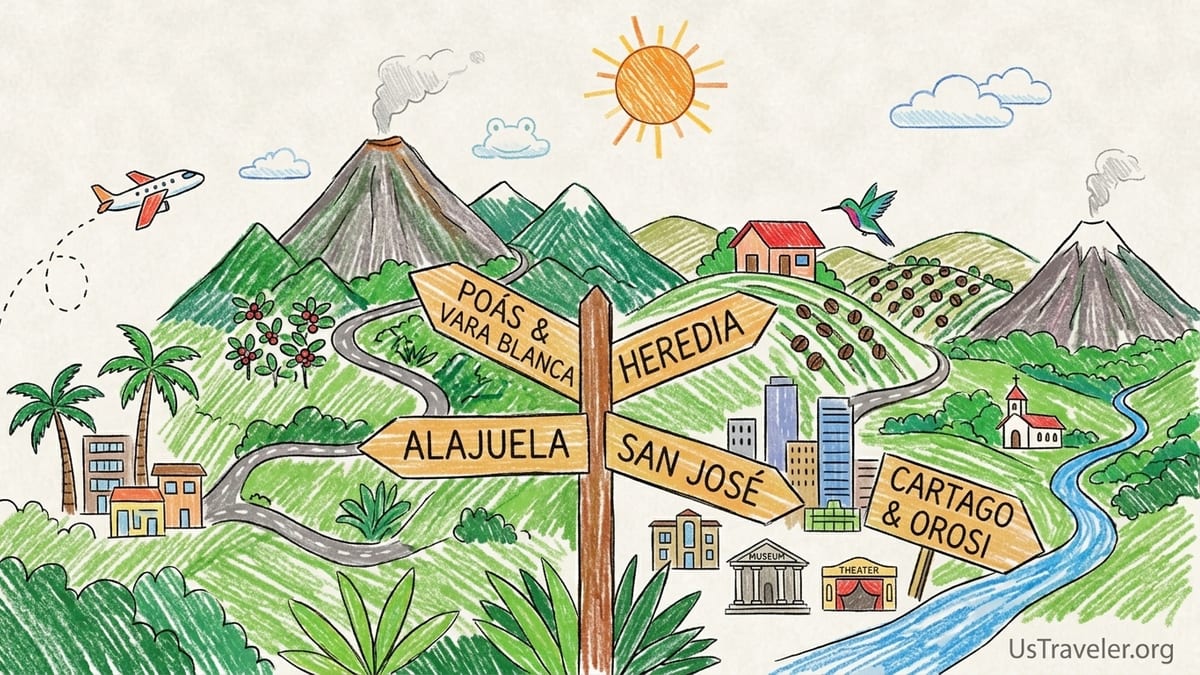
Before choosing between San José, Alajuela, Heredia, Cartago or the Poás and Vara Blanca mountains, it helps to think about what your first days in Costa Rica will actually look like. Are you landing late at Juan Santamaría International Airport (SJO) and flying out early a day or two later? Are you planning city sightseeing, or do you mainly want volcanoes, coffee farms and waterfalls? The Central Valley is compact on the map, yet traffic and winding mountain roads can make a 25 kilometer journey take an hour or more.
Most visitors underestimate just how different the experiences are in each part of the valley. Staying in downtown San José puts you among museums and restaurants but can be a 30 to 45 minute drive from SJO at busy times. Sleeping in Alajuela might put you five minutes from the terminal and on the road to Poás Volcano, but without big-city nightlife. Heredia brings you closer to coffee country, Cartago is the logical base for Irazú Volcano and the Orosi Valley, while Poás and Vara Blanca are for those who want to wake up in the cloud forest itself.
Think of each base in terms of five key factors: airport convenience, restaurant and nightlife scene, tour pickup options, need for a rental car, and the kind of scenery you want to see when you open your curtains in the morning. Once you are clear on those trade-offs, it becomes much easier to decide where to stay and how many nights to allocate.
Below, we compare the main areas most travelers consider, then suggest the kinds of travelers who will be happiest in each. After you decide your base, you can start looking at individual hotels that match your budget and style.
San José: Best for City Sightseeing and Urban Tours
San José is Costa Rica’s capital and the natural choice if you want museums, architecture and a taste of urban life. Staying near the historic center, around the Avenida Central and Barrio Amón, places you within walking distance of landmarks such as the National Theater and the Pre-Columbian Gold Museum, as well as local coffee shops and craft breweries. From this area, you can walk to tour offices that run day trips to Irazú Volcano, Orosi, Poás, coffee farms and zip-line parks, which is convenient if you do not want to drive.
In terms of airport access, San José is not the most convenient. Juan Santamaría International sits near Alajuela, and depending on traffic it can take roughly 25 to 45 minutes by taxi or shuttle to reach central San José. Travelers arriving on a late-evening flight or departing early the next morning sometimes find this stressful. However, if your main goal is to spend a full day or two exploring the city, it is often worth the extra transfer. A typical taxi from the airport to central San José might cost the equivalent of 30 to 40 US dollars, while shared shuttles and ride-hailing services, where available, can sometimes reduce that cost.
San José offers the widest restaurant selection in the Central Valley. Areas like Barrio Escalante have become known for contemporary Costa Rican cuisine, international tapas, and craft beer bars, all within a short ride from most central hotels. You will also find midrange and upscale properties with good on-site dining, which helps if you are tired after a day of travel. If you plan to head out on several organized day tours, look for hotels within the pickup zones frequently used by operators, which often focus on the central corridor from La Sabana to downtown.
The trade-off is that you will be based in a dense city environment with urban noise and traffic. You will not wake up to mountain views or bird calls. For many travelers, this is acceptable for one or two nights at the start or end of a trip, especially if they value easy access to museums, walking tours, nightlife and tour operators more than immediate proximity to the airport.
Alajuela: Best for SJO Flights and Poás Volcano
Alajuela is technically its own city and province, but for travel planning it essentially means the areas around SJO and the road that climbs toward Poás Volcano. If you look at a map, you will notice that the airport terminals sit closer to Alajuela than to downtown San José. That makes Alajuela the most practical base if you are arriving late, departing early, or just want to avoid wasting time in city traffic.
In Alajuela, you can find everything from simple airport hotels with free shuttle vans to more characterful options in nearby Belen or along the road to Poás. Some hotels sit five to ten minutes from the terminal by shuttle, making it easy to sleep in a bit before a morning flight. Travelers connecting to early tours of Poás Volcano or La Paz Waterfall Gardens often choose this area because the roads to the volcano and toward Vara Blanca begin here. Expect typical drive times of about 60 to 90 minutes from the airport area to the Poás crater viewpoint, depending on road conditions and park entry timing.
The city of Alajuela itself has a busy local downtown with sodas serving traditional casados, small bakeries and casual restaurants, though it does not have the same concentration of trendy venues found in San José. That said, if you stay near the airport in neighborhoods with large hotels, you will usually find at least a few chain restaurants, supermarkets and smaller local eateries within a short taxi ride. Many properties also offer on-site dining, which can be helpful after a late-night arrival.
From a logistics point of view, Alajuela works well if your Central Valley time is short and focused on connections rather than sightseeing. You can pick up a rental car near the airport the morning after you arrive, drive to Poás or on toward Arenal and the northern lowlands, and avoid backtracking from downtown San José. If you book guided tours, check whether the operator picks up from airport-area hotels, as some only serve central San José and charge a supplement to reach Alajuela. If your travel days revolve around SJO or Poás, this is usually the most efficient base.
Heredia: Best for Coffee Country and Quieter Suburbs
North of San José, the province of Heredia offers a softer, more suburban feel while still keeping you relatively close to the airport and the city. Many coffee farms carpet the hills around towns like Santa Bárbara and San Isidro, and there are long-established plantations that offer guided tours and tastings. For travelers who want to learn about coffee on their first or last day in Costa Rica without heading far into the countryside, basing in Heredia can be ideal.
In practical terms, Heredia sits somewhere between San José and Alajuela for airport convenience. Drive times to SJO from many Heredia hotels can range from roughly 20 to 35 minutes, depending on exact location and traffic. This is manageable for midday or afternoon flights, but if you have a very early departure you might still prefer to be closer to the terminal in Alajuela. On the other hand, you are generally closer to coffee estates and some botanical attractions than you would be in central San José.
The restaurant scene in Heredia is more dispersed and local than in San José. Expect neighborhood cafes, small bistros and traditional sodas rather than clusters of high-end venues. Some hillside lodges and boutique hotels offer excellent on-site dining that focuses on local produce and, of course, freshly roasted coffee. If you stay in the hills above the city, you can often enjoy wide views of the Central Valley lights at night, along with cooler temperatures than down in San José or Alajuela.
Heredia works especially well if you plan to rent a car. While it is possible to rely on taxis and occasional rideshare services, having your own vehicle makes it much easier to reach scattered coffee farms, viewpoints and smaller villages. If you are comfortable driving, a few days in a Heredia-area lodge can be a gentle, low-key introduction to Costa Rica before you move on to more remote regions.
Cartago & Orosi: Best for Irazú Volcano and Scenic Valleys
Cartago lies east of San José and serves as the historic capital of Costa Rica. Today it feels more like a working local city than a tourist hub, but its location makes it the most logical base for visiting Irazú Volcano National Park and the Orosi Valley. If your main Central Valley goal is to stand at the rim of Costa Rica’s highest volcano and then explore rural landscapes of rivers, hot springs and colonial churches, you should strongly consider sleeping here instead of in San José.
From Cartago, the drive up to Irazú typically takes about one hour on a winding mountain road, passing small farming communities and fields that often sit above the clouds. Starting from San José, that journey can easily exceed 90 minutes each way, and you have to cross the busy Florencio del Castillo Highway. By staying in Cartago, you shorten the ascent and improve your chances of reaching the crater earlier in the morning, when weather is more likely to be clear. Many organized tours that combine Irazú, the Orosi Valley and the Lankester Botanical Garden still depart from San José, but a private driver or rental car from Cartago will give you more flexibility on timing.
Orosi, about 30 minutes from Cartago, is set in a lush valley with a reservoir, riverside viewpoints and some of the country’s oldest colonial-era churches. Spending a night or two here instead of returning to the city lets you experience a quieter side of the Central Valley. You will wake to views of forested hills and coffee-covered slopes rather than traffic. Small guesthouses and eco-lodges dot the valley, some with hot-spring pools. Restaurant options are simpler and more spread out than in San José, so many visitors rely on their lodge’s dining room in the evenings.
The main drawback of Cartago and Orosi is distance from SJO. The drive from the airport to Cartago often takes between 60 and 90 minutes depending on traffic around San José. This is not the best choice if you land late at night or have a very early flight, but it can make perfect sense in the middle of a trip or if your Central Valley time is squarely focused on Irazú and the surrounding countryside. In that case, start your trip with a night near the airport, then move to Cartago or Orosi once you are rested.
Poás & Vara Blanca: Best for Nature-Focused Mountain Stays
For travelers who want to skip the city entirely and dive straight into cloud forest and waterfalls, the slopes around Poás Volcano and the small community of Vara Blanca offer some of the most atmospheric stays in the Central Valley. Lodges in this area often sit on large tracts of land with forest trails, lookouts over the valley and, on clear days, views of Poás itself. Many are between 45 minutes and 1.5 hours by car from SJO, largely depending on exact location and traffic near Alajuela.
Poás Volcano National Park is a short drive from many mountain lodges, though the final stretch of road is narrow and winding. The national park uses timed entry slots that are usually purchased online in advance, and weather at the crater can be unpredictable, with clouds rolling in quickly. Staying in the general Poás and Vara Blanca area maximizes your flexibility. If one morning dawns foggy, you might be able to shift your visit to the next day or combine the trip with a stop at a nearby waterfall garden or coffee farm along the slopes.
These mountain properties are ideal if scenery and wildlife matter more to you than nightlife or urban conveniences. You are likely to encounter hummingbirds around feeders, hear rushing rivers at night and feel the temperature drop significantly compared to San José. Many lodges offer on-site restaurants and may be the only dining option within easy reach after dark, so check menus and meal plans when you book. Some properties are relatively high-end, with fireplaces, hot tubs and organized nature activities, while others are simpler guesthouses on working farms.
For this area, having a rental car is strongly recommended. Public transport is limited and taxis can be expensive for repeated trips on winding rural roads. Some lodges can arrange private transfers from SJO or San José, which is helpful if you prefer not to drive mountain roads yourself. As a rule of thumb, choose Poás and Vara Blanca as your base if you want your first or last Costa Rican nights to feel like a highland retreat rather than a city stopover, and if you are comfortable with more limited external dining and services.
Comparing Airport Access, Tours, Cars and Scenery
When you line up the Central Valley bases side by side, clear patterns emerge. For sheer airport convenience, Alajuela and the immediate SJO area come first. Many hotels there operate free or low-cost shuttles that can reach the terminal in around ten minutes, which is reassuring for flights early in the morning. San José and Heredia usually sit in the middle ground, roughly half an hour away in typical traffic. Cartago, Orosi and the Poás and Vara Blanca mountains generally fall in the 60 to 90 minute transfer range, depending on your exact lodge and the time of day you travel.
For organized tours, central San José has the greatest number of departures, especially for day trips that combine multiple attractions such as city highlights, volcanoes and coffee plantations. Alajuela and airport-area hotels sometimes fall outside these standard pickup zones, so guests may pay a surcharge or have fewer options if they rely entirely on group tours. In Cartago and Orosi, you will find fewer large group excursions but can often arrange private guides for Irazú and the valley. Mountain lodges around Poás and Vara Blanca may partner with local operators for waterfall hikes, birding and farm visits, but offerings vary by property.
Rental-car needs also differ by base. If you plan to stay in central San José and book guided tours, you can comfortably skip a car at the beginning of your trip and pick one up just before you leave the city. Travelers basing in Alajuela for a single airport night also do not strictly need a car unless they head to Poás on their own. In contrast, Heredia hillsides, Cartago and Orosi countryside, and Poás or Vara Blanca nearly always feel more rewarding with your own vehicle, since attractions, viewpoints and small restaurants are spread out along rural roads.
Finally, scenery and atmosphere may be the most important factor for many visitors. Central San José gives you an urban skyline, historic buildings and people-watching. Alajuela provides a more functional, transitional feel close to the terminal. Heredia offers valley vistas and coffee farms. Cartago and Orosi deliver highland vistas, rivers and a sense of history. Poás and Vara Blanca immerse you in cloud forest and waterfalls. Deciding which of those mental images excites you most will point you toward the base that is most likely to make your first days in Costa Rica feel unforgettable rather than purely practical.
Which Base Is Right for You?
If your trip begins or ends with tight flight schedules, Alajuela is hard to beat. Families arriving with children at night often appreciate rolling their suitcases straight to a nearby airport hotel with a pool, then collecting a rental car the next morning to continue to Arenal or the Pacific. Travelers who have only a single full day in the Central Valley and want a quick visit to Poás or a coffee farm before heading to the beach also tend to benefit from staying near SJO rather than in downtown San José.
On the other hand, if you have at least two full days and enjoy city life, San José makes sense. You can spend one day on foot visiting the National Theater, museums and markets, then dedicate another to a guided day trip to a volcano or coffee plantation. Couples interested in restaurants and nightlife usually feel more satisfied basing in central neighborhoods and using organized tours or occasional taxis, rather than staying at an isolated airport property.
Travelers seeking a softer landing, with cooler temperatures, valley views and a focus on coffee, often gravitate toward Heredia or the hillsides above it. This can be a good compromise if you are slightly nervous about driving but still want a quieter, more scenic base. For those who have been to Costa Rica before or who crave rural scenery from day one, splitting time between Cartago or Orosi and a mountain lodge near Poás or Vara Blanca can create a memorable Central Valley circuit, with one base focused on Irazú and valleys, the other on waterfalls and cloud forest.
The key is to match your base to your true priorities rather than to the default label of "San José area" that often appears in booking engines. Look at your arrival and departure times, the specific volcanoes or activities you care about, and your comfort level with driving. Once you have chosen the right base, you can refine your search to specific hotels that offer the right mix of comfort, character and price in that area.
The Takeaway
The Central Valley is much more than an airport stop. It is a patchwork of cities, villages and mountain slopes that each feel different on the ground, even when they are separated by only an hour’s drive. Picking the right place to stay here can save you early-morning stress, reduce time spent in traffic and put the experiences you care about most within easy reach.
Choose San José if you want museums, architecture and the widest choice of tours and restaurants. Choose Alajuela if flight logistics and quick access to Poás matter most. Choose Heredia if your ideal first Costa Rican morning includes coffee fields and cooler air. Choose Cartago and Orosi if Irazú Volcano and tranquil valleys are the main draw. Choose Poás and Vara Blanca if you want to trade city lights for cloud forest, waterfalls and starry nights from the moment you arrive.
Once you are clear on which of those descriptions fits you, it becomes far easier to sort through hotel options and feel confident that your Central Valley base supports, rather than complicates, the rest of your Costa Rican adventure.
FAQ
Q1. Is it better to stay in San José or Alajuela for a late-night arrival to SJO?
For most late-night arrivals, Alajuela is more practical because many hotels are within a short shuttle ride of the terminal, which reduces stress and travel time when you are tired.
Q2. If I want to visit Poás Volcano, where should I base myself?
Alajuela, the Poás slopes and the Vara Blanca area all work well. They place you closer to the park entrance than central San José and make early morning visits easier.
Q3. Do I need a rental car if I stay in downtown San José?
You can often skip a car in downtown San José, since many day tours include hotel pickup and city attractions are reachable on foot or by short taxi rides.
Q4. Which area is best for coffee farm visits without long drives?
Heredia and its surrounding hills are ideal, as several long-established coffee farms offer guided tours and tastings within a relatively short drive of local hotels.
Q5. How far is Cartago from the airport, and is it too far for a first night?
Reaching Cartago from SJO typically takes around 60 to 90 minutes by road, which can feel long after an international flight, so many travelers choose to stay closer for the first night.
Q6. Where should I stay if I want to focus on Irazú Volcano and the Orosi Valley?
Cartago or nearby Orosi make logical bases, shortening the drive to Irazú and allowing you to explore the valley, hot springs and historic churches without constant backtracking.
Q7. Are mountain lodges near Poás and Vara Blanca suitable for a first night in Costa Rica?
They can be, as long as you are comfortable with a longer transfer on winding roads and possibly cooler, misty weather when you arrive after dark.
Q8. Which area has the best restaurant and nightlife options in the Central Valley?
Central San José, especially neighborhoods near the historic core and Barrio Escalante, offers the widest variety of restaurants, bars and evening venues.
Q9. Is it realistic to stay in one Central Valley base and visit both Poás and Irazú on separate days?
It is possible from San José with early starts, but for more relaxed schedules many travelers prefer to pair Poás with Alajuela or its mountains and Irazú with Cartago or Orosi.
Q10. For a two-night stay at the start of my trip, is it worth splitting nights between different bases?
Usually it is better to pick one base for two nights. Moving after a single night often adds stress, and most key Central Valley sights can be visited as day trips from a well-chosen base.