


I planned my South Pacific Costa Rica itinerary around bases, not individual hotels. Over two weeks, I used four main bases: a mainland beach town near Uvita and Dominical, an Uvita-style activity hub for Marino Ballena and nearby waterfalls, a simple stop in Sierpe for boat transfers, and a remote, boat-in ecolodge on the Golfo Dulce side of the Osa Peninsula. Three of these were road-accessible in a standard 4x4 rental, with paved highway access and secure parking. One, the Golfo Dulce lodge, required a taxi and then a 30 to 40 minute boat transfer from Puerto Jiménez, with no roads or villages nearby. Moving every three to four nights did add some repacking, but it did not damage the trip. In this region, the trade-off between staying put and changing bases is really about access to tours, roads, docks, and how isolated you want to feel at night.
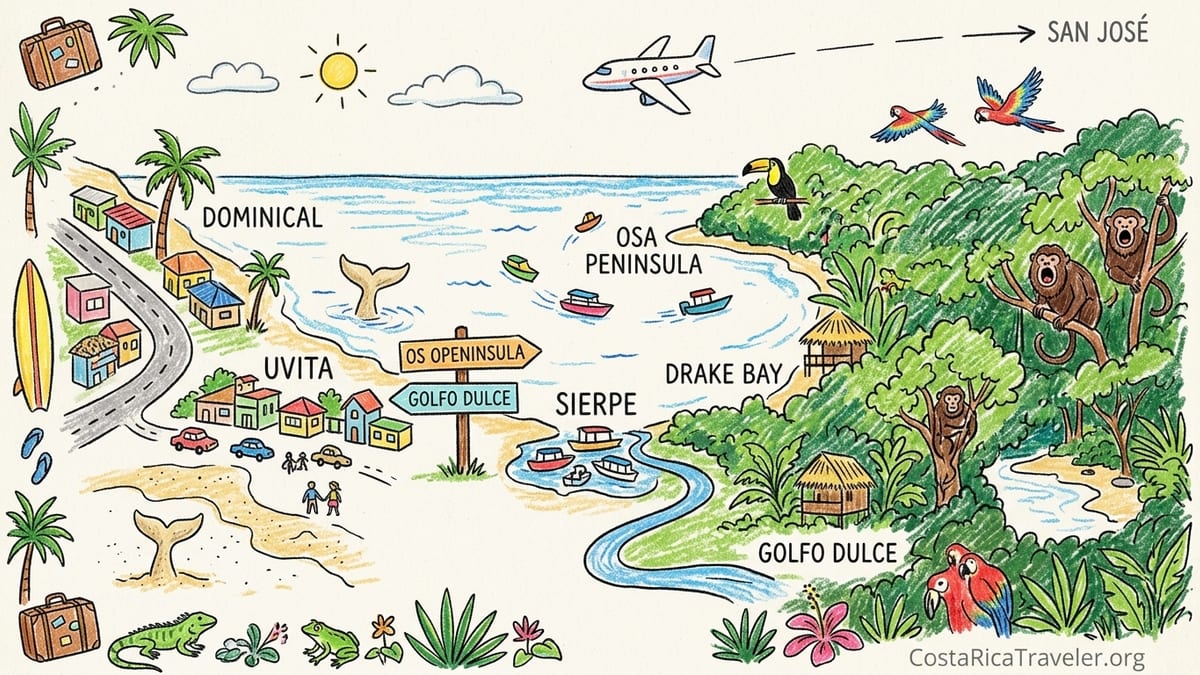
How Many Bases Make Sense in the South Pacific
The South Pacific arc from Dominical and Uvita down to the Osa Peninsula covers a relatively short distance on the map, but travel times stretch because of curvy coastal roads, river valleys and, in some cases, boat transfers. For a trip of 10 to 14 nights, most travelers are choosing between two, three or four bases. Fewer bases mean less packing and more relaxation. More bases unlock very different environments, from lively surf towns to deep jungle coves where the only sound at night is howler monkeys and the sea.
On my own itinerary, I settled on four bases. I split five nights between Dominical and Uvita, three nights using Uvita itself as an activity hub, one night in Sierpe to line up boat transfers, and four nights at a remote ecolodge on the Golfo Dulce side of the Osa. That sequence allowed me to drive the paved coastal highway from San José down to Uvita, keep a rental car where supermarkets and parking were simple, then hand off the logistics to boat captains and lodge staff once I reached the Osa region. It felt like a good compromise between movement and depth.
If I had condensed the plan to two bases, I would probably have stayed longer in Uvita and then chosen either Drake Bay or Puerto Jiménez as a single Osa base. That would have reduced transfers but also limited how remote I could get. The decision here is not only about scenery. It is about whether you prefer to walk to restaurants and supermarkets in the evening, or whether you are comfortable paying more for full-board and transfers because there is literally nowhere else to eat or shop once the boat leaves.
When planning your own bases, think in terms of regional functions rather than particular hotels. A “mainland beach town” base north of Uvita will give you easy road access, a “Uvita-type activity base” concentrates tours and services, Sierpe is a pure transfer hub, Drake Bay is an off-grid lodge area pointed at Corcovado and Caño Island, Puerto Jiménez functions as the eastern Osa hub, and Golfo Dulce or farther south toward Pavones becomes your deep-nature, surf or retreat base.
Mainland Beach Towns: Dominical and North of Uvita
Using a mainland beach town as a first base gave me time to shake off jet lag, get comfortable with driving, and settle into the pace of the South Pacific. Towns like Dominical, Playa Hermosa and the northern part of Uvita share a similar pattern. The highway runs slightly inland, with short paved or gravel spurs leading to the beach. There are clusters of small hotels and vacation rentals, a couple of modest supermarkets, and casual open-air restaurants serving casados, tuna steaks, burgers and ceviche. In Dominical, simple beach bars and places like well-known beachfront eateries line the sand, while Uvita has roadside plazas with bakeries and takeout counters highlighted in local tourism guides.
For a driver, this type of base is easy. The coastal highway is paved, and a high-clearance vehicle is enough for most side roads in dry conditions. Parking is straightforward, either at your accommodation or at public lots near the beach. Wi-Fi and mobile data are decent by regional standards, strong enough to upload photos and check in with work. Many accommodations offer air-conditioning in at least the bedrooms, along with fans and basic mosquito screens, although budget cabins in the hills may rely more on airflow and bed nets than on sealed, air-conditioned rooms.
Food and laundry are simple here. Because the community is spread out along the highway, you are rarely more than a 5 to 10 minute drive from a minimarket, fruit stand or small supermarket stocked with staples such as rice, pasta, snacks, sunscreen and bug spray. Local laundries offer wash-and-fold services priced per kilo, and some vacation rentals include washing machines. That means you can pack lighter and wash along the way, which is useful in a region where humid weather and afternoon rain can leave clothes damp for days.
Wildlife around mainland beach town properties is often more subtle than in the remote jungle, but still very present. I saw scarlet macaws flying over beach almond trees, iguanas on stone walls and white-faced capuchins near rivers, especially in the early morning. At night the area felt quiet rather than isolated. There were always headlights on the highway, a bar with music, and restaurants open until around 9 p.m. That sense of low-key human presence is comforting if you are easing into Costa Rica or traveling with kids who might find deep jungle nights intimidating.
Uvita as an Activity and Tour Base
Spending several nights in or very near Uvita proper worked well as a dedicated activity base. Uvita straddles the coastal highway, with the entrance to Marino Ballena National Park, snorkel and whale-watching operators, banks, pharmacies and multiple supermarkets within a short drive of each other. Regional tourism publications list local tour companies offering trips to the famous “whale tail” sandbar, waterfalls, surf lessons at Playa Hermosa, and day trips farther south. That clustering of services matters if you want to book tours at the last minute or mix independent exploring with guided experiences.
From an accommodation perspective, Uvita offers a spectrum of options. Hilltop lodges reach into the rainforest with sweeping ocean views and cooler breezes. Closer to sea level, small hotels and cabins sit near the park entrance and main road. The majority provide Wi-Fi and fans. Air-conditioning becomes more common as you go up in price, though in shaded, elevated rooms I found I could sleep comfortably with just a fan and screens. Mosquito pressure is moderate in town but increases near rivers and forest edges at dusk, so screened windows and a simple plug-in repellent or bed net are reassuring.
Uvita’s practical advantage is how it concentrates everyday needs. There are full-size supermarkets where you can buy fresh produce, snacks for tours, picnic supplies and basic medicines. Restaurants range from sodas serving traditional casados to pizza, vegetarian cafes and small breweries. This variety means you are not locked into a meal plan. You can eat breakfast at your lodge, grab takeaway for lunch before a boat tour, and walk to dinner at a different restaurant each night. Laundry is also easy. Several hotels either offer laundry service or can direct you to nearby laundries that turn clothes around within 24 hours.
Tour departure points are another reason to consider Uvita as a base. Boat tours into Marino Ballena depart from the beach near the park entrance, while shuttles pick up for waterfall excursions and canopy zip-lines in the hills. Roads to those departure points are a mix of paved and well-graded gravel. For most travelers a standard 4x4 or SUV is sufficient, though very steep hill accommodations may require careful driving in heavy rain. After dark, Uvita feels quiet but not cut off. There is traffic on the highway, some restaurants stay open until about 9 p.m., and street lighting around the central plazas keeps the area from feeling too remote.
Sierpe as a Gateway, Not a Long-Stay Base
Sierpe is less a destination than a hinge in the South Pacific travel system. This small riverside village sits inland from the coastal highway, and official tourism information repeatedly presents it as a gateway for boat travel to Drake Bay, Corcovado National Park and Caño Island. Public boats from Sierpe to Drake Bay typically run twice daily around late morning and mid-afternoon, taking roughly one hour as they weave through mangroves before reaching the open Pacific and landing near Drake. Typical one-way prices are around 20 US dollars per person, and locals pay less.
On my trip, I treated Sierpe as an overnight transfer stop. I drove from Uvita to Sierpe in under two hours, parked near the river with prior arrangement through a riverside restaurant, slept in a simple guesthouse within walking distance of the dock, and boarded the morning boat with only a small daypack. This strategy took stress out of the transfer, especially in the rainy season when afternoon storms can complicate road travel. Parking services near the dock allow you to leave your rental vehicle safely for several days while you are in Drake Bay or at boat-in lodges.
In terms of amenities, Sierpe is limited. There are a few restaurants near the water, small groceries, and a scattering of basic accommodations. Wi-Fi exists but can be patchy, and there is little nightlife. After dark, once the last boats tie up and day visitors leave, the town feels very quiet. That is peaceful for one night but would feel confining for longer stays, especially without a car. Most boats and tours depart from a single riverside area, so you are always close to your next departure, but there are few options for evening walks, restaurant-hopping or alternate activities.
Because Sierpe’s role is primarily logistical, it rarely makes sense to base here for more than one night at either end of a Drake Bay or Corcovado segment. Its importance lies in how it connects road and river. If you plan your accommodation sequence around Sierpe departures and returns, you can time long-distance drives to or from San José or the central Pacific so that you are not rushing to make the only boat of the day. In that sense, Sierpe illustrates how strongly transport access shapes accommodation choice in the South Pacific.
Drake-Style Remote Lodge Bases on the Pacific Side
Drake Bay and the surrounding coastline on the northwest edge of the Osa Peninsula represent a different style of base entirely. Accommodation options here cluster in and around the small village of Agujitas and stretch south along rocky headlands and pocket beaches toward the boundary of Corcovado National Park. Many ecolodges are accessible only by boat, especially during the rainy season, which is why official park information and local operators treat Drake, along with Sierpe and Puerto Jiménez, as primary gateways to Corcovado and Caño Island.
Staying in the village itself keeps you closer to services. There are several small grocery stores, a handful of restaurants and sodas, and tour offices selling day trips to Corcovado’s Sirena and San Pedrillo sectors, as well as snorkeling at Caño Island. Paths in the village are walkable, and some accommodations have road access for 4x4 vehicles during the dry season. In these in-town bases, Wi-Fi is available in most hotels and guesthouses, and while it is not as robust as in Uvita, it is sufficient for messaging and basic research. Air-conditioning is less common at budget levels, but screened windows and fans, alongside the ocean breeze, make sleeping comfortable for many visitors.
Boat-access-only lodges provide a more immersive jungle experience but also a different level of commitment. Several widely recognized ecolodges in Drake and along the nearby coast include boat transfers in their nightly rates or in full-board packages. These transfers often start in Sierpe, where staff will meet you, organize your luggage onto the boat, and then escort you directly to the lodge dock. Because there are no roads to these properties, meals and most tours are arranged through the lodge itself. The lack of alternate restaurants nearby means that full-board pricing, which can appear high at first glance, actually covers the reality that you cannot simply walk into town for dinner.
Life at these remote bases is defined by wildlife and the rhythm of the tides. Monkeys move through the canopy behind the cabins, scarlet macaws call overhead, and it is common to wake to the roar of howler monkeys before dawn. Many lodges have open-sided dining rooms, screened guest rooms and fans, rather than full air-conditioning. Mosquito pressure varies with location and season, but bed nets, screens and floor fans, combined with long sleeves at dusk, were adequate in the places I visited. Laundry options at boat-in lodges tend to be limited to paid service by the staff, often washed and line-dried on site, and Wi-Fi, if present, may only be available near the reception or dining area.
After dark, remote Drake-style lodges feel profoundly isolated, in both good and challenging ways. There is almost no artificial light beyond the property, the ocean becomes a steady roar, and walking outside means carrying a flashlight and watching for mud, roots and tree frogs. For travelers seeking deep immersion in nature, this is a highlight. For those who enjoy a post-dinner stroll through a village or options for a late drink, it can feel restrictive. Before you book, consider honestly whether you will be content with several nights of early dinners, quiet reading and the sounds of the forest as your entertainment.
Puerto Jiménez and the Eastern Osa as a Flexible Hub
On the eastern side of the Osa Peninsula, Puerto Jiménez serves as the main town and transport hub. It faces the sheltered waters of the Golfo Dulce and connects by paved road to the Inter-American Highway via a mountain pass, by small domestic flights from San José, and by passenger boats to and from Golfito. Official tourism and park materials identify Puerto Jiménez as a key gateway to Corcovado, the nearby coastal villages of Cabo Matapalo and Carate, and the remote lodges scattered along both the Pacific and Golfo Dulce coasts.
As a base, Puerto Jiménez is more practical than pretty, but it works extremely well. There are multiple supermarkets, pharmacies, banks, and a range of restaurants from simple sodas to more polished hotel dining rooms. Several accommodations sit right on the waterfront with views over the gulf. Wi-Fi coverage is wider here than in Drake, and mobile data is usually strong in town, which makes it a useful reset point if you have been offline in a remote lodge. Many hotels offer air-conditioned rooms, which provide a welcome break from the humidity, and all have screened windows. Parking is straightforward, whether you arrive in your own rental vehicle or by bus and taxi.
Puerto Jiménez is also where many tours and transfers originate. Boats depart from the town dock toward Golfo Dulce properties, dolphin and whale watching routes on the gulf, and sportfishing grounds. Overland, 4x4 colectivos run to Carate for access to Corcovado’s La Leona sector, and private transfers head to small lodges in Cabo Matapalo. For travelers piecing together a custom itinerary, this concentration of departure points makes Puerto Jiménez a logical base for at least a couple of nights, either before or after a more remote stay. You can arrange Corcovado permits and guides, confirm boat times, and stock up on supplies you will not find at isolated ecolodges.
In terms of everyday comfort, Puerto Jiménez strikes a middle ground. It is livelier and less isolated than Drake’s boat-in lodges, with evening activity around the main street, kids playing in the plaza, and restaurants open into the night. Yet wildlife is never far. Scarlet macaws frequent the trees near the beach, herons and pelicans work the shoreline, and it is common to see capuchin monkeys and coatis on the edges of town. Laundry services are readily available and inexpensive, making it a good place to refresh clothing between more rustic segments of your trip.
If you are wary of committing to a boat-only lodge for your entire Osa stay, consider splitting time between Puerto Jiménez and a more remote property reached by boat on the Golfo Dulce. This lets you enjoy the convenience of town for part of the trip, with restaurant choice and easy logistics, while still experiencing the quiet, roadless side of the gulf.
Golfo Dulce and Farther South: True Remote Jungle and Surf Retreats
The Golfo Dulce region, wrapping around the inner side of the Osa Peninsula, is where my trip felt most remote. Several ecolodges on its forested shores are accessible only by boat from Puerto Jiménez or Golfito. Official lodge information describes meeting guests at the small local airports, transferring them by taxi to the public docks, and then continuing by lodge boat to properties with no road access. Some well known ecolodges on the gulf include private nature reserves of hundreds of hectares, with direct access to pebble or black-sand beaches and hiking trails that disappear into rainforest backed by national park lands.
At my Golfo Dulce base, the lodge rate included boat transportation from Puerto Jiménez and three meals a day, along with guided walks on the property. Pricing at comparable ecolodges in the area often bundles transfers, accommodation and full-board meals together. At first this looks expensive, but once you arrive it is clear why this model exists. There are no other restaurants nearby, no supermarkets, and no roads. If the lodge did not feed you and organize logistics, you would be stranded. Boats into town run on fixed schedules, sometimes only once or twice a day, and are primarily for check-in and check-out days or arranged tours.
Daily life at a Golfo Dulce base is deeply shaped by nature. Dolphins and, in season, migrating whales are occasionally visible from the beach or boats, and sea turtles are sometimes seen off the bow during transfers. On land, howler monkeys, toucans and poison dart frogs are part of the soundscape and scenery. Many lodges operate without full air-conditioning, relying on ocean breezes, ceiling fans and elevated, screen-walled rooms that allow air to move freely. Mosquito pressure can be higher here than in Uvita or Puerto Jiménez, but good screens, nets and a combination of long clothing and repellent made it manageable for me.
Services are intentionally limited to preserve the sense of retreat. Wi-Fi, where offered, is usually confined to common areas and may be slower or switched off during the day. Laundry is typically a paid service, washed in-house and line-dried. Lighting at night is subdued, both to reduce impact on wildlife and to conserve energy, especially at properties using solar power. Once dinner is finished, guests tend to linger over coffee, then retire to hammocks or rooms with books and the sounds of the forest. This is not a place for late-night bar-hopping. It is for people who value quiet, dark skies and early morning paddles or hikes.
Farther south on the mainland side of the gulf and beyond, small surf and nature bases like Pavones and Zancudo offer a different but related feeling of remoteness. They are road-accessible but distant from major towns, with a handful of restaurants, simple supermarkets and long, uncrowded beaches. In these communities, screens and fans are standard, air-conditioning is less universal, and Wi-Fi can be uneven. If you prioritize surfing or simply long walks on empty sand, incorporating a few nights in a farther-south base can be rewarding. Just be aware that driving times back to San José are long, and planning a final night closer to the highway or airport is usually wise.
When Full-Board and Included Transfers Are Worth the Price
Throughout the South Pacific, the question of whether to pay for full-board and included transfers comes down to how isolated your chosen base is. In Uvita, Dominical or Puerto Jiménez, paying a premium for all-inclusive meals rarely makes sense. You are surrounded by independent restaurants and have easy access to supermarkets. You can eat breakfast at your hotel, enjoy lunch at a beachside soda, and walk to a different restaurant each evening without thinking about logistics.
In contrast, in boat-in ecolodges around Drake Bay or the Golfo Dulce, paying more for full-board and bundled transfers often represents good value. Properties without road access must bring in supplies by boat, pay staff to live on-site, and run generators or solar systems for power. In return, they remove nearly all logistical friction for guests. Airport or town pick-ups, boat transfers, meals, filtered drinking water and some guided activities are wrapped into a single per-night rate. Considering the cost of independent boat charters, fuel and the time involved in arranging everything yourself, the inclusive price often lines up with what you would have spent piecing it together in a mainland base.
Another factor is timing. Public boats between Sierpe and Drake Bay, for example, run on fixed schedules. If your international or domestic flight schedule does not mesh with those departures, staying in Sierpe or a mainland base an extra night can become necessary. Lodge-organized private transfers can sometimes bridge those gaps, but at a higher cost. Before booking, ask prospective accommodations exactly which transfers are included, from where, and on which days. Clarify whether they can coordinate with public schedules, and whether there are surcharges for off-schedule pick-ups or heavy luggage.
Finally, consider your own comfort level with isolation after dark. If you know you will miss having the choice of several restaurants, a supermarket and a stroll through town in the evening, a fully isolated lodge might feel confining no matter how well-priced the package is. In that case, base yourself in a town hub like Uvita, Dominical, Drake village or Puerto Jiménez, and take day or overnight tours deeper into the parks and reserves. Full-board and transfers then make sense only for short, carefully chosen forays into the wildest corners of the region.
The Takeaway
Choosing where to stay in South Pacific Costa Rica is really about choosing your mix of accessibility and immersion. Mainland beach towns around Dominical and Uvita give you easy driving, supermarkets, varied restaurants, reliable Wi-Fi and flexible tour options. Uvita itself makes an excellent activity base for Marino Ballena, waterfalls and short coastal excursions. Sierpe, while not a long-stay destination, plays a critical role as the river gateway linking road travel with boat routes to Drake Bay, Corcovado and Caño Island.
Farther out, Drake-style lodge areas and Golfo Dulce ecolodges trade convenience for closeness to wildlife and dark, quiet nights. Puerto Jiménez anchors the eastern side of the Osa, combining practical services with straightforward access to both Pacific and gulf adventures. South of the gulf, low-key surf and nature bases add one more flavor to an already diverse coastline. Across all of these, the fine print of infrastructure matters: where the docks are, how often boats run, whether roads are paved, whether there is secure parking, and what you can realistically do after dark besides listen to the forest.
On my first extended trip, four bases felt about right. I started in a mainland beach town near Uvita for orientation and supplies, used Uvita as a tour and activity hub, spent a focused night in Sierpe purely to connect with the river boats, and then finished at a remote lodge on the Golfo Dulce where transfers and meals were included because there were no other options. If I were to return, I would streamline slightly and use three South Pacific bases: a mainland coast base in the Uvita or Dominical area, an Osa hub around Puerto Jiménez, and one truly remote jungle or Golfo Dulce property reached by boat. That combination keeps driving manageable, preserves a sense of discovery, and balances nights with restaurant choices against nights when the only sounds are waves and howler monkeys in the dark.
FAQ
Q1. How many bases should I plan for a 10 to 14 day South Pacific Costa Rica trip?
For most travelers, three bases work well: a mainland coast base near Uvita or Dominical, an Osa hub such as Puerto Jiménez or Drake village, and one remote jungle or Golfo Dulce lodge if you want a deeper nature immersion.
Q2. Do I need a 4x4 vehicle to reach these South Pacific bases?
You can reach Uvita, Dominical, Sierpe and Puerto Jiménez with a standard SUV, but a 4x4 is recommended for steeper hill accommodations, rainy season conditions and the rougher roads toward Cabo Matapalo and Carate.
Q3. Is Sierpe worth staying in, or should I go straight through to Drake Bay?
Sierpe is best as a one-night transfer stop before or after a boat to Drake Bay or a remote lodge. It has basic guesthouses and restaurants, but limited activities, so most visitors do not base themselves there for longer stays.
Q4. How isolated do Drake Bay and boat-in lodges feel after dark?
Drake village has a few restaurants, lights and people in the evening, while boat-in lodges around Drake and Golfo Dulce feel very isolated, with dark skies, minimal artificial light and only lodge facilities available at night.
Q5. Are supermarkets and pharmacies easy to find in the Osa Peninsula?
You will find proper supermarkets and pharmacies in Uvita, Dominical and Puerto Jiménez. Drake village has small groceries with basics, while boat-access ecolodges and remote surf bases rely on lodge supplies with no independent shops nearby.
Q6. When is it worth paying for full-board accommodation?
Full-board and included transfers are worth the higher price at remote, boat-in ecolodges on the Osa and Golfo Dulce, where there are no alternative restaurants or shops and independent transport would be costly and time-consuming to arrange.
Q7. How reliable is Wi-Fi in these different bases?
Wi-Fi is generally reliable in Uvita, Dominical and Puerto Jiménez, more variable in Drake village, and often limited to common areas or certain hours in remote lodges, where connections can be slow or intentionally restricted.
Q8. What should I expect regarding air-conditioning and mosquito protection?
Many town hotels offer air-conditioning and screens, while remote jungle lodges often rely on fans, elevated screened rooms and bed nets; packing repellent and light long-sleeved clothing is important in all areas.
Q9. Can I do laundry easily while moving between bases?
In town bases like Uvita, Dominical and Puerto Jiménez, laundries and hotel services make it easy. In remote lodges, laundry is usually a paid, limited service, so quick-dry clothing and occasional wash-and-hang in your bathroom help.
Q10. If I return to the South Pacific, how many bases would you personally use?
Based on experience, I would use exactly three South Pacific bases next time: one mainland coast base around Uvita or Dominical, one Puerto Jiménez or similar Osa hub, and one remote jungle or Golfo Dulce lodge reached by boat.