


On a gray September morning in 2025, I boarded a small boat from Bahía Ballena on Costa Rica’s South Pacific coast, hoping to see one of the largest animals on earth. I had read all the promises about Marino Ballena National Park, studied the tide charts and circled “peak whale season” on my calendar. Yet as the outboard engines pushed us into the open Pacific, it became clear that whale watching here is less about guaranteed encounters and more about accepting whatever the ocean offers on that particular day.
Setting the Scene: When and Where This Trip Took Place
The boat trip described here took place on September 14, 2025, in the South Pacific region of Costa Rica, departing from the beach sector of Bahía Ballena, within the area commonly referred to as Costa Ballena. This is one of the principal launch points for commercial whale and dolphin excursions into the waters of Marino Ballena National Park and the surrounding coastal zone. Crucially, this date sits right inside what Costa Rica’s official tourism and conservation materials describe as one of the strongest humpback whale periods of the year, especially September and October, when migrating southern-hemisphere whales concentrate off this shoreline.
Official guidance for the South Pacific region identifies humpback whales as present roughly August to October and December to April around Marino Ballena, with especially high probability around September and October. Those recommendations are based on long-term migration patterns from both hemispheres, not on any single day’s conditions. My experience is just a snapshot within that broader probability window. The fact that I went out in mid-September meant the odds were about as favorable as they get here, but there was never any guarantee we would see whales.
Weather on the morning of my trip was typical of the Costa Rican green season along this coast. A low blanket of cloud softened the light, there was a light onshore breeze, and rain showers hovered over the forested hills behind the bay but did not reach us on departure. Swell was modest at first, in the range that local operators call “tranquilo but not flat,” with long, rolling waves rather than short, choppy wind slop. Those apparently minor details matter a great deal for anyone prone to seasickness and for how easy it is to actually spot a whale’s blow or dorsal fin among the waves.
It is also important to distinguish my single tour in September 2025 from the broader seasonal charts you will see in brochures. On that specific day, we did see humpback whales, but sightings were far from constant. There were long stretches of open-water searching and only short windows of close viewing. A traveler who went one or two days earlier with the same operator might have seen more animals, or none at all, despite identical “high season” labels on the calendar.
Booking the Excursion: Operator, Boat and Price Paid
I joined a shared humpback whale and dolphin watching excursion operated by a licensed local company based in Bahía Ballena, one of the cluster of small outfits that run daily tours in coordination with Marino Ballena National Park rules. This was a standard mixed group outing rather than a private charter or a premium extended trip. The tour was marketed as a three-and-a-half hour outing, including time to navigate from the beach through the park sector, search for marine mammals in open water and make a brief coastal stop on the return.
The price I paid in September 2025 was 100 US dollars per adult, which included the national park entrance fee that day. That figure aligns with the current range of approximately 80 to 100 US dollars quoted by several operators and regional travel guides for standard whale watching departures from the South Pacific coast, reflecting higher fuel costs and park management fees in recent years. Children on my boat paid a slightly reduced rate, negotiated directly when booking, but the operator’s displayed rate structure was primarily aimed at adults and older teenagers.
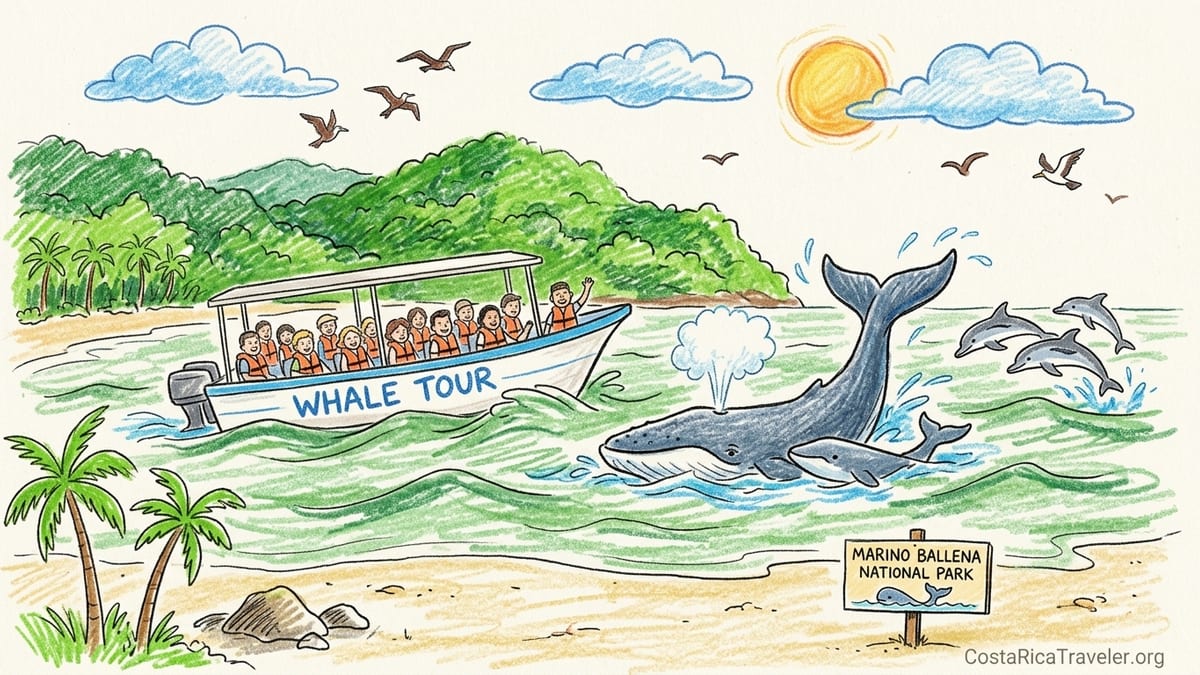
The boat itself was a fibreglass outboard-powered launch, around 9 to 10 meters long. It was open-sided with a light canopy roof for shade, a pointed bow, a central console for the captain, and bench-style seating along the sides. Unlike a large catamaran or double-decked tour vessel, this was a small craft where every passenger sat within a few meters of the water at most. The maximum legal capacity printed near the stern was 18 people, plus crew. On my departure the operator held the group at 14 passengers and three crew members, including captain, guide and assistant, which meant there was enough space for people to shift sides for better views without chaos.
Compared with the larger catamarans that operate out of other Costa Rican ports, this relatively small boat had advantages and drawbacks. The low position near the waterline and the ability to turn sharply offered excellent viewing when animals came close, but it also meant that passengers felt every movement in the swell. Travelers considering similar South Pacific trips should be aware that even on seemingly calm days, a small launch like this produces a much more intimate but also more physically demanding experience than a larger, heavier vessel.
Safety Briefing and Onboard Experience
Safety procedures began on the sand before we ever stepped into the boat. Because departures here are typically from the beach rather than a dock, crew members gathered our group at the park boundary line and explained that boarding would involve wading through knee-deep water to climb in via the bow. They instructed us to hold backpacks above shoulder height, secure cameras inside, and wait for a wave lull before moving. Two crew members stood in the surf to steady the boat as each person climbed aboard. For travelers with mobility challenges, this surf launch can be the most awkward part of the day and is worth asking about in advance.
Once everyone was seated and life jackets were handed out, the guide delivered a bilingual safety briefing in Spanish and English. It included the basics: how to properly fasten the life vest, keeping hands inside the boat when approaching waves, remaining seated whenever the boat was moving at speed, and what to do in the unlikely event of an engine problem. The captain pointed out the location of the fire extinguisher and first-aid kit. Although it did not feel like the heavily scripted safety speech you might hear on a large commercial vessel, the essentials were covered clearly, and the crew checked that children’s vests fit correctly before opening the throttle toward the first search area.
The guide also addressed seasickness briefly before we left the bay, advising anyone who felt unwell to move to the stern where motion is slightly reduced, to focus on the horizon and to sip water regularly. There was a small cooler with bottled water and soft drinks that passengers could access, though no snacks were offered on this particular departure. The guide mentioned they sometimes provide fruit when the sea is calmer and the itinerary includes a beach stop, but on our choppy day the focus was on keeping everyone steady and secure.
I had taken an over-the-counter anti-nausea tablet an hour before departure, and I was glad I did. About an hour into the trip, as the swell outside the protection of the bay built to one and a half to two meters, several passengers started to look pale. Two people eventually became sick over the side, assisted discreetly by the crew. The guide moved them to seats near the stern and checked in on them throughout the trip. Although the conditions never felt unsafe, the constant vertical motion was tiring, and anyone with a known sensitivity to seasickness would be wise to prepare with medication, light food beforehand, and a realistic understanding that even “good” days on the open Pacific can feel quite rough in a small boat.
Searching the Pacific: Time Spent Looking Versus Watching
From the moment we cleared the last rocks of the bay and faced the open ocean, the character of the trip shifted from gentle sightseeing to active searching. The engines settled into a moderate cruising speed, and the captain followed a loose circuit that took us several kilometres offshore, then along the coast parallel to the beaches, and finally back over a mid-shelf area that the guide described as a favored corridor for mother-and-calf pairs. He held a VHF radio and occasionally checked in with other boats, but our guide made clear that there was no central coordination tower or guaranteed “hot spot” that morning. Every vessel was essentially sharing information in real time while running its own search pattern.
Of the roughly three and a half hours we spent on the water, close to two and a quarter hours involved active searching with no whales in close view. Passengers scanned the horizon, the guide pointed out floating logs and seabirds, and the hum of the engines was broken mostly by short explanations of the surrounding landscape. We slowed occasionally when the crew spotted distant splashes that turned out to be nothing more than waves catching unusual light. It was a long exercise in patience, and one of the most honest things the guide said early on was that some trips in September see five or six distinct whale groups, while others see only one or none at all, even in almost identical conditions.
The first real encounter began with a shout from the bow as the captain spotted a blow several hundred meters ahead. He eased the engines back and approached at an oblique angle, keeping enough distance to comply with local whale watching guidelines that aim to prevent boats from crowding or cutting off the animals. For the next 20 minutes, we shadowed a single adult humpback that surfaced in a somewhat irregular pattern, appearing two or three times in quick succession, then remaining underwater for seven or eight minutes at a time. Each approach involved slow repositioning as the captain tried to predict where the whale might resurface, always staying outside the exclusion radius discussed in the pre-trip briefing.
Altogether, if I add up the time when everyone on board could clearly see a whale at the surface, the sum feels surprisingly short. Out of three and a half hours, we had perhaps 30 to 35 minutes of genuine humpback viewing divided across two separate encounters. The first lasted about 20 minutes with the single adult, and the second, toward the end of the trip, involved a mother-and-calf pair that surfaced several times near another boat. Between those windows were long, quiet stretches in which the only wildlife was seabirds and flying fish. Any traveler expecting a continuous show will likely be disappointed, even in the heart of the recommended season.
What We Actually Saw: Species and Behavior on This Trip
On my specific September 14 outing, we observed humpback whales and Pacific spotted dolphins, along with incidental bird life such as frigatebirds and brown boobies. There were no sea turtles, manta rays or other charismatic species that sometimes appear on these tours. It is important to emphasize that this is a factual account limited to what we genuinely encountered; other departures that week reported breaching whales or larger pods of dolphins, while some returned with no cetacean sightings at all despite being on the same coast, under the same broad seasonal pattern.
The first whale we followed appeared to be an adult humpback traveling alone. The guide, a trained naturalist with years of local experience, hesitated to assign a sex without a clear view of the underside of the tail, which demonstrates a welcome caution rare on some commercial boats. We saw several low-angled blows, the arched back with a small dorsal fin, and finally a single full fluke-up dive as the whale descended. It never breached or approached the boat closely, and the guide discouraged passengers from whistling or shouting in an attempt to attract its attention, explaining that noise can cause unnecessary disturbance.
Later, closer to the coast, we encountered a loose group of Pacific spotted dolphins spread over several hundred meters of water. The captain slowed to a crawl and allowed the dolphins to approach and surf the bow wake on their own terms. For about 10 minutes they zigzagged around the boat, rising in small groups of two or three. The guide explained that dolphins are resident here year-round, unlike the migratory humpback whales, so they are often but not always present on tours in any month.
The highlight for most passengers came about halfway back to the bay, when the crew spotted small, rapid blows and a lower, more rounded back just ahead of another tour boat. This turned out to be a mother humpback with a calf, moving slowly in relatively shallow water. Local guidelines discourage boats from surrounding such pairs, especially young calves that are still learning to surface and breathe efficiently. Our captain therefore held the boat at a respectful distance, while the other vessel kept off to the opposite side. Over roughly 15 minutes, we saw the calf surface several times beside the larger body of its mother, including one synchronized dive where both animals lifted their flukes in unison. It was a brief but powerful window into the life that the park exists to protect.
Boat Traffic, Ethics and How Crowded It Felt
One of the key questions for any wildlife-focused traveler today is how their presence, and the broader tourism industry around them, affects the animals they hope to see. On my September 2025 trip, boat numbers felt moderate rather than overwhelming. At the first encounter with the solitary adult humpback, our boat shared the area with two other tour vessels, all maintaining what appeared to be the recommended distances and taking turns in slightly closer positions rather than racing to cut across one another. The atmosphere was focused but not frenetic, helped by the guide’s explanation that both the national park authority and the local boat association encourage operators to limit crowding.
During the mother-and-calf encounter, there were again two boats present within visual range. Our captain and the other vessel coordinated informally by radio and hand signals to stay on opposite sides of the animals, leaving an unobstructed corridor ahead. At no point did we see more than three boats near the same whales, which contrasts positively with accounts from heavily trafficked sites elsewhere in the world where a dozen or more vessels converge on a single pod.
The guide devoted part of his commentary to whale watching etiquette. He pointed out that although whales and dolphins here have been living with regular boat traffic for many years, excessive speed, sudden course changes and loud shouting can add unnecessary stress. He encouraged passengers to keep voices low when the boat was close to animals and reminded parents not to allow children to lean over the rails in excitement. That messaging, while simple, helped shape the mood on board, keeping the experience closer to a natural history outing than a thrill ride.
It is worth noting that not all boats on the South Pacific coast may operate with the same restraint, especially during the whale festival events held around September when additional, less experienced operators sometimes enter the market. When choosing a tour, travelers would do well to ask specific questions about group size limits, adherence to distance regulations and the training of guides, rather than relying solely on glossy marketing photos of breaching whales that may represent rare moments rather than everyday reality.
Guide Quality, Interpretation and Overall Value for Money
The naturalist guide on my tour played an outsized role in shaping how I felt about the trip, especially given the limited viewing time compared with the long hours of searching. His knowledge extended beyond basic whale facts to the broader ecology of the South Pacific coast. During periods without animals in sight, he filled the time with explanations of humpback migration routes from Antarctic feeding grounds to Central American breeding areas, the reasons that September and October are particularly productive months off this coast, and the management challenges faced by Marino Ballena National Park as it balances tourism income with conservation.
What impressed me most was his willingness to say “I do not know” when a question went beyond reliable information. When asked how many individual humpbacks were present in the region that week, he resisted the temptation to quote dramatic but unverifiable numbers, instead explaining that only rough estimates exist and that actual presence varies day by day with weather and prey availability. That cautious approach extended to his descriptions of what future passengers should expect. He reminded the group several times that, even in peak months, some departures see only distant blows or none at all.
From a value-for-money standpoint, the question is more complicated than simply counting minutes of whale viewing and dividing by the ticket price. At 100 US dollars for an adult ticket, my cost per person came out higher than many other half-day activities in the South Pacific region, such as guided waterfall hikes or mangrove kayak trips. If I look purely at direct whale contact, with roughly half an hour of good sightings, the price might feel steep. Yet factoring in the expertise of the crew, the sense of being offshore in a living migration corridor, and the knowledge that part of the fee supports park management and local livelihoods, the experience felt justified, though not cheap.
Crucially, I would not say that this tour validated the idea, sometimes implied in marketing copy, that whale watching here is an almost guaranteed spectacle. On my day, it was a patient, somewhat demanding outing punctuated by short, memorable moments rather than a non-stop wildlife show. Travelers who understand and accept that dynamic are much more likely to feel satisfied with what they receive for the price paid, even if their actual sightings are as brief as ours.
Was It Worth It, And Who Is This Trip Best For?
For me, the answer is yes. The trip felt worthwhile even though our encounters were limited in duration and subtle in behavior. Watching a mother humpback rise beside her calf in the muted, silver light of a September morning is the sort of moment that lingers far longer than its fifteen or twenty minutes on a clock. However, that positive judgment sits within a very specific set of expectations, physical tolerances and personal priorities that may not match every traveler’s.
This kind of small-boat excursion in the South Pacific is best suited to people who genuinely enjoy being on the ocean, who are comfortable with the possibility of seasickness and who are willing to treat sightings as a privilege rather than an entitlement. Families with children who are fascinated by marine life can have a rewarding time, but parents should be honest about their kids’ ability to handle several hours of waiting and choppy motion with no guarantee of dramatic action. Those seeking an easy, gentle coastal cruise with constant scenery and refreshments may prefer a larger catamaran trip out of a different port, where whale encounters are a bonus rather than the primary focus.
Timing does matter enormously. If you can choose your travel window freely and your main goal is humpback watching, centering your visit around September and October in the South Pacific region offers the strongest overall probability, with a secondary pulse of activity from roughly December to April when whales arriving from the north use these waters for breeding and calving. That said, even in those months, a single morning or afternoon remains a roll of the dice. Travelers who can stay several days near the coast and remain flexible about which date they go out significantly improve their chances of at least one solid encounter.
Ultimately, the trip felt less like a commercial attraction and more like a brief admission into an ongoing natural story unfolding with or without human observers. That perspective helped me accept the quiet stretches between sightings as part of the experience rather than dead time. If you go out expecting a theme-park show, the South Pacific may frustrate you. If you go understanding that the whales are wild animals following their own rhythms, the fleeting glimpses you do receive can feel remarkable enough to justify both the price and the early alarm.
The Takeaway
Looking back on my September 2025 whale watching trip off Costa Rica’s South Pacific coast, several realities stand out more strongly than any marketing slogan. The first is that timing truly shapes probability, not certainty. Traveling in mid-September placed me inside the heart of what official tourism and park agencies identify as the most reliable humpback period around Marino Ballena, yet we still spent the majority of our three and a half hours on the water scanning empty waves, with only two relatively brief windows of close whale observation.
The second reality is that the character of the experience is defined as much by the boat, crew and sea conditions as by the animals themselves. A small launch with around a dozen to fifteen passengers creates an intimate, sometimes physically demanding outing, magnifying both the thrill of a whale surfacing nearby and the discomfort of large swells. A thoughtful safety briefing, a naturalist guide willing to be honest about uncertainties, and a captain who respects distance guidelines can transform a modest series of sightings into a meaningful encounter. The same wildlife, under less careful management or with unrealistic promises, might feel like a disappointment.
Finally, the value of a South Pacific whale watching trip is not measured solely in minutes of tail slaps or breaches. It lies in accepting the ocean on its own terms, understanding that some departures will see only distant blows or none at all, and recognizing that your ticket supports a coastal community that has shifted from extractive fishing toward a conservation-based economy. If you can arrive with that mindset, plan your dates around the stronger September and October window or the secondary December to April period, prepare appropriately for motion and weather, and choose an operator who emphasizes safety and ethics over guarantees, then even a day of searching punctuated by a few unforgettable surfacings can feel like money and time well spent.
FAQ
Q1. What exact date did you take this whale watching trip?
My excursion took place on September 14, 2025, during the peak humpback whale season in Costa Rica’s South Pacific region.
Q2. From where did the boat depart, and how long was the tour?
The boat departed from the beach sector of Bahía Ballena on the South Pacific coast, and the total time on the water was about three and a half hours.
Q3. How much did you pay for the whale watching excursion?
I paid 100 US dollars per adult in September 2025, a price that included the Marino Ballena park entrance fee for that day.
Q4. What kind of boat and how many passengers were on board?
The trip used a 9 to 10 meter open fibreglass launch with a canopy roof, powered by outboard engines, carrying 14 passengers plus three crew members.
Q5. What was the safety briefing like before departure?
The crew explained surf boarding procedures, fitted life jackets for all passengers, pointed out safety gear locations and instructed us to remain seated whenever the boat was moving at speed.
Q6. How rough were the sea conditions, and did people get seasick?
Outside the bay the swell built to roughly one and a half to two meters, and at least two passengers became seasick despite the crew’s advice and the availability of water.
Q7. Which marine species did you actually see on this specific trip?
We observed humpback whales, including a mother-and-calf pair, and a group of Pacific spotted dolphins, along with common seabirds, but no turtles or rays.
Q8. How much of the tour was spent searching compared with watching whales?
Out of roughly three and a half hours on the water, we spent about two and a quarter hours actively searching and only around 30 to 35 minutes in clear, close whale encounters.
Q9. Were the whales crowded by many boats during your sightings?
No. At our encounters there were never more than two or three boats near the same whales, and the captains coordinated to keep respectful distances and avoid surrounding the animals.
Q10. Was the experience worth the price even though sightings were brief?
For me it was worthwhile, mainly because I valued the ethical approach, the naturalist interpretation and the chance to be offshore in peak season, but travelers expecting constant action might feel the 100 US dollar cost is high for relatively short viewing windows.