


The first time I sank into Arenal’s volcanic water after a muddy hike, I understood why Costa Rica’s tourism board calls hot springs one of the Northern Plains’ signature experiences in both dry and green seasons. Over several trips I have deliberately tested different La Fortuna hot springs, from Baldi’s high-energy water park of pools and slides to quieter, garden-style complexes. I booked real day passes, dealt with actual lockers and towel deposits, tried the swim-up bars and buffets, and stayed late into the evening. This article focuses on those first-hand experiences and clearly labels anything that comes from research only, so you can decide which hot springs are worth your time and money.
Understanding Arenal’s Hot Springs Scene
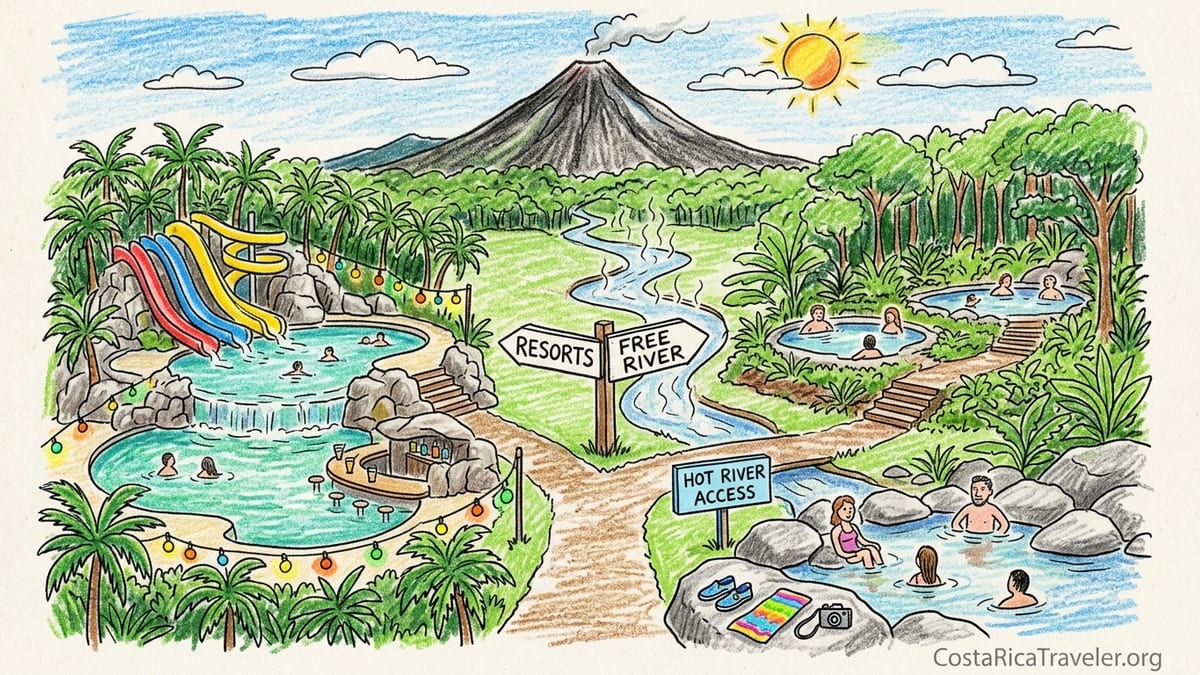
La Fortuna sits below Arenal Volcano, whose geothermal activity heats underground water that is piped into a cluster of hot spring resorts and smaller facilities along Route 142 and the backroads just outside town. The result is a dense strip of thermal options ranging from elaborate resorts with 20 or more pools to simple, local-style baths and even a free riverside spot used mainly by budget travelers and locals. You can build an entire trip around these waters, or, like I did, drop in for a few evenings after hiking the Arenal 1968 trails or visiting La Fortuna Waterfall.
Across multiple visits between the dry season months of January to March and the wetter green season in May and June, I prioritized places open to day guests on straightforward passes, with clear locker and towel options and evening hours. I spent full afternoons and evenings at Baldi Hot Springs and Ecotermales, and I sampled the free thermal river. For higher-priced spots such as Tabacón Thermal Resort, I am relying on recent research about day passes, facilities and pricing, which I clearly separate from my own on-the-ground impressions.
Day pass prices in La Fortuna, as of late 2026, typically range from the equivalent of about 40 to just over 100 US dollars per adult, depending on whether meals are included and how upscale the resort aims to be. Baldi’s official rates list a basic day pass around 50 US dollars per adult for hot springs access only, with packages including lunch or dinner climbing to roughly 75 to 100 dollars. Ecotermales and Tabacón tend to price higher than simple complexes but below the most exclusive luxury stays, especially in the evening time slots that most travelers prefer.
In practice, those numbers matter less than what you actually experience on site: the feel of the water, how crowded the pools are at 8 p.m., whether you can find a quiet corner or you are shoulder-to-shoulder at the swim-up bar. That is where my own detailed visits come in, starting with the largest and liveliest of the resorts.
Baldi Hot Springs: Big, Busy and Full of Features
Baldi Hot Springs markets itself as the world’s largest hot springs complex, and walking in from the parking area to the reception, it does feel like a cross between a tropical resort and a water park. Check-in for my day pass was efficient: staff at the front desk confirmed I wanted a hot springs only ticket, explained the hours (from 9 a.m. to 10 p.m.) and pointed me toward the locker and changing room area just beyond the lobby. Payment was taken on the spot in US dollars, which is widely accepted in Costa Rica, and I received a wristband to show at the gate leading into the pool zone.
Lockers at Baldi are not included in the base price. The resort’s own rate sheet lists a locker rental at just under 7 US dollars per locker, with a separate refundable towel deposit around 10 dollars in cash. In my case, I paid the small locker fee, skipped the towel rental because I had brought my own, and was given a key and number tag. The changing rooms were functional rather than luxurious: banks of lockers, a few shower stalls with modest pressure, and basic toilets. It felt more like a theme park back-of-house than a spa, which matched the overall vibe once I stepped outside into the main pool area.
Baldi’s 20-plus pools are terraced up a hillside, starting with cooler, large family pools at the bottom and rising to very hot, smaller pools near the top. I moved gradually uphill, starting in a medium-warm pool that felt somewhere in the mid-30s Celsius. It was comfortable for a long soak, ringed by faux rock features and palms, with slightly louder music leaking in from a nearby bar. Higher up I found smaller pools that felt significantly hotter, hot enough that I stepped in and out in five- or ten-minute intervals. These upper pools were quieter, both because of the temperature and the distance from the slides and kids’ zones.
Landscaping at Baldi is dense and intentionally dramatic, with tropical plants crowding walkways, artificial rock formations, and colored lighting that kicks in after dark. During the afternoon, I noticed families spreading out on loungers, children racing between shallow pools and the large waterslides, and couples hovering around the swim-up bars. The main bar in one of the larger mid-level pools allowed me to sit chest-deep in warm water while ordering a beer and a simple cocktail. Prices were in line with resort standards, several dollars more than I paid for similar drinks in La Fortuna town later that night, but not shocking for an all-day thermal park.
Baldi After Dark: Crowds, Food and How Long I Stayed
I deliberately arrived at Baldi early in the afternoon to watch how the atmosphere changed into the evening. Between 3 p.m. and 5 p.m., crowd levels picked up noticeably. Tour buses dropped off groups who had done combination activities earlier in the day, and the mid-temperature pools began to feel busy. By 7 p.m., music at the swim-up bar was louder, waterslides were still running, and the main pools had a definite party-energy mix of families, friend groups and couples.
In the hottest small pools higher up the hillside, though, I could still find some quiet. The air temperature dropped slightly after sunset, and steam rose off the pools, softening the lights and making the resort feel more atmospheric. If I stayed close to the central bar cluster, I heard a constant soundtrack of reggaeton and pop; if I climbed further into the gardens, it was mainly the sound of water and conversations. Baldi at night is not a meditative experience, but it does offer different zones depending on how social you want to be.
On the food side, my day pass did not include meals, so I had the choice to add the buffet dinner or eat à la carte. The buffet option pushed the total cost close to what some quieter hot springs charge for a more intimate evening, so I went with simpler bar snacks instead: a plate of fries and a small starter that were perfectly acceptable but not memorable. Talking with other guests and checking recent reviews, I came away feeling that Baldi’s buffet and food overall are serviceable rather than a highlight and that the real value of the ticket is in the sheer number of pools and features.
In total, I spent just under six hours at Baldi, arriving before midafternoon and leaving around 9 p.m. That felt about right for me. After a couple of hours I had sampled enough pools to know their temperature range, tried one of the larger slides, and spent time at the bar. The remaining hours were about choosing my favorite mid-warm pool, letting my muscles unwind, and people-watching. I would have left earlier if my main goal had been a quiet, romantic soak. For travelers who like energy, music and a lot of variety, Baldi’s admission price felt fair, especially compared to smaller complexes that offer fewer pools at only slightly lower prices.
Ecotermales: Smaller Scale and a More Relaxed Evening
My evening at Ecotermales could not have felt more different. Unlike Baldi’s open-structure day, Ecotermales works with defined time slots for either a daytime or evening visit, which keeps total numbers on-site controlled. I booked an evening slot in advance, then checked in at the front desk where staff confirmed my reservation, took payment for the pass, and explained where the changing rooms, restaurant and pools were located. There was no rush of big tour groups funneling in all at once; arrivals were spread out, and the property felt calm from the beginning.
The locker and changing facilities at Ecotermales were more polished than at Baldi when I visited. The locker area sat just off the main path from reception, with a separate corridor leading to showers and toilets. Lockers were included in the admission when I visited, and I received a key attached to a wristband. The changing space was clean, tiled and softly lit, with enough benches and hooks that it never felt cramped even as more guests arrived for the same evening slot.
Ecotermales’ pool layout is simpler than Baldi’s hillside sprawl. A series of terraced pools step gently down from a hotter upper level to cooler lower pools, all set within thickly planted gardens of palms, broad-leafed tropical plants and overhead trees. I started at the lower end, where the water felt warm but not hot and ideal for a longer stretch of floating and conversation. The temperature here was closer to a typical heated pool and suitable for people who are sensitive to high heat.
Moving upward, each pool grew progressively hotter. At the top, the hottest pool was similar in intensity to Baldi’s uppermost basins, where I limited my time to short soaks followed by cool-downs at the side. The landscaping made a big difference to the atmosphere: paths curved gently, lighting at night was soft and mainly at ground level, and I could often only see one or two other pools from where I sat. That created a sense of privacy even though the property is not large.
Ecotermales Atmosphere, Food and Time Well Spent
By design, Ecotermales stays quieter than the big resorts. When I visited for an evening slot, I would describe the crowd as mostly couples and small groups of adults, with a few families. There were no waterslides and no loud speakers anywhere near the water. The sounds were the rush of small artificial waterfalls, occasional clinking of glasses at the bar, and low conversations. For travelers who find the idea of waterslides and party music unappealing, Ecotermales offers an obvious counterpoint.
There is a bar at Ecotermales, but it is not the central focus. I ordered a cocktail and later a beer, both at prices that were still above what you would pay at a bar in La Fortuna proper but a little lower than the resort-style markup at the bigger complexes. Service was relaxed, and it was possible to take drinks back to the water and tuck into a quiet corner. The overall feel was closer to a garden spa than a theme park, which made it easier to stay present and unwind after long hiking days.
Ecotermales also runs an on-site restaurant where many passes can be combined with a dinner. My package included an evening meal, served as a plated dinner instead of a large buffet line. While I will avoid overpraising it, my experience was that the food quality here felt more in line with the total cost than at Baldi. Portions were generous after hours in the water, and ingredients were fresh. I would not come to Ecotermales just for the restaurant, but if you like the idea of combining a quiet soak with a decent dinner on-site, the bundle made sense.
In terms of time, the fixed slot meant I had roughly four to five hours on the property. I used nearly the entire block, moving between pools every twenty to thirty minutes and occasionally stepping out to cool off in the slightly cooler lower pools. Unlike Baldi, where I started to feel “done” mainly because of sensory overload, at Ecotermales I could have stayed a bit longer. For travelers whose priority is relaxation rather than entertainment, this is where spending slightly more per hour of soak can feel worth it.
Simpler Thermal Options and the Free Hot River
Not every thermal experience in Arenal involves a high day-pass price. One afternoon, I joined friends at the free hot river that locals and on-a-budget travelers often use instead of paying for a resort. Access usually involves parking along the road near one of the resorts and walking down a short, sometimes muddy path to the riverbank, where warm water flows through shallow pools formed by rocks and tree roots. There are no official hours, no check-in desk, and no staff supervising the area.
In practice, that means you trade cost savings for some uncertainty. When I visited, the river was busy with a mix of local families and visitors balancing drinks and snacks on rock shelves. The water temperature depended on where you sat: some spots were pleasantly warm, others cooler, and there was no simple way to find hotter or colder zones quickly. Without lockers or a staffed changing area, we took turns staying close to our bags. I wore water shoes to navigate the slippery rocks and wished I had brought a waterproof bag for my phone and keys.
As a cultural and budget experience, the free river soak was enjoyable. I appreciated seeing how locals made the most of their volcanic backyard, and for a short afternoon dip it was hard to complain about the price. Still, after spending evenings at Baldi and Ecotermales, I missed the security of lockers, the ease of proper showers, and the ability to change into dry clothes before getting back into a car. For travelers carrying cameras, passports or other valuables, the lack of secure storage can be a significant downside.
There are also smaller paid hot springs around La Fortuna that sit between the free river and the major resorts in terms of price and features. On this particular sequence of trips, I did not personally visit those mid-range complexes, so I will not describe their check-in or pools first-hand. Researching for this article, I found that several offer fewer pools at lower prices than Baldi, often with simple locker rooms and no waterslides. If you are primarily focused on budget, they are worth looking at, but from my own direct experience the biggest gap in atmosphere is between the completely free river and curated spaces like Ecotermales.
Researched-Only Splurge: Tabacón Thermal Resort
Tabacón is perhaps the most famous of Arenal’s hot springs, often photographed for its natural-looking thermal river winding through lush gardens. I have walked past the entrance and spoken to travelers who spent evenings there, but I have not yet purchased a day pass myself, so what follows is based on current research rather than personal use.
Tabacón sells day and evening passes that typically include access to its series of river-fed pools, use of changing rooms and lockers, and the option to combine with meals. Published comparison guides put its adult day-pass rates roughly in the higher end of La Fortuna’s scale, frequently somewhere in the vicinity of 85 to just over 100 US dollars per adult depending on season and whether meals are included. The setup includes a main thermal river section, quieter corners aimed at adults, and at least one swim-up bar serving cocktails and light food.
The resort positions itself as more of a luxury spa experience than a water-park-style destination. Official descriptions emphasize natural landscaping, a limited-entry system to control crowding, and a separate, more secluded area for hotel guests and certain packages. Spa treatments are offered as add-ons in individual open-air bungalows, and the restaurant menus run more upscale than basic buffets. Reports from recent visitors suggest that if you value design, privacy and a more natural river feel, Tabacón can deliver a memorable evening soak, albeit at a cost that is notably higher than Baldi or the mid-range hot springs.
Because I have not personally swum in Tabacón’s pools, I cannot compare the water temperature variations or the exact feel of the swim-up bar against Baldi or Ecotermales. From a value perspective, looking at the price ladder, I would treat a Tabacón day pass as an intentional splurge rather than a default choice. It likely appeals most to travelers celebrating a special occasion or those who care deeply about landscaped natural aesthetics and are willing to pay extra for that atmosphere.
What Felt Worth Paying Extra For
After multiple evenings moving between different styles of hot springs, certain upgrades felt genuinely worth the extra money, while others did not. Included or reasonably priced lockers and clean, well-arranged changing rooms ranked high on the “worth it” list. At Ecotermales, where locker use was bundled and the facilities felt like a small spa, I moved between water and dry clothes with very little friction. At Baldi, locker rental and towel deposits were separate line items that added up, and the changing rooms felt more crowded and functional. Knowing that, I would happily pay a few dollars more in total ticket price for a smoother infrastructure experience.
Controlled crowd levels were another element I considered worth paying for. Ecotermales’ use of fixed time slots meant I never felt overwhelmed, even during a popular evening session. Baldi’s open structure, by contrast, allowed the property to feel quite busy at peak times. If I were returning to Arenal primarily to rest between hikes during the green season, I would lean toward the quieter model even if it meant fewer pools and no waterslides.
On the other hand, I did not feel that higher buffet food prices or elaborate swim-up bar setups were worth a large premium. At Baldi, the existence of multiple bars and restaurants added to the convenience, but the actual food quality did not justify planning the entire evening around eating on-site. Ecotermales’ plated dinner was pleasant but not the core of the experience. Comparing conversations with travelers coming from Tabacón, I heard similar observations: the thermal water and gardens were the star, not the restaurant pricing. For many visitors, pairing a hot springs pass with a separate meal in La Fortuna town can keep costs in check and introduce more variety.
Finally, the sheer variety of pools is something to weigh against your own preferences. Baldi’s 20-plus pools allowed me to always find a new temperature or setting, from almost cold to very hot, with different depths and features like waterfalls and jets. Ecotermales offered fewer but more focused pools, and the free river even fewer defined spaces. If you enjoy exploring and want your hot springs visit to feel like an activity in its own right, Baldi-type complexes can justify their cost. If you mainly want a couple of hot pools to soak in quietly, paying extra for slides and sprawling layouts may be unnecessary.
The Takeaway
Experiencing Arenal’s hot springs first-hand across a range of styles made it clear why Costa Rica promotes them as a core attraction of the Northern Plains in both dry and green seasons. In January’s clear evenings and in the mist and rain of May, the feeling of slipping into warm volcanic water at the end of a long day stayed consistently satisfying. What changed was the context: sometimes that soak happened in a vast, multi-pool complex filled with families and music; other times it unfolded in a quieter garden surrounded by trees and soft lighting.
Baldi Hot Springs delivered exactly what its reputation promises: a big, energetic playground of thermal pools, waterslides and swim-up bars that suits travelers who like activity and variety. I enjoyed my time there but found that six hours was enough before the crowds and music wore on me. Ecotermales, on the other hand, gave me a calmer, more spa-like evening with fewer people, gentler lighting and just enough facilities to feel taken care of without distraction. I left still wanting another hour or two, which is usually the best sign of a place that balances price and experience well.
Free or very simple hot springs, including the riverside spot locals use, added another dimension: they offered authentic, low-cost ways to enjoy Arenal’s geothermal gift but required tradeoffs in security, comfort and predictability. Higher-priced venues like Tabacón, which I have so far only researched, occupy the other end of the spectrum, promising lush aesthetics and curated privacy at a premium. Where you land on that spectrum will depend on your budget, your tolerance for crowds, and whether your ideal evening involves waterslides, candlelit paths, or simply a warm rock beside a natural flow of water.
If you have two or three nights in La Fortuna, my experience-based advice is to mix styles. Spend one evening at a high-energy complex like Baldi if you enjoy features and people-watching, and dedicate another to a quieter setting like Ecotermales or a similar garden-focused property. Leave room for a short visit to the free river if you are comfortable keeping an eye on your belongings and want to glimpse how locals enjoy their volcanic backyard. With that blend, you will leave Arenal not just having visited hot springs, but having understood the different ways they shape life and leisure in this part of Costa Rica.
FAQ
Q1. Do I need to reserve Arenal hot springs in advance?
For larger complexes like Baldi, you can usually buy a day pass on arrival, especially outside peak holiday periods, although going earlier in the day helps avoid lines. For places that use fixed time slots, such as Ecotermales, advance reservations are strongly recommended, particularly for evening sessions and during popular travel months like December to March and local holiday weeks.
Q2. How much should I budget for a hot springs visit in La Fortuna?
Based on recent visits and research, expect roughly 40 to just over 100 US dollars per adult for a day or evening pass, depending on the resort and whether meals are included. Baldi sits around the middle with a base entry in the 50-dollar range and higher prices if you add buffets, while more intimate or upscale options can cost more, especially with spa treatments or gourmet dinners bundled.
Q3. What should I bring to the hot springs?
At a minimum bring a swimsuit, sandals or water shoes, a change of dry clothes and a small bag for your belongings. A quick-drying towel can save you a rental fee in some places, and a waterproof pouch for your phone and keys is useful both in the big resort complexes and at the free river. Cash in small bills helps with deposits for towels or lockers and with buying drinks at bars that may not take all cards.
Q4. Are the hot springs suitable for children?
Yes, many hot springs welcome families, and larger resorts such as Baldi have multiple shallow pools and waterslides that appeal to kids. The key is to supervise children closely around hot water and slippery surfaces and to steer them toward the cooler pools. Quieter, garden-style hot springs tend to attract mainly adults and couples, but older children who enjoy relaxing in warm water often do fine there as long as they respect the calm atmosphere.
Q5. Is the free hot river in Arenal safe?
The free riverside hot springs near La Fortuna are widely used by locals and travelers, but there is no official supervision, lighting or secure storage. In daylight and with a group, it can feel relaxed and sociable, but you should avoid leaving valuables unattended, use caution on wet rocks, and be extra careful after heavy rains that might change currents or water levels. If you prefer clear safety measures and staff presence, a paid hot springs resort is the better choice.
Q6. What time of day is best for visiting the hot springs?
From experience, late afternoon into evening offers the best combination of warmth, atmosphere and post-activity relaxation. Arriving in midafternoon lets you explore pools before the busiest time, and staying into darkness adds steam, softer lighting and cooler air, which makes the hot water feel more pleasant. Early mornings can be peaceful but are less common for visits, while midday hours are typically dominated by families and tour groups.
Q7. Can I drink alcohol at the hot springs?
Most major hot springs complexes around Arenal operate bars and, in some cases, swim-up bars where guests can buy beer, wine and cocktails. Moderate drinking is permitted, but properties reserve the right to cut off service or ask visibly intoxicated guests to leave for safety reasons. It is wise to alternate alcoholic drinks with water and to avoid spending long periods in the hottest pools when consuming alcohol.
Q8. How long do people usually stay at Arenal hot springs?
On my visits, four to six hours felt like a natural range, giving enough time to check in, change, explore multiple pools, have a meal or snack, and unwind. At larger resorts with many features, some guests stay almost a full day, while at quieter complexes or the free river, two to three hours can be sufficient. If you combine a hot springs visit with daytime tours, plan on a relaxed evening rather than rushing in and out.
Q9. Are the hot springs open in the rainy season?
Yes, hot springs around Arenal operate year-round, and soaking in warm water while a soft tropical rain falls can be one of the region’s highlights. Covered walkways, umbrellas and nearby sheltered bar areas make it easy to move between pools, and the cooler air during showers can make the temperature contrast feel even better. Only extremely heavy storms or safety issues would cause temporary closures, which resorts communicate on-site.
Q10. How do I choose between Baldi, Ecotermales and more expensive options?
If you enjoy lively atmospheres, a lot of different pools, waterslides and social swim-up bars, Baldi offers strong value at a mid-range price. If you prefer quieter, more garden-like settings with fewer people and are willing to pay slightly more per hour for that calm, Ecotermales and similar complexes are a better match. Ultra-upscale options like Tabacón, which I have researched but not personally visited, make sense as a deliberate splurge when natural river aesthetics and additional spa-level amenities matter more to you than keeping costs down.