


I thought I was prepared for Río Celeste. I had stared at the photos for years, bought my SINAC ticket in advance, and told myself the hike in Tenorio Volcano National Park would be a straightforward three‑hour walk. The reality on the ground was muddier, more rushed, more crowded and more beautiful than I expected, all at the same time. If you are planning this hike, here is exactly what I wish I had known before stepping onto the Misterios del Tenorio trail.
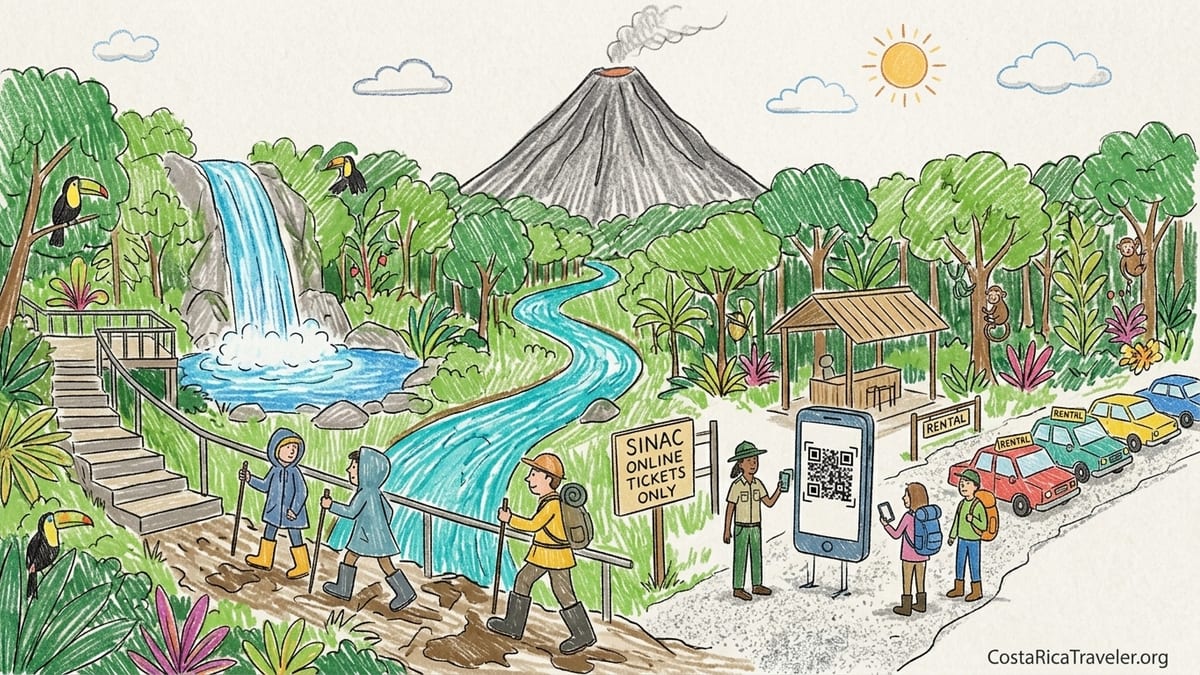
Booking With SINAC: The Transactional Reality
The first surprise came before I even saw a tree. Entry for Tenorio Volcano National Park is now handled entirely online through the official SINAC system, and there is no ticket office at the gate that will bail you out if you arrive unprepared. On my visit I watched two different couples turned away at the entrance because they assumed they could pay in cash. The rangers pointed them back to the same website everyone uses, which requires setting up an account, entering passport details and paying by card. With a patchy mobile signal near the gate, that is not something you want to be doing at 8:15 in the morning from a car parked half on the gravel shoulder.
The current rules are blunt and inflexible. Entry hours are from 8 a.m. to 2 p.m., and visitors may remain in the park until 4 p.m. Capacity is capped at about 1,200 tickets per day, and only 500 people are allowed on the trail at any given time according to SINAC information. Once your chosen date sells out online, there is no standby line. On my day, a Wednesday in the dry season, the early slots between 8 a.m. and 10 a.m. were already booked out two days in advance while mid‑day still had openings.
Prices also feel a bit more like an online booking process than a rustic national park visit. When I purchased, the official rate for nonresident adults was shown in U.S. dollars with sales tax added at checkout. Costa Rican citizens and residents saw prices listed in colones. The amount itself was not shocking compared with other parks in the country, but the requirement to prepay and show a digital QR code at the gate created a very transactional first impression. My advice is to buy at least several days ahead, screenshot the QR code, and download the confirmation email in case your signal drops.
Check the official Tenorio Volcano National Park communication channels the night before as well. The staff sometimes posts water color conditions or temporary closures if the trail has been damaged by rain. That one last check can save you a long drive to find the river chocolate brown or the stairs to the waterfall closed.
Arrival, Parking and That First Glimpse of Crowds
I arrived at the park entrance a little before 8 a.m., thinking I would be among the first on the trail. I was wrong. A line of rental cars already hugged the main road, while several private parking lots on the right advertised day parking for a small fee in Spanish and English. SINAC itself lists only “private paid parking” as a service, so the lots you see are run by local landowners, not the park. I chose one of the gravel lots closest to the gate simply because it was supervised and had people coming and going. The attendant collected a modest fee in cash, handed me a numbered ticket and pointed me toward the bathrooms and a sink to rinse off later.
If you expect a big paved visitor center lot like some United States national parks, adjust that mental picture. The parking experience at Tenorio feels more like pulling into the edge of a rural village than arriving at a packaged attraction. There are small sodas serving breakfast, a few hostels and cabins, a minimarket and informal stands renting rubber boots. Tuk‑tuk motorcycles zipped up and down the road shuttling some visitors from their lodges to the park entrance, weaving around buses that had just dropped off group tours.
Once I reached the gate, the check‑in process moved quickly. A ranger scanned my SINAC QR code from my phone, checked my passport, and gave a short safety briefing in Spanish and English. Swimming inside the park is prohibited, drones are not allowed, and visitors must stay on the main Misterios del Tenorio trail. Over his shoulder I could see the line thickening as day‑tour vans began to arrive. Any illusion of having the forest to myself disappeared before I even passed the official trailhead sign.
If you are driving from La Fortuna or Liberia and tempted to roll in around 11 a.m., be realistic about what that will feel like. At that time of day, the parking lots are close to full, the bathrooms have lines, and the first section of trail can resemble a gentle but continuous procession of people. If, like me, you want a little more space and some photos without fluorescent rain jackets in every frame, aim for an 8 a.m. or 9 a.m. entry and build in extra time for the slow final kilometers of road and finding a parking space.
The Trail Underfoot: Mud, Rain and Footwear Regrets
On paper the Misterios del Tenorio trail sounds very manageable. The main route through the principal attractions is about 3 kilometers one way, or roughly 6 kilometers round trip, with an official estimate of about three hours for the full out‑and‑back. In practice, the real challenge is not the distance but the surface. Tenorio sits in a wet transition zone between lowland rainforest and cloud forest, and even during the so‑called dry season the ground holds onto water. Parts of the trail are hardened with concrete or pavers, but long stretches are natural earth that turns into slick, sticky mud after overnight rain.
I thought my lightweight trail running shoes would be enough. Within fifteen minutes the red clay had caked up under my soles and started to feel like I was wearing platform shoes made of pudding. Every downhill step required concentration as I dodged roots and tried not to skate sideways. Locals at the entrance rent knee‑high rubber boots for a few dollars, and for the first hour I smugly passed people clomping along in plastic. By the time I hit the steeper sections past the waterfall turnoff, I would happily have traded with them.
Rainfall is part of the experience here rather than an exception. The morning of my visit started with filtered sun and mist, but by late morning a light drizzle had turned into steady rain. Tree cover blunted some of it, yet the combination of sweat and rainfall meant I was damp all over even with a light shell. Photographs rarely capture how much the humidity saps your energy. My shirt clung to my back, my camera strap was slick, and each break to catch my breath felt shorter because standing still meant cooling down too quickly in wet clothes.
If I were packing again, I would bring mid‑ankle hiking boots with real tread, quick‑dry socks, and a pair of cheap flip‑flops in the car to change into afterward. A compact trekking pole or a collapsible walking stick picked up from a local stand would also have made some of the steeper, muddy pitches much kinder on my knees. The trail is perfectly doable in average fitness with basic gear, but the right footwear turns the day from “concentrated effort” into “comfortable challenge.”
The Stairs to the Waterfall and the Missing Lower Viewpoint
The waterfall is the first major landmark, but there is a catch. From the main trail you reach a signed junction for the Catarata, then descend a long series of concrete stairs that snake down through dense forest toward the roar of water. Before 2025, these led to a lower viewing platform right above the pool. Recent storm damage changed that. On my visit, the lowest section of stairs and the closest platform remained closed off with tape and a metal barrier, forcing everyone to stop at an upper terrace.
The stairs themselves are no joke. Exact counts vary, but you can expect several hundred steps in total between the top and the current viewpoint. Going down feels almost effortless, carried along by anticipation and the sound of the falls growing louder. Coming back up is another story. Each riser is relatively high, and with wet concrete and muddy soles, I was glad for the sturdy handrails. By the time I climbed back to the main trail my legs burned and my heart rate was sky‑high. Photos of Río Celeste almost never include the steep staircase that makes you earn that postcard shot.
Trail congestion is sharpest on this staircase. Because the lower platform is closed, everyone piles onto the same upper terrace, squeezing along the railings to frame their version of the iconic turquoise curtain of water. On my morning, groups took turns at the front to snap selfies, guiding each other in English, Spanish, French and German. I managed to wedge myself into a corner long enough to set my camera on the railing and shoot a few frames between ponchos. It did not feel dangerous, but it did feel busy, and there was little sense of solitude.
If you struggle with knees, vertigo or heart issues, this is the section to think about. You can still enjoy most of the main trail without going all the way down the stairs, and some visitors chose to skip them entirely and continue on toward the mirador and Laguna Azul. For everyone else, treat the waterfall detour like a mini workout. On the way back up I stopped three times to catch my breath, leaning against the cool mossy wall and letting the line of other hikers pass, reminding myself that this part of the experience simply never makes it into the glossy brochures.
Water Color, Weather and What the Photos Do Not Show
The magic of Río Celeste comes from a mix of minerals and suspended particles where two clear rivers meet upstream at Los Teñideros. Under a certain range of conditions the water scatters light in a way that makes it look electric blue. That effect is very real. When I reached the waterfall, the pool glowed an opaque turquoise that looked almost fake to the eye. Yet the same chemistry that creates that color is also sensitive to rain, volume and sediment. After heavy storms, the river can run milky or brown for days.
I checked the park’s updates the evening before and saw that they had posted a photo of a decently blue river that morning. Even so, the shade when I arrived was less neon than many of the most shared images online. Think “opaque blue‑green paint” rather than “radioactive sports drink.” I talked with a guide leading a small group who said that a week earlier, after several intense downpours, the water had been almost entirely coffee colored and several guests left disappointed. It is worth remembering that no tour operator can guarantee the color on a specific date.
Photos also flatten everything that surrounds that strip of turquoise. Standing on the terrace, the air pulsed with the constant roar of the falls, mist hung in the understory, and every leaf around me was beaded with water. The rocks below were slick, and a cool breeze funneled up the canyon, bringing the smell of wet earth and vegetation. None of that comes through in the Instagram shots where the river sits alone in a tidy frame.
Further along the trail at Laguna Azul and the borbollones, the color shifts again. The lagoon looked like a still, opaque pane of cerulean, while the boiling vents upstream frothed pale grey in the current. By the time I reached Los Teñideros, a light drizzle had thickened and my camera lens fogged briefly every time I took off the cap. Those conditions do not make for perfect postcard photos, but they are what Río Celeste feels like much of the year: blue water under a constantly changing gray‑green sky rather than under perfectly filtered sunshine.
Time Pressure, Physical Effort and the Sense of Being Rushed
The park rules sound generous at first glance. With entry allowed until 2 p.m. and visitors permitted to remain until 4 p.m., a motivated hiker could, in theory, start at 1:45 p.m. and still complete most of the trail. In reality, the combination of mud, crowds and photo stops makes the three hours suggested for the full 6 kilometers feel tight, especially if you want to linger at each viewpoint.
I started hiking around 8:15 a.m. and reached the waterfall terrace in just under 40 minutes, including a few pauses to let groups pass on narrow sections. By the time I had taken photos, absorbed the view and climbed back up the stairs, nearly an hour had gone by. The section from the junction to the mirador, Laguna Azul, the borbollones and Los Teñideros took me almost another hour and a half, partly because the mud slowed everyone down and partly because I kept stopping to shoot details of tree roots, fungus and small birds. My round‑trip time with plenty of breaks was a bit over three hours.
Did I feel rushed? A little. Not because the rangers pushed people along, but because knowing there was a hard 4 p.m. cut‑off in the back of my mind made every pause feel like a calculation. I met a family who had entered just before noon and were already turning back at Laguna Azul worried about the time needed to navigate the stairs and the increasingly crowded trail. On busier days, rangers at the entrance manage the 500‑person trail limit by holding small groups back until others exit, which can subtly add to the feeling that you are on a schedule.
Physically, the hike felt solidly moderate. There are no technical sections where you need to scramble with your hands, but the constant rolling terrain, mud and humidity kept my heart rate elevated. I drink a lot of water in hot conditions and emptied my one‑liter bottle well before the halfway point, refilling at a tap near the restrooms when I finished. Looking back, I would treat this more like a half‑day outing than a simple walk to a viewpoint. Give yourself a full morning or afternoon, bring more water than you think you need, and accept that you may not hit every attraction if the weather or your energy turns.
What I Would Pack Differently for Tenorio and Río Celeste
Hindsight is a ruthless packing coach. Standing next to my mud‑splattered rental car at the end of the hike, peeling off socks in the parking lot, I mentally rewrote my gear list. The first lesson was footwear. I would swap my trail runners for light but supportive hiking boots with aggressive tread and enough ankle coverage to keep mud from sluicing in. Several travelers I met wore simple rubber boots rented at the roadside shops and seemed perfectly happy stomping through the muck, but they sacrificed comfort for traction.
I also underestimated how wet and sticky my clothing would feel. Next time I would bring a second quick‑dry T‑shirt in my daypack, a small microfiber towel, and a plastic bag for muddy layers. A brimmed hat or lightweight cap would have been useful in the occasional sunny gaps on the trail, but a rain jacket with pit zips made a bigger difference. In this climate, breathability is more important than absolute waterproofing. I saw plenty of people sweating through thick plastic ponchos that trapped heat like a sauna.
On the tech side, a simple dry bag or waterproof pouch for my phone and passport would have saved me several nervous moments when the rain intensified. I kept my camera under my jacket between shots and wiped the lens obsessively, but I still picked up a few raindrop smudges in my images. A small lens cloth stashed in an easy pocket is worth its weight in gold here. If you are carrying a larger camera, consider leaving heavy telephoto lenses in the car. A weather‑sealed mid‑range zoom was all I used.
Finally, I would pack a little more patience and a snack with real calories. There are no food vendors inside the park, and while there are sodas and bakeries near the entrance, once you are on the trail you are on your own. I had thrown a single granola bar into my bag and regretted not having something more substantial like a sandwich or trail mix when my energy dipped on the return leg. Tenorio may not be a long alpine expedition, but treating it with the same respect in terms of fuel and gear makes every step more enjoyable.
The Takeaway
By the time I walked out of the forest and handed my wristband to the ranger at the exit, my calves were tight, my boots were caked in mud and my camera battery was down to its last bar. The waterfall had been crowded, the lower platform closed, and the famous turquoise water a little more subdued than the viral photos that drew me here. Yet I also carried with me a set of small, vivid memories that no online gallery had prepared me for: the smell of sulfur near the boiling vents, the sudden burst of birdsong when a shower passed, the quiet stretch of trail between the mirador and Los Teñideros where, for five full minutes, I walked alone.
Tenorio Volcano National Park is not a casual photo stop you tack onto a busy itinerary. It is a real hike on a real rainforest trail, subject to rain, mud, infrastructure repairs and strict visiting rules that keep people moving. The experience is more structured and transactional than the dreamy images suggest, but that structure is also what protects a fragile ecosystem from being loved to death. Once you accept the online booking, the timed entry and the possibility that nature might not perform on cue, Río Celeste becomes less a bucket‑list trophy and more a complex, living landscape that rewards patience.
If you are willing to get dirty, to climb the stairs with a pounding heart, and to share the path with hundreds of other people all chasing the same shade of blue, the park gives back generously. Just book ahead, show up early, wear the right shoes and pack as if you are stepping into a wet, wild place rather than a filtered square on your screen. Do that, and Tenorio and Río Celeste will stay with you long after the mud has washed off your boots.
FAQ
Q1. Do I really have to book Río Celeste tickets online in advance?
Yes. Entry to Tenorio Volcano National Park is handled through the official SINAC online system, and on my visit travelers without advance tickets were turned away at the gate because there is no cash ticket office.
Q2. What are the current entry and closing times for the park?
At the time of my visit, entry was permitted from 8 a.m. to 2 p.m., and visitors could remain on the trails until 4 p.m. sharp, when rangers began clearing the park.
Q3. How long does the hike to the Río Celeste waterfall and main viewpoints take?
Walking at a moderate pace with plenty of photo stops, my full out‑and‑back on the main Misterios del Tenorio trail took just over three hours, including the detour down and back up the waterfall stairs.
Q4. Is the trail very muddy and what footwear is best?
Large sections of the trail were muddy, even after a relatively dry night. I would strongly recommend proper hiking boots or rented rubber boots over casual sneakers or sandals.
Q5. Are the stairs to the waterfall open all the way to the lowest platform?
During my visit the lower portion of the staircase and the closest viewing platform remained closed due to storm damage, so everyone used an upper terrace that still provided a clear, if more distant, view.
Q6. How crowded did the trail and viewpoints feel?
The main trail was consistently busy and the waterfall terrace was crowded, especially from mid‑morning on. I found the quieter stretches between Laguna Azul, the borbollones and Los Teñideros offered the most breathing room.
Q7. Was the river actually that famous bright blue color?
Yes, but with nuance. On my day the waterfall pool and lagoon were a rich, opaque turquoise, slightly less neon than many edited photos online but still striking and unmistakably blue.
Q8. Did you feel rushed by the time limits or park staff?
I felt more mentally rushed by knowing there was a strict 4 p.m. closing time than by any pressure from staff. Rangers were present but did not hurry people along unless they were near closing.
Q9. What would you pack differently if you visited again?
I would bring sturdier hiking boots, a lightweight but breathable rain jacket, a second dry shirt, more water, a real snack, a small dry bag for electronics and a trekking pole for the muddy sections.
Q10. Can you swim anywhere in or near Río Celeste after the hike?
Swimming inside Tenorio Volcano National Park is not allowed. There are legal swimming spots in the river downstream outside the park boundary, but those are separate from the official hike and require their own parking and safety considerations.