


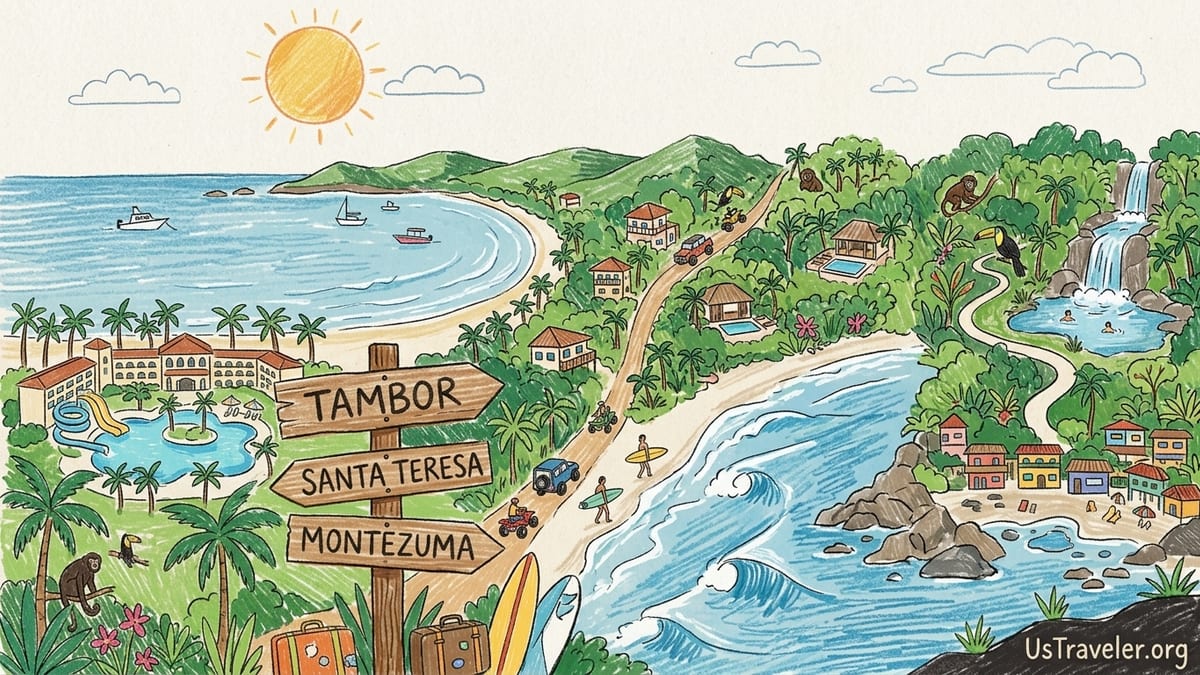
The Nicoya Peninsula’s Pacific coast, especially around Tambor, Santa Teresa and Montezuma, offers some of the most rewarding beach stays in Costa Rica. This is a stretch of shoreline where your choice of hotel or resort is inseparable from the beach you wake up to: gentle bay waters in Tambor, surf-heavy breaks in Santa Teresa, or the coves and rocky points around Montezuma. For travelers comparing full-service resorts with smaller beachfront hotels, villas and simple beach cabinas, understanding how each property connects you to the sand, surf and surrounding roads or ferries is the key to a successful trip.
How Beach and Location Shape Your Stay
In this corner of Puntarenas, three beach personalities sit within a few hours of each other yet feel very different on the ground. Tambor curls around a protected bay where the water is usually calm enough for children and nervous swimmers, and where the all-inclusive Barceló Tambor and more intimate resorts like Tango Mar and Tambor Tropical dominate the immediate beachfront. Santa Teresa, by contrast, is an elongated surf town stretched along several kilometers of beach breaks, with boutique hotels and villa clusters concealed behind palm trees and low jungle, often just a sandy path from the waves. Montezuma is the smallest of the three, a pocket-size village with rocky coves, tide pools and compact sandy stretches, where low-rise beachfront hotels are entwined with jungle and river mouths.
Because the region remains relatively remote, access matters as much as aesthetics. For many travelers driving from San José, the ferry from Puntarenas to Paquera is the defining gateway to all three areas, with Tambor a short drive from the dock and Santa Teresa and Montezuma a longer but scenic ride along paved and partially paved roads. Choosing whether you want quick arrival and all-inclusive convenience in Tambor, or are happy to trade a longer, bumpier approach for surf and bohemian atmosphere in Santa Teresa or Montezuma, will narrow your accommodation options before you start scrolling through photos.
Budget also tracks closely to location and services. A high-season night at a bayfront all-inclusive like Barceló Tambor can start around the mid-200 USD range for two people with meals and domestic drinks included, while a simple beachfront cabina in Montezuma or a small hotel room a short walk from the break in Santa Teresa can still be found, in shoulder season, closer to 120 to 180 USD. Private villas with plunge pools, direct beach paths and concierge services can climb well above that, especially in Santa Teresa and Playa Hermosa, where luxury development has accelerated in recent years.
Tambor: All-Inclusive Ease on a Gentle Bay
Tambor is the most resort-oriented of the three destinations, centered on a broad horseshoe bay where the sea is usually far calmer than on the open Pacific side. Barceló Tambor sits on Ballena Bay as a classic full-service, all-inclusive resort, with two large lagoon-style pools, a separate children’s area, and multiple restaurants serving buffets and à la carte meals. Guests can spend entire days rotating between the pool complex and the dark-sand beach just beyond the palm line, with organized activities, a kids’ club and evening entertainment on site. For families or groups who want to unpack once, avoid rental cars and let the resort arrange excursions to Tortuga Island or nearby canopy tours, Tambor fits the brief.
For travelers who like the idea of a full resort but prefer fewer crowds and more of a boutique feel, Tango Mar Beachfront Boutique Hotel & Villas sits on Quizales Beach, a quieter stretch of coastline a short drive south of Tambor. Here, the beach is more secluded and the property spreads out along a cliff and beachfront, with rooms, villas and a pool terrace looking directly to the Pacific. While Tango Mar offers resort-style amenities, including a pool, on-site dining and a small golf course, it feels more like a private estate than a megaresort. You trade the constant animation of an all-inclusive program for more space, quieter evenings and easier access to relatively empty sand.
Tambor Tropical, on Tambor Bay itself, occupies a different niche again. This adults-only, boutique beachfront resort focuses on spacious suites, a tranquil pool area and a low-key bar and restaurant rather than waterslides or organized games. It typically restricts guests to older teens and adults, which changes the poolside atmosphere compared with Barceló Tambor’s family-driven energy. For couples or small groups wanting calm waters, boat access and a mellow vibe without giving up on-site dining and a curated tour menu, Tambor Tropical is a strong contender.
Access in Tambor is straightforward compared with Santa Teresa or Montezuma. The drive from the Paquera ferry dock to the bay usually takes less than an hour on mostly paved roads, and local taxis are accustomed to servicing resort guests. That makes Tambor attractive for travelers who want a shorter transit day from San José or Liberia, or who are nervous about driving at night on the peninsula’s rougher stretches. You feel removed from big-city Costa Rica, but not so remote that every outing becomes an off-road adventure.
Santa Teresa: Surf Town Energy and Boutique Beachfronts
Santa Teresa has grown from a quiet fishing and farming area into one of Costa Rica’s best-known surf towns, particularly popular with North American and European travelers chasing consistent waves and a barefoot, design-conscious hotel scene. The main beach road runs parallel to Playa Carmen, Playa Santa Teresa and Playa Hermosa, and much of the accommodation labeled beachfront sits either directly on the sand behind tree cover or just across the road with narrow access paths leading out to the shore. The surf is often powerful, especially in rainy season, and many hotels emphasize that swimming is for confident ocean-goers, while long, peeling waves lure intermediate and advanced surfers.
Where Tambor leans into classic pooling and packaged entertainment, Santa Teresa revolves around smaller properties, yoga decks and shaded pools tucked behind privacy walls. Boutique hotels such as Pranamar Oceanfront Villas at the quieter northern end of the beach offer villas and bungalows around a freeform pool, with a yoga shala and restaurant facing the sand. A few kilometers further north in Playa Hermosa, Rayo Verde positions six private villas just steps from the beach, trading mass-market amenities for personalized service and high privacy. These properties typically include breakfast and a la carte dining rather than full all-inclusive plans, encouraging guests to eat in town as well.
Villas and house rentals are more prevalent here than in Tambor, giving independent travelers and groups extra options. A family or two couples might rent a modern three-bedroom villa with plunge pool and partial ocean views a short walk from the beach for a nightly rate comparable to two rooms in a four-star hotel. That said, these rentals often require a 4x4 vehicle, both for the final access track and for navigating the area’s potholed roads, especially during the green season. Travelers expecting the frictionless movement of a gated resort may find the constant coordination of driving, parking and beach access more involved.
Santa Teresa’s relative isolation is part of its appeal but also its main friction point. From the Paquera ferry, expect at least two hours on hilly, sometimes rough roads. First-time visitors should avoid arriving after dark if possible, and those who do not want to drive may prefer arranging private transfers through their hotel. Once there, many people rely on rental quads or minibikes to get between beaches, restaurants and supermarkets, especially given the linear layout of the town. This sense of long, spread-out coastline is exactly what surfers and sunset walkers love, but it means that “steps from the beach” on a booking site can still translate to a significant distance from the central dining and nightlife hubs.
Montezuma: Small-Scale Beachfront and Waterfalls
Montezuma is a compact, bohemian-feeling village at the southeastern tip of the Nicoya Peninsula, known for its waterfalls, rocky coves and creative expat community. The town center hugs a small bay where fishing boats anchor just offshore, and low-key hotels and hostels sit on or slightly back from the beach. Compared with Santa Teresa, where surfing dominates conversations, Montezuma caters more to swimmers, waterfall hikers and travelers who want to combine short beach walks with easy access to river pools and the Cabo Blanco Absolute Natural Reserve to the south.
Beachfront hotels here are human-scale rather than high-rise. Ylang Ylang Beach Resort, for example, lies just beyond the town center, walkable along the beach at low tide or by jungle path, and offers bungalows and suites amid palm trees with a pool and open-air restaurant right above the sand. Smaller beach lodges cluster around Montezuma’s central bay, often blending into palm groves and gardens rather than presenting themselves as big resort compounds. The atmosphere tends to be tranquil, with the clink of dishes at breakfast or sunset cocktails replacing the thump of resort sound systems.
Because Montezuma’s coastline alternates between sandy pockets and rocky outcrops, “direct beach access” can mean anything from stepping off your terrace onto a swim-friendly arc of sand to descending a short path to tide pools and rock slabs. Travelers who prioritize daily ocean swims should confirm with their hotel which part of the shore they front and how conditions vary with tides. The Montezuma Waterfall, one of the area’s signature attractions, is close enough that some hotels advertise walking time to the trailhead in minutes, making it easy to combine beach mornings with freshwater plunges in the same day.
Access to Montezuma is moderately easier than Santa Teresa but more involved than Tambor. From Paquera, the drive passes through Tambor and then winds south along a mix of paved and gravel roads, usually taking around 90 minutes in dry conditions. Public buses connect Montezuma with Cobano, the regional hub, but many visitors either rent a 4x4 vehicle for flexibility or arrange shared shuttles. Once in town, Montezuma is walkable, with most beachfront hotels, cafes and tour offices clustered within a manageable radius, reducing the need for daily driving.
Comparing Resorts, Boutique Hotels, Villas and Simple Beach Stays
When you line up Tambor, Santa Teresa and Montezuma side by side, the contrasts between resort stays, boutique hotels, villas and simple cabinas become clearer. In Tambor, Barceló Tambor represents the full-service, family-oriented all-inclusive template: immediate beach frontage on a calm bay, large pools, kids’ areas, multiple restaurants, evening shows and on-site activities that may include tennis courts and a small climbing wall. Meals and domestic drinks are folded into the nightly rate, giving predictable vacation budgeting and reducing the need to seek out restaurants off property, though many travelers still slip out for at least one meal in a local soda or seafood spot.
Tango Mar and Tambor Tropical shift down in scale from mass resort to boutique without abandoning creature comforts. Expect professionally maintained pools, on-site restaurants, massage or spa services and tour desks, but not the same volume of daily programming. Restaurants at these properties tend to be more intimate, with menus that can justify a higher spend per person compared with all-inclusive buffets, and guests are more likely to split time between on-site dining and independent exploration. The combination of direct or nearly direct beach access, manageable size and calm water around Tambor makes this category especially attractive to couples or friend groups who want a polished setting that still feels like Costa Rica rather than a standalone bubble.
In Santa Teresa and Montezuma, boutique hotels and beachfront cabinas often merge into a continuum, with the main differences being service level and design. A Santa Teresa boutique hotel might offer curated interiors, a chic pool, daily breakfast and a concierge who can book surf lessons, yoga and private dinners, while a simpler beach lodge a few kilometers away focuses on basic rooms with fans or air conditioning, a small shared pool and straightforward beach access. In Montezuma, Ylang Ylang and similar properties bridge the gap, delivering full-restaurant service and pools in a setting that still feels more like a nature lodge than a commercial resort.
Standalone villas and vacation rentals add another layer to the decision. In Tambor, options exist but are less concentrated, since the resort model is dominant. Around Santa Teresa and Playa Hermosa, villa rentals are a major part of the accommodation mix, ideal for groups who want kitchen facilities, private pools and living rooms instead of hotel lounges. The trade-off is the absence of on-site restaurants and organized children’s programs; families must be comfortable cooking, driving into town, or arranging private chefs and babysitters. For some, the payoff is waking up to a largely private view of the surf from a hillside infinity pool, with no neighbors in sight except the howler monkeys in the trees.
Family Facilities, Surf Focus and the Question of Isolation
Families comparing these three destinations often gravitate first to Tambor because of its calm water and resort infrastructure. Barceló Tambor’s kids’ pool zones, supervised activities and buffet restaurants that can accommodate picky eaters form a safety net for parents. The beach directly in front of the resort usually allows for gentle paddling and sandcastle building rather than the heavy shorebreak more typical of Santa Teresa. Tango Mar also appeals to multigenerational groups who want quieter surroundings but still value a pool, on-site dining and, in some cases, accessible golf and spa services.
Santa Teresa’s family friendliness depends heavily on the age and interests of the children. Active teens who surf or want to learn often thrive here, splitting days between lessons, skate parks and casual beachside cafes. Younger children may find the strong waves and relative lack of classic playground-style facilities more challenging, though plenty of hotels offer shallow pools, and families can plan their beach time for lower tides or calmer sections such as Playa Hermosa. Parents should budget additional time and money for transport, whether that means renting a capable vehicle or booking transfers and tours that include pick-up and drop-off.
Montezuma sits somewhere in the middle. The town’s small scale, walkable layout and mix of beaches and waterfalls make it a gentle introduction to the Nicoya Peninsula for families who do not need full resort programming but still appreciate having restaurants and small grocery shops nearby. Children can alternate between supervised swims in protected coves, short hikes to the waterfall and simple wildlife spotting along the beach paths. At the same time, Montezuma’s limited number of properties means families should book well ahead for peak periods such as Christmas and Easter if they want beachfront rooms.
Isolation is both a feature and a potential drawback in all three places. Tambor feels the most self-contained, especially inside an all-inclusive complex where everything from breakfast buffets to evening shows happens on property. Santa Teresa’s isolation is physical rather than social; you are far from major cities, but the beach and dirt roads hum with cafes, surf shops and yoga studios, and the sunset scene can be busy. Montezuma offers true small-town seclusion, especially outside high season, with evenings that tend to be quiet once dinner hours pass. Travelers should be honest about their tolerance for gravel roads, limited medical facilities and patchy mobile coverage when choosing how far off the grid they want to go.
Getting There: Ferry and Road Access Explained
Reaching Tambor, Santa Teresa and Montezuma usually starts with a drive to Puntarenas and a car or passenger ferry across the Gulf of Nicoya to Paquera. Ferry schedules can shift seasonally, and tickets are best booked in advance when traveling with a car during peak vacation periods. The crossing itself takes roughly 70 minutes, with views of islands and the occasionally spotted dolphin or seabird, and drops you on the peninsula side where the road network branches south and west toward the three beach areas.
From Paquera, Tambor is the most convenient destination. The road south toward the bay is mostly paved and relatively flat, passing through forest patches and small settlements before reaching the resort zone in around 45 minutes to an hour in good conditions. This shorter transit makes same-day arrivals from San José international airport manageable even with a midday or afternoon flight, which is one reason Tambor has long been marketed as a user-friendly introduction to the Nicoya Peninsula for first-time visitors.
Montezuma and Santa Teresa lie further along the network of peninsula roads. To reach Montezuma, you generally continue through Tambor toward Cobano and then descend toward the coast, a route that can take around 90 minutes from Paquera depending on traffic and weather. Santa Teresa and neighboring Mal País typically require at least a two-hour drive from the ferry terminal, involving hills, occasional gravel stretches and, in rainy season, muddy patches and potholes. A high-clearance vehicle or 4x4 is strongly recommended, particularly between May and November when heavy rains can degrade road conditions quickly.
For travelers who want to avoid driving altogether, shared shuttles and private transfers connect the ferry to major hotels in Tambor, Santa Teresa and Montezuma, though options are generally more frequent in Santa Teresa due to higher demand. Some visitors also consider small domestic flights to airstrips near Tambor and Cobano during dry season, trading flexibility in luggage and schedules for shorter travel days. Whichever route you choose, planning arrival during daylight hours reduces stress, especially if you are unfamiliar with unlit rural roads and variable signage.
The Takeaway
Choosing among Tambor, Santa Teresa and Montezuma is less about ranking beaches and more about aligning your preferred style of stay with the right stretch of coast. If you want an all-inclusive, family-ready resort on a calm bay with large pools, buffet variety and minimal logistical friction, Tambor, anchored by Barceló Tambor and complemented by Tango Mar and Tambor Tropical, is the natural fit. The beach shapes your days into easy cycles of swimming, lounging and organized outings without constant decisions.
If your dream trip revolves around surf checks, sunset sessions and boutique hotels or villas steps from a powerful Pacific break, Santa Teresa delivers, provided you are comfortable with a longer, sometimes bumpy approach and a town stretched out along several kilometers of coastline. Montezuma, finally, is for travelers who prioritize small-scale beachfront hotels, walkability and easy access to waterfalls and coves over nightlife or large-scale amenities. In all three, your accommodation choice is inseparable from the beach you fall asleep to and wake up beside. Clarifying where you sit on the spectrum between resort convenience and off-grid adventure will make that choice feel less like a gamble and more like the first step of the trip itself.
FAQ
Q1. Is Tambor, Santa Teresa or Montezuma best for a first-time visitor to Costa Rica?
For a first visit focused on low-stress logistics and comfort, Tambor is often the easiest choice because of its calm bay, resort infrastructure and relatively short drive from the Paquera ferry. Santa Teresa and Montezuma suit travelers who are comfortable with rougher roads and a more independent, small-town feel.
Q2. Which area is best for families with young children?
Families with small children usually do best in Tambor, where the bay is calmer and full-service resorts like Barceló Tambor offer kids’ pools, organized activities and on-site medical contacts. Montezuma can also work for families who value small scale over formal kids’ clubs, while Santa Teresa is better suited to older children and teens.
Q3. Where should surfers stay among these three destinations?
Surfers generally favor Santa Teresa, especially around Playa Carmen and Playa Santa Teresa, where beach breaks offer consistent waves for intermediate and advanced riders and lessons are readily available for beginners. Tambor’s bay is typically too gentle for serious surfing, and Montezuma is more about coves, swimming and waterfalls than surf.
Q4. Are there truly beachfront hotels in Santa Teresa and Montezuma?
Yes, both Santa Teresa and Montezuma have hotels and cabinas directly on or just behind the sand, though dense vegetation often hides them from the waterline. In Santa Teresa many properties sit behind the beach road with short access paths, while in Montezuma several small hotels and resorts front directly onto coves and the main bay.
Q5. Do I need a 4x4 vehicle to reach these destinations?
A 4x4 is not strictly required for Tambor in dry season, though it is useful in heavy rains. For Santa Teresa and, to a lesser extent, Montezuma, a high-clearance vehicle or 4x4 is strongly recommended due to hills, gravel stretches and potholes, especially between May and November.
Q6. How do the price levels compare between Tambor, Santa Teresa and Montezuma?
Tambor’s all-inclusive resorts often have higher nightly rates but include meals and drinks, which can balance costs. Santa Teresa tends to be the priciest for boutique hotels and villas, especially in high season, while Montezuma usually offers slightly lower rates and more modest, small-scale properties.
Q7. Can I visit all three destinations in one trip?
It is possible to combine Tambor, Santa Teresa and Montezuma in a single itinerary, especially on trips of 10 days or longer. Many travelers pair a few nights in Tambor’s resort comfort with additional nights in either Santa Teresa or Montezuma to experience a different beach style and atmosphere.
Q8. Is swimming safe at the beaches in these areas?
Swimming conditions vary by beach and season. Tambor’s bay is generally the safest for casual swimmers due to gentler waves, while Santa Teresa often has strong surf and rip currents that demand caution. Montezuma offers a mix of swimmable coves and rocky areas, so local advice and observation are important before entering the water.
Q9. Are there dining options outside the resorts in Tambor?
Yes, although Tambor has fewer independent restaurants than Santa Teresa or Montezuma, there are local sodas and small hotels with restaurants where non-guests can dine. However, guests at all-inclusive resorts may find that most of their meals naturally happen on property because food and drinks are already included in the room rate.
Q10. When is the best time of year to visit these beach areas?
The dry season, roughly from December to April, offers the sunniest conditions and the easiest road travel, which is particularly important for Santa Teresa and Montezuma. The green season brings more rain, especially from September to November, but also fewer crowds and lusher landscapes, though drivers must be prepared for rougher roads and occasional travel delays.