


Puntarenas is one of Costa Rica’s most diverse regions, stretching from the misty cloud forests of Monteverde to the Pacific beaches of Santa Teresa, Montezuma and Mal País, and out across the Gulf of Nicoya to islands like Tortuga and San Lucas. This guide focuses on the destinations Costa Rica’s own tourism board highlights in the Puntarenas tourism area, explaining where to go for wildlife, cloud forest, beaches, surfing, couples’ escapes, family trips, island excursions and short scenic stops, and how long to stay in each place.
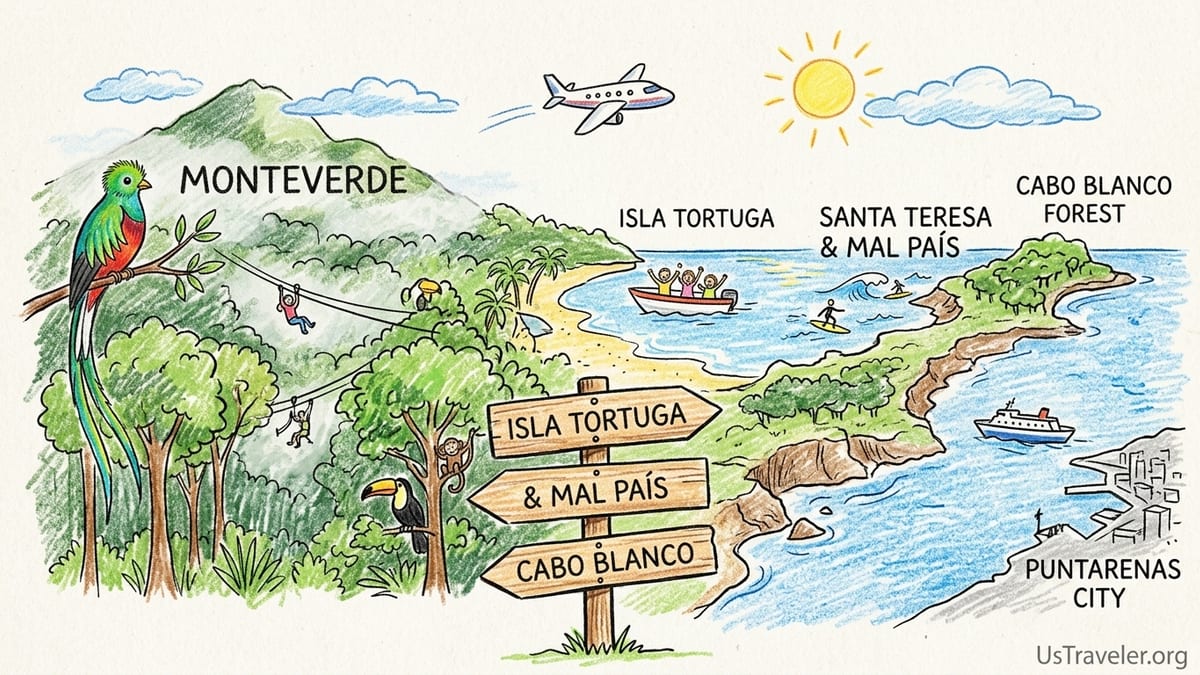
How This Guide Frames the Puntarenas Region
Puntarenas is both a province and an official tourism area that includes the Gulf of Nicoya islands, the Nicoya Peninsula’s southern beaches and the upland cloud forest of Monteverde. The country’s tourism authority consistently spotlights Monteverde, the port city of Puntarenas, Isla Tortuga, Isla San Lucas, Tambor, Montezuma, Cabo Blanco, Santa Teresa and Mal País as signature stops. Together they form a compact loop of forest, coast and islands reachable in roughly half a day’s travel from San José for most segments.
This article does not attempt to list every beach or national park. Instead, it compares these specific destinations by strengths: wildlife and cloud forest versus beaches and surf, relaxed family resorts versus backpacker hangouts, and places worth several nights versus day trips. For example, Monteverde and Santa Teresa generally merit three or more nights for most travelers, while Tortuga Island and San Lucas Island are classic full-day excursions by boat. Understanding this distinction helps you avoid overpacking your itinerary or basing yourself in a place that does not match your travel style.
In practical terms, most visitors will combine one inland base and one coastal base within Puntarenas, then add one or two boat trips. A typical eight to ten day trip might split time between Monteverde’s cloud forest and the beaches of Santa Teresa or Montezuma, with a catamaran day tour to Tortuga Island or a history-focused excursion to San Lucas Island. The ferry routes linking the port city of Puntarenas with Paquera on the Nicoya Peninsula, along with regional air service into Tambor, make it relatively straightforward to connect these very different landscapes.
Prices and services in this guide are indicative rather than fixed. Boat trips to Tortuga Island, for instance, often range around the low to mid one hundreds of US dollars per person for full-day catamaran tours with meals and snorkeling included, while more basic local boats can be cheaper. Hotel rates in Santa Teresa or Monteverde vary widely by season and level, from budget hostels to boutique eco-lodges and full-service beach resorts.
Monteverde: Cloud Forest Icon and Wildlife Hub
Monteverde sits in the Tilarán mountains within Puntarenas province and is Costa Rica’s flagship cloud forest destination. The area around the Monteverde and Santa Elena reserves is known for cool, misty conditions, dripping moss and epiphytes, and an exceptional concentration of birds such as resplendent quetzals, bellbirds and multiple species of hummingbirds. It is regularly cited in international travel publications as one of the world’s classic cloud forest destinations and is considered one of Costa Rica’s natural wonders.
For wildlife and forest immersion, Monteverde is the strongest choice in the Puntarenas tourism area. Guided early-morning birdwatching walks and night hikes to spot frogs, kinkajous and sleeping birds are common offerings, with small-group tours typically priced in the approximate 30 to 60 US dollar range per person depending on length and inclusions. Canopy tours with hanging bridges and zip-lines are popular with families; the combination of cloud forest trails in the morning and zip-lining after lunch works well for children who might not enjoy long hikes.
Monteverde is primarily a several-night destination, not a quick stop. The mountain roads take time, and the microclimate is changeable, so allocating at least two full days allows you to experience both sunny and misty conditions and to visit more than one reserve. Couples often split their stay between a midrange lodge near Santa Elena town, with easy access to restaurants and cafés, and a quieter eco-lodge closer to the forest edge for a more secluded feel. Families frequently choose hotels with on-site trails or gardens where kids can watch hummingbird feeders and capuchin monkeys without long walks.
Monteverde pairs well with the coastal destinations listed in this guide. Many travelers arrive via the Inter-American Highway from San José and then continue onward by road to the port city of Puntarenas or to Paquera to connect with Tambor and the southern Nicoya beaches. Because Monteverde’s altitude brings temperatures that are refreshingly cool compared with the coast, including it in a beach-heavy itinerary creates welcome contrast in both climate and activities.
Puntarenas City and the Gulf of Nicoya Islands
The city of Puntarenas occupies a long, narrow sand spit that reaches into the Gulf of Nicoya. Historically an important Pacific port, today it functions as a regional hub and cruise ship stop, as well as the departure point for ferries to Paquera and the Nicoya Peninsula and for many catamaran tours to islands in the gulf. The seafront promenade known as the Paseo de los Turistas is lined with casual restaurants and ice-cream stands, and on weekends it can feel festive with local families strolling the waterfront.
For most international visitors, Puntarenas city works best as a short stop rather than a long-term base. Many travelers pass through for an hour or two while waiting for the ferry or catamaran, grabbing a plate of ceviche or a whole fried fish at a simple seaside soda. It is also where some tour companies start full-day trips to Tortuga Island or San Lucas Island, bundling bus transfers from beach towns like Jacó or Herradura with ferry or catamaran tickets that depart directly from the dock area in Puntarenas.
The Gulf of Nicoya itself is dotted with islands, mangroves and wildlife refuges, some of which you will pass en route to Tortuga or San Lucas. The scenery from the deck of a catamaran includes distant views of forested hills on the Nicoya Peninsula, small fishing boats and flocks of seabirds. While hardcore wildlife enthusiasts will see more terrestrial species in Monteverde or Cabo Blanco, the gulf is interesting for its coastal ecosystems and for the chance to spot dolphins or sea turtles in the water during crossings, especially in the calmer months.
Because Puntarenas city is compact and primarily focused on transit and local commerce, it is not as strong for extended beach holidays as the southern Nicoya destinations such as Tambor, Montezuma, Santa Teresa or Mal País. However, for travelers coming from San José by bus or rental car, it is the gateway that unlocks those more remote coastal areas, as well as the starting point for the main island excursions described below.
Tortuga Island and San Lucas Island: Day-Trip Highlights
Tortuga Island in the Gulf of Nicoya is one of Costa Rica’s classic full-day island excursions. Known for white-sand beaches and turquoise water, it lies just offshore from the Curú Wildlife Refuge on the Nicoya Peninsula. Tour operators based in Puntarenas, Herradura and Jacó typically run catamaran trips that include a morning cruise, several hours on the island with snorkeling, beach time and lunch, and a return in the late afternoon. Indicative prices from beach towns such as Jacó often fall in the 130 to 150 US dollar per person range for all-inclusive packages, with lower prices sometimes available on larger, more basic boats.
Tortuga Island is strongest for beach-focused day trips, snorkeling and a social atmosphere rather than for solitude or wildlife watching on land. On busy days, several boats may dock at the same small beach, and you will see rental kayaks, banana boat rides and people queuing for snorkeling gear. Families often appreciate the clear, shallow water and the structure of an organized tour, while couples might enjoy the scenic boat ride and the possibility of dolphin sightings along the way. Serious snorkelers should expect fairly good visibility by Pacific standards but not the coral reef conditions of Caribbean destinations.
San Lucas Island, by contrast, is visited as much for history as for scenery. Once home to a notorious island prison, it has been converted into a national park that preserves the crumbling cell blocks, chapel and other structures. Guided tours explain the island’s past and generally include walking through former prison wings, seeing old graffiti and hearing stories about daily life for inmates. Access is typically via small boats from Puntarenas or nearby ports, and tours can be arranged through local agencies or online booking platforms, often combining transport and park entrance fees into a single price.
Both Tortuga Island and San Lucas Island are best treated strictly as day trips rather than overnight destinations. There is no mainstream accommodation on Tortuga itself, and visits are structured around boat schedules. San Lucas, as a protected park with heritage structures, is managed for day visitors, with facilities such as restrooms and interpretive signage but not resort-style services. Travelers planning a week in Puntarenas province might realistically include one of these island excursions, or both if they have a particular interest in maritime scenery and Costa Rican history.
Tambor and Montezuma: Calm Bay Versus Bohemian Beach Village
Tambor lies on the southern Nicoya Peninsula along a broad, calm bay and has evolved from a small fishing community into a low-key beach resort area. The bay’s gentle waves and wide sandy shore make it popular with families and with travelers looking for a quieter alternative to surf-oriented towns. A well-known all-inclusive beach resort and a golf and country club complex sit near the bay, alongside smaller hotels and vacation rentals. Access is relatively easy, especially for those taking the ferry from Puntarenas to Paquera; from the Paquera terminal, Tambor is typically around a 40- to 60-minute drive, depending on road conditions.
Tambor’s strengths lie in swimming, relaxed walks along the bay and as a base for exploring nearby nature reserves and islands. The surrounding area offers access to places such as Curú Wildlife Refuge, Tortuga Island by boat and smaller, less developed beaches. It is a good fit for families with younger children who prefer calmer water and resort amenities like pools, kids’ clubs and buffet meals. Couples who want a simple beach stay with the option of a few excursions may also find Tambor appealing, though nightlife is limited compared with more bohemian towns.
Montezuma, about an hour’s drive from Tambor, has a very different feel. Tucked along the southern edge of the Nicoya Peninsula, it is known for a small, walkable village center with cafés, craft shops, yoga studios and a mix of guesthouses and boutique hotels. The coastline here is rocky and scenic, with small coves, tide pools and sandy stretches framed by palm trees. A signature outing is the hike to Montezuma Waterfall, where visitors can swim in pools beneath the cascades; local tour companies also offer canopy tours, horseback riding and boat trips to Tortuga Island or nearby wildlife refuges.
Montezuma is best for travelers who enjoy a laid-back, artsy atmosphere and do not mind rougher roads. It can work well for couples and solo travelers who appreciate yoga classes, vegetarian cafés and a slower pace. Families with older children or teenagers may also enjoy the waterfalls and tide pools. Montezuma can merit several nights, especially if you plan to use it as a base for visiting Cabo Blanco Reserve, Curú Wildlife Refuge and Tortuga Island, but it is also manageable as a one- or two-night stop within a longer peninsula circuit that continues to Santa Teresa and Mal País.
Cabo Blanco: Conservation Landmark at the Edge of the Peninsula
The Cabo Blanco Absolute Nature Reserve, at the southern tip of the Nicoya Peninsula, holds special significance as Costa Rica’s first major protected area. It protects a mix of dry and moist tropical forest that descends to rocky headlands and small beaches, and it serves as an important refuge for seabirds and terrestrial wildlife. Trails lead through forest where visitors may encounter howler and capuchin monkeys, coatis, agoutis and numerous bird species, especially in the cooler hours of morning.
Cabo Blanco is particularly strong for travelers interested in conservation history and relatively challenging hikes rather than casual beach lounging. The main trails can involve several hours of walking on sometimes steep, uneven paths, making them better suited to reasonably fit adults and older children. Because the reserve has stricter rules than many parks, including fixed opening days and limits on visitor facilities, it feels wilder and less commercial than other coastal protected areas. It is typically visited as a day trip from nearby bases such as Montezuma, Santa Teresa or Mal País.
There is no accommodation inside Cabo Blanco, and services near the entrance are minimal, so you should plan to bring sufficient water, snacks and appropriate footwear. Guided tours can usually be arranged through hotels in Montezuma or Santa Teresa, often including transport and park entrance, which simplifies logistics if you do not have a rental car. For wildlife-focused itineraries, combining Cabo Blanco with Monteverde allows you to experience both cloud forest and lowland coastal forest within the same province, showcasing the ecological diversity that has made Costa Rica’s protected areas model internationally.
Because visiting Cabo Blanco typically occupies most of a day, it is best planned as one of the key nature outings during a multi-night stay in the southern Nicoya area rather than as a quick roadside stop. Travelers prioritizing beaches and surfing might choose just one hiking day here, while those most interested in birds and mammals often allocate more of their coastal time to reserves like Cabo Blanco and Curú.
Santa Teresa and Mal País: Surf, Sunsets and Long Beach Stays
Santa Teresa, together with neighboring Mal País at the southwestern tip of the Nicoya Peninsula, has become one of Costa Rica’s most talked-about beach destinations. The area features long stretches of light sand, consistent beach breaks that attract surfers and a growing scene of cafés, yoga studios, surf schools and small boutique hotels. It is regularly highlighted by both Costa Rican tourism promotions and international travel media as a prime spot for surfing and sunsets, especially for visitors who do not mind unpaved roads and a somewhat dispersed village layout.
For surfing, Santa Teresa and Mal País are among the strongest options within the Puntarenas tourism area. Swell is relatively reliable year-round, with many surf schools offering board rentals and lessons suited to beginners and intermediates. More advanced surfers often seek particular sandbars or nearby beaches like Playa Carmen or Playa Hermosa for specific wave shapes or crowd levels. Daily board rental prices vary but are commonly in the approximate 10 to 25 US dollar range, while group lessons with an instructor might fall between 40 and 70 US dollars depending on duration and whether video coaching or transport is included.
Santa Teresa and Mal País excel as several-night destinations for couples, groups of friends and long-stay travelers. Many visitors book a week-long stay in an ocean-view villa, a small design hotel or a surf-and-yoga lodge, using golf carts, bicycles or 4x4 vehicles to move along the main coastal road for dinners and beach sessions. The social scene ranges from laid-back beach bars and sunset drum circles to occasional late-night venues, but it is still easy to find quiet corners, especially if you stay a short distance up the hillsides behind the beach. Families with water-confident children and teenagers can also thrive here, particularly if they enroll in surf camps or mix beach days with excursions to waterfalls and reserves.
The flip side of Santa Teresa’s growing popularity is that it can feel busy in peak seasons, with higher prices and more traffic on the dusty main road. Travelers seeking a quieter, more traditional village atmosphere may prefer Montezuma or Tambor as a base, making day trips into Santa Teresa for surfing or dining. That said, for beach lovers who want a blend of good waves, international food options, wellness activities and dramatic sunsets, Santa Teresa and Mal País often justify five to seven nights, especially when combined with an inland stay in Monteverde for contrast.
Planning Your Route and Matching Destinations to Travelers
Designing a trip around these Puntarenas destinations involves balancing travel time, ferry schedules and your group’s interests. A common route from San José is to drive or take a shuttle to Monteverde for three nights of cloud forest hiking, canopy tours and night walks, then continue down to Puntarenas city and cross by ferry to Paquera. From there you can head to Tambor for a quieter bay stay or directly to Santa Teresa, Mal País or Montezuma for surf and beach time. Many visitors then add a boat trip to Tortuga Island from either the Nicoya Peninsula side or from Jacó and Puntarenas on the mainland.
For wildlife and forest, Monteverde and Cabo Blanco form the core, with Monteverde focusing on cool cloud forest species and Cabo Blanco on coastal dry forest and seabirds. Families typically enjoy Monteverde’s hanging bridges and hummingbird gardens, while more active travelers relish Cabo Blanco’s longer hikes. For beaches and surfing, Santa Teresa and Mal País are strongest, followed by Montezuma for its characterful village and waterfalls and Tambor for easy swimming. Couples looking for romance often divide time between a secluded lodge in Monteverde and a stylish boutique hotel in Santa Teresa or Montezuma, timing their stay to shoulder seasons for fewer crowds.
Island trips and short cultural stops round out the itinerary. Tortuga Island excels as a fun, scenic boat-and-beach day that suits most ages, especially if you appreciate organized tours with meals, snorkeling and music included. San Lucas Island stands out for travelers interested in Costa Rican history and former prison sites, offering a very different perspective on the Gulf of Nicoya. Puntarenas city itself is best seen as a brief transit hub where you might sample local seafood, stroll the waterfront and board the ferry or catamaran that links the mainland with the Nicoya Peninsula and its islands.
Transport choices shape the character of your trip. Rental cars provide flexibility to explore side roads around Montezuma, Mal País and Santa Teresa and to reach trailheads in places like Cabo Blanco. However, road surfaces can be rough and signage sparse, so some travelers prefer to rely on shared shuttles between major points like San José, Monteverde and Santa Teresa, adding locally arranged tours for Cabo Blanco, Tortuga Island or San Lucas. Domestic flights into the small Tambor airstrip can significantly shorten travel times from the Central Valley, especially for short trips of a week or less.
The Takeaway
Within a relatively compact area, the Puntarenas tourism region combines cloud forest, historic ports, offshore islands and surf beaches, offering an especially rich cross-section of Costa Rica’s landscapes. Monteverde stands out for wildlife and cool, misty trails and deserves several nights. Along the coast, Santa Teresa and Mal País shine for surfing and extended beach stays, while Montezuma and Tambor offer contrasting moods, one bohemian and waterfall-focused, the other calm and resort-oriented.
Tortuga Island and San Lucas Island are most rewarding as focused day trips from coastal bases or from Puntarenas city, delivering white-sand beach relaxation or history-centric exploration. Cabo Blanco, meanwhile, preserves a vital piece of Costa Rican conservation history and provides serious hikers and nature enthusiasts with a wilder alternative to more developed seaside parks. Thoughtfully combining one or two of these hubs with a couple of strategic excursions can turn a simple beach vacation into a more varied journey through the heart of Puntarenas.
Whether you are a couple chasing sunset surf sessions, a family seeking manageable adventures, or a solo traveler fascinated by the contrast between misty ridgelines and island-dotted seas, this part of Costa Rica offers enough variety to fill more than one trip. The key is to be selective, linger where the landscape speaks to you, and let the ferries and mountain roads connect the dots between cloud forest, coastline and islands at a pace that fits your own style of travel.
FAQ
Q1. How many days should I spend in Monteverde versus the beaches of Santa Teresa or Montezuma?
For most travelers, two to three full days in Monteverde is enough for key hikes, hanging bridges and a night tour, while four to seven days on the coast in Santa Teresa, Mal País or Montezuma allows time to relax, surf and add at least one excursion such as Cabo Blanco or Tortuga Island.
Q2. Is Tortuga Island better from Puntarenas, Jacó or the Nicoya Peninsula side?
Experiences are similar, but tours from Puntarenas or Jacó typically use larger catamarans with more onboard services, while boats from Montezuma or nearby areas on the Nicoya Peninsula can feel more intimate and involve shorter sea crossings, which some travelers prefer if they are sensitive to motion.
Q3. Is Santa Teresa suitable for families with young children?
Yes, as long as you choose family-friendly accommodation and take care with surf conditions, many families enjoy Santa Teresa for its long beaches, casual restaurants and surf schools, though the roads are dusty and spread-out, so families who prefer compact, walkable areas may feel more comfortable in Tambor or central Montezuma.
Q4. Do I need a 4x4 vehicle to visit these Puntarenas destinations?
A 4x4 is not strictly required in the dry season for main routes, but it is very helpful around Santa Teresa, Mal País and Montezuma where roads are often unpaved and can become rutted, and in the rainy season a higher-clearance vehicle improves comfort and safety on the way to Monteverde and some park entrances.
Q5. Can I visit Cabo Blanco on my own, or do I need a guide?
You can visit Cabo Blanco independently by paying the entrance fee at the ranger station and following signed trails, but many travelers prefer to join a guided hike arranged through lodges in Montezuma or Santa Teresa to benefit from transport logistics and from a naturalist’s ability to spot wildlife you might otherwise miss.
Q6. Is Puntarenas city worth staying in overnight?
Some travelers overnight in Puntarenas for convenience when catching early ferries or catamarans, and to try local seafood along the promenade, but if your primary goals are beaches, surfing or wildlife, you will likely find it more rewarding to continue on to Monteverde, Tambor, Montezuma or Santa Teresa for your main stay.
Q7. How does Tambor compare with Santa Teresa for a beach holiday?
Tambor offers calmer bay waters, more resort-style lodging and a quieter atmosphere suited to families with small children or travelers who want simple swimming and relaxation, while Santa Teresa focuses more on surf breaks, boutique hotels and a livelier dining and wellness scene, which may better suit couples and active travelers.
Q8. Is San Lucas Island suitable for children?
San Lucas Island can work for older children and teenagers interested in history, as tours focus on former prison buildings and stories that some younger or sensitive kids might find intense, so families should consider their children’s ages and interests and perhaps choose Tortuga Island instead if they prefer a straightforward beach day.
Q9. When is the best time of year to visit Santa Teresa and Montezuma for surfing and good weather?
Surf is generally consistent throughout the year, with larger swells more common in the rainy months and smaller, cleaner conditions in parts of the dry season, so many surfers aim for transitional months when wave quality and weather balance well, while beach-focused travelers often prefer the drier stretch from around December into April.
Q10. Can I combine Monteverde, Tortuga Island and Santa Teresa in a one-week trip?
Yes, a well-paced seven-day itinerary can include two or three nights in Monteverde for cloud forest activities, followed by four or five nights in Santa Teresa or nearby beaches, with a day trip to Tortuga Island either from the Nicoya Peninsula side or via a tour that begins on the mainland if your schedule and budget allow.