


The Puntarenas to Paquera ferry is the classic sea shortcut to Costa Rica’s Nicoya Peninsula and beach towns like Tambor, Montezuma, Santa Teresa and Mal País. As of September 2026, Naviera Tambor continues to operate this regulated public route across the Gulf of Nicoya, with adult walk‑on tickets set at ₡810. What catches many travelers out are vehicle procedures, partial online inventory and confusion between Paquera and a completely different crossing to Playa Naranjo. This guide walks you step by step through tickets, fares, schedules and onward connections so you can plan the crossing with confidence.
Understanding the Puntarenas to Paquera Ferry Route
The Puntarenas–Paquera ferry is a public maritime transport service that crosses the Gulf of Nicoya and connects the port city of Puntarenas on the mainland with the small community of Paquera on the Nicoya Peninsula. The crossing typically takes about 70 to 75 minutes of sailing time, not counting loading and unloading. For most travelers heading to Tambor, Montezuma, Cóbano, Santa Teresa and Mal País, this ferry is the most direct and scenic way to reach the peninsula when coming from San José or Liberia.
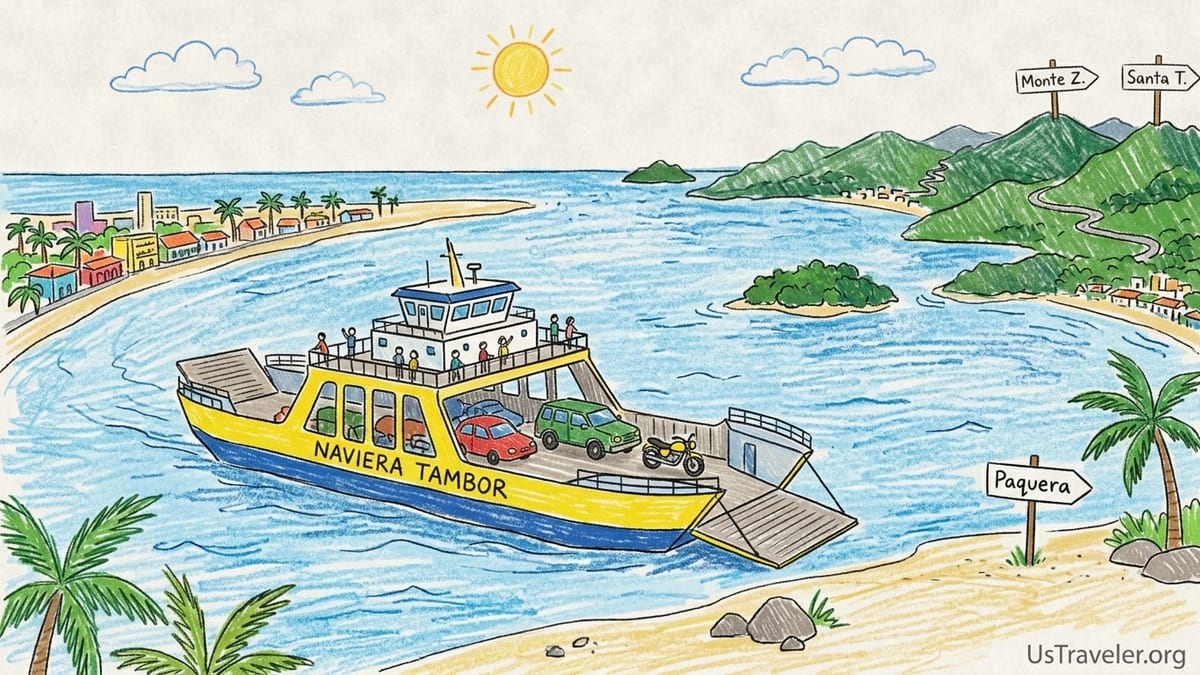
The service is operated by Naviera Tambor under concession and regulated tariffs. Ferries carry both foot passengers and a full range of vehicles, from motorcycles and standard rental cars to buses and light trucks. The passenger cabins offer basic seating, restrooms and simple snack bars. Many travelers spend the trip on the open deck watching the gulf islands and, with some luck, dolphins or sea birds along the route.
In practical terms, the ferry saves time compared with driving entirely by road around the gulf via the Tempisque bridge, especially in peak traffic or when there are roadworks on the northern routes. For example, the drive from San José to Santa Teresa via the bridge can easily run seven to eight hours, while combining a roughly two and a half to three hour drive to Puntarenas, a 1 hour 15 minute sailing and around one and a half hours of driving from Paquera to Santa Teresa is usually shorter and far more relaxing.
Because it is an essential public transport link used by locals, commercial vehicles and tourists, the ferry operates daily all year, including Sundays and holidays. However, demand at Easter, Christmas and during national holidays can be extremely high, especially for vehicles, so advance planning is critical.
Current Fares for Passengers and Vehicles
Fares on the Puntarenas–Paquera route are regulated by Costa Rica’s Authority for Public Services (ARESEP). As of July 1, 2026, the official adult passenger fare on Naviera Tambor’s Puntarenas–Paquera ferry is ₡810, with lower fares for children and free passage for qualifying seniors under Costa Rican rules. These passenger fares apply whether you buy at the terminal ticket office or as part of an online transaction.
Vehicle fares are higher and depend on the type and size of vehicle. Standard private passenger cars and small SUVs are charged a fixed amount per crossing, while motorcycles, bicycles, minibuses and larger trucks have their own categories. For a typical rental sedan or compact SUV, travelers should expect the vehicle ticket to cost the equivalent of roughly 20 to 25 US dollars at current exchange rates, plus the passenger fares for each person in the vehicle. The vehicle tariff is charged per vehicle, not per person, while every passenger still needs an individual ticket.
To understand how this works in practice, imagine a couple driving a compact rental SUV from San José to Santa Teresa. They will pay one vehicle fare for their SUV and then two separate passenger tickets at ₡810 each. A solo traveler on a motorcycle pays the motorcycle tariff plus a single passenger ticket. Walk‑on passengers without vehicles simply pay the passenger fare and board via the foot passenger gangway at each terminal.
Because tariffs are periodically adjusted by the regulator and listed in colones, it is best to treat all converted totals in foreign currency as approximate. Credit card receipts at the terminal are in colones and your bank handles the exchange. Travelers who budget in US dollars should leave some margin for small tariff changes over time and currency fluctuations.
Schedules, Frequency and How Early to Arrive
The Puntarenas–Paquera route operates multiple sailings per day in each direction. The exact timetable can be adjusted by the authorities and operator, but a typical daily schedule in 2026 offers departures spread from early morning to late evening, with roughly eight crossings per day. For example, prior schedules have included morning sailings around 4:00, 6:30 and 9:00, mid‑day departures near noon and mid‑afternoon, and evening sailings at about 18:00 and 20:00. The pattern is similar today, though specific times may shift slightly with official updates.
Because schedules can change with demand, maintenance or regulatory decisions, travelers should verify the day’s sailings shortly before travel. Naviera Tambor’s official site and its real‑time status platform show current departure times and any cancellations. Local tourism information sites and municipal notices in Puntarenas also regularly reproduce updated ferry timetables, particularly when seasonal timetables come into effect.
Arrival time at the terminal is where many visitors miscalculate, especially with vehicles. For foot passengers without a car, arriving 30 to 40 minutes before departure is usually sufficient except in peak holiday periods, when an hour is safer. For vehicles, arriving at least one hour before departure is widely recommended on normal weekdays, as vehicles line up in order of arrival once ticketing is complete. During Easter Week, Christmas, New Year and long weekends, a buffer of 90 minutes or even two hours is not excessive, particularly for popular mid‑morning and afternoon sailings.
Consider a family driving from La Fortuna to catch the 15:00 ferry from Puntarenas on a holiday Saturday. If the drive is expected to take about three and a half hours in light traffic, they should still leave at least five and a half hours before sailing to protect against traffic, refueling stops and the need to be at the ferry terminal no later than 13:30 with the car. Travelers have reported that arriving just 40 minutes before busy sailings sometimes results in being bumped to the next crossing when the vehicle deck fills, even if passenger space remains available.
Online Booking vs Terminal Purchase
Naviera Tambor sells tickets in two ways: directly at the ferry terminals in Puntarenas and Paquera, and online through its official channel, which is currently managed via QuickPayCR. The online system allows travelers to pre‑purchase vehicle spots and passenger tickets for specific sailings and dates, making it very attractive for those who must keep to a schedule or who are traveling on peak dates.
A key detail is that online inventory represents only part of the ferry’s total capacity. The regulator limits how many spaces Naviera Tambor can sell electronically, keeping a significant portion of the deck available for same‑day sales at the ticket windows. This means an apparently “sold‑out” sailing on the website does not necessarily mean there are absolutely no spaces left for vehicles; it simply means the online quota for that sailing has been reached. Locals and some experienced travelers still arrive early without a reservation to buy tickets at the terminal and line up on a first‑come, first‑served basis.
The online purchase flow is straightforward. You choose your route and date, select a sailing time, indicate your vehicle type and number plate, and enter names and contact details. After payment, you receive confirmation that you show on your phone or as a printed page at the terminal. The service provider emphasizes that online purchases are non‑refundable and cannot be changed, so travelers should be sure about dates and times before paying. The system also advises arriving at least 30 minutes before departure, but for vehicles it is wise to interpret this as a minimum and still aim for closer to an hour during busy periods.
Travelers who cannot see online availability for their preferred time have two realistic choices: adjust their plan to an earlier or later sailing with online space, or arrive several hours early for the desired departure and attempt to buy at the dock. For instance, on high‑season Friday afternoons, visitors heading to Santa Teresa often find online slots sold out several days ahead; some choose a morning sailing instead, while others show up very early and successfully board as drive‑up vehicles using the dockside capacity that is not sold online.
Terminals, Check‑in, Luggage and Rental Cars
The Puntarenas ferry terminal sits near the tip of the long sand spit that forms the city’s waterfront. Vehicles queue along the access road leading to the loading ramp, where staff direct cars into lanes. Passengers without vehicles purchase tickets at the main building and wait in the boarding area until instructed to walk on board. The Paquera terminal is much smaller, with a single ramp that serves Naviera Tambor’s ferries and a compact parking and waiting area. Both terminals have basic amenities like restrooms and small vendors selling snacks and drinks.
The check‑in process for vehicles is simple but can feel hectic the first time. On arrival, drivers park in the vehicle lanes, visit the ticket window with their vehicle registration or rental agreement to purchase the appropriate ticket, and then return to the car to wait for loading. Staff will check tickets again at the ramp and direct vehicles into specific rows on the car deck. Luggage generally stays inside the vehicle; there is no separate checked baggage system as on an airline. Passengers can lock valuables out of sight in the trunk and then go upstairs to the passenger deck once loading is complete.
Rental cars are fully accepted on this route, and most major agencies, including international brands and local companies, allow the Puntarenas–Paquera crossing as part of standard contracts. Before travel, confirm with your rental company that the vehicle can be taken on ferries and that there are no restrictions related to coastal roads near Santa Teresa or Montezuma, which can be rough or seasonally muddy. Keep the rental contract and emergency contacts in the glove compartment and have a phone with data or offline maps ready for the peninsula roads.
Walk‑on passengers with backpacks or suitcases simply bring their luggage aboard themselves. Rolling suitcases can be kept with you in the seating area or left neatly against interior walls where they do not block exits. For security, it is unwise to leave bags unattended, as people move frequently between the interior and exterior decks during the crossing. On arrival in Paquera or Puntarenas, follow the crowd off the ship and into the terminal area, where taxis and, at some times, local buses wait for passengers.
Onward Travel to Tambor, Montezuma, Cóbano, Santa Teresa and Mal País
Once you arrive at Paquera, the road network fans out across the southern Nicoya Peninsula. From the terminal, a paved road leads through the small town of Paquera and then toward Tambor, Cóbano, Montezuma and Santa Teresa. Distances are not great in kilometers, but road conditions and curves keep speeds modest, so travel times can surprise those used to faster highways.
Tambor, with its sheltered bay and small airport, is the first major stop. By car, the drive from Paquera to Tambor usually takes 40 to 50 minutes in normal dry‑season conditions. Some travelers choose to stay a night in Tambor to recover from flights before continuing to more remote beaches. From Tambor, Cóbano serves as a central crossroads town inland, with basic services, fuel and bus connections. The drive from Paquera to Cóbano often takes around an hour, depending on traffic and weather.
From Cóbano, the road splits between Montezuma on the southeast coast and Santa Teresa and Mal País on the southwest. The drive from Paquera to Montezuma is typically about 1 hour 15 to 1 hour 30 minutes overall. Reaching Santa Teresa or Mal País can take roughly 1 hour 30 to 1 hour 45 minutes from Paquera in good conditions, sometimes longer if there has been heavy rain or if you are following slow trucks on the narrow roads. Visitors with late‑afternoon ferries should keep in mind that the last part of the drive may occur after dark, which can be tiring given the curves, occasional potholes and presence of pedestrians and animals.
Public buses also connect the Paquera terminal to peninsula destinations. For instance, there are scheduled buses that depart the ferry dock for Paquera town and then on toward Cóbano and Montezuma, timed to meet certain sailings. In San José, long‑distance buses sold by operators using the “La Terminal” bus hub sometimes bundle a bus segment with the ferry crossing, allowing you to buy a combined ticket from the capital to Paquera or even to Santa Teresa. This is useful for travelers who do not plan to rent a car yet still want a straightforward route to the beaches.
Paquera vs Playa Naranjo: Do Not Buy the Wrong Ticket
One of the most common points of confusion for first‑time visitors is that there are two separate ferry routes departing from Puntarenas across the Gulf of Nicoya. The first is Puntarenas–Paquera, operated by Naviera Tambor and described in this guide. The second is Puntarenas–Playa Naranjo, currently served by the cooperative Coonatramar, with its own vessels, tariffs and schedules. Both are regulated cabotage routes, but they land at different ports on the Nicoya Peninsula and serve different traffic flows.
For travelers heading to Tambor, Montezuma, Cóbano, Santa Teresa or Mal País, the correct crossing is almost always Puntarenas–Paquera. Paquera is located on the southern side of the peninsula and feeds directly into the road network that leads to these destinations. Playa Naranjo, by contrast, lies further north and is linked to National Route 160, which is more useful for reaching communities like Jicaral or connecting onward toward the northern Nicoya beaches. While it is physically possible to drive from Playa Naranjo south to Cóbano and Santa Teresa, this route is longer, less direct and not the standard choice for most visitors.
Fares on the Playa Naranjo route differ from those on the Paquera route. By July 2026, the regulated adult passenger fare on the Puntarenas–Playa Naranjo ferry had been adjusted to about ₡1,000, slightly higher than the ₡810 on Puntarenas–Paquera. Schedules and operating vessels also differ, and at times the Playa Naranjo service has faced suspensions or limitations due to maintenance, sedimentation at the dock or other operational reasons, making it less predictable for tourists with fixed itineraries.
In practical terms, when you buy tickets online or at the terminal, double‑check that your selected route clearly says “Puntarenas – Paquera,” not “Puntarenas – Playa Naranjo.” If you are renting a car and planning to drive immediately to Santa Teresa for a pre‑booked hotel stay, accidentally choosing Playa Naranjo can easily add an extra couple of hours of driving and expose you to rougher stretches of road than necessary. When in doubt, ask the ticket staff at Puntarenas to confirm that your ticket is for Paquera and mention your final destination, such as “Santa Teresa” or “Montezuma,” so they can verify you are on the right route.
The Takeaway
The Puntarenas–Paquera ferry is more than a simple boat ride. It is a key link that shapes how travelers experience the journey to Costa Rica’s southern Nicoya Peninsula. Understanding its regulated fares, partial online inventory and practical arrival times can make the difference between a smooth crossing and unexpected delays. For walk‑on passengers, the ₡810 adult fare and frequent daily sailings offer an affordable and scenic route. For drivers, planning around vehicle capacity and peak dates is essential.
For most visitors headed to Tambor, Montezuma, Cóbano, Santa Teresa and Mal País, Puntarenas–Paquera is the correct and most direct route. Confirm that you are not booking the separate Playa Naranjo ferry, build in generous buffer time for road travel and check the latest schedule close to your travel date. With those simple precautions, the Gulf of Nicoya crossing becomes a highlight of the trip rather than a logistical headache, delivering you from mainland traffic to the laid‑back rhythms of the Nicoya Peninsula in just over an hour of sailing.
FAQ
Q1. Do I really need to book the Puntarenas–Paquera ferry online in advance?
While you can still buy tickets at the terminal, online booking is strongly recommended for vehicles on weekends, holidays and school vacation periods, when demand is highest. Walk‑on passengers usually find space, but drivers without reservations may be bumped to a later sailing if the car deck fills.
Q2. How early should I arrive at the ferry terminal with a rental car?
On normal weekdays, plan to arrive at least one hour before your scheduled departure. During peak travel dates such as Easter, Christmas, New Year and long weekends, aim for 90 minutes to two hours in advance, especially for mid‑morning and afternoon sailings popular with tourists.
Q3. Can I board the ferry if the online system shows my preferred time as sold out?
Possibly. Online inventory covers only part of the ferry’s capacity. If a sailing appears sold out online, there may still be spaces available for purchase at the terminal, particularly if you arrive early. However, during peak periods there is no guarantee, so consider adjusting your time or booking another departure.
Q4. What is the current adult passenger fare for Puntarenas–Paquera?
As of September 2026, the regulated adult passenger fare on the Puntarenas–Paquera ferry operated by Naviera Tambor is ₡810 per person, with lower fares for children and exemptions for qualifying seniors under Costa Rican regulations.
Q5. Is the Playa Naranjo ferry a good alternative for reaching Santa Teresa?
Generally no. Playa Naranjo is farther north and connects to different roads. For Santa Teresa, Mal País, Montezuma, Cóbano or Tambor, the Puntarenas–Paquera crossing is simpler and shorter. The Playa Naranjo route is mainly used by locals and travelers heading to other parts of the peninsula.
Q6. How long does it take to drive from Paquera to Santa Teresa or Montezuma?
From the Paquera ferry terminal, allow about 1 hour 15 to 1 hour 30 minutes to reach Montezuma, and roughly 1 hour 30 to 1 hour 45 minutes to get to Santa Teresa or Mal País in normal dry‑season conditions. In heavy rain or at night, trips can take longer.
Q7. Are there public transport options that combine the ferry with buses?
Yes. Buses run between San José and Puntarenas where you can connect to the ferry as a foot passenger, and additional buses meet some sailings at Paquera to continue toward Paquera town, Cóbano and Montezuma. Some long‑distance services also sell combined bus plus ferry tickets through major terminals in the capital.
Q8. Can I bring a rental car on the ferry without extra insurance?
Most major rental companies in Costa Rica allow their vehicles on the Puntarenas–Paquera ferry under standard contracts, and there is no separate insurance required by the ferry operator. Always confirm with your rental agency and ensure your contract does not restrict travel on rough coastal roads that may be encountered beyond Paquera.
Q9. What facilities will I find on board the ferry and at the terminals?
Both terminals have restrooms and small snack vendors. On board, ferries usually offer indoor seating, shaded outdoor areas, basic restrooms and a simple snack bar with drinks and light food. Services are functional rather than luxurious, so bringing your own water and a small snack is a good idea.
Q10. What happens if my ferry is delayed or canceled?
Delays or occasional cancellations can occur due to mechanical issues, port maintenance or severe weather. The operator’s real‑time status tools and local news are the best sources for updates. If a sailing is canceled, tickets are generally honored on the next available crossing, subject to space, so building time buffers into your itinerary is wise.