


Guanacaste’s Pacific coast looks simple on a map: a chain of golden beaches strung south from the Papagayo Peninsula toward Nosara. On the ground, though, each bay and surf town feels very different. Waves, swimming conditions, nightlife, prices, and even the drive from Liberia can change completely from one cove to the next. Picking the right home base is the single most important decision you will make for a Guanacaste beach holiday.
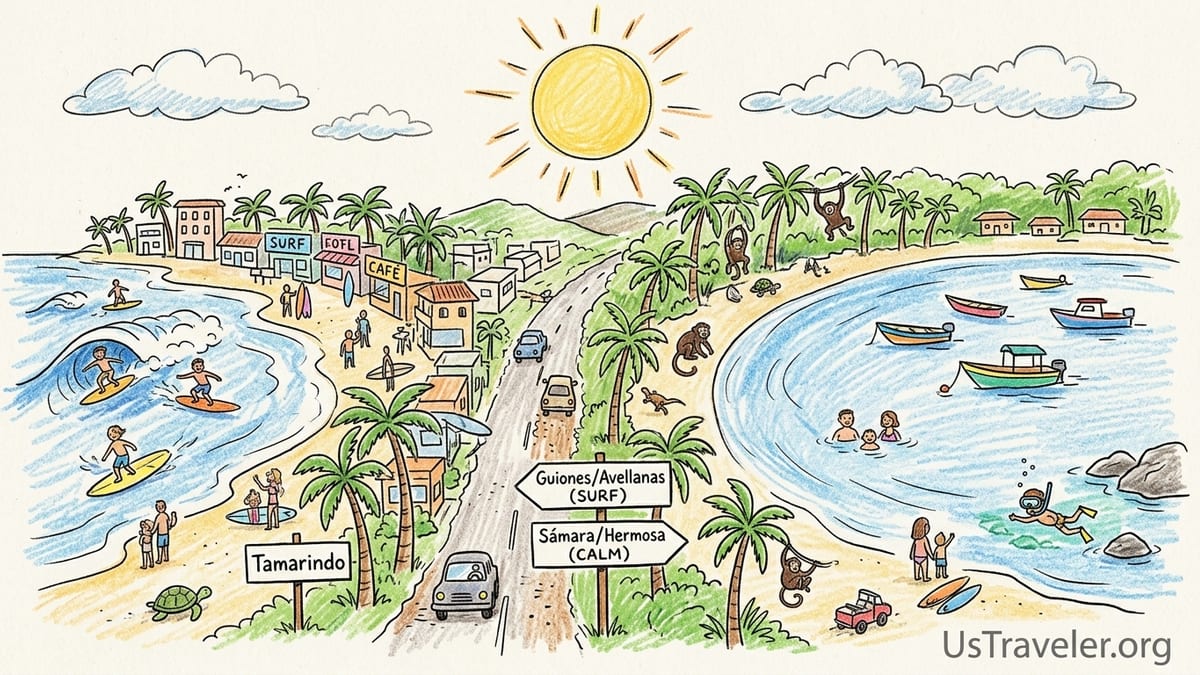
How Guanacaste’s Beaches Really Differ
First-time visitors often assume that any beach in Guanacaste will work for both swimming and surfing. In reality, this stretch of “Gold Coast” is a patchwork of exposed surf beaches like Playa Grande and Guiones, sheltered bays such as Sámara, and hybrid spots like Tamarindo that sit between river mouths and headlands. The result is that two beaches separated by a 20-minute drive can have completely different waves, currents, and town atmospheres.
For example, a February afternoon at Guiones might bring chest-high, long-period swell that keeps intermediate surfers busy for hours, while the same day in Sámara Bay families are floating in knee-deep water between fishing skiffs. On Conchal’s crushed-shell shoreline the sea can be glassy and calm in the morning, perfect for snorkeling from the rocks at either end of the bay, before short wind chop arrives after lunch. Choosing where to stay is largely about deciding which of these daily realities you want outside your front door.
The second big axis of difference is development. Tamarindo, Coco, and Flamingo feel like established resort towns with supermarkets, beach bars, and a range of condos and hotels. Sámara and Nosara/Guiones sit in the “small town with comforts” category, where you can still walk on unpaved streets and hear howler monkeys at dawn. Carrillo, Avellanas, and parts of Hermosa and Panamá remain mostly low-rise and residential, with just enough lodging and dining for travelers who prefer space over scene.
Finally, logistics vary more than many visitors realize. Some beaches, like Tamarindo and Coco, are about 1 hour and 15 minutes on paved road from Liberia airport, which makes them realistic even for a four-night trip. Others, like Guiones and Sámara, require longer drives over winding, partially unpaved roads, especially in the wet season when potholes and occasional washouts slow average speeds. Before you fall in love with photos, it pays to consider how much time you want to spend in a shuttle or rental car.
Calm Bays vs Surf Beaches: Swimming and Wave Levels
If you are picturing long, relaxed swims, you will have a different short list than if you want to surf daily. Guanacaste’s most consistently calm swimming areas on this circuit are Playa Conchal, much of Playa Hermosa (Guanacaste, near Coco), Playa Panamá, and the twin bays of Sámara and neighboring Carrillo. All of these sit inside protected coves or angles of coast that block the full force of Pacific swells most days, so you typically see gentle shore break, especially in the mornings when wind is light.
By contrast, Playa Grande, Tamarindo’s exposed sections, Avellanas, and Guiones are true surf beaches. Here waves are surfable year-round, with more powerful, frequent swells from about May through October. These spots are ideal if you want to take surf lessons or if one person in your group surfs and the others are comfortable wading in shallower water. They are less ideal for long, unstructured swims with small children who cannot yet read the ocean. Official Costa Rican tourism and surf guides often describe Grande and Guiones as “surf destinations first,” which is an accurate way to frame them.
Tamarindo itself straddles the line. Directly in town, sandbars and the shelter of the estuary create softer, rolling waves that surf schools rely on for first lessons, especially at mid to high tide. Walk fifteen minutes north toward Playa Grande or cross the estuary by boat and you quickly meet steeper, faster waves that intermediate surfers seek out. For many mixed groups, this combination is the appeal: one person can paddle out while another takes a walk or a shallow dip close to shore.
The takeaway on water conditions is simple. If your priority is calm water for nervous swimmers, non-swimmers, or elderly relatives, look first at Sámara, Carrillo, Hermosa, Panamá, and Conchal, and treat surf days as excursions. If you want surfing baked into your everyday rhythm, center your search on Tamarindo, Grande, Avellanas, Guiones, or Coco, understanding that swimmers will need to pick their moments and spots.
Sand, Crowds, and Overall Atmosphere
Texture and color of sand change subtly along this coast, and that affects everything from how hot the beach feels at midday to how good it is for long walks. Playa Conchal is the outlier: much of the beach is made from finely crushed shells instead of typical sand, which creates a bright, almost Caribbean look and clear water but can be warmer underfoot in full sun. Tamarindo, Flamingo, Hermosa, Panamá, Sámara, and Carrillo mostly feature light-gold to pale-beige sand, soft enough for barefoot walks and beach soccer games. Guiones and parts of Avellanas and Coco trend toward darker sand in places, especially closer to the tide line.
Crowds correlate strongly with development and road access. Tamarindo is one of Costa Rica’s busiest Pacific beach towns, with a constant mix of foreign visitors, surf-camp groups, and San José residents on long weekends. You are rarely alone on the sand there in high season from December to April, though sunrise and the far north and south ends of the beach are quieter. Coco and Flamingo also see steady traffic, especially when several of the Papagayo-area resorts are full and guests take day trips to their beaches.
Sámara, Guiones, and Avellanas feel notably more relaxed. In Sámara you may share the water with local families, language-school students, and a modest number of foreign visitors, but the bay seldom feels packed outside Easter and New Year. Guiones can look busy at the main surf peaks, particularly in the dry season, yet the beach itself is long enough that a ten-minute walk usually finds space. Avellanas remains low-key, with surfers dispersing between different peaks and day visitors from Tamarindo concentrating near the main access by the estuary.
For travelers who hope for almost-empty beaches, Carrillo is the most reliable option on this list. Its perfect crescent of sand, lined with palms and backed by low development, often has more fishing boats than people in the water. Hermosa and Panamá can offer similar tranquility on weekdays or outside peak holidays, especially at their far ends away from the main public parking areas.
Nightlife, Restaurants, and Town Feel
The strongest nightlife in this region clusters around Tamarindo and, on a smaller scale, Coco. Tamarindo’s main road, running parallel to the beach, hosts a string of bars, casual restaurants, and one or two small clubs that stay open into the early hours during high season. Beachfront venues run sunset happy hours, live music nights, and DJ sets. For a group of friends in their twenties or thirties who want to alternate surf lessons with bar hopping, Tamarindo remains the most practical base, not least because you can walk back to your hotel or rental at the end of the night instead of driving.
Coco’s nightlife is a little more compact and more oriented to a mix of local residents, long-term expats, and visitors. Expect sports bars showing football, karaoke nights, and a handful of beachfront lounges. It is more casual than polished, but if you like to finish a beach day with cold beers and music, both Coco and Tamarindo will feel lively compared to smaller towns down the coast.
Flamingo, Sámara, and Guiones sit at the opposite end of the spectrum. Flamingo has a few polished hotel bars and restaurants, some attached to high-end resorts or condos, but the mood is more sunset cocktail than dance floor. Sámara offers a pleasant evening scene of beachfront bars with plastic chairs in the sand, small live music acts, and places where families can eat dinner while children play near the shore. Nosara and Guiones, despite their surf reputation, are notably mellow at night. The town leans toward early-to-bed yoga and health-food culture rather than late-night parties, with a few exceptions around holiday periods.
Hermosa, Panamá, Avellanas, and Carrillo are quiet at night. You will find hotel restaurants, a few sodas serving local dishes, and maybe a casual beach bar, but little in the way of bar-hopping circuits or clubs. Travelers who prefer to hear waves and insects after 21:00 often choose these towns intentionally, while those looking for nightlife use them as day-trip destinations.
Family Friendliness and Accommodation Options
Families with young children usually care most about three things: safe swimming, walkable distances between lodging and the beach, and access to practical services like grocery stores and medical clinics. On that score, Sámara is one of the strongest all-round choices. Its bay is usually gentle, the town is compact, and there is a mix of small hotels, vacation rentals, language schools, and simple restaurants. You can book a beachfront room with a pool for moderate rates in shoulder seasons and still be within a ten-minute walk of supermarkets and tour desks offering dolphin watching, snorkeling, or horseback rides.
Tamarindo also scores highly for families who are comfortable with a busier setting. There are several large beachfront hotels with pools, kid-friendly menus, and on-site tour offices. Many residential streets behind the beach now host vacation rentals with multiple bedrooms and small private pools, useful for extended families. The trade-off is that you need to manage children around traffic on the main road and keep a closer eye on them in the surf, which has more going on than a closed bay like Sámara or Carrillo.
Conchal, Flamingo, and Hermosa host a mix of mid-range and upscale resorts and condos that suit families seeking a quieter, more polished environment. It is common to see multi-generational groups renting a condo in Flamingo for a week, then driving out for day trips to nearby beaches and adventure parks. Hermosa and Panamá in particular appeal to families and older travelers who want calm water and a chance to snorkel from the beach when visibility and conditions cooperate.
Guiones, Avellanas, and Carrillo work best for families who prioritize space and surf over extensive amenities. In Guiones you can find surf lodges, boutique hotels, and rental houses within walking distance of the beach, but most are low-rise and spread out. Streets are often unpaved, and distances to supermarkets or clinics can be longer. Avellanas and Carrillo have fewer lodging options overall, so prices can be higher for beachfront properties in peak periods and you may need a vehicle for everyday errands.
Road Access, Car Rentals, and Practical Logistics
From Liberia’s Daniel Oduber Quirós International Airport, access is simplest to the northern beaches. Coco, Hermosa, and Panamá sit roughly an hour away on fully paved roads. Many travelers pick up a rental car at the airport in the afternoon and arrive at these beaches in time for sunset. The route to Tamarindo and Flamingo is slightly longer but still largely paved, with only short stretches of uneven or potholed road depending on recent maintenance. Shuttles and shared transfers run frequently on these routes, which makes them realistic bases even if you do not want to drive.
Reaching Guiones, Sámara, Carrillo, and in some seasons Avellanas generally requires more patience. The final stretches to Guiones and Avellanas are often on graded dirt roads that can turn muddy after heavy rain. Sámara and Carrillo are connected by paved highways for most of the trip, but you still pass through winding sections where average speeds are low and overtaking trucks requires care. What looks like a short distance on a map may translate to three to four hours in the car, especially between May and November when rainstorms are frequent.
Because of these differences, travelers on shorter trips of five or six nights often favor the northern beaches, while those on longer itineraries are more willing to invest time to reach Sámara or Guiones. A realistic planning example: a family landing in Liberia at 13:00 in December can often be in Hermosa or Coco with their feet in the sand by 15:00. The same arrival time for a group destined for Guiones might mean reaching their hotel around sunset, assuming daytime traffic and brief stops.
Within each town, you can generally get by without a car in Tamarindo, Sámara, Coco, and Guiones, where much of the lodging, dining, and the beach sit within a walkable area. In more spread-out or low-density places like Hermosa, Panamá, Avellanas, and Carrillo, having at least one rental vehicle per group makes it easier to shop, reach different beach access points, and manage rainy-season downpours without long walks on dark roads.
How the Main Beaches Compare at a Glance
Thinking in terms of “base camps” rather than pretty photographs helps narrow choices. Tamarindo is the region’s all-rounder: beginner-friendly surf close to town, the widest range of hotels and restaurants, the most active nightlife, and straightforward paved access from Liberia. It suits first-time visitors who want to surf, socialize, and have every service at their doorstep, and who are comfortable with crowds, higher prices, and some traffic.
Conchal and Flamingo work best for travelers seeking resort comfort and good swimming within reach of excursions. You might spend three days rotating between the pool and Conchal’s clear water, then take a catamaran cruise from Flamingo or a half-day trip to Tamarindo for surf lessons or shopping. Hermosa and Panamá cater to those who value calm seas and a quieter pace, including many families and couples in their fifties or sixties.
Sámara and Carrillo form a natural pairing for travelers who prioritize tranquil scenery, safe swimming, and a sense of being in a small Costa Rican community rather than a pure resort town. A couple might base in Sámara for a week, walk to cafes and Spanish classes, and visit Carrillo for empty-morning swims and picnics under palm trees. Surf here is secondary, though gentle waves can be suitable for longboard lessons on smaller days.
Guiones, Avellanas, Playa Grande, and, to a more moderate degree, Coco are best understood as surf-centered bases. Guiones is the archetypal surf-and-yoga town: a consistent beach break with a long roster of surf schools, boutique lodges, and health-oriented eateries, but little formal nightlife. Avellanas and Playa Grande offer slightly more rugged versions of that formula, often attracting intermediate surfers who are happy to drive into Tamarindo or Coco occasionally for supplies or a change of scene. These are excellent choices if your daily schedule will revolve around tide charts more than restaurant menus.
The Takeaway
No single Guanacaste beach is “best” for everyone. What matters is how honestly you match your priorities to the character of each town. If you want ease, lessons, and nightlife, Tamarindo or Coco simplify everything from airport transfers to dinner decisions. If you want children splashing in calm bays and early nights on the balcony, Sámara, Carrillo, Hermosa, Panamá, or Conchal are hard to beat. If surfing is the central reason for the trip, Guiones, Avellanas, and Playa Grande deliver more consistent waves and a culture built around them.
A practical approach is to pick one primary base that fits your core needs, then use day trips to taste the others. From Tamarindo you can sample Grande’s punchier surf one day and Avellanas or Conchal another. From Sámara you can explore Carrillo’s nearly empty crescent or drive inland to waterfalls and small ranch towns. Building your itinerary this way avoids constant packing and unpacking while still giving you a feel for the range of Guanacaste’s coastline.
Whatever you choose, keep logistics and season in mind. Dry-season months from December to April usually bring sunnier skies, more consistent surf, and bigger crowds and prices, while the green season from May into November offers lusher hillsides, more afternoon rain, and fewer people on the sand. Booking early for Christmas, New Year, and Easter is wise in all of these destinations. With realistic expectations and one well-chosen base, Guanacaste can feel less like a puzzle of overlapping options and more like exactly the beach holiday you had in mind.
FAQ
Q1. Which Guanacaste beach is best if I want both good swimming and some surfing?
Tamarindo is the most flexible all-round choice, with gentle waves for lessons and swimming near town, and more powerful surf a short walk or boat ride away at Playa Grande.
Q2. Where should a family with small children base for calm water?
Sámara, Carrillo, Hermosa, Panamá, and Conchal generally offer the calmest, most protected water, along with a quieter atmosphere and family-friendly lodging.
Q3. Which beach town has the liveliest nightlife in this part of Costa Rica?
Tamarindo has the most developed nightlife scene, followed by smaller but still social options in Coco. Most other towns along this stretch are comparatively quiet after dark.
Q4. Is Guiones suitable for complete beginner surfers?
Yes, many visitors learn to surf at Guiones with local schools, though the waves are more powerful than in sheltered bays, so lessons and choosing the right tide are important.
Q5. Do I need a rental car to stay at the beach in Guanacaste?
In Tamarindo, Sámara, Coco, and central Guiones you can manage without a car because many services are walkable, but a vehicle is useful in more spread-out places like Avellanas, Carrillo, Hermosa, and Panamá.
Q6. Which beach is best for a quieter, upscale resort stay?
Conchal and Flamingo are strong candidates, with a mix of higher-end resorts and condos, good swimming, and easy access to boat tours and nearby beaches.
Q7. How long is the drive from Liberia airport to these beaches?
Allow around one to one and a half hours for Coco, Hermosa, Panamá, Tamarindo, and Flamingo, and closer to three to four hours for Guiones, Sámara, and Carrillo, depending on road conditions.
Q8. Is Playa Grande a good place to stay with non-surfers?
Playa Grande is very surf focused and relatively quiet at night. Non-surfers who like walks, reading on the beach, and low-key evenings may enjoy it, but it has fewer shops and restaurants than Tamarindo or Sámara.
Q9. Which beach town works best without speaking much Spanish?
Tamarindo, Coco, Flamingo, Sámara, and Guiones all have well-established tourism industries where many people in hotels, restaurants, and surf schools speak English.
Q10. If I only have four or five nights, which base makes the most sense?
For shorter trips, Tamarindo, Coco, Hermosa, Panamá, and Flamingo make the most sense because they are closest to Liberia on paved roads and offer plenty of services without long transfers.