


If you are flying into Liberia International Airport (LIR) and planning a beach stay on Costa Rica’s northwest Pacific coast, you will almost immediately run into the same question everyone now asks: should you base in Papagayo, Tamarindo, Conchal or Flamingo, Playas del Coco, Nosara or Sámara? Current hotel searches frame these towns as direct competitors, yet on the ground they feel very different. Choosing the right one will shape everything from whether you need a rental car to how easily you can walk to dinner or find live music at night.
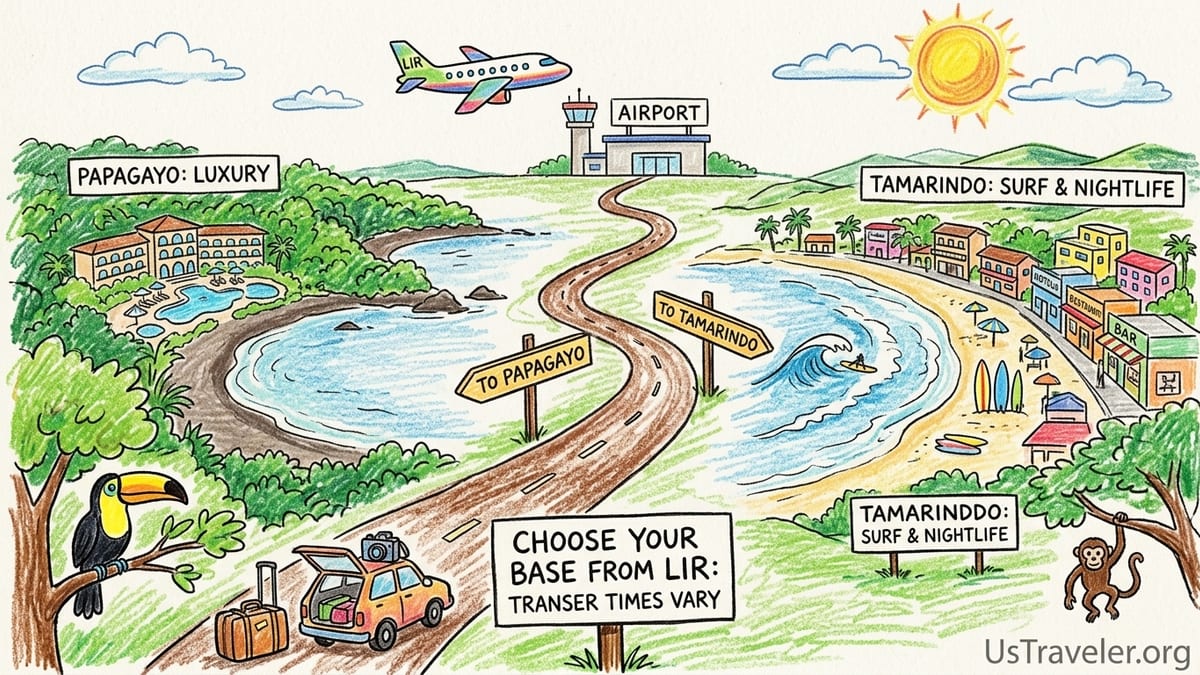
Understanding Guanacaste’s Beach Bases from LIR
Most visitors reach Guanacaste through Liberia International Airport, about 20 minutes inland from the Pacific coast. From LIR, the resort enclave of Papagayo is usually the quickest beach base, with transfers in the 25 to 45 minute range depending on traffic and whether you are staying at a resort like Four Seasons Resort Costa Rica at Peninsula Papagayo, Andaz Costa Rica Resort or Secrets Papagayo. Tamarindo, the region’s liveliest town, is farther south and usually takes around 75 to 90 minutes by road, with the last stretch on smaller coastal highways that can slow down at sunset.
Conchal and Flamingo lie just north of Tamarindo. Driving from LIR to Playa Conchal’s resort complex, anchored by the large all inclusive Westin Reserva Conchal and several condo and villa communities, typically takes about 70 to 90 minutes. Playa Flamingo, with its white curve of sand and marina, is a similar transfer time. Playas del Coco and its neighboring beaches are closer: figure around 35 to 50 minutes from the airport to most Coco hotels and vacation rentals, which is one reason the town has become a favorite for quick four or five night trips.
Nosara and Sámara sit farther down the Nicoya Peninsula and feel like a different, more low key Costa Rica. Depending on the route and season, you should plan on roughly 2.5 to 3.5 hours from LIR to Nosara’s main beach area at Playa Guiones, and a similar 2.5 to 3 hour drive to Sámara. Roads in this part of the peninsula are improving but still include segments that can turn rough in heavy rain, so arrival after dark is not recommended for first time visitors. These longer drives are the trade off for quieter towns and fewer large scale resorts.
Transfer times affect not only arrival day but also how practical it is to explore beyond your base. If you plan to combine a beach stay with Arenal volcano or Monteverde cloud forest, for example, it can make sense to start or finish in Papagayo or Coco, where it is easier to reach the airport at the end of your trip without a long, pre flight drive.
Papagayo: Secluded Luxury and Resort Living
Peninsula Papagayo is Guanacaste’s highest concentration of five star resorts, intentionally developed as a low density, master planned luxury enclave. Many travelers choose it for a few days of polished downtime at the beginning or end of a wider Costa Rica itinerary. The Four Seasons, Andaz and other luxury properties occupy forested headlands and calm bays, with multiple pools, beach clubs, kids’ programs, golf and curated adventure excursions built into the resort ecosystem.
Because Papagayo is so self contained, most guests do not need a rental car. Transfers from LIR are often arranged by the hotels or private drivers, and once checked in you mainly move by resort shuttle or boat between beaches and amenities. Dinner typically means on site restaurants, such as the seafood focused venues at the Four Seasons or the open air Latin and Asian inspired dining rooms at Andaz. Prices tend to be higher than in the surrounding towns, reflecting both the luxury positioning and the relative isolation.
The beaches on the peninsula front the protected Gulf of Papagayo, with sheltered coves and darker volcanic sand rather than the long, surf friendly sandbars of Tamarindo or Nosara. The calm water suits paddleboarding, beginner friendly kayaking and bayside snorkeling. Nightlife in the usual sense is limited. Even at peak season you are more likely to end the night with a cocktail overlooking the bay or a live acoustic set at a lobby bar than bar hop. For many travelers, particularly families and couples who want a low stress base with everything on site, that is a feature, not a bug.
The main drawback of Papagayo is that you are not really in a town. If you imagine wandering out for casual tacos, hitting a different coffee shop each morning or browsing surf boutiques, you will not find that here. It works best as a secluded luxury bubble and airport convenient bookend to days spent inland in the rainforest or in a more walkable beach town elsewhere on the coast.
Tamarindo: Walkable Beach Town Energy and Nightlife
Tamarindo is Guanacaste’s most established surf town and the main competitor to Papagayo for first time visitors deciding where to stay. The core of Tamarindo is a compact grid of streets backing a long crescent beach, with dozens of small hotels, boutique inns, condo complexes and hostels arranged so that many guests can walk everywhere. You step out of hotels like Tamarindo Diria, Jardin del Eden or La Palapa and reach the sand in a few minutes. Budget friendly guesthouses sit slightly up the hill but still close enough that dinner out does not require a car.
If restaurant choice and nightlife are priorities, Tamarindo is the strongest base on this list. The main strip mixes Costa Rican sodas serving casados and gallo pinto with international spots offering wood fired pizza, sushi, vegan bowls and higher end tasting menus. Beachfront bars pour happy hour cocktails at sunset, and there are venues that run late with DJ sets or live bands, particularly in high season. Younger travelers and digital nomads gravitate here because they can surf in the morning, work from a cafe like Nordico in the afternoon and socialize at night without worrying about driving.
The beach itself offers consistent waves suitable for beginners and intermediates, with multiple surf schools renting boards and giving lessons directly on the sand. Families appreciate that the central area can be lively yet still manageable, especially if they choose lodgings slightly removed from the busiest corners. The trade off is that Tamarindo is visibly more developed than the other bases here, with more traffic, more vendors and more construction, particularly in the surrounding hills where new condos and villas continue to appear.
A rental car in Tamarindo is optional. Many visitors rely on airport shuttles and then book tours to nearby attractions such as Playa Avellanas, Playa Grande or Rio Celeste, with local operators providing transport. If you do rent a car, parking around town can be tight and usually involves small paid lots or informal guarded spaces near the beach. Tamarindo fits travelers who value walkability, dining variety and social energy over seclusion and who do not mind sharing the sand.
Conchal and Flamingo: Upscale Beaches without the Late Nights
Just north of Tamarindo, Playa Conchal and Playa Flamingo share some of the same coastline but deliver a more upscale, pared back feel. Playa Conchal is best known for its large, gated resort development set behind a beach of crushed shells and pale sand. The flagship all inclusive resort, operated under a major international brand, sits alongside vacation condos and villas clustered around a golf course, pools and manicured gardens. Guests here tend to stay on property, taking advantage of multiple restaurants, kids’ clubs and organized activities.
Because the resort area is somewhat removed from any main town, a rental car or pre arranged transfers are useful if you want to explore beyond the gates. Many visitors, however, are content with day trips booked through in house tour desks, such as catamaran cruises that sail along the coastline toward Flamingo, or zipline, ATV and wildlife boat tours in the interior. Nightlife is fairly low key and tends to be concentrated in hotel bars or at a handful of beach restaurants where you watch the sunset with fresh seafood and a drink rather than stay out until the early hours.
Playa Flamingo, by contrast, is a smaller, scenic bay fringed with mid sized hotels, condo buildings and villa rentals, plus a modern marina that has spurred more upscale dining in recent years. It shares the same white sand and turquoise water look that you see in many tourism brochures, and it is popular with families and couples who want a refined but not overly formal setting. You will find a mix of sit down restaurants and a few casual bars, but overall Flamingo goes quiet earlier than Tamarindo.
Both Conchal and Flamingo are good fits if you want beaches that photograph like a postcard, access to quality accommodations and tours, yet prefer to avoid the denser nightlife and traffic of Tamarindo. Many travelers split time, starting in Flamingo or Conchal for a laid back resort stay and then heading to a more active town for a few nights, or vice versa. Drive times between these beaches and Tamarindo are usually 30 to 40 minutes, so day visits in either direction are easy with a car or taxi.
Playas del Coco: Convenience, Services and Easy Logistics
Playas del Coco, usually shortened to Coco, is one of the main communities on the Gulf of Papagayo and sits closer to everyday Costa Rican life than either Papagayo’s resorts or Tamarindo’s internationalized strip. From LIR, you can often be checked into a hotel or vacation rental here within 40 minutes. That proximity, combined with the town’s full set of services, makes it attractive to travelers who value convenience and do not require luxury trimmings.
In Coco you will find medium sized hotels, simple cabinas, condo complexes aimed at snowbirds and families, and an increasing number of Airbnb style apartments. The accommodation stock leans midrange rather than ultra high end, but there are comfortable options with pools within a short walk of the beach. The town center runs along a main street parallel to the sand and includes supermarkets, pharmacies, banks, tour operators, casual restaurants and a few late night bars and small casinos.
For travelers who plan to rent a car, Coco works well as a practical base for exploring nearby beaches like Playa Hermosa, Playa Panama and Ocotal, or for day trips into the interior for adventure activities. If you prefer not to drive, you can still arrange boat trips for diving, fishing or sunset cruising directly from the beach or marina style pick up points, and many inland tours include transport. Unlike Papagayo, you can walk to most dinners, and unlike Tamarindo, the traffic is usually lighter and the nightlife more modest.
One reason Coco appears so often in accommodation searches is price. While rates spike over Christmas, New Year and Easter, in much of the year it is possible to find basic but decent rooms here at a lower cost than in Papagayo’s resorts or the trendiest corners of Nosara. That can free up budget for activities, private transfers or a second destination elsewhere in Costa Rica. Coco makes the most sense if you want an efficient, well serviced home base close to the airport rather than a curated luxury escape or a boutique surf town.
Nosara: Surf, Wellness and a Deliberately Slow Pace
Nosara has evolved from a remote fishing village to one of Costa Rica’s most talked about surf and wellness destinations. Centered on Playa Guiones and Playa Pelada on the Nicoya Peninsula, it draws travelers who are as interested in yoga classes, farm to table restaurants and long walks on the sand as they are in nightlife. Local building rules keep construction set back from the beachfront and limit high rises, which preserves a feeling of being in the forest even as boutique hotels and villa compounds have multiplied.
The surf at Playa Guiones is a major part of the town’s appeal. The long, sandy beach offers consistent, year round waves that work for beginners and more advanced surfers, and multiple schools operate directly on the beach road. It is easy to structure a stay around morning surf sessions, late breakfast at a cafe serving smoothie bowls and fresh roasted coffee, midday rest or yoga, and sunset on the sand. At night, restaurants and a few bars fill up, but the atmosphere leans more toward relaxed dinners and occasional live music than packed clubs.
Because Nosara’s lodging stock is dominated by small hotels, surf lodges, wellness retreats and private homes, options span from simple cabinas reachable by foot to design forward boutique hotels with jungle pools and on site yoga shalas. Many properties are tucked along unpaved roads, surrounded by trees and howler monkeys. For families and groups, houses with private pools a short walk or drive from the beach are common. Prices in high season reflect Nosara’s popularity; boutique rooms can be similar in cost to big brand resorts, though with a different, more intimate feel.
Getting around Nosara is where logistics matter. Public transport is limited, taxis can be sporadic and roads are often dusty or muddy. Travelers staying in the central Guiones area can move largely on foot, but if you want to explore outlying beaches or stay up in the hills, having a rental car or at least a golf cart style vehicle is useful. For first timers arriving at LIR, many hotels can arrange private transfers for the long drive, after which some visitors simply stay put and settle into the slower rhythm that defines the town.
Sámara: Laid Back Beach Town for Quieter Trips
Farther down the same coastline, Sámara offers a quieter, more traditional beach town option that still has enough infrastructure to make travel easy. The central beach is a wide, gently curving bay with calm water compared with the heavier surf breaks farther north. Palms line the sand, and low rise hotels, small inns and simple vacation rentals sit just behind them. On most days you will see families playing in the shallows, local kids practicing soccer at sunset and travelers paddling kayaks toward a small offshore island when conditions permit.
The town itself is compact, with a main street leading to the beach and side roads holding supermarkets, bakeries, surf schools and casual eateries. You can walk barefoot from many hotels directly to the sand, and it is easy to go from breakfast at a beachfront cafe to a midmorning swim without ever getting in a car. At night, a handful of bars and restaurants stay open late enough for a relaxed drink or two, but Sámara does not try to compete with Tamarindo’s clubbish bars or Coco’s small casinos.
Accommodation in Sámara runs from basic cabinas and hostels to midrange boutique hotels with pools and ocean views. True large scale luxury resorts are absent, which is part of the appeal for travelers who want something that feels more local and less master planned. Rates here can be friendlier than in Nosara or Conchal, especially outside peak holiday weeks. Many long term visitors and families choose simple apartments with kitchens for weeks at a time, using Sámara as a base to explore nearby beaches such as Carrillo, which is often cited by repeat visitors as one of the prettiest coves in the region.
Reaching Sámara from Liberia takes commitment; you should allow most of an afternoon by road, especially in rainy season when delays are possible. For that reason, Sámara is often better as a longer stay rather than a quick night or two. Once you arrive, however, a car is optional if you are content to stay near town and join organized tours for inland adventures. Sámara suits travelers who picture long, low key beach days, moderate restaurant choice and a less polished, more small town feel.
Do You Need a Rental Car in Guanacaste?
Whether to rent a car is one of the most practical decisions that separates these bases. In Papagayo’s closed resort environment, a rental car is rarely necessary. Transfers from LIR are straightforward, and resorts run internal shuttles and organize excursions with door to door transport. The same is largely true if you choose an all inclusive or full service resort in Conchal. For short trips focused on pool time and a few guided outings, relying on transfers can simplify your stay and avoid worries about unfamiliar driving conditions.
In Tamarindo and Coco, a rental car is optional but useful if you like day tripping. Many visitors manage fine with airport shuttles, local taxis and tour pickups, especially if they plan to stay within town and its immediate surroundings. However, having your own wheels makes it much easier to explore less busy beaches at your own pace, find quieter sunset spots away from the main strips or visit inland towns and waterfalls on your own schedule. Parking can be tight in central Tamarindo but is generally easier in Coco and the smaller beaches nearby.
Nosara and Sámara sit at the other end of the spectrum. Because both are reached via longer drives and have more dispersed lodging, a rental car or at least a robust transfer plan is more important. Many wellness retreats and surf camps in Nosara specifically advise guests on whether they truly need a vehicle based on location. In central Guiones, you can often walk to the beach, yoga studios and restaurants, but if your hotel is up a hill or in neighboring areas, even basic errands become challenging without transport. Sámara’s town core is walkable, yet a car opens up nearby coves and countryside that are less accessible by taxi.
If you are nervous about driving in another country, a good compromise is to book a private transfer from LIR to your first base, then arrange a rental car for delivery to your hotel the following day once you are rested and have daylight on your side. Several agencies serving Tamarindo, Coco and Nosara offer this service. Regardless of where you base, keep in mind that driving after dark on rural roads is slower than the map suggests, and plan arrival in Nosara or Sámara for early afternoon when possible.
Matching Each Base to Your Travel Style
Thinking of Papagayo, Tamarindo, Conchal or Flamingo, Coco, Nosara and Sámara as competing options is useful only up to a point. In practice, each base serves a different traveler profile. Papagayo squares best with visitors who want a short, seamless transfer from LIR, a resort environment with polished service and built in activities, and who do not mind limited local nightlife or high on site prices. It is a frequent choice for milestone trips, family vacations with younger children and travelers using loyalty points at luxury brands.
Tamarindo is the closest thing Guanacaste has to a full service, walkable beach town with broad appeal. Couples, groups of friends and solo travelers who prize variety in restaurants and bars, easy surf access and social energy will likely feel most at home here. It also works as a base for those who want to combine remote days with nights that still offer a buzz. The main downsides are crowds, particularly in December through March, and higher noise levels compared with quieter beaches.
Conchal and Flamingo deliver a more controlled, upscale beach experience. They suit travelers who want quality sand and water, availability of tours and some dining choice, yet who would rather wind down after dinner than seek out bars. These areas are strong options for families with school age kids, multi generational groups and couples who want nicer hotels without the intensity of Tamarindo or the seclusion of Papagayo.
Coco aligns with budget conscious travelers and those who care more about logistics and services than curation. It is where you base if you want to be out on boats, diving, fishing or exploring rather than spending long hours at an infinity pool. Nosara and Sámara, meanwhile, attract visitors drawn to a slower, more intentional rhythm. Nosara skews to surf and wellness travelers comfortable paying boutique prices for a dirt road town and who appreciate design forward small hotels and plant based cafes. Sámara draws those who want a family friendly, low key beach village with enough infrastructure to be easy but not so much that it loses its small town feel.
FAQ
Q1. Which Guanacaste beach town is closest to Liberia Airport (LIR)?
Papagayo’s main resorts and Playas del Coco are the closest, usually 25 to 45 minutes from LIR by car, depending on traffic and exact hotel location.
Q2. If I want nightlife and a walkable town, where should I stay?
Tamarindo is the best choice for walkability and nightlife, with many bars, restaurants and surf shops clustered in a compact area behind the main beach.
Q3. Where should I stay for the most upscale, secluded experience?
Peninsula Papagayo offers the most secluded luxury, with high end resorts, golf and beach clubs in a master planned setting that feels removed from regular town life.
Q4. Is a rental car necessary in Nosara and Sámara?
It is highly recommended. Central areas are walkable, but a car makes it much easier to reach your lodging, explore nearby beaches and handle basic errands.
Q5. Which base is best for an all inclusive beach vacation?
Playa Conchal is a strong all inclusive option, with a large resort complex, multiple restaurants and many activities bundled into one beachside property.
Q6. Where can I find a good balance of price and convenience near LIR?
Playas del Coco offers midrange hotels, full town services and quick airport access, giving a practical base without Papagayo’s prices or Tamarindo’s crowds.
Q7. What is the best area for beginner surfers?
Tamarindo and Nosara’s Playa Guiones both have consistent, forgiving waves and plenty of surf schools geared toward first timers and progressing beginners.
Q8. Which town is best for a quiet, family friendly beach stay?
Sámara is a strong choice for families, with a calm bay, small town feel, modest nightlife and a mix of simple and midrange accommodations close to the sand.
Q9. Can I combine more than one Guanacaste base in a week?
Yes. A common approach is to pair Papagayo or Conchal with Tamarindo, Nosara or Sámara, spending three or four nights in each to sample different vibes.
Q10. When is driving between these towns most challenging?
Driving is most challenging after dark and in heavy rain, especially on the Nicoya Peninsula roads to Nosara and Sámara, so plan longer transfers for daylight hours.