


Guanacaste is where Costa Rica’s volcano country meets the Pacific Ocean, and it might be the easiest place in the country to combine hot springs, ziplining, waterfalls and sailing in one trip. The challenge is choosing which tours are worth a full day in the van and which are better as relaxed half-day outings. This guide compares the region’s major bookable experiences and breaks down pickup zones, drive times and entrance fees so you can match the right Guanacaste tour to your beach base.
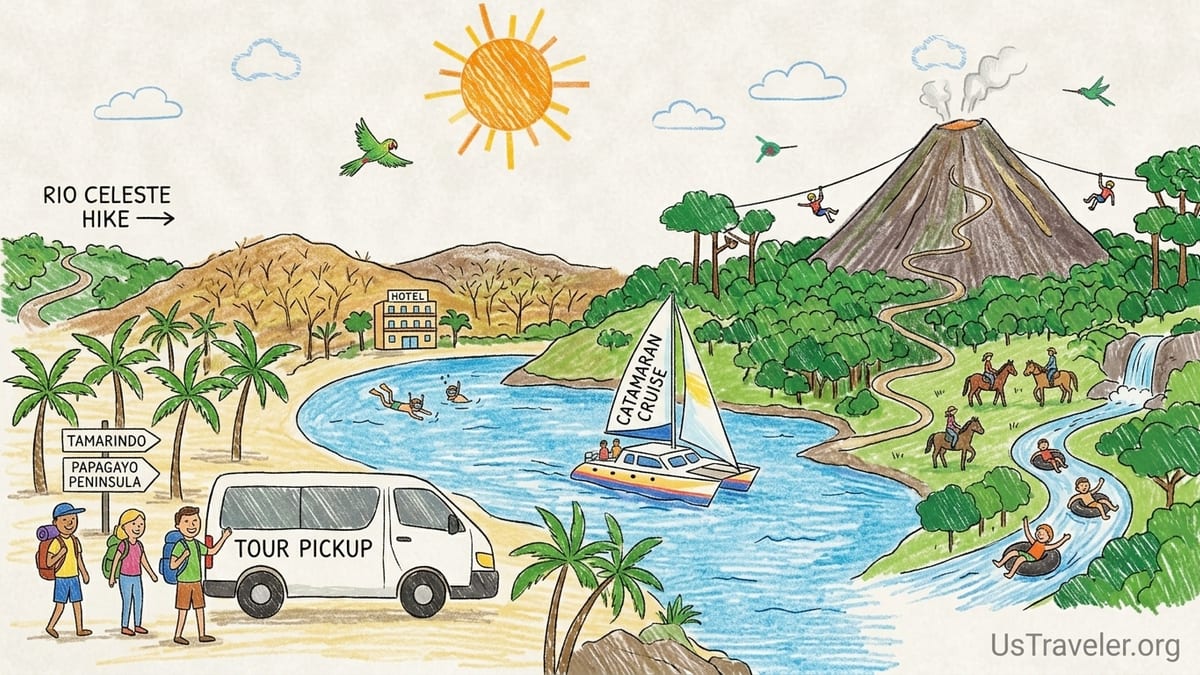
How Guanacaste Tours Work: Pickup Zones, Timing and Pricing
Most Guanacaste excursions are sold as day trips with hotel pickup from three main coastal hubs: Tamarindo and nearby Langosta and Playa Grande, the Papagayo Peninsula and its surrounding beaches like Hermosa and Panama, and the Flamingo and Potrero area that also covers Brasilito and Conchal. When you see a tour described as a Guanacaste combo or adventure day, it usually means shared transportation from one of these zones, bilingual guide, lunch and activity fees bundled into a single price.
From Tamarindo and Flamingo, the volcano and rainforest tours typically mean 75 to 120 minutes of driving each way, while Papagayo guests are slightly closer to the mountains and some boat docks. For example, a typical Rincon de la Vieja adventure package from Tamarindo or Flamingo lists a pickup window around 7:00 to 7:30 a.m. and a drop-off between 4:30 and 6:00 p.m., depending on extra stops and traffic. A Rio Celeste excursion is even longer, advertised as roughly three hours each way from Tamarindo or Papagayo, turning it into a 10 to 12 hour day.
Group tours to Rincon de la Vieja adventure parks usually start around the low 100s in US dollars per person from the beaches, while more complex itineraries like Rio Celeste hikes combined with wildlife farms and waterfalls increase the price into the mid 100s. Pacific catamaran cruises often fall in a similar range, especially for afternoon sail and snorkel trips that include an open bar and hot meal. Private options, whether a dedicated driver-guide inland or a chartered catamaran, typically cost several times more but can be economical for families or small groups who fill most of the seats.
One practical detail that surprises many visitors is that some national parks and waterfalls in Guanacaste require tickets to be purchased online in advance, and some access roads or private attractions charge separate tolls or entrance fees. If you book with an established operator out of Tamarindo, Papagayo or Flamingo, these costs are usually rolled into the tour price, but do confirm what is included, especially if you see low headline rates that exclude national park tickets or hot springs access.
Rincon de la Vieja: Volcano Trails, Hot Springs and Adventure Combos
Rincon de la Vieja National Park is the workhorse of Guanacaste tours. The volcano lies about 25 kilometers northeast of Liberia by road and is reached from the beaches by paved highway followed by a private access road. Most visitors head for the Las Pailas sector, where a loop trail winds through dry forest and open clearings past bubbling mud pots, steam vents and small fumaroles, giving a close look at the volcano’s geothermal activity on a manageable half-day hike. Park authorities have periodically restricted access to the summit due to recent minor eruptions, so travelers typically focus on lower trails and waterfalls instead of crater viewpoints.
In practice, many travelers never notice the boundary between the national park and nearby ranches and lodges that have built full adventure parks at the base of the volcano. Places around the Las Pailas entrance sell day passes that bundle together canopy zipline courses, short horseback rides, canyoning or rappelling, river tubing on the Rio Negro, and access to hot springs with volcanic mud baths. A classic example is a full Rincon combo from Tamarindo or Flamingo that includes hotel pickup, the Las Pailas geothermal loop, a buffet lunch, a two hour river tubing run and a soak in rustic riverside hot springs before the late afternoon ride back to the coast.
These combo days justify the long inland drive because you combine several headline activities in a single outing. A typical shared tour will leave coastal hotels around 7:00 a.m., reach the volcano area by about 9:00 a.m., and then rotate through hiking, tubing, horseback riding and hot springs until roughly 3:00 p.m. before returning to the beach. Travelers based on the Papagayo Peninsula are a little closer and can sometimes fit this package into a slightly shorter day, but the pattern is the same: one long inland excursion that checks multiple boxes for adventure seekers.
Entrance fees around Rincon can be confusing because the government run national park has its own ticketing system, while private ranches charge separate rates for their adventure parks and hot springs. Many tour operators bundle all these costs into one price for simplicity. If you are booking directly with individual providers or driving yourself, budget for both the per-person park entry and parking or road tolls, and then additional per-activity fees for waterfalls, tubing or hot springs managed by nearby lodges.
Ziplining, Waterfalls, Tubing and Horseback Riding: Choosing the Right Combo
Zipline tours around Rincon de la Vieja and along the coast are some of the most popular bookable experiences in Guanacaste. Inland canopy courses near the volcano often include hanging bridges and canyon ziplines that run across river gorges far above the forest floor, while coastal options near Tamarindo and Papagayo tend to offer shorter drives but less dramatic scenery. A beach based zipline from Tamarindo or Flamingo might involve a 20 to 40 minute transfer into the hills followed by 90 minutes on the lines, so it functions well as a half-day activity or in combination with an afternoon surf lesson or sunset cruise.
Waterfall access around Rincon can range from gentle strolls to more challenging hikes. Within park boundaries, waterfall trails such as those leading to features like La Cangreja or Escondida are several kilometers long and involve elevation gain, so they usually make sense only if you have an entire day to dedicate to the national park itself. On the private ranch side, popular spots such as the canyon waterfall near the Las Pailas gate are designed to be experienced in under an hour and are often paired with horseback rides from the stables and hot springs visits, creating easy to book circuit style days from the coast.
River tubing on the Rio Negro or similar rivers at the foot of Rincon has become a signature Guanacaste adventure. Outfitters provide helmets, life jackets and sturdy inflatable tubes and guide small groups down a stretch of Class II and III rapids that are generally suitable for active families, especially during the dry season when water levels stabilize. Because it requires the same inland access road as ziplining and hot springs, tubing rarely justifies its own separate tour from the coast. Most travelers experience it as one component of a combined adventure pass that may also include horseback riding, a canyon climb or a short zipline circuit.
Horseback riding is widely available across Guanacaste, from one hour sunset rides on the beach out of Flamingo or Conchal to half-day ranch experiences at the base of Rincon. If your heart is set on galloping along the shoreline, book a coastal ride from Tamarindo or Conchal and keep your volcano day for other activities. If you want to experience traditional Guanacaste cowboy culture, then a Rincon based ride through pasture and forest toward a waterfall or hot spring is a better fit and makes sense as part of a full day inland trip, particularly for guests staying in Papagayo who have slightly shorter transfer times.
Rio Celeste Tours: When the Long Drive Is Worth It
Rio Celeste, the sky blue river and waterfall inside Tenorio Volcano National Park, has become one of the most sought after day trips from Guanacaste. The drive from Tamarindo to the park trailhead is roughly three hours each way under typical conditions, and similar from the Papagayo area, so operators selling Rio Celeste tours from the coast design full day itineraries that justify six hours of road time. These often run about 12 hours door to door, with early pickups around 6:00 a.m. and evening drop-offs after sunset.
A standard Rio Celeste excursion from Tamarindo might include a mid-morning guided hike of two to three hours on the park trail to the main waterfall viewpoint and the section where the river changes from clear to bright blue. Because swimming is not allowed inside the national park, most tours add a separate stop at a nearby river access, a small waterfall or a countryside restaurant with a natural pool where guests can cool off. Some pair the hike with a visit to a small wildlife rescue or organic farm that offers the chance to see sloths and frogs up close, along with a traditional casado lunch and demonstrations of coffee, chocolate or sugarcane processing.
From Papagayo, Rio Celeste packages follow a similar pattern but may use slightly different roads and departure times. A private tour with a dedicated driver-guide from a Papagayo resort often appeals to couples or families who want to move at their own pace and avoid the crowded group buses. For these private trips, the cost is significantly higher per person at low occupancy but becomes more reasonable for groups of four to six. The big tradeoff is energy: on a shorter stay of four or five nights in Guanacaste, many travelers conclude that one full day in the mountains at Rincon de la Vieja, combined with a separate catamaran cruise on the Pacific, offers a better balance than committing a second inland day to Rio Celeste.
Because Tenorio Volcano National Park has daily visitor limits and increasingly popular online ticketing, Rio Celeste tours are best booked in advance during the high season from December through April and again around mid year holiday peaks. The park trail can be muddy year round, and heavy rain can dull the river’s famous electric blue color, so flexible travelers often try to schedule this excursion for a day with a reasonable weather forecast, even if that means swapping it with a catamaran trip or a lighter activity later in the week.
Catamaran Cruises and Snorkeling off Tamarindo, Flamingo and Papagayo
While the volcano tours dominate inland, catamaran cruises are the signature coastal experience in Guanacaste. Both Tamarindo and Flamingo host a fleet of sailing and power catamarans that operate shared morning snorkel cruises and afternoon sunset trips, with hotel pickups from nearby resorts and shuttle connections for guests staying in Papagayo or more remote beaches. It is common for Tamarindo based operators to pick up travelers from Langosta, Playa Grande and sometimes Conchal, while Flamingo boats regularly receive guests from Potrero, Brasilito and surrounding hills.
A typical shared afternoon catamaran from Tamarindo or Flamingo departs the beach or marina around 1:00 to 2:00 p.m., motors or sails to a protected bay or cove for snorkeling and beach time, serves a hot late lunch on board and then returns at sunset. The package usually includes snorkeling gear and guide, open bar with local beer, rum and cocktails, soft drinks and a simple menu of rice dishes, salads and grilled chicken or fish. Morning departures are more focused on snorkeling with brighter light and calmer seas and often end by early afternoon, freeing the evening for dinner on shore.
From the Papagayo Peninsula, some resorts have direct access to small marinas where catamarans can pick up guests at the hotel pier, while others use short van transfers to a central dock. Private charters are particularly popular here for multigenerational families or wedding groups staying at large resorts that want a boat entirely to themselves for half a day. These private trips often add customized touches such as upgraded menus, birthday cakes or stops at specific beaches, and operators can sometimes offer flexible start times to match guest schedules and avoid the hottest midday sun.
Compared with inland tours, catamaran cruises have the advantage of minimal driving time from most coastal hotels and simple pricing that rarely involves additional entrance fees or complicated ticketing. For travelers who want adventure without a long van ride, a single day that pairs a morning zipline near Tamarindo or Papagayo with an afternoon catamaran, or a leisurely catamaran followed by an evening in town, often delivers a satisfying mix of activity and relaxation. Many visitors end up booking a volcano adventure one day and a catamaran the next, using the sailing day as a lower effort counterbalance to their time on the mountain.
Group Tours vs Private Tours: What You Get for the Price
Choosing between a shared group tour and a private tour in Guanacaste comes down to priorities around cost, flexibility and comfort. Group tours are the default for most visitors and rely on minibuses that collect guests from multiple hotels within a pickup zone before heading inland or to the dock. They are usually the most economical option per person and offer the chance to meet fellow travelers, but they operate on fixed timetables and can involve relatively early starts and a couple of extra hotel stops before and after your own pickup.
Private tours, whether a dedicated van and driver-guide to Rincon de la Vieja or a chartered catamaran, give you control over departure times, pacing and sometimes activity selection. A family of five staying in Tamarindo might find that upgrading from a shared Rincon combo to a private version allows them to start at 8:30 a.m. instead of 7:00 a.m., leave the hot springs early if younger children are tired and still be back in town in time for dinner. For couples, the cost jump is more significant, but some volcano and Rio Celeste operators offer semi-private small group departures that cap numbers around eight to ten guests for a middle ground between fully shared and fully private.
Another key distinction is guiding style. On larger group buses, you might share one bilingual guide among 15 to 20 people, especially on popular Rincon adventure days or Rio Celeste hikes. On a private tour, the guide can customize explanations, adjust the pace to your fitness level and spend more time on wildlife spotting or photography. The same applies on catamarans: shared afternoon cruises off Tamarindo or Flamingo can feel lively and social, while private morning sails from Papagayo tend to be quieter and tailored to families with children or older travelers.
When comparing prices online, pay attention to what is included and what is not. Some lower priced inland tours list transportation and guiding but exclude national park entrance, tubing or hot springs, which you pay for on arrival. Others include everything from door to door. Similarly, private catamaran charters sometimes quote boat-only prices with fuel and crew, while food and drink packages are optional add-ons. Clarifying these details before you pay a deposit will prevent surprises and allow a fair comparison between shared group and private options.
When a Full-Day Tour Makes Sense and When to Stay Closer
Not every activity in Guanacaste needs to be a full day away from the beach. In general, Rincon de la Vieja adventure combos, Rio Celeste hikes, and long wildlife oriented river safaris justify early starts and late returns because the attractions are at least 90 minutes inland and often involve multiple segments. A Rincon day that includes the Las Pailas loop, a hearty lunch, two hours of river tubing and a soak in volcanic hot springs is arguably one of the most efficient uses of your time, packing several classic Costa Rica experiences into a single excursion from Tamarindo, Papagayo or Flamingo.
By contrast, stand-alone ziplines, short horseback rides and beginner surfing lessons can be comfortably enjoyed on half-day schedules close to most coastal hotels. If you are staying in Tamarindo or Playa Grande, surf schools line the beach and can get you on a board for a morning or sunset session without any van transfers. Coastal horseback tours from Conchal, Flamingo or Papagayo often begin right from the sand or a nearby stable. For these experiences, you rarely need to commit an entire day, and it is usually better to leave a long inland tour for another date.
Catamaran cruises occupy a middle ground. Morning or sunset trips typically last four to five hours dock to dock and can feel like a full event even though there is little overland travel involved. If your group wants one inland day and one boat day during a short stay, a common pattern is to start with the volcano trip when everyone has the most energy, then follow with a later wake-up and a relaxing sail the next afternoon. Travelers with a full week or more on the coast often add a separate half-day activity, such as a mangrove boat tour to see crocodiles and monkeys, on one of the remaining days.
Ultimately, the best use of your time and budget comes from clustering activities geographically. From Tamarindo or Flamingo, group together inland adventures like Rincon, Rio Celeste and wildlife river tours so you minimize repeated long drives. From Papagayo, take advantage of your relative proximity to both the volcano region and marinas by alternating mountain and water days. In every case, reading the small print on pickup windows, estimated drive times and what is included in the advertised price will help you choose tours that are genuinely enjoyable rather than exhausting.
The Takeaway
Guanacaste’s strength as a destination lies in its variety. Within a two to three hour radius of Tamarindo, Papagayo and Flamingo you can hike around an active volcano, float down a jungle river on an inner tube, ride horses to waterfalls, soak in hot springs, chase the turquoise waters of Rio Celeste and sail along a coastline framed by dry forest hills. The key is to prioritize the full-day inland trips that appeal most to you and then fill the rest of your days with lighter, closer to home experiences.
If your time is short, a practical strategy is to choose one major inland day, most often Rincon de la Vieja, and one catamaran cruise, then add a local zipline or surf lesson if energy and budget allow. Travelers who are passionate about hiking or photography might add a second inland excursion to Rio Celeste, while those traveling with young children or older relatives may prefer to keep driving hours lower and lean more heavily on coastal activities. Either way, understanding how pickup zones, drive times, entrance fees and group versus private options work across Guanacaste will help you get the most from one of Costa Rica’s most adventure rich regions.
FAQ
Q1. How long is the drive to Rincon de la Vieja from Tamarindo, Papagayo and Flamingo?
From Tamarindo and Flamingo, most tours quote about 1.5 to 2 hours each way under normal traffic. From the Papagayo area, the transfer is usually a little shorter, often around 1.25 to 1.75 hours, depending on the exact hotel and road conditions.
Q2. Is Rio Celeste really worth a full-day tour from the Guanacaste beaches?
For travelers who love hiking, scenic rivers and photography, Rio Celeste is often a highlight and justifies the roughly three hour drive each way. If you have a short stay or prefer lighter days, you might prioritize Rincon de la Vieja and a catamaran cruise instead, as these combine more activities with less total driving.
Q3. Do I need to book Rincon de la Vieja tours in advance?
During the dry season and holiday periods, it is wise to secure Rincon adventure packages or national park entries several days ahead, especially if you want specific activities like river tubing and hot springs. Outside peak dates, same week bookings are often available, but last minute travelers may have fewer choices of pickup times or may need to join larger groups.
Q4. Are entrance fees included in most Guanacaste tours?
Many reputable operators bundle national park tickets, private access fees, tubing or zipline passes and hot springs entry into an all-inclusive price, particularly on full-day adventure combos. However, some low priced tours exclude these charges, so always read inclusions carefully and ask if park or hot springs fees are extra before booking.
Q5. What is the best base for tours, Tamarindo, Papagayo or Flamingo?
All three hubs work well, but Papagayo is marginally closer to the volcano region and some marinas, while Tamarindo and Flamingo have livelier town atmospheres and more restaurants and surf schools. If you plan to do multiple catamaran trips, staying near Tamarindo or Flamingo is convenient, whereas Papagayo can offer slightly shorter drives to Rincon and other inland adventures.
Q6. Are zipline tours in Guanacaste suitable for children?
Most canopy tour operators around Rincon and near the coast accept children above a certain age or weight, often around 6 to 8 years old or a minimum weight specified in their safety guidelines. Family oriented courses use tandem harnesses and shorter lines, while more extreme canyon ziplines and rappels may have stricter age or weight limits, so it is important to check details before reserving.
Q7. Can I visit hot springs without doing a full adventure combo?
Yes, several lodges and ranches near Rincon de la Vieja sell standalone hot springs passes that allow access to pools and volcanic mud baths without tubing or ziplines. From Tamarindo, Papagayo or Flamingo, some operators offer shorter hot springs focused excursions, or you can drive yourself and pay only for the hot springs access if you have a rental vehicle and are comfortable with mountain roads.
Q8. What should I pack for a full-day inland tour in Guanacaste?
For Rincon or Rio Celeste days, bring lightweight hiking clothes, closed-toe shoes with good grip, a swimsuit and quick-dry towel, a change of clothes, sun protection, insect repellent and a waterproof layer in case of rain. Many travelers also appreciate bringing a small daypack, reusable water bottle and a dry bag or zippered pouch to protect phones and cameras during tubing or sudden showers.
Q9. Are Guanacaste catamaran cruises more relaxed or more of a party?
Shared afternoon catamaran trips from Tamarindo and Flamingo tend to be social and can feel festive, especially during holiday weeks, while morning departures and many Papagayo based cruises attract families and couples seeking a calmer outing. If you want a particular atmosphere, ask the operator about the usual crowd on each departure or consider a private charter for a fully controlled experience.
Q10. Is it better to rent a car or rely on tours for exploring Guanacaste?
For travelers who are comfortable driving on rural roads and want maximum flexibility, renting a car lets you visit beaches and some inland sights independently and keep tour spending for specialized experiences like catamarans or guided wildlife trips. If you prefer not to drive, Guanacaste’s network of volcano, Rio Celeste and sailing tours with hotel pickup from Tamarindo, Papagayo and Flamingo makes it entirely feasible to enjoy the region using shared or private excursions alone.