


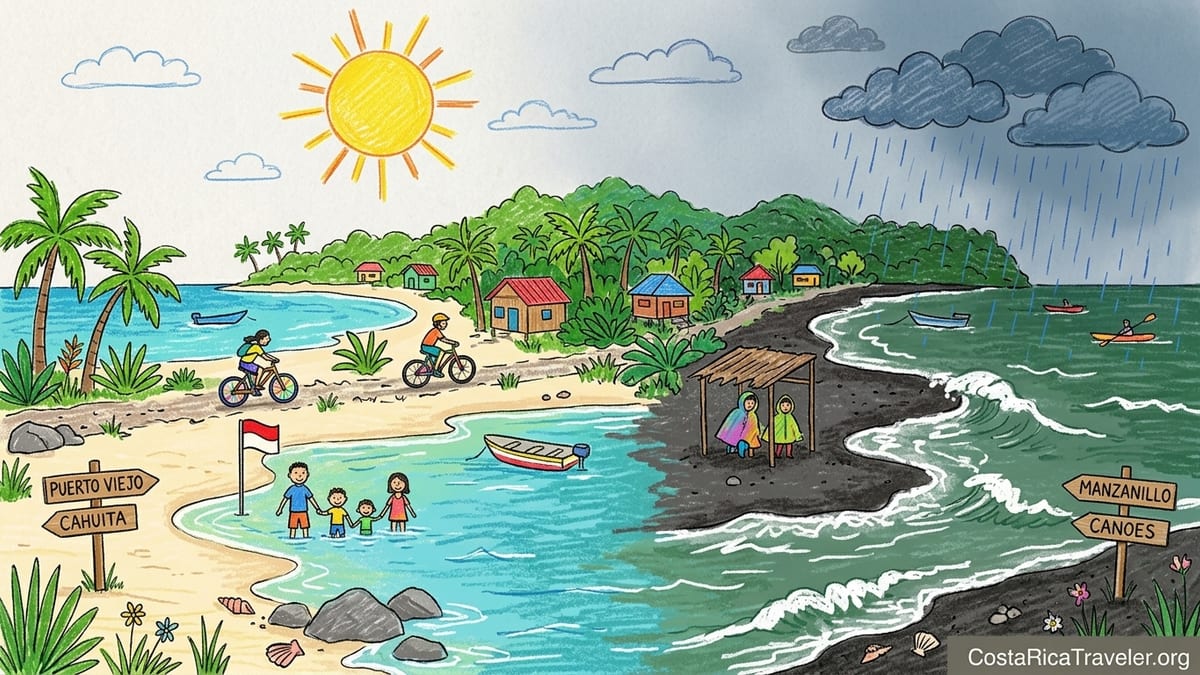
Costa Rica’s southern Caribbean coast is often imagined as one long, calm, turquoise lagoon. In reality it is a mix of powerful surf beaches, black-sand shores, reef-backed coves and pocket bays that change character with the swell and seasons. This guide compares key beaches from Limón to Manzanillo so you can match specific stretches of coast with the kind of trip you want, whether that is beginner surf lessons, shaded family swims, romantic coves or quiet wildlife walks.
Understanding Costa Rica’s Caribbean Coast and Seasons
The Caribbean side of Costa Rica runs from the port city of Limón south to the Panama border, with the most visited beaches clustered around Cahuita, Puerto Viejo de Talamanca, Punta Uva and Manzanillo. Unlike the Pacific coast, this side does not have a simple dry and rainy season. Official climate data and national tourism information describe two relatively drier periods around February to March and again around September to October, separated by wetter spells from November to January and from May to August. Rain, however, is possible in any month, so beach days are often planned around morning or afternoon showers rather than weeks of guaranteed sunshine.
For visitors, the key point is that calmer seas and clearer water are somewhat more likely in those drier windows, especially in September and October when many local operators in Puerto Viejo and Cahuita report easier snorkeling and more reliable sunshine. At the same time, Caribbean storms and distant swells can arrive in any season, changing wave height and currents quickly. That means none of the beaches in this guide can promise consistently flat, lagoon-like conditions. Travelers should always check the day’s surf, talk with local guides and heed flags or lifeguard advice before swimming.
Access along this coast is relatively easy. A single paved road, Route 256, links Puerto Viejo with Playa Cocles, Playa Chiquita, Punta Uva and Manzanillo, and much of it is flat enough for comfortable bicycle riding. Small lodges, guesthouses and cabinas line the side roads into the jungle, so most of the beaches described here can be reached by a short bike ride or walk from nearby accommodation, even if you do not rent a car.
Throughout this article, conditions are described as they are typically experienced, using recent operator information and official guidance where available. Because ocean and weather patterns can change year to year, treat these descriptions as a framework rather than a guarantee, and always adjust your plans based on real-time local advice.
Safety, Waves and Rip Currents on the Caribbean Coast
The Caribbean coast of Costa Rica faces open water, and many beaches here experience strong waves and rip currents. National safety campaigns advise swimmers to enter the water only where others are swimming, to pay attention to beach flags and signage, and to stay out of the sea wherever a red flag is posted. Lifeguard coverage remains limited outside a few more developed beaches, so self-awareness and caution play a larger role here than at heavily patrolled resort areas in other parts of the country.
Rip currents tend to form where waves break unevenly and water returning to the sea funnels into narrow channels. On beaches like Playa Cocles and Playa Negra, visitors sometimes underestimate the power of these currents because the shore break can look manageable from the sand. Local surf instructors often explain that if you feel yourself being pulled seaward, you should not swim directly back to the beach against the current. Instead, conserve energy, stay calm, and swim parallel to the shore until you leave the current’s grip, then angle back in with the waves.
Lifeguard posts have existed at Cocles at various times, particularly near the main public access where surf contests and local events are held, but travelers should not assume any given day will have active guards. In quieter stretches like Playa Chiquita, Punta Uva’s outer points or Playa Grande near Manzanillo, there is generally no lifeguard presence at all. Families traveling with children often combine shallow shoreline play with firm rules about how far anyone may go into the water and choose days with smaller surf when possible.
Because swells often rise in the afternoons, many local guides recommend swimming and snorkeling in the morning when winds are lighter and surface conditions calmer. This pattern is especially relevant in protected spots such as Punta Uva’s inner bay and the reef-backed beaches within Cahuita National Park, which can shift from glassy to choppy over the course of a few hours.
Playa Negra: Black Sand North of Puerto Viejo
Playa Negra is the black-sand beach that begins just north of Puerto Viejo and runs for several kilometers toward Cahuita. The sand here is dark and volcanic, which means it absorbs heat quickly. On sunny days it can become very hot by midday, so many visitors bring sandals to cross the upper beach and sit closer to the wet shoreline where the sand is cooler. The visual effect is striking, especially on days when bright turquoise water contrasts sharply with the dark beach and the green backdrop of palm trees and coastal forest.
Wave conditions at Playa Negra vary. Some stretches closer to town can be relatively mellow, offering rolling waves suitable for bodysurfing or relaxed swims when the swell is small. Other sections, especially farther north, can see stronger surf and rips. Local tourism maps and guesthouse hosts often advise guests to ask about that day’s conditions before venturing too far from shore. There are no designated snorkeling reefs right off Playa Negra, so the beach is more about swimming, walking and sunset views than underwater exploration.
Facilities range from basic to comfortable. Near town and around small hotels such as those on the northern edge of Puerto Viejo, you will find beach bars, simple restaurants and small convenience stores along the road. Toilets are usually tied to these businesses rather than provided as standalone public facilities. Parking is informal; many people leave cars along the roadside and keep valuables out of sight. The relatively flat coastal road makes Playa Negra one of the easiest beaches to reach by bicycle from central Puerto Viejo, with typical bike rentals in town costing the equivalent of roughly 8 to 12 US dollars per day as of late 2026.
Accommodation near Playa Negra includes guesthouses, small eco-hotels and vacation rentals set just inland from the beach, often under tall coconut trees. These stays appeal to travelers who want a quieter base than central Puerto Viejo but still within a short ride of the town’s restaurants and bars. At night, the sound of the surf can be surprisingly loud, a reminder that even where the sand is calm and black, this coast still faces the open Caribbean.
Playa Cocles and Salsa Brava: Surf Hub and Strong Waves
Playa Cocles lies just southeast of Puerto Viejo town along Route 256 and is one of the most recognizable beaches on the southern Caribbean coast. The sand is light beige, wide at mid-tide, and backed by palms and sea almond trees that provide intermittent shade. Cocles is open to the prevailing swell and is known as a consistent beach break favored by intermediate surfers. Compared with the shallow reef at nearby Salsa Brava in Puerto Viejo proper, Cocles offers a sand bottom and less punishing wipeouts, which makes it attractive for surf lessons and board rentals.
Several surf schools operate around Cocles, setting up near the main beach access close to the small island just offshore. As of late 2026, many advertise group beginner lessons of about two hours in the range of 45 to 60 US dollars per person, including board and rash guard, with private lessons costing more. Prices vary by operator and season, but public chalkboards along the beach road and signs at surf shops give a clear idea of current rates. Lessons typically begin with a safety briefing about currents and where to stay within sight of the instructor, which is especially important because Cocles can generate strong rip currents when swell is up.
Salsa Brava, by contrast, is an advanced reef break near the center of Puerto Viejo, reached by a separate beach access. Surf forecasts describe it as a powerful, shallow coral reef wave suitable only for experienced surfers. At size, its steep takeoff and exposed reef make falls hazardous, and the area is not appropriate for casual swimmers or beginner surfers. Visitors sometimes walk out along the reef platform at very low tide, but locals often caution against doing so because of sharp coral and rapidly changing sea conditions.
On the sand at Cocles, you will find simple food stands, small restaurants and beach bars set just off the road, with informal parking along the access lanes. Public toilets are limited, so many people rely on facilities at cafes where they have purchased food or drinks. Shade from palms is present but patchy. Most accommodations in the area sit a short walk inland, ranging from budget-hostel style cabinas to mid-range jungle lodges. Bicycles are widely used, and Cocles sits only a 5 to 10 minute ride from Puerto Viejo, making it easy to stay in town and visit for morning surf sessions.
Playa Chiquita and Punta Uva: Sheltered Coves and Kayaking
Continuing southeast along Route 256, Playa Chiquita is a quieter, more broken-up stretch of pale sand separated by rocky outcrops and small coves. Access paths lead from the road through private land and guesthouses to the beach. The sand here is generally soft, with pockets of natural shade under palms and sea grapes. Because reefs and rock formations sit offshore in several places, the waves in some of these little coves can be smaller than at Cocles, although currents are still possible. Travelers with children often appreciate the more intimate scale, where it is easier to keep track of everyone, while still staying alert to changing surf.
Facilities at Playa Chiquita are modest but pleasant. On the main roadside you will find a handful of cafes, small restaurants and mini markets. Toilets are normally available to paying customers rather than as public standalones. There are no formal lifeguards, boardwalks or changing rooms on the sand. Board rental options here are fewer than in Cocles; many surfers instead base themselves in Puerto Viejo or Cocles and ride bikes down to Chiquita when swells look favorable. Nearby accommodation tends toward small eco-lodges, vacation rentals and boutique hotels tucked into the trees, often marketed to couples and travelers seeking a quieter stay.
Just beyond Playa Chiquita lies Punta Uva, which combines a small headland, protected inner bay and more exposed outer beach. The sand is light and fine, and when regional conditions cooperate, the inner bay can be notably calmer than Cocles or Playa Negra. On such days, the water in the lee of the point appears turquoise and clear, and visitors of all ages paddle close to shore or float on rental kayaks. This sheltered feel is real yet not guaranteed. Stronger Caribbean swell or wind from the wrong direction can wrap around the point and produce shorebreak and currents even inside the bay, so swimmers should always assess on the day rather than assume lagoon-like conditions.
Punta Uva is a local hub for sea kayaking and short coastal tours. Beachfront operators and small agencies in Puerto Viejo offer guided kayak trips along the coast and into nearby river mouths, sometimes using clear-bottom boats. Recent traveler reports describe guided outings of roughly two and a half to three hours, including snorkeling stops when visibility allows, in the range of about 60 to 70 US dollars per person. Independent kayak rentals on the beach, when available, are often charged by the hour. Shade is moderate, with trees lining much of the backshore, and small restaurants at either end of the beach offer meals, drinks and restroom access for customers. Parking is usually informal along the access tracks, and most visitors arrive by bicycle, taxi or rental car from lodgings scattered between Playa Chiquita and Punta Uva.
Manzanillo, Playa Grande and the End of the Road
At the southern end of the main coastal road sits the village of Manzanillo and the gateway to the Gandoca Manzanillo Wildlife Refuge. The main Manzanillo Beach in front of the village is a broad, golden-sand crescent framed by palm trees and basic seafront houses. On calmer days, the section immediately in front of town can be relatively gentle, attracting local families and day-trippers from Puerto Viejo who come for shallower water near the shoreline. When swell builds, waves break more heavily along the open parts of the bay and rip currents can form, so conditions should not be taken lightly even here.
Facilities in Manzanillo are simple but more concentrated than at some smaller coves. The village has a few sodas and seafood restaurants, small shops, and basic accommodations from budget guesthouses to modest beachfront cabinas. Toilets are usually found in these establishments, and changing in your lodging before and after beach time is common. Shade on the sand is good near the treeline, although some areas have exposed stretches, so carrying a sarong or lightweight umbrella can still be useful. Parking is mainly on village streets and sandy clearings, and spaces can fill on local holidays and sunny weekends.
North of the village, beyond the headland, lies a longer, wilder stretch often referred to as Playa Grande. Access is via trails from Manzanillo or by following paths through the refuge. The sand is similar in color to Manzanillo Beach but feels more remote, with dense coastal forest behind and no permanent beachfront buildings. There are no lifeguards or formal facilities on this stretch, so visitors must bring water and plan to pack everything out. Surf here can be punchy and less forgiving for inexperienced swimmers. Because of the isolation, many travelers limit themselves to walks, photography and shallow wading on smaller days rather than full swims when conditions are uncertain.
Accommodation around Manzanillo is more limited than around Puerto Viejo, which helps keep nights quiet. Small jungle lodges and cabins just outside the village appeal to travelers who prefer birdsong and early mornings over nightlife, and who do not mind a slightly longer drive or bike ride back toward Cocles or Punta Uva for additional dining options. Bicycle access along Route 256 is straightforward but involves a bit more distance back to Puerto Viejo, so night riding requires strong lights and care.
Cahuita National Park: Playa Blanca and Puerto Vargas
North of Puerto Viejo lies Cahuita National Park, celebrated for its white-sand beaches and offshore coral reef. There are two main beach sectors inside the park. Playa Blanca is reached from the Cahuita village entrance, where visitors pay a voluntary contribution that supports local management. The sand here is almost white, very fine, and shaded in many spots by palms and coastal trees. Gentle lapping waves are common close to shore on calmer days, though stronger surf and currents can arrive with larger swells. A walking trail follows the coast through the forest, connecting beach clearings where capuchin monkeys, raccoons and sloths are often seen.
Public facilities at Playa Blanca include ranger presence, information signs and simple infrastructure near the entrance. Toilets and showers sit close to the trailhead rather than all along the beach, so many visitors plan bathroom breaks before longer walks. Small restaurants and sodas are located just outside the park in Cahuita village. Inside the park there are no full-service beachfront bars or rental shops, which helps preserve a quieter, more natural feel. Parking is available near the village entrance in small paid or donation-based lots, and many travelers arrive by bus from Limón or Puerto Viejo and walk into the park on foot.
The Puerto Vargas sector is reached from a separate park entrance along the coastal road south of Cahuita. Here, a long boardwalk leads through forest and mangroves to another stretch of light sand backed by dense vegetation. The feel is more remote, and facilities are simpler. Visitors often choose Puerto Vargas for quieter walking and birdwatching, then swim in short sessions closer to the main access where other people are present. There is generally less informal shade infrastructure such as beach huts, so sun protection is important.
Cahuita’s coral reef is a protected resource. Snorkeling is officially regulated, and park authorities and local operators emphasize that access to the beach does not automatically grant permission to enter reef areas. In practice, this means that while anyone can walk and swim in designated beach zones, snorkeling on the main reef is intended to be done with certified local guides, often by small boat to specific moorings. Recent tour listings indicate guided snorkeling outings of about two hours, including equipment and park arrangements, at prices commonly in the range of 40 to 60 US dollars per person, depending on group size and inclusions. Weather and water clarity control whether tours operate on a given day, and heavy rain or strong swell can lead to cancellations.
Playa Bonita near Limón: Local Beach with Facilities
Closer to the port city of Limón, Playa Bonita serves as a local beach and an option for travelers arriving by cruise ship or staying briefly in the city. The beach is a small bay of brownish-golden sand backed by restaurants, a few small hotels and simple beach bars. Compared with the more rural shores around Puerto Viejo and Cahuita, Playa Bonita feels more urban and compact, with concrete terraces and decks built close to the sand in places. Trees along the edge provide some shade, and many visitors sit at tables under fixed umbrellas associated with the beachfront eateries.
Wave conditions at Playa Bonita can be lively, and the bay opens toward the Caribbean in a way that captures swells, especially during more active weather. Local accounts and surf reports describe surfers frequenting this spot when conditions align, and the shorebreak can be quite forceful. Casual swimmers often stay in the very shallow zone close to shore and avoid days when waves are large. The bottom near the immediate shoreline is mostly sand, but rocks and reef outcrops exist farther out, so it is not a prime snorkeling destination.
Facilities are one of Playa Bonita’s strengths. Restaurants and bars front the sand, and many have toilets for customers, outdoor showers to rinse off sand and some on-site parking. Visitors who come by taxi from central Limón can usually arrange pickup directly from the establishments facing the beach. Lifeguard coverage may be present during busy periods, but it is not continuous or guaranteed, so standard precautions and attention to posted flags still apply.
Accommodation options at Playa Bonita include a small number of beachfront or near-beach hotels, some of which are used by business travelers and short-stay visitors in transit. Those planning a longer Caribbean holiday often use Limón mainly as an arrival point and continue down the coast to Cahuita or Puerto Viejo for more extensive beach time. Still, Playa Bonita can be a convenient introduction to the Caribbean shore for an afternoon, especially for visitors who value easy access to food, restrooms and shaded seating.
How These Beaches Compare for Different Travelers
Looking across Playa Negra, Cocles, Playa Chiquita, Punta Uva, Playa Grande, Manzanillo, Playa Blanca, Puerto Vargas and Playa Bonita, several patterns emerge. For families, Punta Uva’s inner bay and the better-sheltered pockets of Playa Chiquita and Cahuita’s Playa Blanca stand out on calmer days, thanks to softer sand, some natural shade and generally gentler entry into the water. However, none of these spots can promise consistently flat conditions, and parents still need to monitor currents closely. Playtime along the wet sand and in ankle-deep shallows is usually a safer focus than full-on swimming whenever waves look stronger.
Surfers have a different set of priorities. Intermediate riders gravitate to Playa Cocles for its consistent beach break and the availability of board rentals and lessons, while more advanced surfers may seek out Playa Negra’s peaks or, in the right conditions, the heavy reef barrels at Salsa Brava. Kayak-inclined surfers sometimes combine a stay at Punta Uva with trips north or south depending on swell. Beginner surfers will find the best support by booking structured lessons with Cocles schools that choose appropriate sand-bottomed sections and times of day when the sea is more forgiving.
Couples and photographers often favor the aesthetics and relative quiet of Playa Chiquita, Punta Uva and the trails within Cahuita National Park. The black sand of Playa Negra provides dramatic sunset foregrounds, while the white sand and turquoise water at Playa Blanca look almost tropical postcard-like when skies clear. Playa Grande’s wild stretches suit visitors seeking wider landscapes and fewer buildings in their images, particularly early in the morning when human footprints are few.
Travelers focused on snorkeling will find the richest protected reef in Cahuita National Park, accessed by guided boat tours rather than by simply swimming out from the beach. On days of good visibility and low swell, shallow areas around Punta Uva can also reveal fish and coral heads, but they are more exposed and do not offer the same structured protection or management as Cahuita’s reef. For quieter overnight stays, Playa Chiquita, Punta Uva and Manzanillo offer lower-key villages and lodgings set in the trees, while Puerto Viejo and Limón provide livelier dining scenes and more nightlife within easy reach of their nearest beaches.
Although this article does not use visual tables, it can be helpful to imagine categories. For families prioritizing shade and calmer entries, Punta Uva bay and Playa Blanca usually rank high. For surfers, Cocles and the breaks near Puerto Viejo take precedence. Couples might place Playa Chiquita and Manzanillo at the top of their list for quieter evenings, while photographers could divide their time between Playa Negra’s unique sand and Cahuita’s bright reefs and beaches. Understanding these distinctions makes it easier to match specific beaches to each day of a short itinerary.
Suggested Two-Day Beach-Hopping Route
With only two full days on Costa Rica’s southern Caribbean coast, visitors can still sample a surprisingly wide range of beaches. A practical plan is to base yourself in or near Puerto Viejo, where bicycle rentals, shuttle services and restaurants cluster, then explore in two broad loops. On the first day, focus south of town. Start the morning at Playa Cocles, arriving by about 8 or 9 a.m. to catch lighter winds. Join a surf lesson or rent a board with guidance from the instructors if you already have some experience, then relax under the trees with a cold drink from a nearby cafe.
By late morning or lunchtime, ride or drive down to Playa Chiquita, where you can eat at a roadside restaurant and then follow one of the narrow paths to the beach. Spend the early afternoon exploring the small coves, watching wave patterns and choosing spots for careful wading or shallow swims if conditions look gentle. As the day cools, continue farther to Punta Uva. Here you might rent a kayak for an hour of paddling near the headland, or simply enjoy the view from under the palms. If the inner bay is calm, this can be an excellent place for families to end the day, always within easy talking distance of the shoreline.
On the second day, head north. Catch an early bus or drive to Cahuita village and enter Cahuita National Park at Playa Blanca. Walk the coastal trail, stopping at clearings to swim where others are already in the water and conditions appear manageable. If you have pre-booked a reef snorkeling tour and weather allows, spend part of the morning on the boat with a licensed guide, then return for a picnic under the trees. In the afternoon, continue to the Puerto Vargas sector for a quieter walk and a different feel of forest and beach. On the way back toward Puerto Viejo, detour to Playa Negra for a sunset stroll along the dark sand before dinner in town.
Travelers with an extra evening might replace one of these sunset stops with a trip to Manzanillo, arriving mid-afternoon to explore the village beach and, if tides and park rules permit, a short walk along the trails into the wildlife refuge. A quick seafood dinner at one of the simple local restaurants, followed by a careful drive or taxi ride back to your lodging, rounds out the sense of having reached the literal end of the road. In all cases, the most successful itineraries on this coast tend to stay flexible, adapting to that day’s swell, storms and skies rather than trying to keep every hour locked in advance.
The Takeaway
Costa Rica’s Caribbean coast is not a single band of calm turquoise water but a varied shoreline of surf breaks, protected coves, black-sand sweeps and reef-backed bays. Playa Negra, Cocles, Playa Chiquita, Punta Uva, Playa Grande, Manzanillo, Playa Blanca, Puerto Vargas and Playa Bonita each offer a different combination of sand color, wave energy, shade, services and nearby lodging. Seasonal patterns increase the odds of sunnier skies and clearer seas in February to March and September to October, yet rain and changing surf remain a constant possibility throughout the year.
For families, the more sheltered days at Punta Uva and Cahuita’s Playa Blanca often feel best, provided adults keep a careful eye on currents and stay close to shore. Surfers can base themselves around Playa Cocles and Puerto Viejo, using local surf schools and shops to track daily conditions and choose appropriate breaks. Couples and photographers may be drawn to the quieter, more intimate coves of Playa Chiquita and Manzanillo, where forest meets sand with fewer crowds, while dedicated snorkelers should set aside time for a regulated reef tour inside Cahuita National Park.
No matter which beach you choose, treat the Caribbean as a living, changing environment rather than a fixed backdrop. Ask hotel staff about that day’s safety flags, look for other swimmers, respect national-park rules about reef access and consider booking licensed local guides for ocean activities like snorkeling and sea kayaking. With this mindset, you can enjoy the full range of the coast’s character, from pounding surf at Cocles and the hollows of Salsa Brava to the bright shallows at Playa Blanca and the tranquil, palm-framed curve of Punta Uva on a still morning.
FAQ
Q1. Is Costa Rica’s Caribbean coast safe for swimming with children?
It can be, but conditions change quickly. Choose more sheltered beaches like Punta Uva bay or Playa Blanca on smaller-swell days, keep children in very shallow water, watch them constantly and avoid any area with red flags or visibly strong surf.
Q2. Where can I find beginner surf lessons near Playa Cocles?
Several surf schools along the road behind Playa Cocles in Puerto Viejo offer beginner group lessons, typically two hours long and including equipment. Many advertise walk-up spaces at beach kiosks, though booking a day or two ahead in busy months is wise.
Q3. Are Salsa Brava and Playa Cocles suitable for first-time surfers?
Playa Cocles can be suitable for beginners when conditions are small and lessons are supervised by local instructors on sand-bottom sections. Salsa Brava is an advanced, shallow-reef break and is not appropriate for first-time surfers or casual swimmers.
Q4. Do I need a guide to snorkel in Cahuita National Park?
For the main coral reef inside Cahuita National Park, yes. Beach access for swimming and walking is open in designated areas, but guided tours with licensed operators are required for official reef snorkeling to protect the coral and manage visitor impact.
Q5. When is the best time of year for calmer seas on the Caribbean side?
Historical climate patterns and tourism information point to relatively drier and often calmer periods around February to March and September to October, though rain and swells can still occur, so there are no guaranteed flat-sea months.
Q6. Can I rely on lifeguards at these beaches?
Lifeguard coverage is limited and inconsistent. Some busier stretches like Playa Cocles may have guards at times, but many beaches, including Playa Chiquita, Punta Uva, Playa Grande, Manzanillo and Puerto Vargas, typically have no lifeguards on duty.
Q7. Is Playa Negra in Puerto Viejo good for snorkeling?
Playa Negra is better known for its striking black sand, surf and sunsets than for snorkeling. There are no major reef structures immediately offshore for casual snorkeling, and visibility is often affected by wave action and dark sand in the water.
Q8. How easy is it to get around the beaches without a car?
It is relatively easy. Many visitors rent bicycles in Puerto Viejo and use the mostly flat Route 256 to reach Playa Cocles, Playa Chiquita, Punta Uva and even Manzanillo. Buses and taxis also link Puerto Viejo with Cahuita and Limón.
Q9. Are there public toilets and showers on these beaches?
Facilities vary. Cahuita National Park sectors and Playa Bonita near Limón have the most formal infrastructure. On other beaches, toilets and showers are usually available only in restaurants or hotels for customers rather than as stand-alone public services.
Q10. Can I visit multiple beaches in one day?
Yes. Many travelers combine Cocles, Playa Chiquita and Punta Uva in a single southbound day, or Cahuita National Park and Playa Negra on a northbound day from Puerto Viejo, using bicycles, buses or short drives to move between them.