


On a warm, drizzling night in Tortuguero this August, I paid 35 US dollars, put on a sticky pair of rented rubber boots, and walked into the dark with ten strangers, a local guide and the quiet hope that somewhere on this Caribbean beach a green sea turtle would haul herself out of the waves just for us. Two hours later, soaked, bitten by mosquitoes and still straining my eyes into the black surf, I walked back without having seen a single turtle. That was the night I started to question what, exactly, we are paying for on Tortuguero’s famous turtle tours, and whether the industry has been honest about the limits and ethics of turning nesting into a product.
A Real Night on Tortuguero’s Beach
I visited Tortuguero on August 11, 2026, near the heart of the green turtle nesting season that typically runs from roughly late June through October in this part of Costa Rica’s Caribbean coast. I booked my tour through a small agency on the village’s sandy main path for 35 US dollars per person, not including the separate national park fee. The operator advertised “high chances” of sightings and showed me glossy photos of turtles laying eggs as proof.
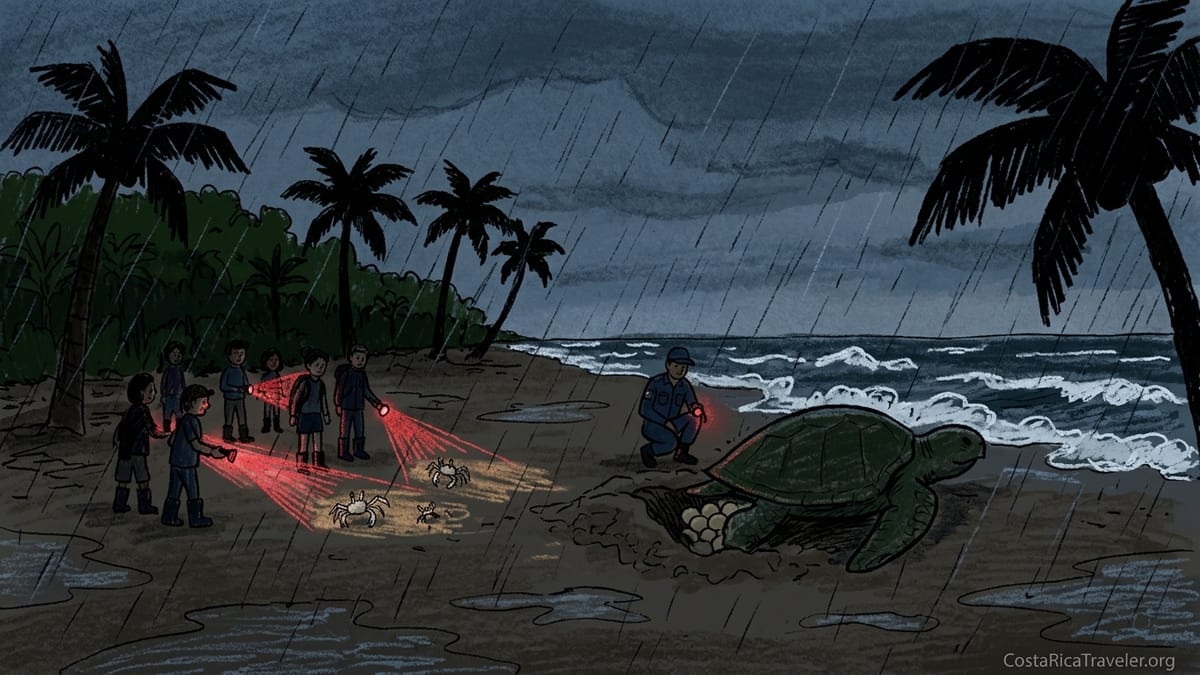
Our group met at 7:45 p.m. outside the agency’s office. We were 10 paying visitors, the maximum group size many reputable local outfits now advertise, with one licensed guide. Light rain had started to fall; the sky above the canals was a blank, low ceiling. We were issued rubber boots for the muddy path to the beach and told to wear dark clothes. Phones were to be kept off. Flash photography and headlamps were strictly forbidden once we entered the nesting zone.
By 8 p.m. we were at one of the village’s official waiting areas, a dim patch of sand behind the treeline just outside Tortuguero National Park. Somewhere along several kilometers of protected beach, park-authorized “turtle crawlers” were already walking the tide line in near-total darkness, looking for the telltale tracks and slow, laborious crawl of females emerging from the sea. According to the park service, these crawlers are the only people allowed to search for turtles at night, and they radio guides only when a turtle is far enough into nesting that visitors will not disturb her.
We waited. Every few minutes, a red beam from our guide’s filtered flashlight would sweep the sand at our feet, checking for crabs rather than turtles. The radio hissed, then went quiet. Other groups were called and disappeared into the darkness. At about 9:10 p.m., our guide shook his head and told us calmly that so far no crawler in our section had reported nesting activity we could visit. At 10 p.m., our official two-hour slot ended. The rain thickened into a steady sheet, and we walked back along the mud track, past other returning groups that had seen, variously, “one turtle in the distance” or “only tracks.” Our group saw none.
How Tortuguero’s Nighttime Turtle Tours Actually Work
One of the first misconceptions visitors bring to Tortuguero is that you can simply walk down the beach after dark and look for turtles on your own. You cannot. Tortuguero National Park, managed by Costa Rica’s conservation authority SINAC, makes it very clear that nighttime turtle watching is allowed only with authorized guides and under a specific system of control. Official park materials state that the park allies with local organizations to establish turtle crawlers who are highly trained and are the only ones permitted to detect emerging turtles under strict ecological rules.
The basic system is this. During nesting season, guides and tour agencies in the village reserve turtle tour permits for the evening. On the afternoon of your tour, the national park runs a kind of lottery that assigns your group a specific time block, usually either around 8 p.m. to 10 p.m. or 10 p.m. to midnight. Lodges like Pachira Lodge, Tortuga Lodge and several independent agencies describe the same pattern: you do not choose the slot; the park assigns it on the day. Some websites still list 7 p.m. to 10 p.m., but current operators widely reference the two main 8 to 10 and 10 to midnight windows.
During your assigned slot, you are not free to wander. Groups are held at designated waiting points near the forest edge while turtle crawlers roam the active nesting beach, usually working in coordination zones. When a crawler finds a turtle that has committed to nesting, especially when she is already digging the nest or starting to lay eggs, they radio one guide at a time to bring their group to a specific area, often from the back, avoiding the surf line to reduce disturbance. In theory, this system limits the number of people around each turtle and keeps the beach mostly dark and quiet.
The national park brochure and recent tour descriptions repeat the same non-negotiable conditions: visitors must be accompanied by a certified guide, must stay with the group, and must follow instructions about distance, light, and noise. For many travelers, this controlled, almost clinical choreography can be surprising. It is not a free-form beach stroll under the stars. It is regulated wildlife viewing that tries to balance tourism with one of the world’s most important nesting sites for green turtles.
Why Lights, Touching and Guarantees Are a Problem
Even if you never see a turtle, you will hear a lot about light on Tortuguero’s night tours. Guides explain that bright white light can disorient hatchlings and disturb nesting females. Scientific studies and decades of field experience have shown that artificial light on nesting beaches can cause turtles to abort nesting attempts, change their orientation, or avoid lit sections of beach altogether. This is why guides use only dim red-filtered lamps and why phone screens and camera flashes are banned on the sand.
Tortuguero’s official information emphasizes that visitors are positioned only when the turtle is at a nesting stage that is considered safe to observe, typically when she is laying eggs or camouflaging the nest. Approaching earlier, when she is still choosing a spot or beginning to dig, increases the risk she will abandon the attempt and drag herself back to the ocean without nesting. Touching a turtle, blocking her path, or crowding her flank for a better angle is not just unethical; it may directly reduce her reproductive success.
This is where some of the marketing around turtle tours starts to feel dishonest. Booking sites and street-front agencies in the village often feature language like “see turtles up close” or “guaranteed unforgettable experience,” sometimes even implying that the later 10 p.m. slot has “higher chances” of sightings, as one large online reseller currently claims. What they rarely emphasize in the same font size is that no wildlife encounter can be guaranteed, and that strict rules on light and distance mean you may not be able to take any usable photographs at all.
When operators suggest otherwise, they push guides into an impossible corner. If a guide knows that guests expect close, well-lit photos because the agency sold the tour that way, there is a subtle pressure to skirt the rules: to allow a few seconds of flashlight for “just one picture,” to creep closer than the recommended distance, to linger around a nervous turtle longer than is ideal. Responsible guides resist that pressure. Less scrupulous ones may quietly accept it, especially if they rely on tips.
Seasonality, Species and the Roulette of Wild Nature
Tortuguero is one of the world’s key nesting sites for the green sea turtle, and that is the species most visitors hope to see. Local lodges and conservation groups describe the main green turtle nesting season here as running roughly from June through October, with a peak often during July, August and September. Outside those months, nesting activity drops, though you may still have a chance of seeing other species.
Leatherback turtles nest earlier in the year on Costa Rica’s Caribbean coast, generally around March to June. Hawksbill turtles can nest in smaller numbers with a more extended but sparse pattern. However, these species have far fewer individuals than the green turtle population that gives Tortuguero its name. Booking a turtle tour in, say, late May or early November may be legal and technically possible, but the chance of a sighting is lower and depends heavily on seasonal and oceanic conditions that change year to year.
Even during peak months, there are slow nights. Heavy rain, rough surf, lunar phase, and other factors still poorly understood can all influence how many turtles come ashore. My August 11 walk, for example, coincided with a humid, moonless night that seemed perfect to my tourist eyes, yet our assigned stretch of beach was quiet. Other visitors in the same week reported dozens of turtles the night before or after. The system of crawler patrols and timed slots can reduce human pressure, but it cannot summon wildlife on cue.
This unpredictability is not a flaw in the system; it is precisely what keeps Tortuguero wild. When agencies talk as if your dollars can bend nature’s schedule, they are selling an illusion. A conservation-focused operator will spell out that you are paying for a chance, not a show: for the privilege of waiting respectfully in habitat where turtles may or may not appear.
The Full Cost of Reaching Tortuguero for a Two-Hour Window
To understand the ethics of turtle tours, you also have to consider the investment that gets most visitors to that dark beach in the first place. Tortuguero has no road access. The classic overland route from San José involves a bus or shuttle to the dock at La Pavona, then a public boat up the jungle canals to the village. Recent traveler reports put the public boat fare between La Pavona and Tortuguero at roughly the equivalent of 7 to 10 US dollars per person one way, payable in colones. Parking at La Pavona, if you arrive by rental car, is around 10 dollars per night.
From San José, a public bus to Cariari, then another bus to La Pavona, can keep costs low but adds hours of changes with no air conditioning. Shared shuttles directly to La Pavona from the capital or the Caribbean coast are widely advertised in the 30 to 50 dollar range per person each way, depending on route and season. Add to that your hotel or lodge in Tortuguero, where budget rooms in the village might start around 30 to 40 dollars per night for a simple double, while canal-side lodges that bundle meals and tours can easily run 150 dollars or more per person per night.
On top of transport and lodging comes the Tortuguero National Park entrance fee, which foreign adult visitors currently pay per day. While the exact amount changes periodically, recent figures place it in the mid-teen to low-twenty US dollar range. Crucially, you must hold a valid park ticket for the day of your turtle tour, even if you never set foot on a daytime trail, because the nesting beach is inside the park boundaries. That ticket is separate from any canal tour you might do the same day.
Finally, there is the turtle tour fee itself. Local agencies and online booking platforms commonly quote prices around 30 to 40 dollars per person for the two-hour night walk, not including the park ticket. Some bundles that include transport, boots and sometimes rain ponchos advertise prices slightly higher. Cheaper offers exist in the village, occasionally dipping closer to 25 dollars, but you should ask hard questions about who will guide you and whether the operator is indeed booking legal spots through the park’s system or improvising around it.
Good Guides, Questionable Operators and the Ethics in Between
In Tortuguero, as in many wildlife destinations, there is a visible difference between outfits that lead with conservation and those that lead with price and promises. Conservation-focused guides tend to emphasize their accreditation, often displaying SINAC-issued guide cards, mentioning training with the Sea Turtle Conservancy, or clearly explaining the crawler system and why rules exist. Group sizes are capped around ten people per guide. They speak about turtles as animals with their own needs, not as props, and will say plainly that there is no guarantee you will see one.
By contrast, cheaper or less transparent operators may gloss over these details. Some sell “night walks” that blur the line between a general nocturnal wildlife walk in the village surroundings and an actual turtle nesting tour inside the park. Prices can be similar, which confuses visitors. Others hand you off to a guide you meet only at the beach, with little clarity about his credentials. In the worst cases, there have been reports in other Costa Rican nesting sites of unregistered guides taking people along the beach in defiance of regulations, using flashlights freely and crowding turtles.
As a traveler, you have limited ways to verify credentials, but you can ask specific questions: Will we enter Tortuguero National Park for this tour? Is the park ticket included? How many people per guide? Are you using the official crawler system? What are your rules on photography? A reputable operator will be glad you asked and will give precise, consistent answers. A vague response or pushback is a warning sign.
Walking back boot-deep in puddles that August night, I found myself less angry about not seeing a turtle and more unsettled by how casually some agencies framed the experience. Posters showed close, bright images that you simply cannot take under the current rules. Flyers promised “you will see turtles” in bold type, followed by a small-print note that sightings are not guaranteed. The dissonance between marketing and reality risks eroding trust in both local guides and the conservation project they are meant to support.
The Unromantic Truth: Mosquitoes, Rain and No Photos
Nothing about a Tortuguero turtle tour is glamorous once you step beyond the brochures. This is one of the wettest parts of Costa Rica, with official data placing average annual rainfall in the several-thousand-millimeter range. On the ground, that translates to a high chance that your night on the beach will include rain. Paths from the village to the park quickly turn to mud, and the loaner boots, while functional, are often damp from the previous group.
When the rain is not falling, the mosquitoes usually are. Stagnant water in the canals and dense vegetation make for ideal breeding conditions. Some guides discourage heavy use of strong insect repellent right on the nesting beach because of concerns about chemicals and turtle hatchlings, so at least part of your wait may be spent swatting in relative discomfort. Long sleeves and trousers are wise, but in the humidity they can feel like a portable sauna.
The darkness itself can be disorienting. There is almost no artificial light along the nesting beach, and the canopy behind it blocks any village glow. Walking in a single-file line, your only reference is the faint oval of sand illuminated at your feet by the guide’s red-filtered torch. If a turtle is found and your group is called, you will likely crouch or stand on damp sand for 20 to 30 minutes, peering at a dark shape a few meters away. It is powerful and humbling, but it is not visually easy.
Photography is the clearest casualty of this system. The combination of strict no-flash rules, distance, and minimal light means that most casual cameras and phones will capture at best a noisy, grainy silhouette. Some guides allow a few seconds of low-light images once the turtle starts covering her nest, but even then they restrict angles and brightness. If you arrive expecting the kind of close, sharp shots you might see in a coffee-table book, you will almost certainly be disappointed. You have to choose: do you value the turtle’s well-being, or a perfect picture?
Alternatives: What To Do in Tortuguero Besides the Night Walk
If my August experience made me more skeptical about turtle tours, it also nudged me toward other parts of Tortuguero that felt more rewarding per dollar and per mosquito bite. At dawn the next morning, I joined a canal trip by paddled canoe, gliding through narrow black-water channels while howler monkeys roared like distant engines in the canopy. In three hours we saw toucans, sloths, basilisk lizards sprinting across the water and a heron swallowing a fish in one slow, prehistoric gulp. The canal tour took place in full daylight, with reasonably good chances of wildlife and no restrictions on quiet photography.
Back in the village later that day, I spent an hour in the Sea Turtle Conservancy Visitor Center, located near the airstrip. This small museum, run by one of the leading organizations that has studied Tortuguero’s turtles since the 1950s, charges a modest admission that recent sources place at about 2 to 3 US dollars per person. Inside are dioramas of nesting beaches, panels explaining turtle life cycles and migratory routes, and historical photos of early research in Tortuguero, long before the first tourist day trip.
That hour in front of a map tracing a green turtle’s 5,000-kilometer oceanic loop did more to ground my understanding of the species than the night I spent staring into black surf. I left with a clearer sense of why strict rules exist on the beach, and why even one disturbed nesting attempt could matter over a turtle’s lifetime of relatively few successful nests.
Tortuguero also offers day walks in the park’s forest trails, village cultural experiences and simple pleasures like watching the canals from a dockside soda with a plate of rice and beans. None of these has the headline drama of a 150-kilogram turtle digging a nest at your feet, but together they can make your trip feel less like a gamble on a single nighttime spectacle and more like a rounded visit to a living coastal community.
The Takeaway
Would I pay for a Tortuguero turtle tour again after my empty August 11 walk? Yes, but with tighter conditions and a different mindset. I would only book during the core of the green turtle season, ideally between mid-July and September, when local data and long-running observations suggest the highest nesting activity. I would choose an operator that speaks openly about the crawler system, clearly separates general night walks from official nesting tours, and caps groups at around ten people per guide.
I would go in accepting that I might again see nothing, or that I might see a single dark silhouette in the rain from several meters away. I would leave my expectations for photography at the dock and treat any blurry image as a bonus, not the goal. I would also view the 30 to 40 dollars I hand over not primarily as a ticket to a show, but as a contribution to a conservation framework that employs local people to protect turtles that were once slaughtered here on an industrial scale.
For travelers weighing whether the cost and discomfort are worth it, the honest answer is that it depends what you are really buying. If you need guaranteed sightings and perfect photos, Tortuguero’s regulated night walks will frustrate you, and you might be better served by focusing your visit on sunrise canal tours and a thoughtful hour in the Sea Turtle Conservancy Visitor Center. If, however, you are willing to trade certainty for integrity and accept that the turtles set the terms, then standing quietly in the dark, even on a night when no turtle appears, can feel like an act of respect rather than consumer disappointment.
In the end, conservation has to outweigh our desire for guaranteed images. The turtles of Tortuguero return here guided by ancient instincts, not by tour schedules or online reviews. The least we can do is meet them on their own conditions: with patience, humility and the understanding that sometimes the most ethical wildlife encounter is the one you pay for and never quite see.
FAQ
Q1. Can I walk Tortuguero’s nesting beach on my own at night to look for turtles?
Visitors are not allowed to walk the nesting beach independently at night. Turtle watching must be done with an authorized guide using the official system of turtle crawlers and assigned time slots inside Tortuguero National Park.
Q2. What are the typical time slots for turtle nesting tours in Tortuguero?
Most operators work with two main windows assigned by the national park on the afternoon of your visit, usually around 8 p.m. to 10 p.m. and 10 p.m. to midnight, though exact times can vary slightly by season and operator.
Q3. How much does a turtle night tour usually cost, and what is not included?
Recent prices for regulated turtle tours are often around 30 to 40 US dollars per person for a two-hour night walk. This usually does not include the separate national park entrance fee, which you must also purchase for the day of your tour.
Q4. When is the best time of year to see green turtles nesting in Tortuguero?
The main green turtle nesting season in Tortuguero generally runs from about June through October, with higher activity often reported in July, August and September, though exact timing and nightly numbers vary each year.
Q5. Why are flash photography and bright lights banned during turtle tours?
Bright white light can disorient both nesting females and hatchlings, sometimes causing turtles to abandon nests or head away from the ocean. For this reason, tours restrict lighting to dim red-filtered lamps and prohibit flashes and uncovered phone screens on the nesting beach.
Q6. Is it normal not to see any turtles on a night tour during the nesting season?
Yes. Even in peak season, some nights have few or no turtles emerging in the sectors assigned to your group. Weather, ocean conditions and natural cycles all influence activity, and no ethical operator can guarantee a sighting.
Q7. How much should I budget to reach Tortuguero and do a turtle tour?
Budget-minded travelers should factor in transport to La Pavona, the public boat to Tortuguero, at least one or two nights of lodging, daily park entrance fees and the turtle tour itself, which together often total at least several hundred US dollars for a short visit for two people.
Q8. How can I tell if a turtle tour operator is conservation-focused and legitimate?
Look for clear mention of certified guides, use of the official crawler system, small group sizes, honest messaging about no guarantees and strict rules about light, distance and touching. If an agency promises guaranteed sightings or bright close-up photos, consider it a red flag.
Q9. Are there rewarding alternatives if I decide not to book a night turtle tour?
Yes. Sunrise canal trips offer excellent wildlife viewing, and the Sea Turtle Conservancy Visitor Center in Tortuguero village provides informative exhibits on turtles and conservation for a modest admission fee, alongside forest walks and village experiences.
Q10. If I care about conservation, should I still pay for a turtle tour that might show me nothing?
Many travelers choose to book with reputable operators knowing there is no guarantee, treating the fee partly as support for local conservation and regulated monitoring. If you accept that mindset, even a turtle-free night can feel like an ethical contribution rather than a wasted ticket.