


The alarm went off at 4:30 a.m. in San José and for a few seconds I genuinely considered rolling over and pretending I had never booked a Pacuare River rafting trip. By 5:15 a.m., though, I was standing in the dark hotel driveway with a dry bag and a knot in my stomach, waiting for the white Exploradores Outdoors bus that would take me toward one of Costa Rica’s most celebrated whitewater rivers and, as it turned out, toward one of the most intense physical days of my life.
Booking the Trip and What It Really Costs
I booked a full-day Pacuare River Class III–IV rafting tour with Exploradores Outdoors, one of the long-standing operators based in the Turrialba and Siquirres area that run daily trips from San José. In October 2026, their one-day Pacuare trip was advertised at about 130 US dollars per person before the 13 percent Costa Rican VAT, including hotel pickup from San José, a hot breakfast at their operations center, all rafting gear, a riverside lunch and transport on to La Fortuna, Puerto Viejo or back to San José. Once taxes were added, my final cost landed closer to 147 US dollars.
The booking was straightforward. I reserved online the week before, paid a deposit by card and received a confirmation with a detailed schedule. The minimum age listed for the Class III–IV Pacuare run was 12 years, with a note that younger children could only raft the milder Reventazón river instead. The confirmation also flagged medical restrictions in plain language: people with serious heart conditions, recent surgeries, uncontrolled epilepsy or advanced pregnancy were advised not to join, and everyone had to be able to fit properly into a life jacket and helmet.
The cancellation rules were more rigid than many casual tours in Costa Rica. For this Pacuare day trip, canceling within 48 hours meant losing the full amount unless the river was deemed unsafe by the guides due to extreme flooding or landslides. The company reserved the right to switch guests to another river or section if water levels rose beyond their internal safety threshold. That mattered because in the rainy season the Pacuare can go from playful to punishing overnight, and seeing that in the fine print reassured me that they took river levels seriously.
I chose the day trip specifically because it fit into a longer overland route. Exploradores allowed me to start in San José and finish in Puerto Viejo de Talamanca on the Caribbean coast at no extra charge. For solo travelers or couples trying to avoid backtracking, this built-in transfer can offset part of the tour price, especially compared with paying for a separate shuttle.
Early Pickup, Long Transfers and the First Taste of Rainforest
The minibus arrived at my San José hotel almost exactly at 5:15 a.m. It was still dark, the streets slick from an overnight drizzle. I was the second pickup. Over the next 40 minutes we zigzagged through the city, collecting a mix of sleepy travelers in quick succession. Seats filled with couples in quick-dry shirts, a family with two teenage boys and a pair of friends from Germany quietly second-guessing their decision in the pre-dawn gloom.
We headed east on the highway through Braulio Carrillo National Park, fog clinging to the slopes and flashes of dense cloud forest visible when the mist lifted. The guide riding shotgun, Allan, used this stretch to outline the day in Spanish and English. The drive from San José to their breakfast and operations center near Siquirres would take around two and a half hours depending on traffic and construction. After breakfast and gear fitting we would drive another 45 minutes to the Pacuare put-in. He was honest that for a roughly three-hour run on the river, we would be spending more time in vehicles than in the raft.
That ratio turned out to be accurate. We reached the Exploradores center a little after 7:45 a.m. The compound was basic but organized, with a large covered dining area, clean bathrooms and racks of helmets and life jackets. The first order of business was breakfast. We lined up for gallo pinto, scrambled eggs, plantains, toast, fresh fruit and strong coffee. This meal is included in the tour price, and it felt less like a perk and more like essential fuel for what was coming.
By 8:30 a.m., we were being sorted by language and experience level into rafting groups. My raft would carry six guests plus a guide, with a separate safety kayaker for the overall group. Pickup to put-in was on track to be a solid three plus hours, a reminder that the Pacuare is not a half-day jaunt from the city but a full commitment.
Gear Fitting, Safety Briefing and Paddling 101
The gear room was where my nerves first spiked. Stacked on the walls were bright yellow helmets and red and blue personal flotation devices in multiple sizes. We were weighed and asked our approximate height so the staff could hand us appropriately sized life jackets that would cinch snugly around the torso. The guides made it clear that if the jacket could be pulled over your head when fully tightened, it was the wrong fit. They re-adjusted straps themselves rather than leaving guests to guess, insisting on a tight, almost restrictive feel that would keep a floating person’s mouth and nose out of the water.
Next came paddles and, for those who wanted them, neoprene tops. The operator provided basic splash jackets at no extra charge, while full wetsuits were not necessary at the water temperatures we were expecting that October morning. The Pacuare is a warm tropical river and even under clouds the air felt thick and humid. Footwear was strictly closed-toe: river sandals with heel straps or old sneakers. Flip-flops were not allowed in the raft.
Before leaving the center, Allan delivered a safety briefing that was both calm and firm. He covered river grades, reminding us that Class III and IV rapids meant strong currents, waves and technical maneuvers but that we were not running waterfalls or extreme Class V drops. He demonstrated the “high-side” command used to prevent the raft from flipping against a rock, the correct swimming position with feet downstream and nose and toes up, and how to grab the rescue rope if a guide threw it. Non-swimmers were allowed as long as they were honest about it, but they were placed closer to the guide and reminded to keep their PFD on and buckled at all times, even during calm sections or lunch.
The final step was a quick practice on land. We sat in the beached rafts and went through forward paddle, back paddle, stop, left back, right back, and get down. It looked simple in the gravel parking area. Later in the day, with whitewater crashing over the bow and my thighs shaking, those commands would feel much harder to execute cleanly.
Putting In and Meeting the First Calm Stretches
The gravel road to the put-in followed a patchwork of banana and pineapple fields. We pulled off at an unassuming clearing where several other outfitters’ trucks were already unloading bright inflatable rafts. Exploradores uses a put-in on the upper part of the standard lower Pacuare section, near the town of Tres Equis, giving enough river distance to combine warm-up rapids, deep jungle gorges and the famous Class IV drops toward the end.
Carrying the raft down to the water was its own mini workout. The river at the put-in was slate green and smooth, with a low morning fog hugging the opposite bank. The rain had stopped sometime before dawn, so the Pacuare was running at what the guides called a “medium plus” level: higher and faster than in the dry season, but below the chocolate-brown flood stage that can force operators to cancel or move to another river.
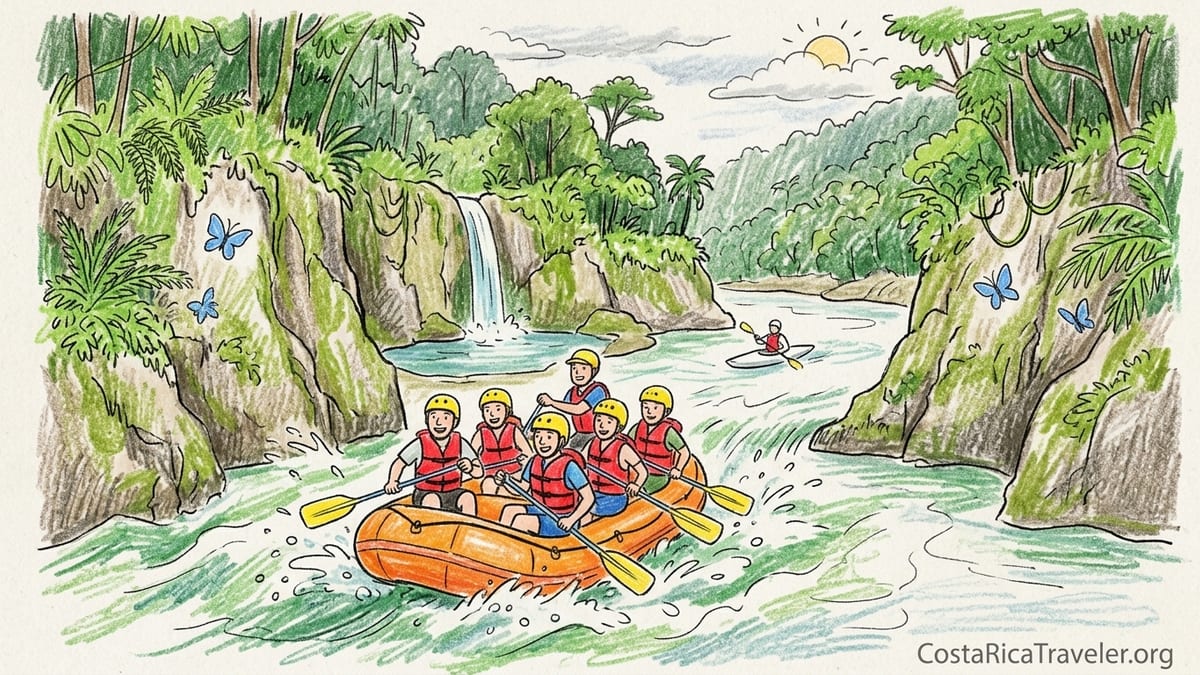
We practiced a few strokes in an eddy before the current caught the raft. The first kilometer consisted of gentle Class I and II ripples, enough to feel the pull of the water and get used to Allan’s sharp commands. Even in these easy stretches the scenery stole my attention. Steep forested slopes rose directly from the water. Vines draped from giant trees, and epiphytes clung to branches overhanging the river. A pair of blue morpho butterflies zigzagged briefly over the raft and disappeared into the foliage, a small reminder that this was genuinely wild rainforest, not a man-made theme park.
Within twenty minutes my T-shirt was damp with a mix of splash and sweat. Paddling looked leisurely in promotional photos, but holding the correct forward stroke position and rotating from the hips with each command was demanding. The raft felt light and responsive with six paddlers, and the margin for laziness was much smaller than I had imagined in the city.
Into the Gorges: Real Rapids, Rainfall and Rising Nerves
Our first real test came at a named Class III rapid that Allan introduced simply as “the warm-up.” The line was straightforward, but as we dropped into the tongue of smooth green water the raft bucked more violently than I expected. A standing wave crashed over the bow and soaked my legs. I dug my paddle into the froth with more desperation than technique, aware of the large boulders flashing by on either side.
The Pacuare’s famous canyon section unfolded in stages. Long calm pools alternated with boulder gardens and S-shaped drops where the river pinched between rock walls smothered in ferns and moss. At one point a narrow chute opened into a cathedral-like gorge with nearly vertical walls on both sides. Tiny waterfalls trickled from the greenery, some no wider than my hand, others broad enough to erode alcoves in the rock. We slid along beneath them, dodging spray as the raft spun gently in the slower current.
As the canyon tightened, the difficulty ratcheted up. Allan warned us before each major rapid, giving its name and nature. The day I ran the Pacuare we hit a sequence that included several genuine Class IVs, each with a distinct feel. One featured a sharp lateral wave that threatened to knock us off balance if we did not lean in aggressively. Another had a steep drop followed by a powerful hole on river left that we had to avoid with precise forward and back paddling.
Rain returned midway through the canyon, a steady curtain that blurred the ridgelines above us. It did not feel cold, but the additional water feeding into tributary streams raised the river level noticeably within an hour. Waves that had been just above knee height at the first big rapid were chest-high later in the morning. Allan commented quietly that the Pacuare was “waking up,” his euphemism for a river going from sporty to serious. Our margin for error shrank, and he shortened his commands to single syllables to keep reactions quick.
Waterfalls, Calm Sections and the Reality of Fatigue
Not every moment on the Pacuare is an adrenaline spike. After one intense stretch of rapids, Allan guided the raft into a calm eddy on river right where a clear waterfall dropped into a jade-green side pool. We hopped out carefully, helmets still on, and waded against the cool current until we were standing directly under the cascade. The force of the water on my neck and shoulders was startling after being seated in the raft. The stop was brief, maybe ten minutes, but crucial for shaking out legs and arms that were beginning to cramp.
Back in the raft, the physical toll of the morning caught up with me. My lower back tightened from bracing my feet under the thwart, and blisters began to form where the paddle shaft rubbed against my palms. The guides had not oversold the day as a workout. Even with consistent paddling from all six of us, Allan frequently asked for maximum effort to punch through big waves or avoid exposed rocks. During longer pools he deliberately had us paddle steadily rather than rest entirely so that we would not cool down too much or lose rhythm.
The calm sections were some of my favorite moments. We drifted silently past dense stands of jungle where layers of vegetation created a thousand shades of green. I spotted a pair of white egrets standing motionless on a gravel bar and heard the distant call of what the guide identified as a toucan, though it remained hidden in the canopy. The operator had never promised specific wildlife sightings, and in reality most of the movement was subtle: a splash from a fish, a flash of color from a bird, the rustle of branches high above as something moved away from the river at our approach.
By late morning the rain eased, leaving low clouds clinging to the canyon rim. The air felt heavier, and with the humidity came an almost sleepy calm between rapids. That fragile relaxation evaporated each time Allan called us to get ready for another Class III or IV, but the alternation between quiet and chaos was part of what made the Pacuare feel alive rather than like a continuous roller coaster.
The Final Rapids and Comparing Time on River vs. Transfers
The last major sequence of Class IV rapids arrived when my arms were already rubbery. Allan pulled over to a calm eddy and gave us a sober briefing. The upcoming drops required tight lines and quick responses. Swimming was possible if someone mis-timed a lean or failed to paddle through a lateral hit. While the guides did not dramatize the risk, there was a noticeable shift in tone. Helmets were re-tightened, PFD buckles checked again, and the safety kayaker went ahead to set up below the biggest features.
Running those final rapids felt like a controlled fistfight with the river. Waves broke over the bow and smacked me in the chest, momentarily blinding me. Commands came fast. “Forward! Forward! Get down! Left back!” My thighs burned from crouching low in the raft while still paddling. In one rapid the raft tilted sharply toward a boulder and we executed the high-side drill almost instinctively, scrambling toward the rock to keep from flipping. The move worked, and the raft slammed back down into the main flow upright. My heart pounded so hard afterward that I could feel it in my teeth.
Almost as abruptly as they began, the rapids eased. The canyon widened, the walls softened into forested slopes and houses appeared far above us on the hillsides. We passed under a road bridge, and the take-out at Siquirres came into view: a gravel ramp, clustered rafts and a line of waiting buses. It was just after 1:00 p.m. when we carried the raft onto the shore, which meant we had spent roughly three and a half hours on the water with short stops.
When I compared that to the logistics, the equation of the day became clear. From hotel pickup at 5:15 a.m. to final drop-off in Puerto Viejo around 5:30 p.m., the trip was a twelve-hour commitment. Of that, about three and a half hours were on the river, two and a half to three hours were the morning drive from San José including breakfast, another forty-five minutes was the drive from the center to the put-in, and roughly three and a half hours were the post-rafting shower, lunch and transfer to the Caribbean coast. If your primary goal is hours in whitewater, a multi-day trip that splits the shuttles over two or three days arguably offers better value in “river time” per hour of travel.
Back at the Exploradores center, we rinsed off in simple but clean showers and changed into dry clothes. The company provided towels. Lunch was a buffet of rice, beans, chicken or vegetarian options, salad and juice. It was included in the tour price, and my appetite after paddling made it feel like a feast rather than a standard tour meal.
Guide Qualifications, Safety and Who Should Not Go
One of the reasons I chose a major operator instead of a cut-rate deal was the emphasis on guide training. Exploradores Outdoors promotes that its lead guides hold international or national whitewater certifications and first-aid or wilderness first responder training. On our trip, Allan mentioned having more than a decade of experience on the Pacuare, and it showed in both his river reading and his calm but assertive presence in the boat. The safety kayaker had a throw bag, first-aid kit and communication device secured in his boat.
Before the trip I had wondered whether non-swimmers should attempt the Pacuare. Having now seen the river at medium-high flows, my personal view is that the answer depends heavily on their comfort level and strictly on following the operator’s own rules. The outfitter allowed non-swimmers but only if they wore PFDs at all times, listened carefully during the safety talk and accepted that going into the water, while not likely, was possible. In heavy rain or flood conditions, the same outfitter reserves the right to turn away non-swimmers or those who appear particularly anxious. That gatekeeping might disappoint some guests on the day, but on a river with genuine Class IV features it struck me as responsible rather than overly cautious.
Children are another sensitive category. The minimum age for this Pacuare run was fixed at 12 years, with no seasonal exception, and the guides enforced it. There were two 13-year-olds in another raft on our trip. Both were strong swimmers and had rafted before. Even so, their parents kept them close to the guide and double-checked gear at each stop. Watching those teenagers disappear momentarily behind waves on the bigger drops made it obvious why operators refuse younger kids despite persistent requests from vacationing families.
Travelers with known cardiac issues, severe asthma, uncontrolled diabetes or recent surgeries were advised by the operator to consult a doctor before booking. The real-world experience of the day explained why: this is not a gentle float. Paddling hard for minutes at a time, bracing through jolts and absorbing repeated cold-water hits is taxing even for generally fit adults. Anyone with doubts about their ability to handle elevated heart rate, cold shock or strenuous effort in a remote canyon should take those warnings seriously.
Finally, the company’s weather policy matters. In weeks of heavy rain, trips can be altered or canceled if the Pacuare reaches unsafe levels. Guests may be switched to alternate rivers with milder flows or different character. That can be frustrating if you are fixated on the Pacuare name, but having now seen how quickly the river can rise after sustained rainfall, I would not want to be with an operator that pushes out regardless just to avoid refunds.
Day Trips vs. Overnight Jungle Lodge Packages
On the drive out of the canyon we passed a riverside landing for one of the Pacuare jungle lodges. Multi-day packages here typically combine Class II–III entry rafting, one or two nights in a remote eco-lodge and a Class III–IV exit run back downstream. Current 2026 rack rates for these lodge-based experiences vary widely depending on comfort level, but it is common to see two- or three-day packages in the 300 to 650 US dollar range per person before tax, often including transportation from San José, all meals, guided hikes or canopy tours and the rafting itself.
Compared with my 130 US dollar plus tax day trip, the overnight options are a significant jump in price. However, they also spread the transfers across multiple days and offer additional river kilometers. Many itineraries start farther upstream than the standard day trip, giving guests more time in remote upper canyon sections before reaching the lodge, then continue through the classic lower canyon on departure day. People I met at my next hotel who had done the overnight version described waking to the sound of the river, swimming in side pools in the late afternoon when the rafts were off the water and watching night settle over the jungle without road noise or artificial light.
The trade-off is that you commit more of your Costa Rica itinerary to one area. For travelers on a ten- to fourteen-day route who want to split time between Arenal, Monteverde, the Caribbean and the Pacific, a full two- or three-day Pacuare package can feel like a big allocation. In my case, with only one open day between San José and the Caribbean, the single-day format was the only realistic option. If I return to Costa Rica with more flexibility, I would strongly consider an overnight package to deepen the experience and reduce the sense of racing through such a spectacular canyon.
From a physical perspective, overnight trips can be a bit kinder. You still paddle challenging rapids, but you are not combining them with a very early wake-up and long same-day cross-country transfer. You also have the chance to stretch, rest and soak tired muscles at the lodge between river days, instead of going straight from the take-out ramp to a bus seat for several more hours.
The Takeaway
My day on the Pacuare River was not a curated highlight reel. It started in the dark with a groggy 4:30 a.m. alarm, included long stretches of driving, featured rain for part of the morning and left me with sore shoulders, raw palms and a deep fatigue that hit only when the adrenaline wore off on the bus to Puerto Viejo. It also delivered some of the most striking river scenery I have ever seen, from narrow moss-lined gorges stitched with waterfalls to wide, glassy pools that reflected a ceiling of jungle.
The operator delivered what it promised in practical terms. The published price of about 130 US dollars before tax matched what I paid, and the inclusions were real: early hotel pickup, a hearty breakfast, properly fitted modern gear, a safety-focused briefing, three and a half hours on genuinely Class III–IV water, a filling lunch and onward transfer. There were no invented heroics, no staged rescues and no choreographed wildlife encounters. The river itself provided more than enough drama.
The hardest part of the day for me was not one specific rapid, although the final Class IV sequence in the lower canyon certainly spiked my heart rate. The true challenge was maintaining consistent, committed paddling while tired, wet and occasionally a little scared. Reacting quickly to commands, trusting the guide’s line through chaotic whitewater and staying mentally present even after hours on the move demanded more than casual effort. It was a reminder that on this river, guests are not passive passengers but active crew.
My favorite section was a quiet one: a long, winding gorge where the Pacuare slipped between vertical walls draped in curtains of vegetation and narrow waterfalls. The rapids there were mostly moderate, but the sense of being enclosed by living rainforest, far from roads and villages, was profound. If I were to choose again between formats, I would still do a one-day trip if time were tight, but given a more flexible itinerary I would invest in an overnight rafting-and-jungle-lodge package. The Pacuare is too special to rush, and having now felt its pull, I would happily trade a couple of beach days for one more dawn on that river.
FAQ
Q1. How much did my Pacuare River day trip actually cost?
The full-day Class III–IV Pacuare trip with Exploradores Outdoors cost about 130 US dollars per person before the 13 percent Costa Rican VAT, landing around 147 US dollars after tax, including breakfast, lunch, gear and transport from San José to the Caribbean.
Q2. How long was I actually on the water compared with driving and transfers?
From put-in to take-out I spent roughly three and a half hours on the river, while the overall day from 5:15 a.m. hotel pickup in San José to arrival in Puerto Viejo around 5:30 p.m. totaled about twelve hours, with the rest of the time devoted to driving, meals and preparation.
Q3. What were the real rapid grades on my trip?
The section I ran included a mix of Class II warm-up waves, sustained Class III boulder gardens and several genuine Class IV rapids that required precise paddling, strong lateral leans and close attention to the guide’s commands, especially after rainfall increased the flow.
Q4. What was the minimum age and who should avoid this trip?
The minimum age on my Exploradores Outdoors Pacuare run was 12 years. People with serious heart conditions, recent major surgery, uncontrolled epilepsy or advanced pregnancy were strongly advised not to participate and should follow the operator’s medical and eligibility rules.
Q5. Can non-swimmers safely raft the Pacuare?
Non-swimmers were allowed on my trip, but only if they wore properly fitted life jackets at all times, listened carefully to the safety briefing and accepted that falling in, while unlikely, was possible. In higher water, guides may decline non-swimmers for safety.
Q6. How did weather and river level affect the difficulty?
Overnight and mid-morning rain raised the Pacuare’s level from moderate to medium-high, making waves taller, currents faster and lines through Class IV rapids tighter. The guides adjusted routes and emphasized more aggressive paddling as the river “woke up.”
Q7. What gear was provided and what did I have to bring?
The operator supplied helmets, certified personal flotation devices, paddles and basic splash jackets, as well as towels after the trip. I needed to bring a swimsuit, synthetic or quick-dry clothing, secure closed-toe shoes, sunscreen, any medications and a dry change of clothes for after rafting.
Q8. How do one-day trips compare with overnight lodge packages?
My one-day trip cost about 147 US dollars after tax and gave me a concentrated three and a half hours on the river plus a cross-country transfer. Overnight jungle lodge packages typically run between 300 and 650 US dollars before tax, spread transfers across two or three days and add more river distance, lodging and rainforest activities.
Q9. What kind of physical condition is recommended?
Guests should be comfortable with sustained moderate to vigorous effort, including strong paddling, bracing in turbulent water and repeated cold-water hits. Basic cardiovascular fitness, decent balance and healthy joints make the experience more enjoyable and safer.
Q10. If I could choose again, which rafting format would I book?
With limited time I would book the same one-day Pacuare run for its mix of logistics and river time. With a more flexible itinerary, I would choose a two- or three-day rafting-and-jungle-lodge package to gain extra canyon sections and slower, deeper immersion in the rainforest.