

The Central Valley of Costa Rica is one of the easiest places in the country to tour in a single day. From San José, Alajuela and Heredia you can reach active volcanoes, misty coffee plantations, lush waterfall gardens and rafting rivers in just one to two hours. The challenge is not getting there, but choosing which combination of stops and which style of tour gives you the best value for your time and money. This guide compares the main Central Valley day trips and tour formats so you can confidently pick the experience that fits your travel style.
Understanding Central Valley Day Trips from San José
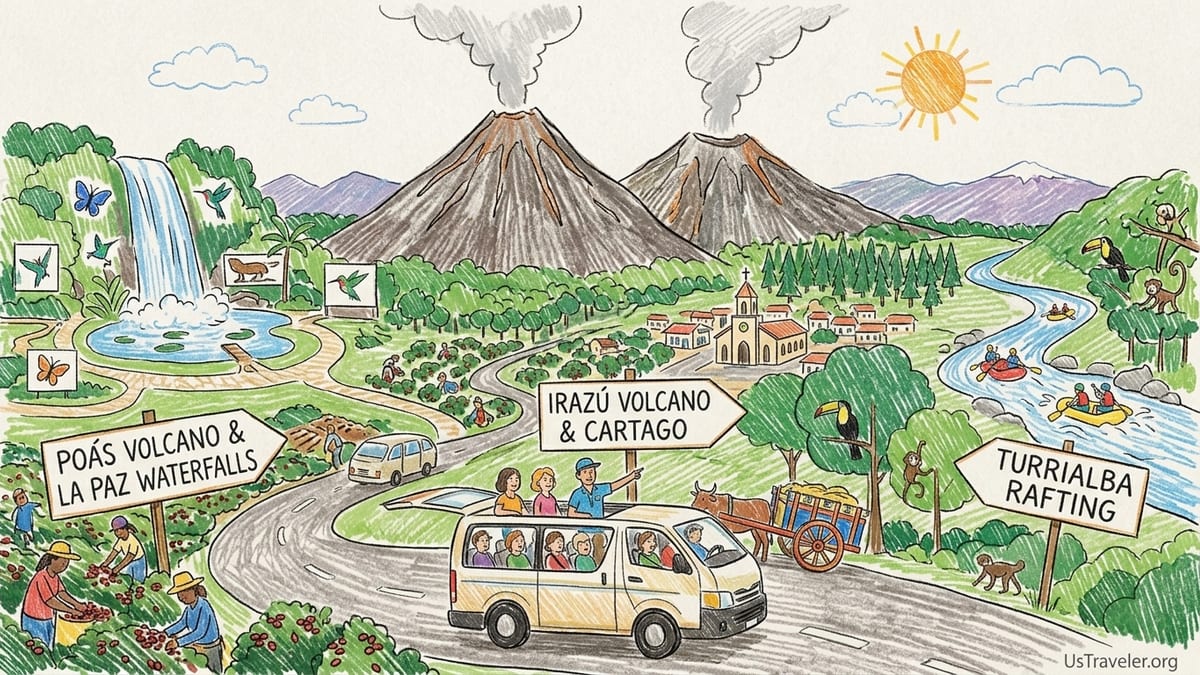
Most Central Valley excursions start from hotels in San José, Alajuela or the airport area, with pickup typically between 6:00 and 7:30 a.m. A classic full-day tour runs 10 to 12 hours, returning around late afternoon or early evening. Common routes radiate north to Poás Volcano and coffee farms, east to Irazú Volcano, Cartago and Orosi, and further east toward Turrialba for rafting and canyoning. Because distances are relatively short, it is realistic to visit two or even three major attractions in a single day without feeling rushed if the itinerary is well planned.
Group tours usually operate in air-conditioned minibuses or small coaches, while private tours use vans or SUVs for your party only. A typical shared Poás plus La Paz plus coffee tour, for example, will collect guests from a circuit of downtown and airport hotels before heading up toward the mountains. Private trips can often start later, adjust stops on the fly and linger at viewpoints or coffee farms according to your interests. When you compare options, pay close attention to what is included: entrance fees, meals, and whether hotel pickup is door to door or limited to central meeting points.
Travel times are a crucial factor. From central San José to Poás Volcano National Park is usually about 1.5 hours in light traffic. Reaching La Paz Waterfall Gardens, which sits on the northeastern flank of Poás, adds only another 20 to 30 minutes. Irazú Volcano, above Cartago, tends to be a two-hour climb each way. Turrialba and the Pacuare or Pejibaye rivers are also around two hours by road. These times can stretch during weekday rush hours around San José, so early starts are common and worthwhile.
Poás, Coffee and La Paz: The Signature Central Valley Combo
The most popular Central Valley day trip combines Poás Volcano, a coffee plantation tour and La Paz Waterfall Gardens. Many operators follow a similar pattern. After hotel pickup, the minibus heads first to a coffee estate such as Doka or Britt, where visitors learn about cultivation, harvesting and roasting, and sample freshly brewed coffee. From there, the road continues up to Poás for a timed entry slot at the crater viewpoint, before dropping down the Caribbean slope to La Paz Waterfall Gardens for lunch and an afternoon of trails and animal exhibits.
On current commercial itineraries, this combo usually runs from about 6:30 a.m. to 6:00 p.m. and includes breakfast or lunch, entrance fees and a bilingual guide. Prices for shared tours tend to fall in a mid-range per-person bracket, with private versions priced higher but covering just your group. For instance, some private operators sell a Poás plus La Paz day with hotel pickup, buffet lunch and all entries included, while others separate food and entry costs to keep the listed rate lower. Always read the inclusions carefully so you can compare like with like.
La Paz Waterfall Gardens itself is a substantial attraction, not just a quick stop. The park contains several waterfalls, a large animal sanctuary with rescued wildlife, a butterfly observatory and hummingbird garden, plus paved and stepped trails through cloud and rainforest. It sits about 45 minutes from the San José airport and roughly 20 minutes from Poás, which explains why it so often appears in combination tours. If you join a group trip, expect to have three to four hours there, usually including a buffet lunch at the onsite restaurant. Self-drivers can spend longer, but should factor in that tickets are not inexpensive and the park is designed as a full-day destination.
Irazú, Cartago, Orosi and Botanical Gardens
The other classic Central Valley day trip pairs Irazú Volcano with Cartago and the Orosi Valley. A typical itinerary collects guests in San José around 7:00 a.m., then climbs toward Irazú’s crater rim. At the top, if the weather cooperates, visitors peer into the ash-colored crater and walk across the moonlike landscape of the national park. Because clouds often roll in by late morning, reputable operators schedule Irazú as the first stop and emphasize early departures.
After descending, most tours stop in Cartago, the former capital, to visit landmarks such as the Basilica de los Ángeles and the ruins of the old parish church on the main square. Some itineraries then continue into the Orosi Valley to admire views of Lake Cachi, drive through coffee-covered hills and stop in the village of Orosi itself. Others substitute or add the Lankester Botanical Garden, known for its orchid collections. Commercial Irazú plus Cartago plus Orosi day trips from San José usually last around eight to ten hours and often include a sit-down lunch at a countryside restaurant.
Pricing for these Irazú-based tours is broadly comparable to the Poás and La Paz circuits, with group tours including hotel pickup, transport, guide services and national park fees. When comparing, look not just at cost but at how many stops are realistically built into the day. For example, a tour that lists Irazú, Cartago, Orosi and Lankester in one day may be more rushed than one that chooses only Irazú, Cartago and a leisurely valley viewpoint plus lunch. For independent travelers renting a car, this route is straightforward but involves mountain driving and can be foggy, so comfort with winding roads is important.
San José City and Cultural Tours
While volcano and nature excursions dominate Central Valley day trips, cultural tours of San José itself are also widely offered. These typically include hotel pickup in the late afternoon or early evening and last three to five hours. A standard route might cover the National Theater, the Pre-Columbian Gold Museum or Jade Museum, the central market, main plazas and historic neighborhoods such as Barrio Amón or Barrio Escalante. Some tours combine guided walking with a traditional dinner in a city restaurant, while others focus on architecture and history.
City tours tend to be more affordable than full-day volcano trips because there are no national park fees and the driving distances are short. Shared evening excursions by minibus are common and are convenient for travelers who do not want to navigate after dark or worry about parking downtown. Private guides and drivers can customize the experience further, for example adding a craft beer stop, a coffee tasting or a visit to local galleries. For visitors who only have one or two nights in the capital, a well-structured city tour can provide context about Costa Rican history and everyday life before you head to the beaches or rainforests.
Self-guided exploration is easy in the central districts during daylight, but guided tours come into their own if you prefer to be picked up and dropped off at your hotel, are concerned about safety after dark, or want commentary from a local expert. When evaluating a cultural tour, look at the maximum group size, whether museum entrance fees are included, and if the tour operates in your preferred language. Many operators run bilingual Spanish and English tours, with some offering additional languages on request for private groups.
Coffee-Focused Excursions around the Central Valley
Dedicated coffee tours are a highlight of the Central Valley. Well-known estates near San José include Doka Estate near Poás, Café Britt in Barva de Heredia and smaller farms in Naranjo, Sarchí and the hills above Cartago and Turrialba. Half-day tours often combine a plantation visit with tastings and a simple meal, making them ideal if you want a shorter excursion or need to fit sightseeing around flights. Many operators provide morning hotel pickup, transport to the farm, an interactive tour explaining cultivation and processing, and return to your hotel by mid-afternoon.
Coffee is frequently bundled with other stops. For example, several Poás plus La Paz itineraries start with breakfast at a coffee estate, followed by a walking tour through fields, drying patios and roasting rooms. Some San José-based agencies offer a “coffee and culture” day that mixes a farm visit with a guided city tour. When comparing options, check whether you are visiting an operating farm during harvest season or a more theatrical demonstration style attraction; both can be enjoyable, but the experience feels different. If visiting independently, you will usually need to reserve a tour time directly with the estate and may need a rental car or taxi to reach rural locations.
Prices for coffee-focused excursions vary according to whether they are group or private, and whether they include meals. A private half-day tour with hotel pickup, plantation visit and lunch will typically cost more per person than a seat on a larger shared bus, but gives you more flexibility to ask detailed questions and linger in the café or gift shop. For serious coffee enthusiasts, private barista sessions and cupping experiences are available at some estates and in specialty coffee shops in San José, usually by prior arrangement.
Turrialba and Active Adventures: Rafting, Canyoning and More
Travelers seeking more adrenaline often look east to Turrialba and the Pacuare or Pejibaye rivers. Full-day rafting tours from San José generally include an early hotel pickup, a drive of roughly two hours toward Cartago and Turrialba, breakfast at a roadside restaurant, several hours of rafting, a riverside picnic lunch and return transport in the late afternoon. Well-known operators supply professional river guides, safety kayakers, helmets, life jackets and all technical gear, which makes these activities accessible even if you have no prior rafting experience.
The Pacuare River is famous for its jungle canyon scenery and class III to IV rapids, typically offered to reasonably fit adults and older teenagers. The Pejibaye River near Turrialba, with class II to III rapids, is marketed as more family-friendly, suitable for children and older travelers who still want a taste of whitewater. Some companies offer multi-day packages that combine rafting with overnight stays in riverside lodges, while others sell one-day excursions that return to San José the same evening. As with volcano tours, inclusions matter: better operators roll transport, breakfast, lunch, all river fees and equipment into a single price.
Turrialba also serves as a base for canyoning, canopy tours, horseback riding through coffee and sugarcane fields, and visits to rural communities and indigenous villages. These products are often sold as part of multi-day itineraries rather than simple day trips, but some agencies will arrange a one-day private adventure from San José for travelers with limited time. Because Turrialba lies farther from the capital and road conditions can change with weather, a guided tour or private driver is usually more practical than self-driving for first-time visitors, especially in the rainy season.
Group Tours vs Private Tours vs Self-Drive
Choosing between a group tour, a private tour and self-driving depends on your budget, comfort with local roads and desire for flexibility. Group tours are the most economical option for solo travelers and couples. They offer predictable schedules, a guide, and built-in logistics such as timed entries for attractions like Poás Volcano National Park and lunch reservations at La Paz Waterfall Gardens. The trade-offs are early pickup rounds, fixed itineraries and limited flexibility if you want to linger at a viewpoint or skip a souvenir stop.
Private tours cost more per vehicle but can be excellent value for families or small groups, especially for itineraries such as Poás plus La Paz or Irazú plus Orosi. You gain door-to-door pickup, control over departure time within reason, and the ability to adjust the pace. For example, families with young children may prefer to shorten time at Cartago’s churches and add an ice cream stop, while amateur photographers may ask for extra time along scenic valley roads. Many private drivers are also licensed guides, and some can combine driving services with informal guiding at certain sites.
Self-drive offers maximum independence but comes with caveats. Roads to Poás, La Paz, Irazú and the coffee highlands are paved but steep, with sharp curves, changing weather and occasional fog. Parking at major attractions like La Paz Waterfall Gardens and the national parks is straightforward, and the sites have their own ticket offices. However, driving out of San José in rush hour, dealing with unfamiliar traffic patterns and navigating narrow mountain roads can be stressful. Self-driving tends to work best for confident drivers, those who already plan to rent a car for a longer itinerary, or travelers who want to combine a Poás and La Paz loop with a transfer to Arenal or the Caribbean rather than return to San José.
What Is Typically Included: Pickup, Fees, Meals and Timeframes
When comparing Central Valley tours, look beyond the headline destination list to the details of what is included. Most reputable full-day excursions from San José offer hotel pickup and drop-off from major hotels in San José, Alajuela and sometimes Heredia. Some charge extra for outlying locations or require guests staying in private rentals to meet at a central hotel or shopping mall. Pickup windows can be 20 to 50 minutes long depending on how many stops the minibus must make to collect participants.
Entrance fees are a major cost component. Poás Volcano National Park, Irazú Volcano National Park, La Paz Waterfall Gardens, coffee estates and botanical gardens all charge per-person entry. Many day tours bundle these fees into the ticket price, which simplifies budgeting but makes the headline rate look higher than options that list fees as “not included.” In practice, once you add up entries and meals, an inclusive tour can be better value and reduce the need to carry large amounts of cash. Always verify whether national park permits and private attraction tickets are covered before booking.
Meals range from simple roadside breakfasts to full buffet lunches. A Poás plus La Paz plus coffee day, for instance, might include a typical Costa Rican breakfast at a coffee plantation and a buffet lunch inside La Paz Waterfall Gardens. Rafting trips usually include breakfast on the way to the river and a picnic lunch served riverside. City and cultural tours might bundle a single dinner or leave meals at your own expense. Typical full-day excursions last eight to twelve hours, while half-day coffee or city tours run four to six hours. If you are connecting to or from the airport the same day, leave generous buffers; traffic delays are common around San José, especially in the late afternoon.
When to Join a Tour and When to Go It Alone
Certain Central Valley experiences lend themselves strongly to guided tours. Activities that involve technical equipment or safety considerations, such as rafting on the Pacuare or canyoning near Turrialba, should be done with licensed operators. Likewise, volcano trips that rely on timed national park entries and weather windows benefit from guides who monitor conditions and adjust plans accordingly. For many travelers, the convenience of being picked up at the hotel, not needing to navigate mountain roads and having commentary throughout the day justifies the cost.
On the other hand, confident drivers may prefer to self-drive to nearby sites such as Poás Volcano and La Paz Waterfall Gardens, especially if they want to move at their own pace or are using the excursion as a one-way transfer to another region. The same applies to coffee estates that allow independent visitors by prior reservation. In these cases, renting a car for a day and paying your own entrance fees can be cost-effective for families or groups. It is important to start early to avoid clouds at the volcanoes and to check the latest road and park conditions before setting out.
Hybrid approaches are also common. Some visitors hire a private driver for the day to reach Irazú, Cartago and Orosi or to combine a coffee tour with Poás and La Paz, effectively creating a semi-guided trip with maximum flexibility but without the responsibility of driving. Others may explore San José independently by day and join a guided evening food or culture tour. The right choice depends on your priorities, but in all cases it pays to clarify logistics, inclusions and cancellation policies before confirming any booking.
The Takeaway
Central Valley day trips from San José offer a rich mix of volcanoes, coffee culture, waterfalls, gardens, history and adventure. Poás plus coffee plus La Paz combinations are ideal if you want a classic “best of” nature day in the highlands, with relatively short drives and a balance of scenery, wildlife and local flavors. Irazú plus Cartago plus Orosi tours deliver striking volcanic landscapes framed by colonial history and lush valleys. Coffee-focused excursions deepen your understanding of one of Costa Rica’s signature exports, while trips to Turrialba cater to adrenaline-seekers drawn to whitewater and canyon walls.
When choosing between tour options, focus on more than just the destination list. Consider whether you prefer the social atmosphere and lower per-person cost of group tours, the flexibility and privacy of a private driver-guide, or the independence of renting a car and designing your own route. Pay attention to hotel pickup zones, what entrance fees and meals are included, and realistic travel times between stops. With a clear sense of your budget, interests and comfort level on the road, you can select the Poás, Irazú, coffee, La Paz, Orosi or Turrialba experience that turns a simple day trip into a highlight of your Costa Rica journey.
FAQ
Q1. Is it better to visit Poás or Irazú Volcano from San José?
Poás is closer and pairs naturally with coffee estates and La Paz Waterfall Gardens, making it ideal for a varied nature day. Irazú offers higher elevation, sweeping crater views and combines well with Cartago and the Orosi Valley. If you want shorter drives and more variety in one day, Poás is usually best; if you prefer stark volcanic scenery and historic towns, choose Irazú.
Q2. How long is a typical Poás, coffee and La Paz day trip?
A standard Poás plus coffee plus La Paz tour usually lasts about 10 to 12 hours. Most operators pick up around 6:30 to 7:30 a.m., visit a coffee plantation for breakfast and a tour, continue to Poás for a timed crater visit, then spend three to four hours at La Paz Waterfall Gardens with lunch included before returning to San José in the late afternoon or early evening.
Q3. Are entrance fees included in Central Valley day tour prices?
Often they are, but not always. Many reputable operators include national park permits for Poás or Irazú, La Paz Waterfall Gardens entry and coffee estate fees in the advertised price. Others list these as extras to be paid on the day. Always read the inclusions section carefully and, if necessary, ask the operator to confirm in writing which entrance fees and meals are covered.
Q4. Do tours offer hotel pickup from the San José airport area?
Yes, most Central Valley tours provide pickup from major hotels in San José, Alajuela and the airport corridor. Some may charge a small surcharge or require a minimum number of participants for pickups outside the central area. If you are staying in a vacation rental, you may be asked to meet at a nearby hotel or a central landmark.
Q5. When should travelers consider renting a car instead of booking a tour?
Renting a car can make sense for confident drivers who want maximum flexibility, especially for visiting Poás, La Paz or coffee estates at their own pace or combining these stops with onward travel to Arenal or the Caribbean. It is less advisable for first-time visitors uncomfortable with mountain roads, or for activities like rafting and canyoning where specialized guides and equipment are essential.
Q6. Are Central Valley day trips suitable for children and older travelers?
Yes, many are. Poás, La Paz and coffee plantation tours are commonly marketed as family-friendly. Paths at La Paz and some coffee estates include stairs and uneven surfaces, so mobility should be considered. Rafting on gentler rivers near Turrialba, such as family-oriented sections of the Pejibaye, can be suitable for children and older adults, while more intense Pacuare trips are best for fit, confident swimmers.
Q7. What should I wear and bring on a volcano and coffee tour?
Dress in layers, as temperatures range from warm in the valley to cool and windy at the volcano craters. Wear comfortable closed shoes with good grip, a light waterproof jacket, sunscreen and a hat. Bring a reusable water bottle, insect repellent for lower elevations and some cash or a card for snacks and souvenirs at coffee estates or La Paz.
Q8. How far in advance should I book a Poás or Irazú tour?
It is wise to book at least several days in advance, especially in the high season from December to April, because national park entries have daily limits and popular Poás and La Paz combos can fill quickly. For private tours or custom itineraries that combine multiple stops, booking one to two weeks ahead provides better availability and flexibility.
Q9. Can I combine a Central Valley day trip with a same-day flight?
It is possible but not ideal. Full-day tours often return to San José in late afternoon when traffic is heaviest, which can be risky if you have an evening departure. If you must combine a tour and flight on the same day, choose a shorter half-day coffee or city tour, inform the operator about your flight time and leave generous buffers.
Q10. Are San José city tours worth it if I only have one night in the capital?
Yes, an evening or half-day city tour can be a good way to experience the National Theater, main plazas, markets and museums without worrying about logistics. For travelers who spend most of their time at beaches or in the rainforest, a guided city visit adds cultural and historical context to the trip and makes good use of a short stay in the Central Valley.