

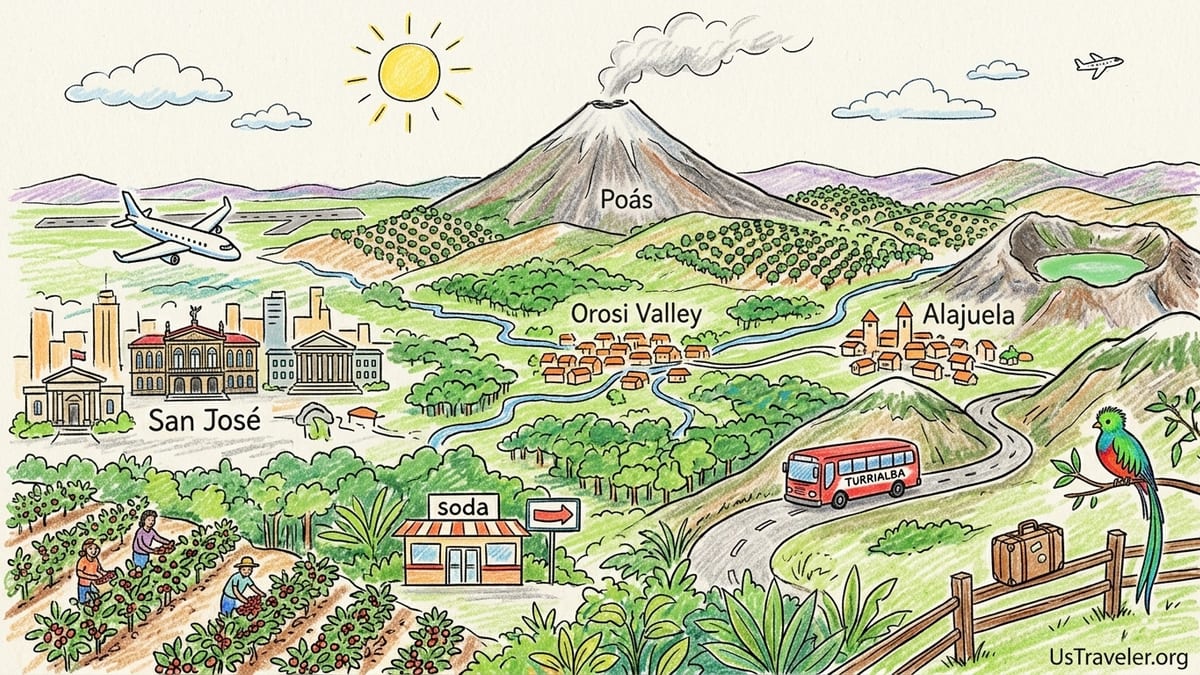
Costa Rica’s Central Valley is far more than a transit hub between beaches and rainforests. Centered on San José and the surrounding highlands, it blends historic cities, steaming volcanoes, cool coffee country and some of the most scenic valleys in the country. With short driving distances and a wide range of small hotels and lodges, it is an ideal region for travelers who like to base themselves in one or two places and explore with day trips. This guide focuses on the Central Valley core: San José, Poás and Irazú volcanoes, the coffee lands of Alajuela, Heredia and Los Santos, plus the historic cities and valleys of Cartago, Orosi and Turrialba.
How to Use the Central Valley as a Base
The Central Valley sits at roughly 900 to 1,700 meters above sea level, which keeps temperatures moderate compared with the coasts. Many international flights land at Juan Santamaría International Airport, between San José and Alajuela, which makes this area a logical start or end point for a Costa Rica itinerary. For most travelers, the choice is whether to sleep in the capital itself or in smaller towns such as Alajuela or Heredia and then make excursions to volcanoes, coffee farms and valleys.
San José works best for travelers interested in culture, museums and nightlife, and for those who are comfortable navigating a busy Latin American city. Alajuela and Heredia suit visitors who want easier access to Poás Volcano and coffee country while staying closer to the airport. Cartago, Orosi, Turrialba and the Los Santos region make rewarding overnight bases if you want more time for hiking, rafting or coffee immersion, but they are farther from the main airport and often require an extra travel day.
To keep driving manageable, many visitors plan two or three nights in San José or Alajuela at the beginning or end of a trip, using that time for day tours to Poás Volcano, nearby coffee estates and city sights. Then they add one or two nights in Cartago or Orosi for cloud forest hikes and hot springs, and two nights in Turrialba if rafting the Pacuare River is a priority. Los Santos works best as a quiet add-on of two or more nights for serious coffee fans and hikers.
San José: Culture Hub and Urban Base
San José is the cultural and political heart of Costa Rica, and the best place in the Central Valley for museums, performing arts and urban food culture. Downtown remains compact and walkable. Within a few blocks you can move from the neoclassical halls of the Teatro Nacional to the Pre-Columbian Gold Museum beneath Plaza de la Cultura, the Jade Museum’s modern galleries, and the Museo Nacional housed in a former fortress where bullet marks from the 1948 civil war are still visible. A typical museum ticket costs the equivalent of roughly 10 to 18 US dollars per adult, with discounts for children and students.
Neighborhoods north of the center, such as Barrio Amón and Barrio Otoya, preserve early 20th century wooden mansions that now house small hotels, cafes and design shops. Staying here places you within a 10 to 15 minute walk of the main museums while avoiding the busiest commercial streets. Travelers with one full day in the city often combine a morning walking Avenida Central and the Central Market, lunch at a simple soda (local diner) or contemporary coffee shop, and an afternoon in either the Gold or Jade museum before dinner at a modern Costa Rican restaurant in Barrio Escalante.
San José is not a wildlife destination and does not offer the volcano views of smaller towns, but it is the best Central Valley base if you want to understand Costa Rican history and contemporary culture. It works well for one to three nights at the start or end of a trip. From a practical standpoint, you will find the widest range of accommodations here, from budget hostels around Avenida Central to mid-range business hotels and a handful of boutique properties in Barrio Amón and Escalante. Many tour operators include hotel pickup in San José for full-day excursions to Poás Volcano, coffee farms, waterfalls and rafting rivers.
Alajuela, Heredia and Coffee Country around Poás
Alajuela city lies just northwest of the main international airport and makes a convenient, lower-key alternative to San José for the first or last night of a trip. The compact center has a cathedral square, several basic hotels and guesthouses within an inexpensive taxi ride of the airport, and easy access to highway routes toward Poás Volcano and the northern lowlands. For many travelers, Alajuela is a practical overnight base before a morning flight, with time for an evening stroll and a simple dinner near the central park.
North of Alajuela and Heredia the city quickly gives way to coffee plantations and cloud forest. Hillside communities such as San Isidro de Alajuela, Fraijanes and the slopes approaching Poás Volcano are dotted with boutique inns, chalet-style lodges and coffee farm stays. A typical mid-range lodge might offer coffee plantation views, a fireplace in the main lounge and breakfast included, with room rates often in the range of 120 to 200 US dollars per night depending on season. These properties are ideal if you want quiet evenings, cool nights and easy access to both Poás Volcano National Park and organized coffee tours.
Heredia, sometimes called the City of Flowers, is a university town with a manageable center, colonial-era church and several cafes popular with students. It is a comfortable overnight destination for travelers who prefer a local atmosphere over downtown San José but still want to stay close to museums and city day trips. Coffee enthusiasts can book guided tours at well-known estates in the hills above Heredia and Alajuela, where guides explain bean varieties, processing methods and the economics of Costa Rican coffee. Many tours end with tastings and the option to purchase beans directly from the source.
Poás Volcano: Day Trip for Volcano Views and Short Hikes
Poás Volcano National Park is one of the most accessible active volcanoes in Central America. The crater viewpoint sits at the end of a short, paved path at roughly 2,700 meters above sea level, where visitors look down into a turquoise crater lake framed by sulfur-stained rock. Because the volcano is active, access regulations change over time, and advance reservations with a timed entry slot are typically required. Recent travelers report that visits to the main crater viewpoint are often limited to short periods, around 20 minutes, to reduce exposure to volcanic gases and manage crowds.
The park also offers short forest trails to viewpoints over the surrounding countryside and, in clear weather, down toward the Central Valley. On cloudy mornings the crater can be completely obscured, so many local guides recommend booking the earliest possible entry slot and planning some flexibility. A standard day tour from San José or Alajuela often combines Poás with a coffee plantation visit and possibly a stop at waterfalls or a strawberry farm. Full day packages usually cost in the range of 90 to 160 US dollars per person including transport, guide, park fees and lunch.
Because of its proximity to the airport and Central Valley towns, Poás works best as a day excursion rather than a primary overnight destination. Travelers who stay two or three nights in the coffee country between Alajuela and Poás can visit the crater early one morning, then spend the rest of their time visiting coffee estates, walking nearby cloud forest trails or simply enjoying the cool climate. The area is suitable for short hikes and birdwatching, but longer backcountry treks are more common in regions such as Los Santos and Tapantí.
Cartago and Irazú: History, Highlands and Panoramic Volcano Scenery
Cartago, about 25 kilometers east of San José, is Costa Rica’s oldest major city and was the colonial capital until the early 19th century. Today it is a workaday provincial city framed by highland fields and volcano slopes. The Basilica de Nuestra Señora de los Ángeles, with its mix of Byzantine and colonial influences, is a national pilgrimage site, and the partial ruins of the old Santiago Apostol Parish add atmosphere to the compact center. Cartago itself offers modest urban sightseeing, local markets and a handful of hotels and guesthouses aimed mainly at domestic visitors and students.
The primary draw for most international travelers is Irazú Volcano, whose summit lies around 3,400 meters above sea level. On clear mornings the crater area offers panoramic views over the Central Valley and, on exceptional days, toward both the Caribbean and Pacific coasts. The national park’s main trails are short and exposed, and the high altitude means temperatures can feel near freezing with wind chill, especially at dawn. Visitors should bring layers, a hat and sun protection even if departing from warm San José. Entry fees are comparable to other Costa Rican national parks.
Cartago and Irazú work well as either a day trip from San José or as an overnight combination with Orosi Valley. Travelers who want to see sunrise at Irazú or explore more of the surrounding highlands may prefer to spend a night in Cartago or on a small farm stay in the foothills, but the city is close enough that many visitors are satisfied with a single day excursion that combines the Basilica, a simple lunch in town and an afternoon or morning at the volcano.
Orosi Valley: Coffee, Hot Springs and Rainforest Hiking
South of Cartago the road descends into the Orosi Valley, one of the most picturesque areas of the Central Valley region. The landscape here blends steep green hillsides, coffee and sugarcane plots, the Cachi Reservoir and patches of rainforest. The small town of Orosi has a colonial church and simple plaza, with a handful of family-run guesthouses, lodges and restaurants serving hearty casados and trout from local streams. Prices in small inns are often lower than in San José, and the atmosphere is notably quieter, particularly on weekday nights.
The valley is a good base for travelers who want a mix of light culture, hot springs and serious hiking. Several properties in the area offer thermal mineral pools with valley views, sometimes as part of a hotel and sometimes as day-use facilities, typically charging a few tens of dollars for entry or including access for overnight guests. A short drive southeast brings you to the Tapantí-Macizo de la Muerte National Park, one of the rainiest and lushest protected areas in Costa Rica. Well-marked trails lead through dense forest along rivers and waterfalls, where birdlife includes quetzals, tanagers and hummingbirds. Day visitors can expect basic facilities such as parking, picnic areas and signed paths, but services are more limited than in heavily visited national parks.
Orosi is worth at least one or two nights for travelers focused on hiking and countryside scenery. It is less convenient for frequent day trips back to San José given the winding road, but it combines naturally with Cartago and Irazú on a loop through the eastern Central Valley. Travelers without a rental car can arrange private transfers or book guided day tours from San José that visit the Orosi lookout, church and a hot springs complex, though these often spend less time on longer forest hikes.
Turrialba: Countryside Base for Rafting and Archaeology
Turrialba, east of Cartago, has a relaxed agricultural feel and serves as the main gateway to several of Costa Rica’s best known whitewater rivers. The town itself is modest, with a central park, supermarkets, basic hotels and a few more atmospheric lodges on the surrounding hillsides that combine valley views with on-site trails and small restaurants. Nightlife is limited, which suits travelers who come primarily for early-morning rafting departures or quiet evenings after outdoor activities.
The Pacuare River, accessed from the Turrialba region, is widely regarded as one of the country’s top whitewater rafting destinations, with sections of class III and IV rapids that run through a steep-walled jungle canyon. Rafting companies based in Turrialba and San José offer one-day runs and overnight trips that include riverside eco-lodges only reachable by raft. Prices for full-day trips with transport, gear, guide and lunch typically start in the low hundreds of US dollars per person, with higher rates for multi-day itineraries that include lodging and additional activities such as canyoning or zip lining.
Beyond rafting, the area around Turrialba offers hiking, mountain biking and cultural visits. The Guayabo National Monument, a pre-Columbian archaeological site set on the slopes above town, preserves stone causeways, aqueducts and mounds amid secondary forest. Visitors can combine a half-day visit here with an afternoon walk in the countryside or a coffee farm tour. Turrialba Volcano itself has experienced periods of notable activity in recent years, which has affected access to its upper slopes; conditions and regulations can change, so travelers interested in visiting the highlands around the volcano should confirm current status with local operators shortly before arrival.
Turrialba is a strong candidate for a two or three night stay if rafting or archaeology is a priority. The travel time from San José is longer than to Poás or Irazú, but staying locally avoids pre-dawn departures and late returns. It is less suited to day trips, though some operators do run long-day Pacuare tours from San José and La Fortuna for visitors who cannot spare the extra night.
Los Santos: High-Altitude Coffee and Underrated Hiking
South of the Central Valley, reached via the Inter-American Highway toward Cerro de la Muerte, the Los Santos region encompasses highland cantons such as Dota, Tarrazú and León Cortés. This is one of Costa Rica’s most celebrated coffee regions, producing high-altitude beans that regularly earn premium prices on international markets. Hillside towns like Santa María de Dota, San Marcos and Copey sit amid patchwork slopes of coffee farms, pasture and patches of cloud forest. The climate is cool, often misty, and nights can feel cold compared with San José, especially above 2,000 meters.
Los Santos is ideal for travelers who value quiet rural landscapes over nightlife and resort facilities. Coffee cooperatives and family-run estates offer tours that explain each stage of production, from selective hand picking to wet and dry processing and roasting, usually followed by tastings. In some cases you can stay directly on a working coffee farm in simple but comfortable rooms, waking to views of valley slopes lined with coffee plants and the sound of roosters and church bells from nearby villages. This region is also known among Costa Ricans as a good area for farm-to-table cuisine, with cheeses, smoked trout and baked goods made in small local kitchens.
For hikers, Los Santos offers a growing network of trails through cloud forest ridges and rural backroads, ranging from half-day walks to multi-day treks that link villages and viewpoints. Some routes follow old coffee transport paths, while others climb to high peaks with expansive views over the Talamanca range on clear days. Infrastructure is more limited than in national parks, so visitors should expect basic trailheads, local guides and homestays rather than marked visitor centers. Birdwatching is excellent, with chances to see quetzals around higher elevation forests, especially in the early morning during the dry season months.
Because of travel time from San José and the slow, winding local roads, Los Santos rewards a stay of at least two nights, preferably three, rather than a rushed day trip. It is best suited to travelers with a rental car or those willing to arrange transfers through lodges or local operators. For many, a stay here serves as a quiet interlude between more crowded beach or volcano destinations, focused on walking, coffee, reading by the fire and conversations with local hosts.
Overnights vs Day Trips: Matching Places to Interests
When planning a Central Valley itinerary, it helps to group destinations by which are best as home bases and which are better treated as excursions. San José, Alajuela or Heredia, Turrialba, Orosi and the Los Santos region all work well as overnight bases depending on your interests. Poás Volcano and, for many visitors, Irazú Volcano fit naturally as day trips. Cartago city itself can go either way, serving as a half day stop en route to Orosi or as a simple overnight stop for those who prefer to divide driving days.
For culture, museums and urban dining, San José is the clear overnight choice, with Heredia a quieter alternative close by. For coffee tourism that still allows quick access to the airport and city, consider one or two nights in the hills above Alajuela or Heredia, where you can tour nearby estates and visit Poás in a day. Travelers who prioritize hot springs and rainforest hikes in Tapantí should plan at least one night in Orosi or its surroundings, while those keen on rafting and archaeology will get more from Turrialba by staying two nights to allow both a full rafting day and a separate visit to Guayabo.
Wildlife in the Central Valley is more subtle than in coastal rainforests, but birdwatchers in particular will appreciate dawn walks around coffee country and highland parks. For scenic countryside and slower travel focused on rural life, Los Santos offers the most immersive experience and is best enjoyed over several days. In contrast, travelers with limited time who still want a varied introduction to the Central Valley can base themselves in San José or Alajuela for three nights, taking one full day to Poás and a coffee farm, one day for San José’s museums and markets, and, time permitting, a third day to Cartago and Irazú.
FAQ
Q1. Is San José worth an overnight stay or just a transit stop?
San José is worth at least one night if you are interested in Costa Rican history, architecture and food. With a full day you can visit the main museums, walk Avenida Central, explore a historic neighborhood such as Barrio Amón and enjoy dinner in a local restaurant. If you prefer nature over cities and arrive late at night, you might choose to stay in Alajuela near the airport instead and head straight to rural areas the next morning.
Q2. Should I stay in Alajuela or San José for visiting Poás Volcano?
Both work, but Alajuela and the nearby hills are more convenient for Poás. Staying north of the airport typically shortens the drive to the park and makes it easier to book an early morning entry slot, which often offers clearer views of the crater. San José offers more nightlife and cultural options, so the decision comes down to whether you value city amenities or shorter travel times to the volcano and coffee country.
Q3. How many days do I need for Cartago, Irazú and Orosi?
Many travelers combine Cartago and Irazú Volcano as a single long day trip from San José, with a quick stop at the Basilica and lunch in town. To add the Orosi Valley, hot springs and a hike in Tapantí National Park, plan at least one night in Orosi or its surroundings. A two-night stay in the valley gives you time for a full hiking day, a relaxed visit to Cartago and half a day in the hot springs without rushing.
Q4. Is Turrialba only for hardcore rafters?
No. While the Pacuare River is the main draw, Turrialba also offers gentler river sections, countryside walks, mountain biking and the Guayabo archaeological site. Families and travelers who prefer calmer activities can skip the most challenging rapids and instead choose scenic float trips on milder rivers or spend their time exploring farms and Guayabo. That said, if rafting does not interest you at all, other Central Valley bases like Orosi or Los Santos may align better with your priorities.
Q5. What is the best base for coffee-focused travel?
If you want in-depth coffee experiences with easy logistics, choose the hills above Alajuela or Heredia, where several large and mid-sized estates offer tours in English and day trips from the city. For a more immersive, small-town experience in a region famous for high-altitude beans, plan two or three nights in the Los Santos area around Dota or Tarrazú. There you can often combine farm stays, cooperative tours and guided walks through coffee plots and nearby cloud forest.
Q6. Can I see wildlife in the Central Valley, or do I need to go to the coasts?
You will not find the same density of monkeys, sloths and large mammals as in coastal rainforests, but birdlife is excellent in the highlands and coffee landscapes. Areas around Poás, Tapantí and Los Santos are known for hummingbirds, tanagers and, at higher elevations, resplendent quetzals. Many lodges set up feeders near dining areas, making it easy to see colorful birds at close range. For classic rainforest wildlife, however, you will still want to include a coastal destination elsewhere in your itinerary.
Q7. Is renting a car necessary to explore these Central Valley destinations?
Renting a car offers the most flexibility, especially for reaching Orosi, Turrialba and the Los Santos region on your own schedule. Roads are generally paved but can be narrow, steep and winding, and parking in central San José requires extra attention. Travelers who prefer not to drive can still visit most places through a mix of private transfers, public buses and guided day tours from San José or Alajuela, though connections to remote highland villages may be limited and time consuming.
Q8. Which volcano is better for views, Poás or Irazú?
Poás offers an impressive crater lake visible from a relatively short, paved trail and is closer to the main airport, which makes it popular for quick visits. Irazú is higher and can offer sweeping vistas over the Central Valley and, in ideal conditions, toward both coasts, but the summit area is colder and more exposed. If your schedule allows, visiting both provides a good contrast: Poás for its active crater and surrounding coffee country, Irazú for its high-altitude landscapes and combination with Cartago’s historic sites.
Q9. Where should I stay if I want mostly hiking and quiet countryside?
For hiking-focused trips with a quiet base, Orosi and Los Santos are strong choices. Orosi gives you easy access to Tapantí-Macizo de la Muerte National Park and nearby hot springs, while Los Santos offers a patchwork of trails through high-elevation coffee landscapes and cloud forest. Both regions favor small lodges and guesthouses over large resorts, and evenings tend to be low key, centered on simple meals and early nights rather than nightlife.
Q10. How many nights should I dedicate to the Central Valley overall?
A balanced itinerary might spend three nights in the Central Valley for a quick overview, or up to a week if you want to explore multiple valleys and volcanoes in depth. With three nights you can base in San José or Alajuela, spend a day at Poás and a coffee farm, a day on city and cultural visits, and, if time allows, a day trip to Cartago and Irazú. With five to seven nights you can add two nights in Orosi or Turrialba and two or three nights in Los Santos for hiking, coffee immersion and rural landscapes before heading to the coasts.