


Costa Rica’s coastline stretches across two very different oceans, and choosing where to base yourself can shape your entire trip. On the Pacific, long surf beaches and dry-season sunshine pull in first-time visitors and dedicated surfers alike. On the Caribbean side, reef-backed bays and laid-back Afro-Caribbean culture create a slower, more tropical rhythm. This guide compares the country’s main beach hubs coast by coast so you can decide not just which beaches to visit, but which one to call home for your vacation.
Pacific vs Caribbean: Two Very Different Coasts
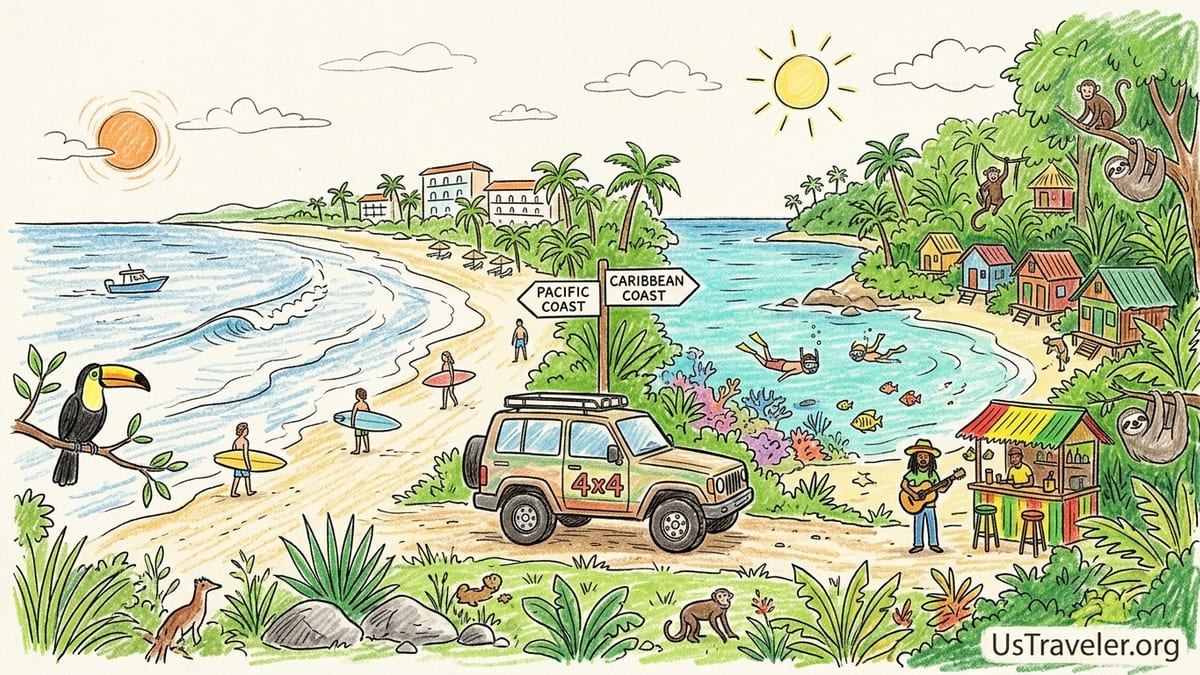
Costa Rica’s official tourism materials make a clear distinction between the Pacific and Caribbean coasts, and travelers feel that contrast the moment they arrive. The Pacific side, especially the northwestern province of Guanacaste, is characterized by long, open beaches, consistent surf and a pronounced dry season from roughly December to April. Many of the country’s largest beach resorts, from Papagayo to Flamingo and Conchal, sit on this coastline, where infrastructure is relatively developed and road access is easier.
On the Caribbean side around Puerto Viejo, the feel is more tropical and humid, with rain more evenly spread through the year. Instead of long surf beaches, you get smaller coves like Cocles and Punta Uva, often backed by coral reef. The sea here can be calmer at certain times, with pockets of excellent snorkeling when visibility cooperates, but powerful swells can also arrive during the Caribbean surf season. The Afro-Caribbean and Indigenous cultures in this region give it a different food, music and language mix than the rest of the country.
When choosing a base, the first question is which climate, culture and ocean conditions you want. If you are visiting in the North American winter and want a high chance of dry, sunny days and reliable surf, the Pacific is usually the safer bet. If you prefer lush rainforest, reef-backed beaches, and a slower, more bohemian feel, the Caribbean near Puerto Viejo can be compelling, especially outside peak rainy spells.
From there, it becomes a question of matching specific beach areas to your priorities: learning to surf, swimming with kids, nightlife, wildlife, or secluded eco-lodges. The following sections walk through the key hubs from north Pacific to Caribbean, focusing on how each performs on swimming, surfing, snorkeling, wildlife, families, nightlife, hotel supply, road access and seasonality.
Tamarindo & Flamingo: Pacific All-Rounders With Nightlife
Tamarindo is often the first name that comes up when people research Costa Rica’s beaches, and for good reason. The main beach here offers mellow, rolling waves that are ideal for surf schools, with several peaks that work for beginners and lower intermediates. Numerous operators along the sand offer 90-minute group lessons that often cost in the range of 50 to 70 US dollars including board rental and rash guard. The waves are usually small enough near shore that older children and cautious adults can enjoy playing in the whitewater, although currents can still be strong on bigger swell days.
Swimming in Tamarindo is possible but not entirely calm. This is an open Pacific beach break, so there are days with rougher surf and stronger rip currents. Families who want glassier water often take a taxi or short drive north to Playa Flamingo or Playa Hermosa, where the bay shape can block some of the swell and create better swimming conditions on calm days. Flamingo in particular has grown into a small upscale hub, with a modern marina, mid-range hotels on the hillside and a few high-end villas renting for several hundred dollars a night in peak season.
Nightlife is one of Tamarindo’s defining features. Bars around the central crossroads and beachfront run happy hours at sunset, and it is one of the few coastal towns where you can reliably find DJs, live music, and late-night venues on most nights in high season. For younger travelers, groups of friends, or surf camps, this social energy is a key reason to base here. For others, it can be a drawback: noise from bars and beach clubs can carry into nearby hotels, so those seeking quiet often stay slightly outside town and taxi in for dinners or surf lessons.
In terms of access and services, Tamarindo and Flamingo are among the most convenient options in this guide. Both lie within about a 1.5-hour drive of Liberia International Airport on paved roads. You can arrive, pick up a standard rental car, and be at your hotel before sunset without needing four-wheel drive. The trade-off is crowding. In the December to March dry season, expect busy lineups in the surf, advance bookings for popular hotels and condos, and restaurant dinner bills that can feel closer to mid-range US prices than rustic Central America.
Conchal & Papagayo Area: Swimmers, Snorkelers and Resorts
Playa Conchal, just south of Flamingo, is one of the Pacific coast’s best options for people who care more about swimming and snorkeling than surfing. The beach is composed of millions of tiny crushed shells rather than typical sand, which helps make the nearshore water notably clear by Costa Rica standards. On calm days, visitors regularly report putting on a simple mask and seeing schools of small tropical fish within a few meters of the shoreline. Independent vendors sometimes rent basic snorkel gear, but many travelers bring their own mask and fins to avoid sizing issues and to ensure quality.
Surfing at Conchal is limited. Small shorebreak waves can roll in, but there is no consistent surfable break, so surfers typically take day trips to nearby Tamarindo or Playa Grande while non-surfing family members stay behind to swim or relax under rented umbrellas. This makes Conchal and the nearby Papagayo-area beaches appealing for mixed groups, where some want lessons and others simply want calm water and resort comforts. High-end all-inclusive and boutique properties in Papagayo often package snorkeling boat trips, sunset catamaran cruises and spa treatments together, with nightly rates that can easily exceed several hundred dollars in peak months.
Wildlife around Conchal and Papagayo is more about marine life and dry forest species than dense jungle. You might spot pelicans diving just offshore, rays gliding through the shallows, or howler monkeys in the trees behind the beach. However, the experience is more resort-oriented than wild. Hotels tend to be larger, with pools, air conditioning and kids’ clubs, and the overall feel is of comfort rather than remote adventure. Road access is straightforward, with paved routes from Liberia and relatively short transfer times, making these beaches popular for shorter trips and for visitors comfortable in a more polished, planned environment.
Seasonality here largely mirrors Tamarindo and Flamingo. December to April is sunny and dry, with dusty hillsides and predictable sunsets, while May to November brings greener landscapes but also heavy afternoon rains and higher surf on exposed points. Because the bays at Conchal and some Papagayo coves are slightly more protected, swimming can remain pleasant on many days in rainy season, though storms can reduce underwater visibility for snorkeling.
Nosara & Santa Teresa: Surf Towns for Longer Stays
Travelers who picture a low-rise, yoga-and-smoothie surf town often end up torn between Nosara and Santa Teresa, both on the Nicoya Peninsula. Nosara’s main surfing beach, Playa Guiones, is widely known for its consistency. Surf schools based here often emphasize that they can run lessons almost every day of the year thanks to the reliable beach break, making it attractive for week-long surf camps. The long, gently sloping sandbar spreads out the crowds a bit, and the town behind the beach has a reputation for wellness-oriented cafes, boutique hotels and family-friendly villas set in the trees rather than right on the sand.
Swimming in Nosara is moderate rather than tranquil. The waves that make Playa Guiones so good for surfing also bring shorebreak and currents that can challenge inexperienced swimmers, especially children. Families often choose accommodation with a pool and focus on wave play under the supervision of surf instructors instead of pure flat-water swimming. Wildlife is a major plus here, with howler monkeys, iguanas and abundant birdlife commonly visible from hotel balconies, and seasonal sea turtle nesting at nearby Ostional for those willing to take a guided night tour.
Santa Teresa, further south, attracts more advanced surfers and digital nomads willing to trade comfort for wave quality. The main beaches, Santa Teresa and Playa Carmen, pick up significant Pacific swell. On many days, this creates excellent shoulder-to-head-high surf but also a heavy shorebreak that is not ideal for casual swimmers. Several surf shops line the dusty main road, renting boards and offering private lessons that might start around 70 to 90 US dollars for a two-hour session. The nightlife is more scattered and bohemian than Tamarindo’s, with sunset gatherings on the sand, a handful of bars and occasional live music rather than a compact strip of clubs.
Access is the main factor that makes Nosara and Santa Teresa better suited to travelers with a bit more time. Roads in the Nicoya Peninsula are historically rough, and while some sections have improved, Santa Teresa in particular still involves stretches of unpaved, potholed road where a high-clearance or four-wheel-drive vehicle is strongly recommended, especially from roughly May through November when rains can deteriorate conditions. Nosara’s access roads are a mix of paved and gravel, and while a standard car can sometimes suffice in dry season, many visitors still choose a more robust rental for peace of mind. If your priority is daily surf and a relaxed rhythm rather than easy day trips and big-hotel comforts, both towns reward longer stays of a week or more.
Manuel Antonio & Uvita/Dominical: Beaches With Serious Wildlife
South of the more developed Guanacaste coast, Manuel Antonio and the stretch around Uvita and Dominical combine beach time with some of Costa Rica’s best-known wildlife experiences. Manuel Antonio is centered on a compact national park where monkeys, sloths and bright tropical birds are often seen along well-marked trails. Several small coves inside the park offer relatively calm swimming on many days, especially in the morning before crowds build. Outside the park, Espadilla Beach provides a longer strip of sand with surfable waves and more vendors renting chairs, umbrellas and boogie boards.
For families, Manuel Antonio’s mix of wildlife, manageable hiking and beach access is hard to beat, particularly for first-time visitors. Many mid-range hotels sit on the hillside between the town of Quepos and the park entrance, with jungle views and frequent animal sightings from balconies. A guided tour of the park with a naturalist, often in the range of 40 to 60 US dollars per person, is a common highlight. Nightlife, however, is limited compared with Tamarindo. There are restaurants with views and a few bars, but this is not a late-night party destination.
Uvita and Dominical, about an hour further south, feel wilder and less resort driven. Dominical is another surf town, with a consistent beach break that draws intermediate and advanced surfers. Swimming here demands caution because of strong currents, but the broad beach and laid-back town make it appealing for travelers who prioritize waves and a casual vibe over polished infrastructure. Uvita, by contrast, is known for the whale-tail shaped sandbar in Marino Ballena National Park and for seasonal humpback whale watching trips, often running from roughly August to October and again in the first months of the year, depending on migration patterns.
Snorkeling in this part of the Pacific is more reliant on boat trips than shore access. Operators in Uvita, for example, run excursions out to nearby islands where underwater visibility can be better than along the mainland beaches. Road access along the coastal highway from San José to Manuel Antonio and further to Uvita is fully paved, though local roads up to lodges can be steep. The region sees heavier rainfall from around May through November than Guanacaste, which leads to lush vegetation but more frequent downpours, particularly in September and October. This makes shoulder months like late November or February to April attractive for visitors who want a balance of green scenery, wildlife activity and more predictable beach weather.
Puerto Viejo, Cocles & Punta Uva: Caribbean Reefs and Tropical Calm
On the Caribbean side near the Panamanian border, Puerto Viejo de Talamanca, Cocles and Punta Uva offer a different kind of Costa Rica beach base. Puerto Viejo itself is the main town, with a concentration of restaurants, bars and small guesthouses along a compact strip close to the sea. Just to the south, Playa Cocles and Playa Chiquita provide more spacious sand with fewer buildings, while Punta Uva and nearby coves feel distinctly tranquil, backed by dense jungle and leaning palm trees.
Swimming conditions on this coast change significantly with the seasons. During calmer periods, particularly outside the main Caribbean swell months, the water at Punta Uva and sections of Cocles can be calm and clear enough for enjoyable snorkeling over patch reefs close to shore. Travelers who bring a mask often describe seeing small coral heads, colorful reef fish and, occasionally, rays in a few meters of water. However, when larger swells arrive, especially between roughly December and March and again around July depending on yearly patterns, powerful waves and currents can make many of these beaches unsafe for casual swimming.
Surfing here is defined by the more advanced reef breaks, most famously the heavy wave often referred to as Salsa Brava near Puerto Viejo, which is strictly for experienced surfers with reef skills. Beach breaks at Cocles can cater to intermediates when conditions line up, and there are local surf schools that offer shorter beginner lessons when the swell is small. Families with young children tend to favor the more protected corners of Punta Uva or stay in hotels with pools, using the beach more for sand play and early-morning paddles on calm days than for full-on swimming.
Nightlife in Puerto Viejo is livelier than in most small Pacific towns outside Tamarindo. Reggae and calypso spill out of bars, and there is a tangible Afro-Caribbean influence in the food and music. Accommodation is mostly small-scale: rustic cabinas, jungle lodges and some design-forward boutique hotels hidden in the trees. Road access from San José involves crossing the central mountains and descending toward Limón, then south along the coast. The route is fully paved but subject to heavy rain, occasional landslides and slow truck traffic, so transfer times can be longer than the distance suggests. Rainfall is more evenly distributed through the year than on the Pacific, and many travelers aim for drier spells that often occur around September and October or in shorter windows earlier in the year, though patterns can vary.
How to Choose Your Beach Base
When you compare these beach areas side by side, a few profiles emerge that can help clarify your choice. If surfing is central to your trip, Tamarindo, Nosara, Santa Teresa, Dominical and parts of Cocles all provide consistent waves, with Tamarindo and Nosara better for beginners and Santa Teresa and Dominical stronger for intermediates and advanced surfers. Surf schools in Tamarindo and Nosara in particular are accustomed to first-timers of all ages, often bundling multi-day lesson packages with board rental and photos, which can be attractive for families or couples wanting to progress quickly over a week.
If swimming and snorkeling matter more than surfing, Playa Conchal, select Papagayo bays and certain days at Punta Uva stand out. Conchal’s relatively clear water and gently shelving shore make it a favorite for travelers who want to spend long stretches floating or snorkeling near fish without boarding a boat. In Papagayo, resort beaches tucked into small coves can offer similar conditions, though these are often accessible primarily to hotel guests. On the Caribbean side, shore snorkeling can be rewarding at Punta Uva and some sections of Cahuita National Park when conditions are calm and water clarity cooperates, but it is important to accept that Caribbean weather can turn visibility from excellent to poor in a day.
For wildlife and nature, Manuel Antonio, Uvita, Nosara and the Puerto Viejo area deliver more consistent sightings than the resort-heavy corners of Guanacaste. In Manuel Antonio, the national park’s dense concentration of monkeys, sloths and reptiles makes it possible to see more species in a morning than many travelers spot elsewhere in a week. Around Nosara and Puerto Viejo, staying in jungle lodges or treehouse-style rooms increases your odds of hearing howler monkeys at dawn or seeing toucans and parrots overhead. If you want whales, planning around Uvita’s peak seasons and booking a licensed operator with good safety practices is key.
Families with younger children generally gravitate to Tamarindo, Conchal, Papagayo and Manuel Antonio. These areas offer easier road access, a range of hotel types including larger resorts with pools and kids’ clubs, and nearby medical facilities should they be needed. Teens who surf may prefer Tamarindo, Nosara or even Santa Teresa for the wave culture, while teens more interested in wildlife might enjoy Manuel Antonio or Puerto Viejo. Nightlife-seeking adults can weigh Tamarindo and Puerto Viejo as the liveliest bases, with Nosara, Santa Teresa and Dominical providing more low-key, bar-and-live-music scenes rather than full-on clubbing.
The Takeaway
Costa Rica’s beaches are diverse enough that there is no single “best” choice, only better or worse fits for your particular trip. The dry, surf-rich Pacific coast suits visitors chasing sunshine and waves, with Tamarindo and Flamingo providing accessibility and nightlife, Conchal and Papagayo delivering calmer waters and resort comforts, and Nosara, Santa Teresa, Manuel Antonio, Uvita and Dominical layering in varying degrees of wilderness, wildlife and remoteness.
On the Caribbean side, Puerto Viejo, Cocles and Punta Uva offer warm water, reef-backed bays and a strong cultural identity that feels distinct from the rest of the country. Conditions here can be more variable, but for travelers who value atmosphere, food and slow days on tree-lined beaches as much as guaranteed sunshine, it can be a compelling base.
The most successful itineraries usually match one primary beach base to your top interests, then add day trips or a short second stop rather than trying to see every coast in a single week. Whether you end up with a surfboard under your arm in Nosara, a snorkel mask in hand at Conchal, or a pair of binoculars trained on a sloth in Manuel Antonio, choosing the right home beach will shape how you remember Costa Rica long after the sand has washed out of your shoes.
FAQ
Q1. Which Costa Rica beach is best for first-time visitors?
For a first trip, Tamarindo and Manuel Antonio are strong options. Tamarindo offers easy access from Liberia, plenty of hotels, surf schools and restaurants. Manuel Antonio combines beaches with a compact national park full of wildlife and has a wide range of mid-range lodgings.
Q2. Where should families with young kids base their beach stay?
Families with small children often do well in Tamarindo, Playa Conchal, Papagayo or Manuel Antonio. These areas have relatively easy road access, many hotels with pools, calmer swimming options nearby and services like supermarkets and clinics. Choosing a property set back from late-night noise can make a big difference in sleep quality.
Q3. What is the best beach area in Costa Rica for beginner surfing?
Tamarindo and Nosara’s Playa Guiones are among the most reliable beginner surf spots. Both have long sandy beaches, multiple surf schools and consistent, manageable waves. Tamarindo has more nightlife and urban energy, while Nosara feels quieter and more wellness focused.
Q4. Which beaches are best for snorkeling from shore?
Playa Conchal on the north Pacific coast is one of the best-known shore snorkeling spots, with relatively clear water and fish close to the beach on calm days. On the Caribbean side, Punta Uva and parts of Cahuita can be excellent when seas are flat and visibility is good. Conditions change quickly, so local advice is important.
Q5. How important is renting a 4x4 to reach these beach towns?
For Tamarindo, Flamingo, Conchal, Papagayo and Manuel Antonio, a standard car is usually sufficient in dry season. Nosara, Santa Teresa and some lodges around Uvita sit at the end of rough or steep roads, especially in rainy months, so many travelers prefer a high-clearance or four-wheel-drive vehicle for those areas.
Q6. When is the best time of year to visit Costa Rica’s Pacific beaches?
For mostly dry, sunny weather, the Pacific dry season from roughly December to April is ideal, though prices and crowds rise. Surfers sometimes favor shoulder months like May, June and November, when swells are stronger and landscapes are greener but afternoon showers are common.
Q7. Is the Caribbean coast a good choice in the rainy season?
The Caribbean around Puerto Viejo has a different pattern from the Pacific, with rain more spread through the year and some relatively drier windows, often in September and October. It can be a good alternative when the Pacific is at its wettest, but weather is always variable, so it pays to stay flexible with activities.
Q8. Which beach area has the liveliest nightlife?
Tamarindo is generally the liveliest Pacific beach town, with multiple bars, beach clubs and restaurants open late in high season. On the Caribbean side, Puerto Viejo has a compact but energetic nightlife scene, with reggae and calypso bars near the center. Nosara, Santa Teresa and Dominical are more low-key.
Q9. What is the most affordable beach base among these options?
Prices fluctuate by season, but Dominical, parts of Puerto Viejo and some smaller towns around Tamarindo often offer more budget-friendly guesthouses and cabinas than Papagayo or central Manuel Antonio. Traveling in shoulder months and booking simple accommodations can stretch your budget significantly.
Q10. Can I combine Pacific and Caribbean beaches in one trip?
It is possible, but travel times are longer than they look on a map. Many visitors who have 10 to 14 days will choose one main Pacific base, such as Tamarindo or Manuel Antonio, then add three or four nights near Puerto Viejo for a taste of the Caribbean, accepting a full-day transfer between coasts.