


Renting a car is still the easiest way to see Costa Rica on your own schedule, but the rules, insurance options, and road realities can be confusing. In 2026, improved highways mean many popular routes are perfectly manageable in a normal car or standard SUV, while a true 4x4 is essential only for specific regions or rainy-season conditions. This guide compares picking up a rental from San José’s Juan Santamaría International Airport (SJO) and Guanacaste’s Liberia Airport (LIR), and walks you through insurance, deposits, vehicle choice, and real-world routes so you can book confidently.
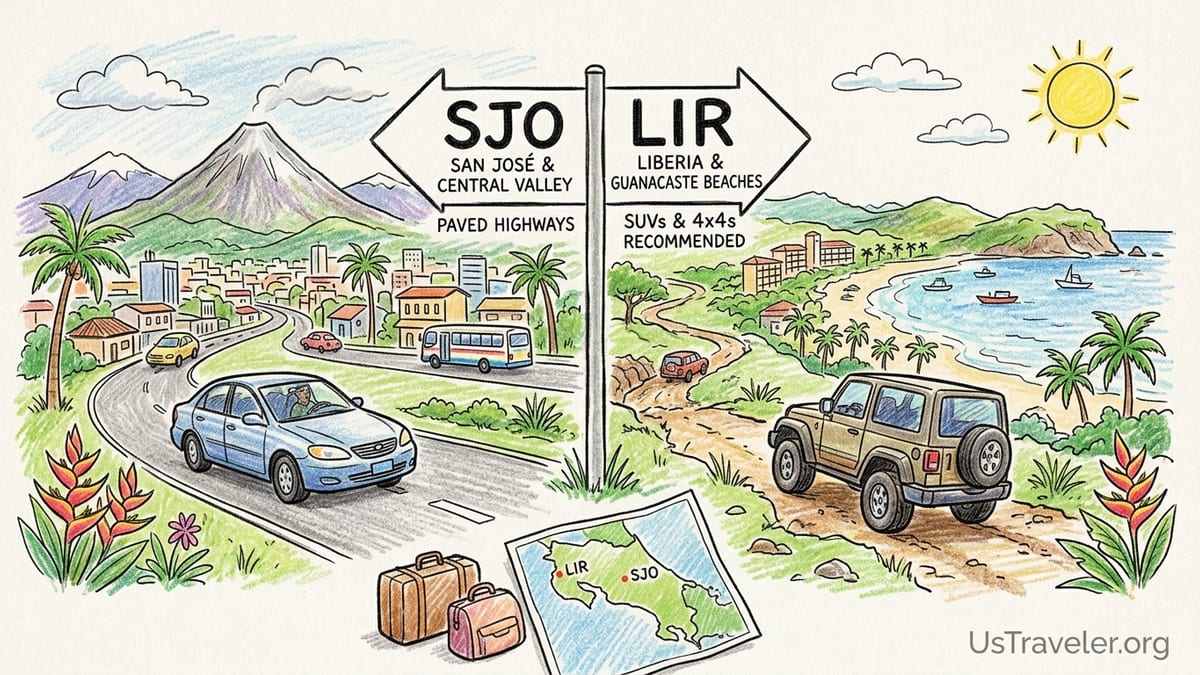
SJO vs Liberia: Which Airport Is Better for a Rental Car?
Most visitors fly into either Juan Santamaría International Airport (SJO), serving San José and the Central Valley, or Guanacaste Airport in Liberia (LIR), serving the northwest Pacific and Nicoya Peninsula. Both airports are well served by major international and local rental agencies, but the driving experience and best vehicle type can differ depending on where you are headed first.
SJO is usually the better choice if your itinerary includes the Central Valley, La Fortuna and Arenal, Monteverde, the Central Pacific towns of Jacó and Manuel Antonio, or the southern Pacific around Dominical and Uvita. From SJO, these routes use main paved highways such as Route 1, Route 27 and Route 34, where a 2WD sedan or crossover handles conditions well for most of the year. Traffic can be dense near San José, and driving right after a long-haul flight can feel stressful, but you gain flexibility for loop itineraries that start and end in the central part of the country.
Liberia (LIR) works best if you are focusing on the Guanacaste beach destinations such as Playas del Coco, Tamarindo, Playa Conchal, Flamingo and the Papagayo Peninsula. These are largely reached by paved highways like Route 21 and Route 155, with short stretches on graded side roads. In dry season, a basic 2WD is enough for typical resort stays and day trips. If your plans extend down the Nicoya Peninsula toward Samara, Nosara or Santa Teresa, or inland to Rio Celeste or Monteverde, an SUV with higher clearance becomes much more attractive, especially between May and November when heavy rain can deteriorate secondary roads.
Rental processes at both airports follow similar patterns. Many agencies operate off-site and shuttle you from the terminal to their lot. It is common at both SJO and LIR for the advertised online price to show only the bare vehicle rate, with most insurance charges and deposits explained only at the counter. To avoid surprises, confirm written quotes that include mandatory basic liability, any collision coverage you plan to use, and the expected deposit for your specific booking and pickup location.
Understanding Mandatory and Optional Insurance in Costa Rica
Costa Rica requires all rental vehicles to carry a form of third-party liability that covers damage or injury you might cause to others. This basic liability component is mandated by regulation and must be purchased through an authorized insurer in Costa Rica, which is why you cannot entirely rely on your home auto policy to satisfy local law. Rental agencies fold this liability into products often labeled “SLI,” “TPL” or “Mandatory coverage,” charging roughly the local equivalent of a mid-range daily fee depending on vehicle class and agency.
On top of that legal minimum, agencies sell a Collision Damage Waiver, often called CDW or LDW. CDW limits your financial responsibility for damage to the rental car itself. In theory, many premium credit cards offer CDW coverage for rental cars in foreign countries. In practice, Costa Rica is often excluded, or coverage excludes 4WDs and off-pavement damage. Several local agencies now state in their conditions that third-party CDW purchased online or via credit cards is not accepted unless you provide specific written proof that meets Costa Rican regulatory standards, and declining in-house CDW can trigger a much higher deposit, sometimes in the 3,000 to 5,000 US dollar range held on your card for the duration of the rental.
A common pattern in 2026 is for visitors to buy the legally required third-party liability and either accept the agency’s basic CDW or show a letter from their credit card issuer and sign additional paperwork. For example, a Budget-branded franchise has described deposit tiers where a renter who only takes minimum liability faces a higher deposit, while someone who adds their CDW and a zero-deductible package leaves only a smaller refundable amount, around 500 to 1,000 US dollars, as security. These numbers vary, but the general trade-off is clear: the more coverage you buy locally, the lower your deposit and potential out-of-pocket exposure.
There are also optional products such as extended liability, roadside assistance packages, glass and tire waivers, and “super protection” bundles that reduce your deductible to zero. These can add a substantial percentage to your daily rate, but they also make incidents like cracked windshields on gravel roads or punctured tires far less stressful. Before arrival, it is worth calling your chosen rental company in Costa Rica and asking them to email a written explanation in plain language: which pieces are legally mandatory, which can be replaced by a credit card letter, what each daily rate covers in approximate terms, and how each choice changes the deposit and deductible for the exact vehicle category you are booking.
Deposits, Credit Cards and One-Way Rentals
Every rental agency in Costa Rica will place a security deposit on your credit card, and this is where many travelers get caught off guard. For a compact 2WD with mandatory liability and the agency’s CDW, a typical deposit may range between 500 and 1,500 US dollars. If you decline CDW and rely on a credit card policy, the same agency may increase the deposit to around 2,000 dollars or more. For a larger SUV or 4x4, deposits trend higher again. The hold is usually released within several business days after the car is returned without new damage, but your card limit must comfortably accommodate both the deposit and your travel expenses during the trip.
Some agencies at SJO and LIR publish sample deposit tables by coverage level. A typical structure could look like this in practice: with minimum liability only, a deposit around 2,000 dollars; with liability plus in-house CDW, around 1,000 dollars; with liability, CDW and an added protection that reduces the deductible to near zero, a deposit around 500 dollars. These examples are only indicative but reflect real conversations travelers report having at counters in San José and Liberia. It is smart to travel with at least one major credit card in your own name dedicated to the rental, and a second card for everyday spending.
One-way rentals between SJO and LIR are widely available and can make sense if you are entering the country in one region and flying out of another. For instance, some travelers land at SJO, drive via La Fortuna and Monteverde, then continue to the Guanacaste coast before dropping the car at Liberia for a beach departure. Others do the reverse: landing at LIR, working their way through the Nicoya beaches and Arenal, then finishing in San José for urban time or an early flight. Most agencies charge a one-way fee that increases with distance, often in the 50 to 150 dollar range for SJO to LIR unless it is waived during promotions. Always ask for this fee in writing so it is not added unexpectedly at the counter.
Keep in mind that smaller local agencies may not support all one-way combinations or may limit drops at secondary offices. If you are planning more complex routing, such as picking up at SJO and dropping in a smaller coastal town, confirm that the office exists year-round and that opening hours align with your return flight. At both major airports, early-morning returns are usually possible, but you may need to budget time for a short shuttle back to the terminal after vehicle inspection.
2WD vs SUV vs 4x4: Matching the Vehicle to Your Route
The most out-of-date advice about driving in Costa Rica is that every visitor automatically needs a 4x4. In 2026, many key tourist routes are fully paved and heavily trafficked, and a 2WD sedan or crossover is perfectly adequate most of the year. The decision should be based on your specific itinerary, the season, and how far off the main highways you expect to go.
Consider a classic loop from SJO to La Fortuna, then down to Manuel Antonio and back to the Central Valley. This route uses paved roads such as Route 1, Route 27, Route 34 and paved connectors into La Fortuna and Quepos. Recent driving reports describe this corridor as comfortable for a standard 2WD car year-round, assuming you avoid unpaved shortcuts like certain segments of Route 713 between Arenal and the Pacific. Many families in compact sedans or mid-size 2WD SUVs complete this itinerary without problems, and independent route guides explicitly state that no 4WD is required if you stay on the main paved options.
In contrast, a route that combines SJO or LIR with Monteverde, Nosara, or the Osa Peninsula looks very different. The main approach to Monteverde still includes sections of narrow, steep, and in parts unpaved road where heavy rain can create slick mud and potholes. Regional road condition guides consistently classify Monteverde as a destination where a high-clearance SUV or true 4x4 is highly recommended in the rainy months. Similarly, the road from Nicoya to Nosara, as well as some stretches around Samara and Santa Teresa, can deteriorate after storms, and the access roads toward Drake Bay and into parts of the Osa Peninsula remain hilly, with long unpaved stretches. For these regions, a 4x4 is less a luxury and more an insurance policy against being stuck or damaging an underbody.
A practical compromise for many visitors is to rent a standard SUV, not a full off-road 4x4, for added ground clearance and better comfort on patched pavement and occasional gravel. From Liberia, a mid-size SUV is ideal if you plan to combine easy paved destinations such as Playa Hermosa, Tamarindo and Playas del Coco with a side trip to less developed beaches that require a short stretch on dirt. From SJO, an SUV works well if you are comfortable with city traffic but want extra clearance up to places like Monteverde or rural lodges around Arenal where hotel access roads can be steep or rutted even if the main road into town is paved.
Rainy Season, Road Clearance and Navigation Tools
Costa Rica’s rainy season typically runs from about May to November, with downpours most intense in the afternoons and into the night. During this period, the difference between driving a low-slung sedan and a higher-clearance SUV becomes much more noticeable, particularly on secondary roads where standing water, deep potholes and small washouts can appear quickly. Even if you stick to paved routes, heavy storm runoff can temporarily flood sections or deposit gravel and debris, making cautious, slower driving essential.
On coastal and rural routes near Liberia, travelers report that roads to Samara, Nosara and other Nicoya beaches can shift from dusty and corrugated in the dry months to muddy and rutted in October. Certain segments of Route 160, which runs along part of the Nicoya Peninsula, are notoriously unpredictable in the wettest weeks, with photos circulating of mud-filled ruts and previously passable fords becoming impassable. Likewise, the uphill roads into Monteverde from either the Route 1 or Tilarán side can stay slick for hours after a storm, favoring vehicles with both higher clearance and, in some cases, four-wheel drive.
Navigation tools are a major advantage for modern drivers. Waze has become the dominant app for real-time driving in Costa Rica, reflecting live user reports of accidents, flooded sections, police checkpoints and roadwork. Google Maps is still useful for an overview, but Waze often produces more realistic drive-time estimates and will reroute you around blocked sections when possible. For offline navigation in areas with intermittent mobile signal, such as rural Nicoya and parts of the southern Pacific, it is sensible to download offline map areas before you leave Wi-Fi, or ask your rental company if they still offer GPS units that run local map sets tailored to Costa Rican roads.
Even with good navigation, however, you should not treat all shortcuts as equal. When Waze or Google suggests a small side road that saves ten minutes between La Fortuna and the Central Pacific, remember that locals may rate roads differently than first-time visitors. In practice, sticking to the main highways, even if a navigation app shows a slightly longer duration, remains the safest choice in poor weather. Locals and long-term expatriates regularly recommend avoiding infamous unpaved alternatives when rain is heavy, especially after dark, regardless of whether you are in a 2WD or a 4x4.
Route-Specific Advice: When a Normal Car Is Enough
Several of Costa Rica’s best-known tourist itineraries can now be comfortably driven in a regular 2WD car, especially between December and April. One of the most popular loops starts at SJO, runs to La Fortuna and Arenal, then continues to the Central Pacific beaches before circling back. The main route from SJO to La Fortuna uses paved highways such as Route 1 plus either Route 702 via San Ramón or Route 141 via Naranjo, and route planners describe them as straightforward mountain and lowland roads. From La Fortuna to Manuel Antonio, most experienced drivers now choose the long but fully paved sequence through Route 4, Route 35, Route 27 and Route 34. Recent route guides explicitly state that a normal 2WD car handles this itinerary without difficulty as long as you avoid smaller unpaved connectors and accept a 4.5 to 6 hour drive time depending on traffic and weather.
From SJO or La Fortuna to Jacó and Manuel Antonio, the primary corridor is Route 27 from the Central Valley to the coast, then Route 34, with Route 618 providing the final paved access into Manuel Antonio itself. Although this coastal road has experienced occasional damage from storms in past years, it has been improved and is heavily maintained because it serves one of the country’s busiest national parks. As of 2026, numerous recent driver reports describe this drive as fully manageable in a standard 2WD, with the main challenge being weekend and holiday traffic, not terrain. Travelers who have completed a SJO to Manuel Antonio round trip in compact economy cars routinely describe narrow curves and slow trucks, but not technical off-road conditions.
From Liberia, the core Guanacaste beach circuit is also 2WD-friendly. The route from LIR to Playas del Coco, Hermosa, or the Papagayo Peninsula follows paved roads almost door to door, and the drive to Tamarindo and Playa Conchal generally involves a mix of smooth highway and some patched sections. Even side trips to Flamingo, Potrero and Playa Avellanas are typically described as suitable for standard cars in good weather. Many resort visitors choose a simple compact car for airport transfers and day trips to supermarkets and viewpoints, reserving more rugged vehicles only if they intend to explore more isolated beaches, river estuaries or inland dirt tracks that still characterize parts of the Nicoya Peninsula.
Routes and Destinations That Justify an SUV or 4x4
While a 2WD is sufficient for many itineraries, there are still clear situations where an SUV or full 4x4 is the sensible or even necessary choice. Monteverde is the most notable example. Even though some approaches have been gradually paved, the final stretches remain narrow, steep and partially unpaved, and they can become rough after intense rain. Reputable local driving guides consistently recommend high clearance and, in rainy months, 4WD for this ascent, especially if your lodge sits outside the main town on a steeper side road. Visitors who arrive in small sedans often find themselves scraping undercarriages or needing to leave the car parked lower down and walk or taxi the final hill.
The same logic applies to several pockets of the Nicoya Peninsula beyond the main paved spines. Around Samara and Nosara, the access road from Nicoya includes partially unpaved sections that can develop potholes and muddy ruts. In dry season, a mid-size SUV without 4WD is usually sufficient, but by October and November, locals describe flooding and washouts that make higher-clearance vehicles, often with 4WD, more reassuring. South of Nosara toward Ostional and Santa Teresa, stretches of Route 160 can involve rough surfaces and occasional river crossings; where there are still unbridged fords, heavy rain can render them temporarily impassable even for 4x4 drivers.
Farther south, on the Osa Peninsula and Drake Bay access roads, large portions remain unpaved, hilly and exposed to heavy Pacific rainfall. Travelers targeting wildlife lodges near Corcovado National Park frequently opt for genuine 4x4s, not just crossovers, and still plan their arrival around tide charts or daytime river levels. Inland, certain back-road approaches to Rio Celeste and remote waterfalls also reward extra clearance, particularly after storms when side tracks can turn to sticky clay. In all of these cases, a 4x4 is less about tackling extreme off-roading and more about preserving your itinerary, protecting the vehicle, and giving you the option to press on safely when conditions change.
Whenever you consider an SUV or 4x4, also think about where you will park and maneuver in towns. Narrow streets in older centers such as La Fortuna and Quepos can feel tight in full-size trucks. A compact or mid-size 4x4 often hits the sweet spot: enough clearance and traction for rough segments, but still manageable for parallel parking and tight hotel lots. If your trip includes both easy coastal highways and demanding rural spurs, designing the route with the most challenging section in mind and then selecting the smallest capable vehicle for that challenge usually produces the best balance between cost and comfort.
Ferries, Island Hops and Restrictions on Unpaved Roads
Some visitors plan to link road segments with ferry crossings, particularly across the Gulf of Nicoya between Puntarenas and the Paquera or Naranjo terminals. These ferries can save driving time if you are connecting the Central Pacific coast with parts of the Nicoya Peninsula, such as Montezuma or Santa Teresa. Rental cars are normally allowed on these ferries, but schedules can be affected by weather, maintenance or holiday demand, so it is important to confirm departure times close to your travel dates and arrive at the docks with plenty of margin.
Ferry use adds a few practical considerations. You will pay a vehicle fee and a per-passenger fee at the terminal, usually in local currency with ticket offices near the dock. On busy weekends or during national holidays, lines of cars can stretch far back from the pier, and some travelers choose to reserve a specific sailing online in advance where systems allow. If you are sprinting directly from SJO or LIR to catch a last departure of the day, it is very easy to misjudge traffic and miss the boat entirely. Many drivers now prefer to break the trip with an overnight stop in a mid-point town and take an earlier, less stressful ferry the next morning.
Rental contracts sometimes restrict driving on non-paved roads or through rivers, particularly for lower-clearance vehicles. Even when unpaved surfaces are allowed, damage that occurs while crossing rivers or flooded sections, driving on beaches or entering explicitly prohibited routes is often excluded from insurance coverage. Agencies may note such restrictions in the fine print, but staff do not always emphasize them at the counter. Before leaving the lot, it is wise to ask directly whether your chosen vehicle can be driven on specific regional roads you are considering, such as certain segments of Route 160 or the rougher approaches to Drake Bay. Having this discussion in plain language, and ideally noted on your paperwork, reduces the risk of unpleasant arguments if you encounter damage later.
In addition, some rental companies prohibit their vehicles from boarding small local boats or barges, such as those used for informal river crossings or lake shortcuts. For example, popular tourist “jeep-boat-jeep” transfers between Arenal and Monteverde rely on specialized vehicles and do not allow self-drive rentals on the boat section. If your itinerary involves crossing significant bodies of water by craft other than the main government-regulated ferries, assume that your rental car is not allowed aboard unless the agency explicitly confirms otherwise.
The Takeaway
By 2026, Costa Rica has become a far more accessible self-drive destination than its reputation sometimes suggests. Main arteries linking SJO with La Fortuna and the Central Pacific, and LIR with the core Guanacaste beaches, are paved and well traveled, and a straightforward 2WD car or standard SUV is fully adequate for many classic itineraries. The dated notion that all visitors must rent a 4x4 now yields to a more nuanced, route-specific reality where vehicle choice should reflect the roads you actually plan to drive and the season you are traveling.
The most important steps are to understand Costa Rica’s unique rental insurance structure, secure clear written quotes that include mandatory liability and any CDW you will rely on, and prepare for realistic deposits that depend on your coverage choices. From there, mapping your route in detail, checking recent road-condition reports for sensitive segments such as Monteverde, Nosara and the Osa Peninsula, and favoring main highways over enticing “shortcuts” will do more to keep you safe than oversized tires alone.
Whether you pick up at Juan Santamaría International Airport or Guanacaste Airport in Liberia, a calm approach at the rental counter, an honest assessment of your driving comfort level, and a flexible itinerary that leaves space for weather and traffic will go a long way. With the right vehicle for your routes and season, Costa Rica’s network of mountains, beaches and cloud forests opens up at your own pace, turning the drive itself into one of the highlights of the trip.
FAQ
Q1. Do I legally have to buy insurance from the rental company in Costa Rica?
Yes. Costa Rican law requires a local third-party liability component that must be purchased through a Costa Rica–authorized insurer, which is why every rental quote includes a mandatory coverage line from the agency.
Q2. Can my credit card’s rental car insurance replace CDW in Costa Rica?
Sometimes, but not always. Many cards either exclude Costa Rica or exclude 4x4 vehicles and unpaved-road damage. Even when coverage applies, agencies may demand an official letter and will usually increase your deposit if you decline their in-house CDW.
Q3. Is a 2WD car enough for La Fortuna and Manuel Antonio?
For most travelers, yes. The main paved routes between SJO, La Fortuna and Manuel Antonio are regularly driven in standard 2WD cars, provided you avoid minor unpaved shortcuts and drive cautiously in heavy rain.
Q4. When do I truly need a 4x4 in Costa Rica?
You generally need a 4x4 if your itinerary includes Monteverde, off-pavement parts of the Nicoya Peninsula around Nosara and Santa Teresa in rainy season, back roads to Rio Celeste, or access routes in the Osa Peninsula and Drake Bay.
Q5. How big a deposit should I expect on my credit card?
Deposits vary by company and coverage, but a range of roughly 500 to 1,500 US dollars is common when you purchase the agency’s CDW, and around 2,000 dollars or more if you decline it and rely on a credit card policy.
Q6. Is it safe to drive at night from SJO or Liberia?
It is legal but not ideal for first-time visitors. Rural roads can be poorly lit, with sharp curves, pedestrians and animals. Most travelers prefer to schedule arrivals so that longer drives happen in daylight whenever possible.
Q7. Will navigation apps work well in Costa Rica?
Yes. Waze is widely used for real-time traffic and incident reports, while Google Maps is helpful for planning. In remote areas, download offline maps or consider a rental GPS as a backup for when mobile data drops.
Q8. Can I drive my rental car on ferries in Costa Rica?
Rental cars are normally allowed on the main Gulf of Nicoya car ferries between Puntarenas and Paquera or Naranjo. Always confirm with your rental agency, and avoid loading vehicles onto informal boats or barges unless explicitly permitted.
Q9. Are one-way rentals between SJO and Liberia common?
Yes. Many agencies allow pickups at one airport and drop-offs at the other, usually with an added one-way fee. It is important to have that fee quoted in writing when you book so it does not come as a surprise at the counter.
Q10. Should I choose a smaller car or a larger SUV for towns and parking?
In busy towns such as La Fortuna, Jacó and Quepos, narrow streets and tight hotel lots make compact vehicles easier to park. A mid-size SUV often strikes the best balance, offering extra clearance without becoming unwieldy in urban areas.