


Costa Rica packs a remarkable range of landscapes, wildlife and beach towns into a country barely larger than West Virginia. Yet when you start planning a trip, the sheer number of regions and national parks can feel overwhelming. Instead of listing the seven official tourism regions, this guide focuses on the specific hubs and coastlines most travelers actually combine on a first or second trip: La Fortuna and Arenal, Monteverde, Manuel Antonio, Tamarindo and the wider Guanacaste coast including Papagayo, Santa Teresa and Nicoya, Tortuguero, Puerto Viejo and Cahuita on the Caribbean, the Osa Peninsula and Drake Bay, plus the capital San José. For each, we look at what it really offers in practice for wildlife, beaches, surfing, families, couples, adventure and luxury, and whether it deserves several nights or is better treated as a short stop.
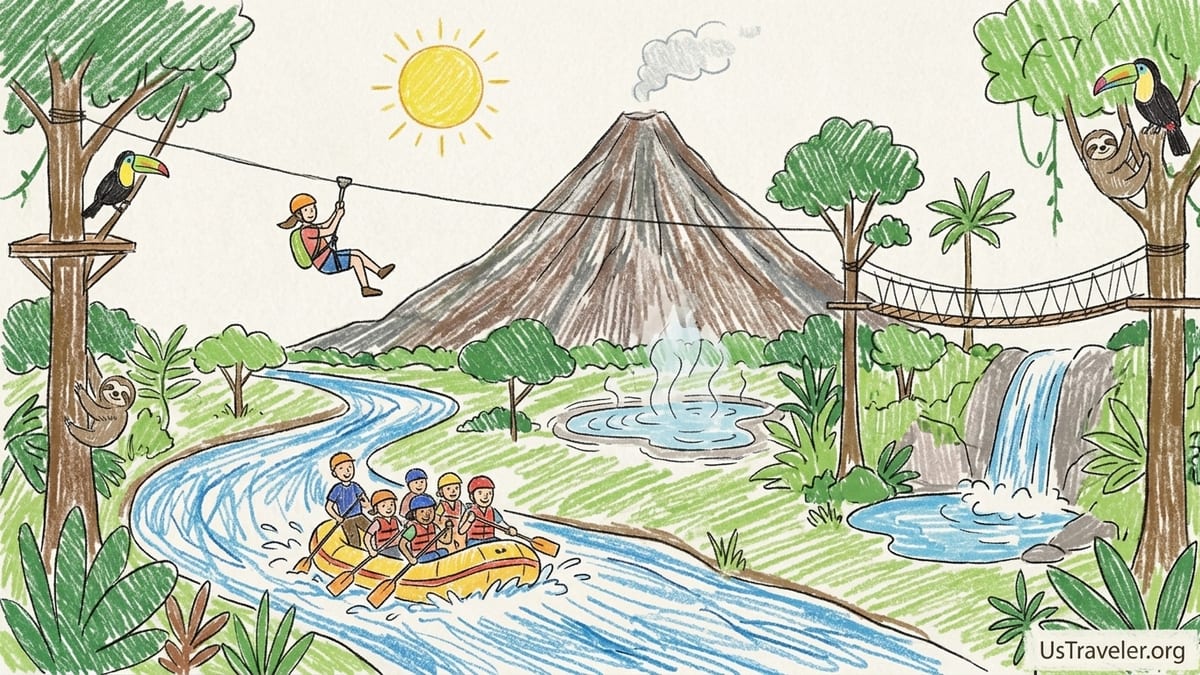
La Fortuna & Arenal: Costa Rica’s Adventure Capital
La Fortuna, the small town at the foot of Arenal Volcano, is the country’s most concentrated hub for soft adventure. Within a 30-minute drive you can combine hanging bridges in primary rainforest, whitewater rafting on the Balsa River, canyoning down waterfalls, and soaking in hot springs that range from family-friendly waterparks to quiet, candlelit pools. Tour operators in town sell bundled days such as “Arenal volcano hike plus Eco Termales hot springs with dinner,” often in the 150 to 200 US dollar per person range, while more budget-conscious travelers might opt for a 20 to 30 US dollar day pass at places like Los Lagos with slides and basic springs instead of high-end spa complexes.
Wildlife here is present but secondary to the activities. On a guided walk at Mistico Arenal Hanging Bridges you are likely to spot howler monkeys, toucans and bright-blue morpho butterflies, but this is not the deep jungle feel of Osa or Tortuguero. What La Fortuna excels at is variety and logistics. Families can schedule a half-day zipline at Sky Adventures in the morning, return for naps and pool time, then head out for an evening frog and sloth night walk. Couples can splurge on a volcano-view suite with a private plunge pool and book in-room massages after a day of hiking the Arenal 1968 lava trails.
For most itineraries, La Fortuna deserves at least three nights and up to five if you want a relaxed pace. Two full days lets you cover a waterfall hike plus hot springs one day and hanging bridges plus zipline another. Adding river rafting or an ATV countryside tour justifies an extra night. Travelers on a very short trip might be tempted to treat La Fortuna as a quick stop, but the transfer times from either Liberia or San José airports make one-night stays feel rushed and poor value.
In terms of budget, La Fortuna spans basic hostels with shared kitchens for under 40 US dollars per night to polished resorts where a villa with volcano views can run 350 to 600 US dollars or more in high season. It is not the best choice for pure luxury seclusion or beach time, because there is no ocean here, but as a central base for active families, multi-generational groups and adrenaline-seeking couples, it is hard to beat.
Monteverde: Cloud Forest Trails and Quiet Evenings
Monteverde sits high in the Tilarán Mountains, reached by winding roads from La Fortuna or the Pacific coast. It is cooler and mistier than most of Costa Rica, with moss-draped trees and constant low clouds that give the “cloud forest” its name. The main draw is on-foot immersion in nature: guided walks in the Monteverde Cloud Forest Biological Reserve or Santa Elena Reserve, hanging bridge parks with two-hour circuits across the canopy, and night tours that reveal kinkajous, tarantulas and sleeping birds illuminated in the beam of your guide’s flashlight.
Compared with La Fortuna, Monteverde is less about big adventure setups and more about slower, sensory experiences. A typical day might start with a birding-focused morning walk looking for resplendent quetzals, followed by a coffee and chocolate tour at a small farm, then a leisurely afternoon in town before heading out again for a night walk that costs roughly 30 to 45 US dollars per person including transport. There are ziplines and canopy tours here too, but they share the spotlight with conservation-focused activities, making the area particularly appealing to nature lovers and older kids who enjoy learning about ecosystems.
Monteverde suits couples who prefer sweaters and craft beer to swim-up bars, and families whose children can manage two to three hours of walking without complaint. The climate is cooler, often in the 60s Fahrenheit at night, and rain is common even in the dry season, so it is less ideal if you are craving long days at the pool. Most visitors stay two or three nights, enough time to do one cloud forest reserve, one hanging bridge park and one night tour, perhaps adding a coffee tour or horseback ride if you have extra time.
Luxury here is subtle rather than flashy. You will find boutique lodges with fireplaces, floor-to-ceiling forest views and four-course tasting menus using local ingredients instead of big all-inclusive resorts. Prices tend to sit in the mid-range to upper-mid-range bracket, with many comfortable lodges in the 150 to 300 US dollar per night range and simple cabinas closer to 70 to 120 US dollars. Monteverde is rarely a “short stop” because of the travel time to reach it, and is best planned as a two- or three-night anchor between Arenal and the beaches.
Manuel Antonio: Wildlife and Beaches in One Compact Package
Manuel Antonio on the central Pacific coast manages to combine accessible wildlife with soft-sand beaches in a small, manageable footprint. The national park is one of Costa Rica’s busiest, but for first-time visitors it is often the easiest place to reliably see sloths, white-faced capuchin monkeys, iguanas and colorful crabs in just a few hours. Inside the park, short, mostly flat trails lead to sheltered coves where families spread towels under almond trees and kids play in relatively calm water while iguanas patrol the sand nearby.
Outside the park, the winding hill between Quepos and the beach is lined with mid-range hotels, vacation rentals and a few higher-end boutique properties with infinity pools. This is not a heavy surf destination compared with Tamarindo or Santa Teresa, but beginners can still take lessons on the main public beach for around 50 to 70 US dollars for a two-hour group session, and boogie boarding is popular with children. For adventure, travelers add ocean kayaking to hidden coves, catamaran cruises that may spot dolphins, and half-day waterfall hikes inland.
Manuel Antonio is highly suited to families and multi-generational groups because it compresses many of Costa Rica’s “must-dos” into one place: beach time, easy wildlife viewing, short hikes, and a range of restaurants that include everything from simple beach shacks selling casados for under 10 US dollars to date-night spots with white tablecloths and sunset cocktails. For couples, the catch is that it can feel crowded in high season, especially on park days when cruise ship passengers join day tours.
Most itineraries allocate three to four nights here. That allows one full day dedicated to the park, another for a boat or catamaran trip, and at least one flexible day for beach or pool time. As a short stop of one or two nights it can still work, especially if you are driving between San José and the southern Pacific coast, but you will need to accept that you are experiencing a sample rather than a full immersion. Luxury is present in pockets in the form of cliffside suites with private plunge pools and dedicated concierges, though Manuel Antonio’s overall vibe remains more relaxed holiday town than ultra-exclusive enclave.
Tamarindo, Papagayo & Guanacaste Beaches: Surf, Sunsets and Resorts
The north Pacific province of Guanacaste is Costa Rica’s classic beach playground, especially for travelers flying into Liberia. Tamarindo is the busiest hub, a long crescent of sand with a walkable town behind it, full of surf schools, taco joints and ice cream shops that stay open late. It is one of the country’s best places to learn to surf, with multiple surf shops offering beginner lessons for around 50 to 65 US dollars including board rental. Families appreciate that older kids can join teen-focused surf camps for a few mornings while parents linger at beach cafes or schedule spa treatments.
Nearby, Playa Langosta, Playa Grande and Playa Avellanas offer a more laid-back feel while still being reachable from Tamarindo by car or taxi. A typical week-long stay might include three or four nights based in Tamarindo for its restaurant scene and surf lessons, then two or three nights in a quieter beach like Playa Grande or Playa Conchal, where water is often clearer and upscale beachfront hotels cater to both couples and families. Sunset catamaran cruises, costing roughly 80 to 120 US dollars per person including open bar and light food, are a popular splurge that combine snorkeling, dolphin spotting and golden-hour views.
Farther north, the Papagayo Peninsula is Guanacaste’s luxury showcase. Here you find large name-brand resorts with extensive spas, golf courses and private-feeling coves, often charging 500 to 1,200 US dollars per night in high season for rooms that include access to multiple pools, kids’ clubs and on-site restaurants. Wildlife is present in the form of howler monkeys in the trees and rays or turtles spotted on snorkeling excursions, but Papagayo is primarily about relaxation, service and convenience rather than deep immersion in nature. It suits honeymooners, resort-focused families and travelers who want a seamless fly-and-flop experience close to Liberia airport.
Santa Teresa and the Nicoya Peninsula, while technically also in the broader Guanacaste area, feel very different from Tamarindo or Papagayo. Reached via a combination of long drives and sometimes unpaved roads, Santa Teresa is a string of surf breaks, yoga studios and small boutique hotels set along a dusty main road. The beaches are beautiful but the waves can be powerful, making them better suited to intermediate and advanced surfers and couples who enjoy a slightly bohemian, international backpacker-meets-boutique vibe. For non-surfers, days revolve around long beach walks, acai bowls, sunset drinks and occasional day trips to waterfalls.
Guanacaste beaches overall are excellent for longer stays. Tamarindo alone can comfortably absorb a full week if you mix surf lessons, estuary wildlife tours to see crocodiles and birds, and day trips to nearby beaches. Papagayo is ideal for three to five nights of resort downtime, either at the start or end of a more active itinerary. Santa Teresa and Nicoya deserve at least three nights because of travel time and the slow, late-rising rhythm of the surf community. As a quick overnight, only Papagayo really makes sense due to its proximity to the airport.
Tortuguero & the Caribbean South: Wildlife, Culture and Slower Travel
Tortuguero on the northern Caribbean coast is one of Costa Rica’s most distinctive destinations. There are no roads into the village; visitors arrive by boat or small plane and spend their time gliding along narrow canals that cut through flooded rainforest. Wildlife viewing is superb: on a single morning canoe tour you might see three species of monkeys, sloths, basilisk lizards that run across the water, and herons stalking along the banks. From roughly July to October, guided night walks on the beach search for nesting green sea turtles, a highlight that requires permits and strict rules about light and noise.
Because getting here involves logistics, most travelers visit Tortuguero on a two- or three-night package that includes boat transfers, basic but comfortable lodge accommodation, and guided canal tours. Prices vary widely, from more budget-minded packages around 400 to 600 US dollars per person to higher-end eco-lodges that can double that, especially in prime turtle season. There are no surf breaks or luxury beach clubs here; the sea is often rough and swimming is not recommended. Tortuguero is best for wildlife-focused couples, photographers and families with school-age children who can handle early starts and afternoon downtime at the pool or hammock.
Farther south, the Caribbean vibe shifts again in Puerto Viejo and Cahuita. Here the pace is languid, with reggae-inflected cafes, Afro-Caribbean cuisine and cyclist-friendly roads where many visitors get around on rental bikes rather than cars. Beaches range from surf-able Playa Cocles to calm snorkeling coves near Cahuita National Park, where easy coastal trails make it possible to see sloths and monkeys without strenuous hiking. Simple beachfront cabinas might cost 60 to 120 US dollars per night, while stylish jungle lodges with outdoor showers and plunge pools sit in the 200 to 400 US dollar range.
The Caribbean south is excellent for couples and independent travelers who want culture and atmosphere alongside nature. Families can do well too, particularly with children comfortable in the water who can try beginner surf lessons or snorkeling tours. It is not the best match for travelers seeking polished all-inclusive resorts or guaranteed dry-season sunshine, since the Caribbean follows its own weather patterns and can see heavy rain at unexpected times. Most visitors spend three to five nights in Puerto Viejo or Cahuita, using one day for Cahuita National Park, another for a chocolate and indigenous culture tour, and the rest for beaches and biking.
Osa Peninsula, Drake Bay & Remote Wilderness
The Osa Peninsula in the far south is Costa Rica’s wild frontier, home to Corcovado National Park and some of the most biologically rich lowland rainforest in Central America. Drake Bay on the northern side, and the more remote lodges along the gulf and Pacific coast, serve as gateways to this wilderness. Reaching Drake Bay might involve a domestic flight to Palmar Sur or Drake itself, followed by a boat ride along the coast, and luggage weight limits often apply on the small planes, which is worth considering if you travel with lots of gear.
Once there, days revolve around guided hikes into Corcovado, often to Sirena Ranger Station, and boat trips to Caño Island for snorkeling or diving. A standard full-day Corcovado excursion with park fees, guide, lunch and boat transfers typically costs a few hundred US dollars per person and leaves early in the morning. Wildlife sightings can be extraordinary: all four Costa Rican monkey species, tapir tracks in the mud, scarlet macaws at close range, even the occasional puma for the luckiest visitors. Many eco-lodges operate on a full-board basis with meals and some tours included in nightly rates that can range from 250 to well over 700 US dollars per person per night depending on comfort level and season.
Osa is not ideal for casual beach holidays or very young children. Beaches may be stunning but can have strong currents, and medical facilities are far away. Instead, this region shines for serious wildlife enthusiasts, photographers, adventurous couples and older families who are comfortable with humidity, mud, basic infrastructure and early starts. Electricity may be limited, and air conditioning is far from universal. The trade-off is a feeling of immersion that more developed regions simply cannot match.
Because of the travel effort, Osa deserves at least three nights and more commonly four or five. That allows time for one or two Corcovado hikes, a day at Caño Island, and at least one free day for kayaking, birdwatching from the lodge balcony or simply resting in a hammock while toucans call in the distance. It almost never makes sense as a short stop, and is best placed in the middle of a trip so you are not rushing to or from international flights.
San José: Hub, Culture Stop or One-Night Transit
San José, Costa Rica’s capital, rarely tops anyone’s dream list, yet it plays an important role in most itineraries. For some travelers it is purely a transit hub, a place to sleep after a late arrival before heading to La Fortuna or the coast the next morning. Airport hotels and mid-range city properties typically cost between 80 and 200 US dollars per night and include breakfast, airport shuttles and secure parking. For this purpose, a single night is sufficient, and there is no need to plan sightseeing unless you have extra time.
However, San José can be a rewarding short city break if you enjoy museums, markets and coffee culture. Within the compact downtown you can visit the National Theater, the pre-Columbian Gold Museum and the Central Market in a single day, combined with a coffee-tasting session at a specialty café. Food-minded travelers increasingly schedule one or two nights here to experience modern Costa Rican cuisine at chef-driven restaurants that spotlight local produce, cacao and seafood in creative tasting menus.
From a comparison standpoint, San José does not compete with destinations like Manuel Antonio or Puerto Viejo for wildlife or beaches; its value lies in context and convenience. It is a useful base for day trips to nearby coffee plantations, Poás Volcano or the waterfalls of Bajos del Toro, all typically sold as full-day excursions for 120 to 200 US dollars including transport and lunch. Couples and solo travelers who enjoy cities can justify two nights, while families with children often prefer to minimize time here in favor of the countryside.
As for luxury, San José offers a small number of high-end hotels with rooftop pools, spa services and club lounges, but the overall feel is businesslike rather than resort-like. If your main goal is pampering, you will likely be happier at a Pacific beach resort or hot springs hotel near Arenal, using San José strictly for flight logistics.
The Takeaway
Designing a Costa Rica itinerary is less about ticking off official tourism regions and more about choosing a few complementary hubs that match your priorities. La Fortuna and Arenal excel at adventure, hot springs and family-friendly logistics, while Monteverde offers cooler air and contemplative cloud forest walks. Manuel Antonio efficiently combines wildlife and beaches in a compact area that suits families and first-timers. The Guanacaste coast, from Tamarindo to Papagayo and Santa Teresa, delivers classic surf and sand with options that span lively towns to secluded luxury resorts.
On the Caribbean side, Tortuguero and the Puerto Viejo and Cahuita area showcase slower travel, canal and coastal wildlife and Afro-Caribbean culture, ideal for travelers less concerned with five-star polish. The Osa Peninsula and Drake Bay provide intense, sometimes challenging wilderness experiences that reward those willing to trade comfort for biodiversity, while San José anchors the whole system as a practical hub with enough culture and food to justify a short stay if your schedule allows.
If you have ten to fourteen days, many travelers choose a triangle such as San José to La Fortuna to Monteverde to a Guanacaste beach, or San José to Tortuguero to Arenal to Manuel Antonio. With more time, you can add Osa or the Caribbean south. Rather than racing to see everywhere, pick two or three main bases for several nights each, and treat other areas as future-trip material. The country’s compact size means that once you have experienced its mix of volcanoes, forests and surf towns, you are likely to start planning a return visit long before you leave.
FAQ
Q1. How many regions should I combine on a 10-day Costa Rica trip?
For 10 days, most travelers are happiest with two or three main bases, such as La Fortuna and Arenal plus a Pacific beach like Tamarindo or Manuel Antonio, with perhaps one night in San José for flight logistics.
Q2. Is La Fortuna or Manuel Antonio better for families with young kids?
La Fortuna is better for varied, low-commitment activities like short waterfall hikes and hot springs, while Manuel Antonio is ideal if you want beach and easy wildlife in one place. Many families successfully combine both.
Q3. Where should surfers base themselves, Tamarindo or Santa Teresa?
Tamarindo offers easier access, more beginner-friendly waves and a bigger town, while Santa Teresa suits intermediate and advanced surfers who prefer a more remote, bohemian beach community.
Q4. Is Monteverde worth visiting if I am already going to Arenal?
Yes, if you have the time and enjoy cooler temperatures and hiking. While both have ziplines and hanging bridges, Monteverde’s cloud forest is a distinct ecosystem with a different feel and birdlife.
Q5. How many nights should I stay in Tortuguero?
Two to three nights is typical. That schedule allows for one or two canal wildlife tours, a village or beach walk, and, in season, a guided night turtle walk without feeling rushed.
Q6. Is the Osa Peninsula suitable for first-time visitors?
It can be, especially for travelers who prioritize wildlife and do not mind humidity, early mornings and sometimes basic infrastructure. It is less suited to very young children or anyone needing quick access to medical care.
Q7. What is the best area for a luxury beach resort stay?
The Papagayo Peninsula in Guanacaste has the highest concentration of large, full-service luxury resorts, while parts of Manuel Antonio and Santa Teresa offer smaller boutique properties with a more intimate feel.
Q8. Do I need a rental car to visit these regions?
A rental car gives flexibility in areas like Guanacaste beaches and La Fortuna, but many travelers use shared shuttles and local tours instead, especially for Tortuguero and Osa where road access is limited or nonexistent.
Q9. When is the best time to visit for wildlife viewing?
Wildlife is present year-round, but the drier months from roughly December to April make it easier to hike, while turtle nesting in Tortuguero peaks mid-year and humpback whales appear seasonally off parts of the Pacific.
Q10. Is San José worth more than a one-night stay?
It can be if you enjoy museums, markets and dining. One extra full day lets you explore downtown highlights or take a nearby coffee or volcano day trip before or after your time in the countryside.