


Costa Rica looks compact on the map, yet its regions feel like different countries. A volcano and hot springs break in La Fortuna is a world apart from surfing dirt-road beaches in Santa Teresa or spotting monkeys in Manuel Antonio. Choosing the right base first, then your hotel, is the single decision that will most shape your trip. This guide compares Costa Rica’s main hubs so you can match each region to your travel style, budget and flight plans before you start shortlisting properties.
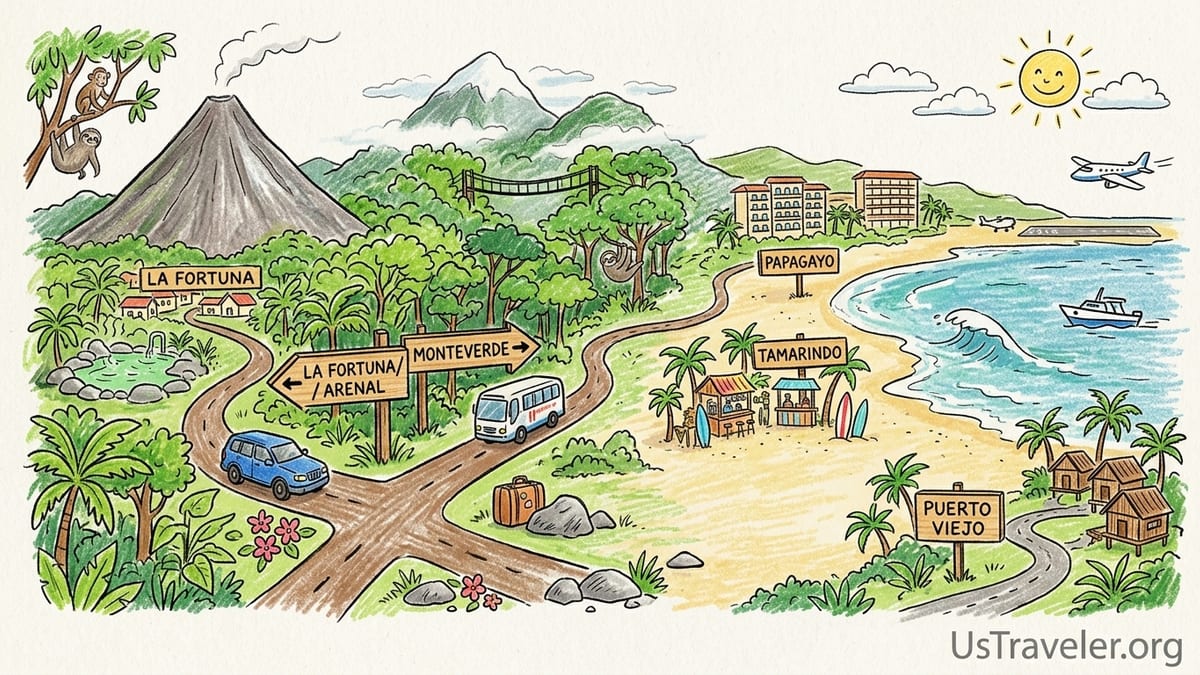
How to Choose Your Costa Rica Base
Costa Rica has two main international gateways: San José’s Juan Santamaría International Airport (SJO) in the Central Valley and Daniel Oduber Quirós International Airport in Liberia (LIR) in Guanacaste. SJO works best for La Fortuna and Arenal, Monteverde, Manuel Antonio, the Caribbean coast around Puerto Viejo and the Osa Peninsula. Liberia is the natural entry point for Guanacaste’s dry Pacific beaches, Papagayo’s resort peninsula and Tamarindo’s busy surf town. Many travelers fly into one airport and out of the other to avoid backtracking, for example arriving in San José for Arenal and Monteverde, then finishing on the Guanacaste coast and flying home from Liberia.
Distances that look short on Google Maps can take longer because most routes are two-lane highways that wind through mountains or along the coast. As of 2026, real-world drive times are typically three to four hours from San José to La Fortuna or Monteverde, around three hours to Manuel Antonio and four to five hours to Puerto Viejo, depending on traffic and weather. Liberia sits 25 to 40 minutes from Papagayo and about one hour from Tamarindo. When planning, think in half days of travel rather than strict mileage, and avoid scheduling long drives on your arrival night if you land late in the day.
Car rental gives you the most flexibility, especially if you are stringing together Arenal, Monteverde and either coast. A standard sedan works for La Fortuna, Tamarindo, Manuel Antonio and central Guanacaste, but many travelers choose a higher-clearance SUV or all-wheel-drive vehicle for Monteverde, Santa Teresa and parts of the Osa Peninsula, where unpaved roads and steep hills are common. If you do not want to drive, shared tourist shuttles link all the major hubs, while domestic flights on small planes cut journey times dramatically to Drake Bay, Puerto Jiménez and some Nicoya Peninsula airstrips.
Accommodation styles vary sharply by region. La Fortuna mixes mid-range hotels with on-site hot springs and budget lodges in town. Monteverde is defined by simple cabins and eco-lodges. Manuel Antonio compresses hillside boutique hotels and villa-style resorts with ocean views. Guanacaste and Papagayo lean into full-service beach resorts and all-inclusive complexes, while Tamarindo and Santa Teresa skew to small hotels, surf lodges and vacation rentals. Puerto Viejo tends toward bungalows under palm trees, and the Osa Peninsula is known for remote, high-end jungle eco-lodges reached by boat or bush plane.
Arenal & La Fortuna: Volcano Views and Hot Springs
La Fortuna, the main base for visiting Arenal Volcano, is often the first stop after San José. It combines an easily accessible town with a ring of countryside hotels facing the volcano. The area is known for its hot springs, the classic cone-shaped Arenal Volcano and adventure activities. From SJO, expect a drive of about three to four hours under normal conditions. You can also reach La Fortuna from Liberia in around three hours, which makes it a flexible add-on to either airport. Roads are paved the whole way, so a regular sedan is usually sufficient.
Staying along the main “volcano road” outside town puts you closer to the hot springs complexes. Well-known options include mid-range properties with day-pass springs and upmarket resorts that bundle access into the nightly rate. At the luxury end, thermal resorts with lush landscaping and quiet, guest-only pools can easily exceed a few hundred dollars per night in high season. In town, small hotels and guesthouses start much lower, appealing to travelers who do not need on-site springs and are happy to buy day passes to spots such as family-friendly hot springs parks where you can spend an afternoon moving between pools.
La Fortuna works well for active travelers, families and first-time visitors who want to see “classic Costa Rica” in one place. Within a short radius you can hike lava trails at viewpoints like Arenal 1968, walk hanging bridges through rainforest, ride zip lines, try canyoning, join a safari float on the Peñas Blancas River or visit La Fortuna Waterfall, reached by a long staircase down to a plunge pool. Most tours include hotel pickup, which means you can base yourself a short drive outside town without needing to drive at night.
Three nights in La Fortuna is usually enough to experience the highlights without feeling rushed. This gives you two full days for activities and one evening dedicated to hot springs. If you are combining Arenal with Monteverde and either Manuel Antonio or Guanacaste, La Fortuna makes a logical starting point before moving deeper into the country or over to the coast.
Monteverde: Cloud Forest and Cool Mountain Air
Monteverde is Costa Rica’s cloud forest destination, set on a high ridge where warm air meets cooler mountain winds and condenses into mist. The villages of Santa Elena and Monteverde host most of the lodges and restaurants, while nearby reserves protect dripping green forests filled with orchids, bromeliads and birdlife. From San José or La Fortuna, count on roughly three to four hours of travel, including stretches of steep, winding road. Paving has improved in recent years, but many travelers still prefer a higher-clearance vehicle, especially in the rainy season.
The region’s accommodations lean toward cozy cabins, basic inns and eco-lodges that blend into the hillsides rather than full-service resorts. You will find simple lodges with shared verandas for under typical mid-range prices, comfortable mid-scale hotels with on-site trails and small spas, and a handful of boutique eco-lodges and nature-focused retreats at higher nightly rates. Many places prioritize sustainability, with solar panels, rainwater collection and limited air-conditioning because temperatures stay cooler at altitude, especially at night.
Monteverde suits travelers who value nature, hiking and a slightly off-grid feel over pool time. The main experiences are walking cloud forest trails, gliding across hanging bridges, early-morning birdwatching and night walks with a naturalist guide to spot frogs, insects and nocturnal mammals. Adventure parks offer zip lines that cross deep valleys, and coffee and chocolate farm tours showcase small-scale agriculture. Because the roads slow travel and the weather can be damp and breezy, Monteverde pairs best with Arenal and one coast rather than as a quick detour.
Plan on two or three nights to justify the journey. This gives you a full day devoted to the cloud forest reserves and another for canopy tours or coffee farms. If you are nervous about driving, shared shuttles run between La Fortuna, Monteverde, San José and the Pacific coast. The La Fortuna to Monteverde journey can also be broken up by using a “jeep-boat-jeep” style transfer, which crosses Lake Arenal by boat and avoids some mountain driving.
Manuel Antonio: Wildlife, Beaches and Easy Access
Manuel Antonio on the Central Pacific coast is one of Costa Rica’s most popular bases because it blends sandy beaches with easy wildlife viewing and straightforward access from San José. The drive from SJO takes about three hours along a modern coastal highway, which makes the region feasible even on a shorter trip. The nearby town of Quepos handles services and the marina, while the main hotel zone climbs a steep hill between town and the national park, with many properties stacked on the slopes for ocean views.
Accommodation ranges from compact boutique hotels with infinity pools overlooking the forest to larger family-friendly resorts with multiple pools, kids’ clubs and on-site restaurants. There are also apartment-style rentals and private villas on the hillsides, often reached by steep access roads. Prices cover a wide band: simple guesthouses and budget hotels sit near the highway and in Quepos, while mid-range hillside hotels often cost moderate nightly rates in high season. Upscale properties with extensive amenities and uninterrupted sea views can rival the pricing of better-known Caribbean islands.
Manuel Antonio National Park remains the core attraction, with short, well-marked trails through secondary forest, white-sand beaches and regular sightings of monkeys, sloths and iguanas. Guided morning walks help you find wildlife using spotting scopes, and many visitors spend the afternoon swimming or relaxing on park beaches. Outside the park, you can book ocean kayaking, catamaran cruises, surfing lessons, parasailing or mangrove boat tours. This mix of activities makes Manuel Antonio ideal for families, first-time visitors and anyone wanting a balance of nature and beach without venturing too far from the capital.
Because the area is compact and parking at the park is limited, many travelers rely on taxis or hotel shuttles instead of driving every day. A rental car is helpful if you plan day trips to quieter beaches or nearby waterfalls, but it is not strictly necessary if you choose a hotel on the main hill road. Three nights is a comfortable minimum; four or five nights lets you slow down and alternate park days with relaxed beach time.
Guanacaste, Papagayo, Tamarindo & Santa Teresa: Pacific Beach Choices
Guanacaste, in Costa Rica’s northwest, is the country’s driest and sunniest region, especially from December to April. Liberia’s airport sits close to the main beaches, so you can often reach your hotel within one to two hours of landing. This makes Guanacaste the easiest choice for a resort-style beach holiday, whether you want an all-inclusive complex on the Papagayo Peninsula or a lively surf town such as Tamarindo. For trips focused almost entirely on sand and sea, many travelers skip San José entirely and fly in and out of Liberia.
The Papagayo Peninsula and nearby bays host large, full-service resorts, including upper-upscale international brands with multiple pools, on-site golf, kids’ clubs and curated restaurants. Many sit in secluded coves with calm water suited to paddle-boarding and kayaking. Nightly rates here run at the higher end of Costa Rica’s scale, especially in peak season and during holidays. A stay on Papagayo suits travelers who value convenience, predictable weather, a controlled resort environment and the ability to book all activities through a concierge, from sunset catamarans to zip-line day trips inland.
Tamarindo, roughly an hour from Liberia, delivers a very different atmosphere. The town stretches along a broad surf beach lined with cafés, bars, surf schools and a mix of hotels, hostels and small condo-style properties. It attracts younger travelers, surfers and families who want a walkable beach town with dining variety and some nightlife. You can learn to surf on the gentler parts of the break, book turtle nesting tours in season or join boat trips into the nearby estuary. Prices range from basic rooms in simple guesthouses to polished boutique hotels with pools tucked just back from the sand.
Farther down the Nicoya Peninsula, Santa Teresa feels more remote. Reaching it from Liberia or San José involves a longer, sometimes bumpy drive and, depending on your route, a vehicle ferry. The reward is a low-rise beachfront village with dirt roads, yoga studios, surf camps and small design-forward boutique hotels hidden in the jungle. Power cuts and dust are part of the experience, but so are glowing sunsets and long, uncrowded surfable beaches. This area suits repeat visitors, digital nomads and travelers who are comfortable with less infrastructure and who usually rent a 4x4 or ATV to move around.
Puerto Viejo: Caribbean Culture and Laid-back Vibes
On Costa Rica’s opposite coast, Puerto Viejo de Talamanca and the surrounding villages such as Cocles, Playa Chiquita and Punta Uva sit near the border with Panama. This Caribbean strip has a distinct character, with Afro-Caribbean culture, reggae music, rice-and-beans cooked in coconut milk and a slower pace than the Pacific hubs. Reaching Puerto Viejo typically involves a four to five hour drive from San José, including a mountain pass and then a long, flat stretch toward the coast. There is no direct access from Liberia, so most Caribbean-bound travelers use SJO.
Accommodation here is smaller in scale than in Guanacaste or Papagayo. Expect colorful guesthouses, wooden bungalows under palm trees, jungle lodges set back from the road and a growing number of stylish small hotels designed for couples and remote workers. Many places rely on fans rather than full air-conditioning, and some have open-air bathrooms and outdoor showers. Price points are generally lower than on the Pacific, though there are now some higher-end boutique options scattered along the road to Punta Uva that compete with mid-range Pacific hotels.
Puerto Viejo appeals to travelers who prioritize atmosphere and culture over polished infrastructure. Days revolve around biking between beaches, renting a surfboard, taking yoga classes and snorkeling when conditions allow. Nearby Cahuita National Park offers easy coastal hikes and good chances of seeing monkeys and sloths, while the Gandoca-Manzanillo Wildlife Refuge protects a wilder, less developed stretch of coast. Guided visits to Indigenous communities and cacao farms add context. Nightlife is livelier around Puerto Viejo town, with beach bars and small music venues.
A car is helpful for exploring the string of beaches, but many visitors get around by bicycle or short taxi rides, especially if they stay in or near Puerto Viejo itself. The region fits best into itineraries that also include Arenal and possibly Tortuguero on the northern Caribbean. For a first trip that focuses on the Pacific, Puerto Viejo is often better saved for a return visit when you want a different side of Costa Rica.
Osa Peninsula & Drake Bay: Remote Wilderness
The Osa Peninsula in Costa Rica’s far south is one of the most biodiverse corners of the country. Corcovado National Park protects primary rainforest where tapirs, scarlet macaws and multiple monkey species live, and where guided hikes feel genuinely wild compared with the more accessible parks around Arenal or Manuel Antonio. Access is part of the adventure. Travelers either take a short domestic flight from San José to Drake Bay or Puerto Jiménez, or they drive several hours from the Central Valley and then continue by 4x4 or boat, depending on where they are staying.
Most visitors base themselves in Drake Bay on the peninsula’s northern side or around Puerto Jiménez and the Golfo Dulce in the east. Drake Bay is typically reached by boat along the coast or via a small airstrip, while Puerto Jiménez has road access and flights. Accommodation skews to eco-lodges, often with wooden walkways, open-air lounges and set-meal dining rather than a la carte restaurants. At the higher end, fully inclusive jungle lodges package meals, boat transfers and guided excursions into nightly rates that may rival or exceed luxury beach resorts.
The Osa is best suited to travelers who prioritize wildlife, hiking and isolation and who do not mind rustic elements. Electricity may be limited to certain hours in some lodges, and Wi-Fi can be weak or absent. In exchange, you wake up to howler monkeys, fall asleep to the sound of the surf or the forest and spend days on guided hikes into Corcovado, snorkeling trips at Isla del Caño, mangrove tours or kayaking on calm inlets. Because park access is regulated and guided, you need to book ahead, especially in the dry season from December to April.
Given the travel effort, plan a minimum of three nights on the Osa Peninsula, and four or more if you are serious about wildlife photography or hiking. Many itineraries pair an arrival night in San José with a domestic flight south the next morning, then finish on an easier-access beach like Manuel Antonio or Guanacaste before flying out. Renting a car just for the Osa portion makes less sense than using flights and lodge transfers, unless you are combining the peninsula with road-trip stops along the southern Pacific coast.
San José & The Central Valley: Practical Gateway
San José and the surrounding Central Valley towns are where most international trips begin or end. While many travelers treat the capital purely as a transit stop, it can be worth a night or two, especially if your flight arrives late or departs early. Airport hotels in the Alajuela area cater to this, offering free shuttles, early breakfasts and secure parking for rental cars. In the city itself and nearby suburbs like Escazú and Santa Ana, you will find business hotels, restored mansions and design-forward boutiques that appeal to travelers interested in museums, coffee culture and local restaurants.
For drivers, overnighting near the airport on arrival simplifies logistics. You can collect your rental car the next morning after resting, then tackle the mountain roads to La Fortuna, Monteverde or Puerto Viejo in daylight rather than in the dark after a long flight. On departure, returning to San José the day before your flight gives you a buffer in case of traffic delays or weather disruptions and allows time to drop off the car without rushing. Travelers who plan a loop that starts and ends at SJO often structure their trip around this rhythm.
San José itself offers more than many visitors expect. The historic center has a walkable grid of streets with the National Theater, plazas and markets, while nearby coffee farms on the slopes above the valley run tours and tastings. Prices cover the full range from simple city guesthouses to international-brand hotels and a handful of upscale boutique properties with rooftop pools or city views. For most itineraries, one or two nights is sufficient to get a feel for the capital without cutting into your time in Arenal, the cloud forest or at the beach.
If your trip uses Liberia as either the entry or exit point, you can often avoid San José entirely by connecting directly to Guanacaste’s coastal towns. Some travelers still choose to fly into San José for Arenal, spend several days in the interior, drive across to Guanacaste beaches and then fly home from Liberia, effectively using both airports to minimize backtracking and highway time.
Trip Types: Matching Regions to Your Style
Thinking in terms of trip types can simplify the decision. For a first-time, one-week visit, many travelers choose a classic combination of Arenal and Manuel Antonio: three nights in La Fortuna for hot springs and adventure, then four nights on the Central Pacific for beach time and wildlife. This loop uses San José as the gateway, involves manageable three to four hour drives and offers a broad snapshot of Costa Rica without internal flights. Car rental is optional; you can link the hubs with shared shuttles and rely on tours once in each base.
For a longer, 10- to 14-night trip with two airports, a popular pattern is to arrive in San José, head to La Fortuna and Monteverde for six or seven nights split between volcano and cloud forest, then drive down to the Guanacaste coast and finish with four to six nights on a beach near Liberia. This suits couples, families and groups who want variety but also a relaxing final stretch. If you prefer not to drive the slow road between Monteverde and the coast, shuttle companies connect these legs and can be booked in advance.
Beach-focused holidays without much moving around point strongly toward Guanacaste and Liberia or, for a more off-grid feel, Santa Teresa and the broader Nicoya Peninsula. Choosing Papagayo or a resort near Tamarindo lets you land, transfer in under two hours and stay put. At the other extreme, adventure and wildlife enthusiasts may build their itineraries around the Osa Peninsula and Puerto Viejo, trading some comfort and easy access for deeper immersion in rainforest and Caribbean culture. These trips often layer a night in San José, a domestic flight to Drake Bay or Puerto Jiménez and then a very different tone than the resort areas.
Budget also plays a role. As a rough guide, Papagayo, top-end Tamarindo hotels and Osa Peninsula eco-lodges sit at the upper end of Costa Rica pricing, especially in dry season. Manuel Antonio, La Fortuna and mid-range Guanacaste resorts occupy the middle band. Puerto Viejo and basic lodgings in Monteverde and Santa Teresa can feel more affordable, though transportation costs to distant regions add up. Rather than chasing the lowest nightly rate, consider where you will actually use a resort’s facilities and where you are happy with simpler rooms because you will spend most of your time outside.
FAQ
Q1. Which airport should I fly into for Arenal, Monteverde and Manuel Antonio?
San José’s Juan Santamaría International Airport works best for this route. From SJO it is roughly three to four hours to La Fortuna or Monteverde and about three hours to Manuel Antonio in normal traffic, which makes a simple loop without backtracking.
Q2. When is it worth flying into Liberia instead of San José?
Liberia makes the most sense if most of your time is on the Guanacaste coast, Papagayo or Tamarindo. Many travelers on resort-style or beach-heavy trips fly in and out of Liberia and skip San José entirely to avoid a four- to five-hour cross-country drive.
Q3. Do I need a 4x4 rental car in Costa Rica?
You do not need a 4x4 for La Fortuna, central Tamarindo or Manuel Antonio in typical dry-season conditions, where paved roads dominate. A higher-clearance vehicle or all-wheel drive becomes useful for Monteverde, Santa Teresa, some parts of the Nicoya Peninsula and more rural areas around the Osa Peninsula, especially in the rainy months.
Q4. How many bases should I plan for a 10-day trip?
Most visitors are happiest with two or three bases in 10 days. A common pattern is three nights in La Fortuna, two or three nights in Monteverde and four or five nights at the beach in Manuel Antonio or Guanacaste, which balances travel time and relaxation.
Q5. Is Puerto Viejo safe and practical for a first trip?
Puerto Viejo is a well-established destination with a laid-back atmosphere, but reaching it involves a longer drive from San José than the Pacific coast. It is practical if you are comfortable with a four- to five-hour transfer and want Caribbean culture, but many first-time visitors focus on Arenal and the Pacific and save Puerto Viejo for a later trip.
Q6. How far in advance should I book Osa Peninsula lodges?
For peak season between December and April, it is wise to book Osa Peninsula eco-lodges several months ahead, especially if you want specific guided hikes into Corcovado National Park or rooms with particular views. Outside peak times there is more flexibility, but planning ahead still helps because many properties are small.
Q7. Can I visit both coasts in one trip?
It is possible, but you should allow at least 12 to 14 nights to avoid spending most of your time in transit. A realistic itinerary might include San José, La Fortuna, Puerto Viejo and either Manuel Antonio or Guanacaste, using shared shuttles or a rental car and accepting several long travel days.
Q8. Where should I stay if I don’t want to rent a car?
If you prefer not to drive, choose walkable hubs with good tour infrastructure such as La Fortuna, Tamarindo or central Manuel Antonio. In these places you can move around by taxi, join group tours with hotel pickup and use shared shuttles for longer transfers between bases.
Q9. What is the easiest region for traveling with young children?
Manuel Antonio and the Guanacaste coast are often the easiest with younger children. Both have relatively short transfers from their nearest airport, family-oriented hotels with pools and kids’ menus and a mix of gentle activities such as calm beaches, boat trips and short wildlife walks.
Q10. How many nights should I spend in San José?
For most itineraries, one or two nights in San José or near the airport is sufficient. Many travelers overnight on arrival or before departure for convenience, then spend the bulk of their time in La Fortuna, Monteverde, Manuel Antonio or the beach regions where Costa Rica’s natural highlights are concentrated.