


Costa Rica looks small on the map, but its regions feel like different countries: dry Pacific beaches, misty cloud forests, active volcanoes, Caribbean jungle and a busy capital in the middle. For first-time visitors, understanding how these pieces fit together is the key to planning a smooth trip that matches your budget, timing and travel style.
How Costa Rica Fits Together
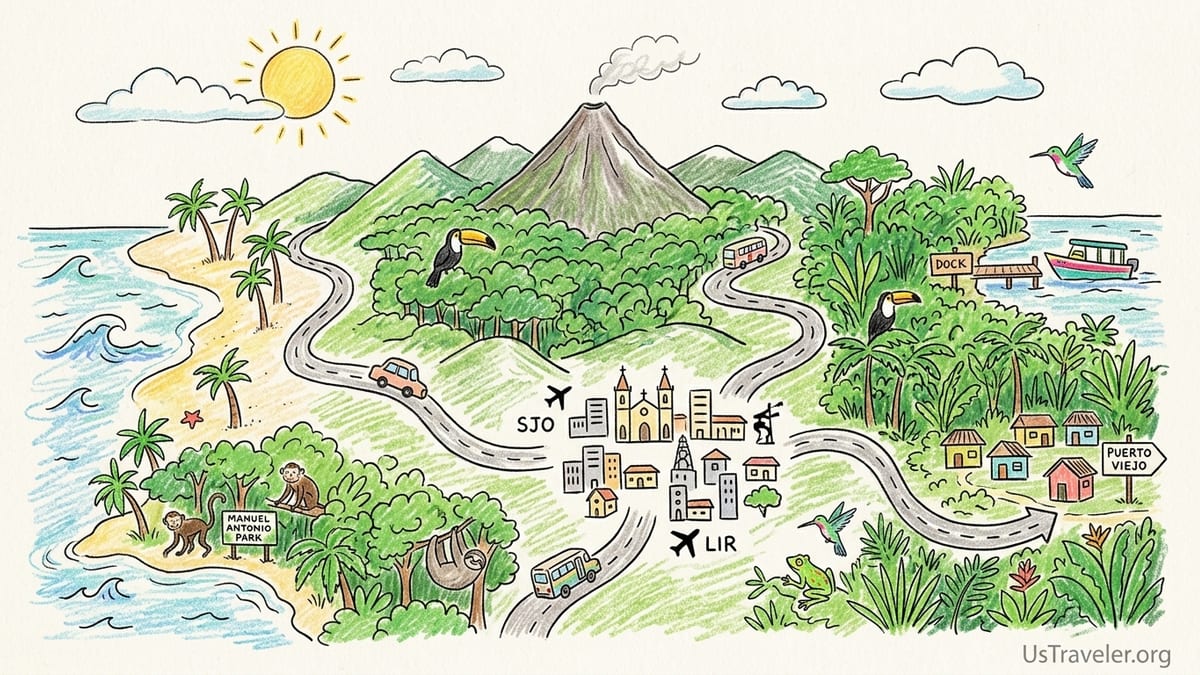
Costa Rica stretches only about 200 miles from Pacific to Caribbean, with the Central Valley and capital San José in the middle, and mountains and volcanoes running roughly northwest to southeast. In practice, most trips mix two or three regions: a volcano or cloud forest inland and one stretch of coast on either the Pacific or Caribbean side. Trying to “do it all” in 7 to 10 days usually leads to long days in the car and rushed stops.
The Pacific coast is the most visited, with drier weather in the northwest and wet, dense jungle in the south. The Caribbean side, from Tortuguero down to Puerto Viejo, has heavier rainfall, lush forest and a distinct Afro-Caribbean culture and cuisine. In between, the Northern Plains around Arenal and the cloud forests of Monteverde provide the classic interior highlights for hiking, wildlife and cooler temperatures.
Transport is slower than many visitors expect. A drive that looks like 100 kilometers on the map can easily take three to four hours on curvy, two-lane roads. As a planning rule of thumb, count on average road speeds of 35 to 45 kilometers per hour once you leave major highways. A realistic 10-day first trip might choose, for example, Arenal, Monteverde and the Central Pacific coast, or Arenal plus Guanacaste beaches, without also crossing to the Caribbean.
Two international airports anchor the main routes. San José’s Juan Santamaría International Airport (SJO) is in the Central Valley and works best for Arenal, Monteverde, Manuel Antonio and the Caribbean. Liberia’s Daniel Oduber Quirós International Airport (LIR) sits in Guanacaste, close to the resort beaches in the northwest. Some travelers fly into one and out of the other to avoid backtracking by road.
San José & the Central Valley: The Hub
The Central Valley is where most Costa Ricans live and where many first-time travelers land. San José itself is not usually the star of a vacation, but it is practical as the country’s main transport hub. From SJO, shared shuttle companies and private drivers can reach Arenal or Manuel Antonio in about 3 to 3.5 hours, Monteverde in roughly 3.5 to 4.5 hours, and the Caribbean coast around Puerto Viejo in about 4 to 4.5 hours, depending on traffic and roadworks.
Spending a night in or near San José can make sense if you arrive late, have an early flight out, or want to visit nearby sights like Poás Volcano National Park or the coffee farms around Alajuela and Heredia. Many travelers choose mid-range chain hotels near the airport, where rooms often run in the range of 120 to 180 US dollars per night including breakfast, airport shuttles and reliable Wi-Fi.
Within the Central Valley, the climate is milder than at the coasts, with warm days and cooler evenings. This makes it a comfortable place to adjust after a long-haul flight before heading to hotter and more humid regions. Urban attractions are modest but worthwhile if you have time: the National Theater, pre-Columbian Gold Museum and central markets where you can try a casado plate or gallo pinto breakfast.
For logistics, the Central Valley is where you will most likely pick up a rental car if you choose to drive. Major agencies operate at SJO and in nearby towns, offering compact SUVs that are better suited to rural roads. Expect to pay roughly 45 to 70 US dollars per day for a small SUV outside peak Christmas and Easter weeks, plus mandatory local insurance.
Guanacaste: Dry Pacific Beaches and Easy Resort Living
Guanacaste in the northwest is the driest, sunniest part of Costa Rica, with long stretches of Pacific coastline and many of the country’s most developed beach towns. From Liberia airport, it is often less than an hour to Papagayo Gulf resorts and around 1.5 hours to popular surf and family spots such as Tamarindo or Playa Flamingo. This makes Guanacaste attractive for travelers who want maximum beach time with minimal transit.
The region offers a broad range of accommodation, from large all-inclusive resorts with multiple pools and buffets to smaller boutique hotels and simple cabinas. A mid-range beachfront hotel in Tamarindo or Playa Hermosa might cost around 150 to 250 US dollars per night in the dry season, while inland lodges near Rincón de la Vieja National Park, known for volcanic mud pots and waterfalls, often bundle guided hikes and hot springs into package rates.
Beach experiences vary by town. Tamarindo has surf schools lining the sand, sunset catamaran sails and a busy restaurant scene, while quieter spots like Playa Conchal or Playa Avellanas focus more on swimming, stand-up paddleboarding and low-key dinners at beachfront sodas. Inland, Rincón de la Vieja and Palo Verde National Parks showcase dry tropical forest, horseback rides to waterfalls and riverboat safaris where you might spot crocodiles, herons and howler monkeys.
For first-time visitors, Guanacaste works well for a straightforward one-region trip, particularly for families or groups who prefer not to move around too much. A typical one-week stay might combine five or six nights at the beach with a day trip to Rincón de la Vieja for hiking and hot springs, plus perhaps a sunset cruise or snorkel excursion offshore.
Northern Plains & Arenal: Volcano, Hot Springs and Adventure
The Northern Plains center on the town of La Fortuna and Arenal Volcano, one of Costa Rica’s most famous silhouettes. From SJO, the drive to La Fortuna takes around 3 to 3.5 hours in normal traffic. From Liberia, it is often similar or slightly shorter by private transfer through Cañas and Tilarán. Many visitors pair Arenal with either Guanacaste beaches or the Central Pacific coast to balance jungle adventure with time on the sand.
Arenal is known for its hot springs resorts, canopy zip-lines, hanging bridges and waterfall hikes. Entry to the popular La Fortuna Waterfall, for example, is typically priced around the equivalent of 18 to 20 US dollars per adult, while a half-day zip-line canopy tour might cost from 60 to 90 US dollars per person depending on the operator and group size. Hot springs experiences range from simple, river-style spots used by locals to elaborate landscaped resorts with multiple pools, slides and on-site restaurants.
Accommodation around La Fortuna spans everything from basic rooms facing the volcano to high-end eco-lodges with floor-to-ceiling windows and included guided walks. Many mid-range hotels sit a short drive outside town and can arrange transfers to activities, which is helpful if you choose not to rent a car. Nights here are usually cooler than on the coast, with more frequent showers, particularly from May to November, which keeps the surrounding forest lush and green.
In terms of itinerary planning, Arenal works as a two- or three-night stop for most first-time trips. That gives you time for one adventure day, one hiking or wildlife day and some time at the hot springs without feeling rushed. Continuing on to Monteverde involves about 3 to 3.5 hours by road, or a “jeep-boat-jeep” combination across Lake Arenal that breaks up the journey and offers scenic views.
Monteverde & Puntarenas Highlands: Cloud Forest and Cooler Air
Perched in the highlands of Puntarenas province, Monteverde and neighboring Santa Elena are Costa Rica’s classic cloud forest destinations. Reached by curvy mountain roads from either Arenal or the Central Pacific, Monteverde feels noticeably cooler and mistier than the lowlands. Travelers come here for hanging bridge walks, birdwatching, night wildlife tours and small reserves such as Monteverde Cloud Forest Biological Reserve and Santa Elena Reserve.
The drive from San José to Monteverde usually takes around 3.5 to 4.5 hours, depending on the exact route and weather. From La Fortuna, the overland route can take about 3 hours by road, while the popular lake crossing option uses a short boat ride on Lake Arenal followed by a jeep or van up into the hills. Road conditions have improved in recent years but still slow vehicles, particularly in heavy rain.
Monteverde’s accommodation tends to be smaller lodges, inns and cabins scattered across hillsides. You might pay roughly 100 to 180 US dollars per night for a comfortable mid-range lodge including breakfast, with views over the Gulf of Nicoya on clear days. Many properties can organize guided night walks, farm visits and zip-lines, which are similar in price to Arenal’s adventure activities. Evenings are cool enough that you may want a light jacket or sweater, unusual in much of the rest of the country.
For first-time visitors, Monteverde is an excellent counterpart to either coast. A classic 8- to 10-day loop might run SJO to Arenal, then Arenal to Monteverde, then down to Manuel Antonio on the Central Pacific, before circling back to San José. That route provides volcano, cloud forest and beach without repeating the same roads or spending more than about 4 hours at a time in transit.
Central Pacific & Manuel Antonio: Easy Beaches from San José
The Central Pacific region, part of Puntarenas province, includes coastal hubs such as Jacó, Herradura and Quepos, as well as Manuel Antonio National Park. From San José, the modern highway reaches Jacó in around 1.5 to 2 hours and Quepos or Manuel Antonio in roughly 3 hours. This makes the Central Pacific the easiest coastal region for short trips or long weekends from the capital.
Jacó is the busiest town, known for surfing, nightlife and a broad range of hotels and condos. About an hour farther south, Manuel Antonio combines dense jungle, small coves and accessible wildlife viewing with a compact national park. Inside the park, it is common to see white-faced capuchin monkeys, iguanas and, with luck, sloths along the main trails. Guided walks usually cost around 25 to 40 US dollars per person, plus the park’s entrance fee, and many travelers consider a guide worthwhile for spotting camouflaged animals.
Accommodation here ranges from budget guesthouses in Quepos to mid-range hillside hotels with ocean views and small pools, up to luxury villas frequented by destination wedding groups. In high season, a mid-range room with sea view around Manuel Antonio can reach 200 to 300 US dollars per night, while more modest options in Quepos town may be closer to 70 to 120 US dollars. Many hotels partner with local operators to offer kayaking in the mangroves, catamaran cruises, surf lessons and horseback rides to nearby waterfalls.
The Central Pacific works well in combination with Arenal or Monteverde. A realistic week-long itinerary might include three nights near Arenal followed by four nights at Manuel Antonio, allowing time to adjust, enjoy the beaches and explore the national park without rushing. Because this coast is closer to San José than other Pacific regions, it is also practical for trips of only five or six days.
South Pacific & Osa Peninsula: Wild Coast and Intense Wildlife
South of Manuel Antonio, the coastline becomes wilder and less developed, with towns such as Dominical, Uvita and Ojochal leading toward the Osa Peninsula. This area is one of Costa Rica’s richest for wildlife, home to Corcovado National Park and marine reserves like Marino Ballena National Park, known for its whale tail-shaped sandbar at low tide. Driving from San José to Dominical usually takes around 3.5 to 4 hours, and to the Osa Peninsula’s main access towns, Puerto Jiménez or Drake Bay, can be 6 to 8 hours depending on route and weather.
Travelers choose the South Pacific for a mix of quieter beaches, humpback whale watching in season and immersive jungle stays. Boat tours from Uvita often run half-day trips to look for whales and dolphins when conditions allow, with prices commonly starting at around 75 to 100 US dollars per person. In Corcovado, guided day trips or overnight treks are usually mandatory and relatively costly compared with other parks, reflecting the remoteness and conservation focus of the area.
Accommodation ranges from surfer-friendly guesthouses in Dominical to mid-range boutique hotels in Uvita and remote eco-lodges in Osa that may only be reachable by boat or 4x4. These remote lodges often include meals and guided walks in package prices that can start around 250 to 400 US dollars per person per night, especially in high season. Electricity may be limited in some places, creating a closer-to-nature, off-grid experience that appeals to wildlife enthusiasts more than to those seeking nightlife.
For a first trip, the South Pacific is best if you have at least 10 to 14 days and a strong interest in nature and hiking. It combines well with a short stay in the Central Pacific or Arenal. A compact route might be SJO to Uvita, then on to Puerto Jiménez for several nights, and back out via a short domestic flight from Puerto Jiménez to San José to avoid repeating the long road journey.
Caribbean Coast, Tortuguero & Puerto Viejo: Jungle, Culture and Different Seasons
Costa Rica’s Caribbean side feels distinct from the Pacific in both culture and climate. The northern section around Tortuguero is often reached by road and boat from near Guápiles, taking around 4 hours from San José including the canal trip. There are no roads into Tortuguero village itself, so travelers leave cars at secure parking lots and continue by organized boat transfer. The area is sometimes described as a mini-Amazon, with canals lined by rainforest where guides look for caimans, toucans, howler monkeys and, in season, nesting sea turtles on the beaches.
Farther south, the coast around Cahuita and Puerto Viejo de Talamanca offers a more laid-back, Afro-Caribbean atmosphere. From San José, expect a journey of around 4 to 4.5 hours by road, crossing the mountains and descending to Limón province. Once there, travelers find small beach communities like Playa Cocles and Punta Uva, with reggae playing at beach bars, coconut-based Caribbean dishes such as rondon stew and rice and beans cooked in coconut milk, and coral reefs close to shore for snorkeling when seas are calm.
Accommodation on the Caribbean tends to be smaller guesthouses, jungle lodges and bungalows set back from the sand. Prices vary widely, but simple beachfront cabinas can sometimes be found for under 100 US dollars per night outside peak weeks, while stylish boutique hotels in the jungle with pool and breakfast often cost 150 to 250 US dollars. Many properties lend bicycles for getting around, since distances between villages are short and the main road is relatively flat.
Weather patterns differ from the Pacific. While the western side of Costa Rica is driest from roughly December to April, the Caribbean can see its relatively drier windows in February and March and again around September and October, with heavier rain more evenly spread through the year. This makes the south Caribbean a good alternative when the Pacific is in its wettest months, although travelers should always stay flexible and expect showers at any time.
Beaches, Volcanoes, Wildlife and National Parks in Practice
Across all these regions, Costa Rica’s main draws repeat with regional flavor: beaches on both coasts, a string of volcanoes and a dense network of national parks and reserves. On the Pacific, beaches in Guanacaste and the Central Pacific tend to have better road access and more services, while parts of the South Pacific and Osa remain rugged and less developed. On the Caribbean, beaches often back directly onto rainforest, with howler monkeys audible from the sand in places like Playa Negra or Punta Uva near Puerto Viejo.
Volcano experiences vary with location. Arenal near La Fortuna offers well-developed infrastructure, from accessible trails and hot springs resorts to organized night walks looking for frogs and nocturnal animals. Other volcanoes such as Poás and Irazú are day-trip targets from the Central Valley, typically involving early starts to catch clear views before clouds roll in. Park authorities sometimes limit visitor numbers or adjust opening hours in response to volcanic activity, so same-week confirmation with your hotel or tour operator is wise.
Wildlife is visible in most regions with a bit of patience and often with a guide. Manuel Antonio and Cahuita National Parks, for example, are known for relatively easy sightings of monkeys, sloths and colorful birds along well-used trails. In Tortuguero, the focus shifts to canals, where motorized boats and kayaks explore narrow waterways fringed with thick vegetation. In Corcovado on the Osa Peninsula, multi-hour hikes with local guides may offer chances to spot tapirs, peccaries and a wider variety of bird species, but require more fitness and planning.
Entrance fees for national parks are generally set in US dollars and, for many flagship areas, fall around the range of 15 to 20 US dollars per adult. Guided tours add another layer of cost but often make the difference between glimpsing a sloth and walking past it unnoticed. For first-time visitors, budgeting for at least a few guided walks, especially in your first days, can help you learn what to look and listen for when exploring independently later in the trip.
Getting Around, Seasons, and Choosing SJO vs LIR
Transport in Costa Rica is a mix of rental cars, shared shuttle services, private transfers and occasional domestic flights. For pairs or families who value flexibility and are comfortable with mountain driving, renting a small SUV can make sense on routes like SJO to Arenal or Arenal to Manuel Antonio. Travelers who prefer not to drive can rely on shared tourist shuttles that typically cost the equivalent of 40 to 70 US dollars per person for common routes, or private transfers that run more but offer door-to-door convenience and the ability to stop for photos and meals.
Domestic flights operate between San José and regional airports such as Liberia, Tambor, Quepos, Puerto Jiménez and others, although schedules and airlines can change and luggage weight limits are stricter than on international flights. For example, a 45-minute flight from San José to Puerto Jiménez can replace a 7- to 8-hour road journey to the Osa Peninsula, which many travelers consider worthwhile when time is limited and budgets allow.
Costa Rica’s climate is generally divided into a drier “high” season from roughly December to April and a wetter “green” season from about May to November, with local variations. In Guanacaste and much of the Pacific, January through March are typically sunniest and busiest, with higher accommodation prices and fuller tours, while May and June often bring afternoon showers but fewer crowds and lower rates. On the Caribbean, April and October can be relatively drier, making them attractive months for Puerto Viejo or Tortuguero even as Pacific regions see more rain.
Choosing between SJO and LIR depends mainly on your route. For a first-time visit focusing on Arenal, Monteverde, Manuel Antonio or the Caribbean, San José is usually the more efficient starting point, with most drives in the 3- to 4.5-hour range. Liberia works best if your trip centers on Guanacaste’s Pacific beaches and nearby parks like Rincón de la Vieja. If you plan a north-to-south journey along the Pacific, consider flying into Liberia, working your way down through Guanacaste and the Central and South Pacific, then flying home from San José to avoid retracing the same ground.
The Takeaway
For first-time visitors, Costa Rica rewards focused itineraries more than frantic cross-country dashes. Deciding early whether you want mainly beach time, cooler mountain air, wildlife immersion or a mix of all three will help you choose between Guanacaste, Arenal and Monteverde, the Central or South Pacific, and the Caribbean. Layer on realistic travel times of three to four hours between regions and consider starting and ending at different airports if your route allows.
In practical terms, a classic 7- to 10-day first trip might pair Arenal with either Guanacaste or the Central Pacific, or combine Arenal, Monteverde and Manuel Antonio, using San José as your international gateway. Travelers with two weeks can add wilder Osa or the Caribbean coast for a deeper look at the country’s landscapes and cultures. By understanding how Costa Rica’s regions connect, when they are at their best weather-wise and what kind of travel each supports, you can shape a trip that matches your expectations and leaves space for the relaxed, unhurried pace that many people remember most.
FAQ
Q1. How many regions should I visit on a 7-day first trip to Costa Rica?
Most first-time visitors are happiest with one inland base such as Arenal and one coastal region, for a total of two main stops, to avoid spending too much time on the road.
Q2. Is it better to fly into San José (SJO) or Liberia (LIR) for a first visit?
San José usually works best if you plan to visit Arenal, Monteverde, Manuel Antonio or the Caribbean, while Liberia is more convenient for Guanacaste’s Pacific beaches and nearby parks.
Q3. Do I need a 4x4 rental car to get around Costa Rica?
On the main routes between San José, Arenal, Guanacaste and the Central Pacific, a regular compact SUV is usually sufficient, but 4x4 can be useful in the rainy season or in more remote areas like parts of Osa or Monteverde’s side roads.
Q4. When is the best time of year for beach weather in Costa Rica?
On the Pacific coast, beach towns in Guanacaste and the Central Pacific tend to be sunniest and driest from about December through April, while the Caribbean can have relatively good windows in February to March and again around September to October.
Q5. How long does it take to drive from San José to Arenal or Manuel Antonio?
Under normal conditions, San José to La Fortuna near Arenal takes around 3 to 3.5 hours by car or shuttle, and San José to Manuel Antonio is usually about 3 hours via the main coastal highway.
Q6. Is Tortuguero worth including on a first trip?
Tortuguero is rewarding if you have at least two nights to spare and a strong interest in wildlife and canals, but its remote access by boat means it fits better into 10- to 14-day itineraries than very short trips.
Q7. Can I combine the Caribbean coast and the South Pacific in one itinerary?
It is technically possible but involves long travel days, so it is more comfortable on a two-week trip; many first-timers instead choose either the Caribbean plus Arenal or the Pacific plus Arenal and Monteverde.
Q8. Are national parks in Costa Rica crowded?
Flagship parks such as Manuel Antonio, Arenal and Tortuguero can be busy in peak months like January, February and Easter week, while visiting early in the morning, midweek or in the green season usually means fewer people.
Q9. Is Costa Rica suitable for traveling without speaking Spanish?
Yes, in major tourist regions many people in hotels, tour companies and restaurants speak at least some English, though learning a few basic Spanish phrases is appreciated and helpful in smaller towns.
Q10. How much should I budget per day for a mid-range Costa Rica trip?
Budgets vary, but many mid-range travelers spend roughly 150 to 250 US dollars per person per day covering accommodation, meals in local restaurants, park fees and a couple of organized activities across the trip.