


From central San José, Poás Volcano rises on the northern horizon like a promise: steaming crater, cool cloud forest air and, on a clear morning, a surreal turquoise lake in the caldera. Today you can see it on anything from a quick half-day dash to full-day packages that combine the volcano with a coffee estate such as Doka or Hacienda Alsacia and the lush La Paz Waterfall Gardens. Choosing between those options is less about right or wrong and more about how early you want to wake up, how much you want to spend and how much driving you are willing to tackle yourself.
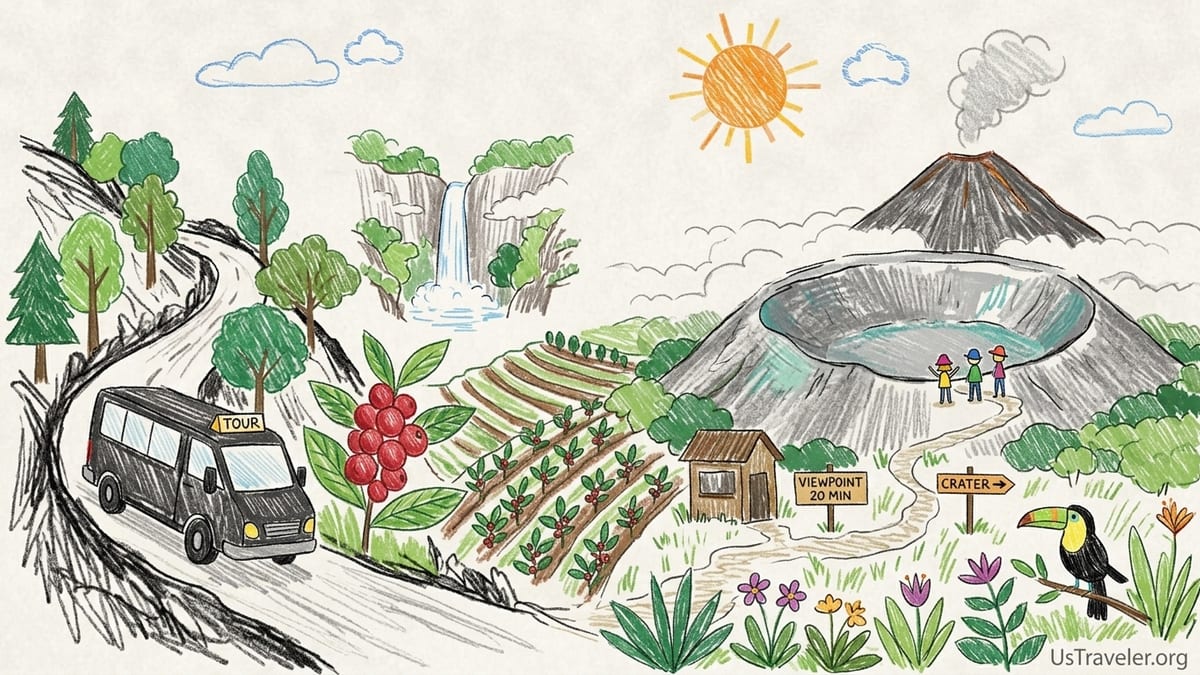
Understanding Poás Volcano National Park Today
Poás Volcano National Park lies roughly 50 kilometers north of downtown San José, with the main crater viewpoint at about 2,700 meters above sea level. Access is heavily regulated because the volcano is active and regularly emits gases. After major eruptions in 2017 and subsequent activity, the park reopened with strict rules on visitor numbers, entry times and safety equipment managed by rangers at the gate. Expect an organized, time-controlled visit rather than a wander-where-you-like national park experience.
As of 2026, visitors must enter in timed slots and typically receive around 20 minutes at the main crater viewpoint, plus the time it takes to walk the short paved path from the parking area. Entry hours usually run in the morning and early afternoon, but the volcano can close temporarily if gas levels spike or new activity is detected. Tour operators monitor these advisories and often adjust departure times or reorder the day so you are at the crater as early as possible, when visibility is generally best.
Weather at Poás is notoriously fickle. The volcano sits in a cloud forest zone where clear skies can turn to thick fog in minutes. Even in the dry season, many travelers arrive to find the crater completely socked in, while those who reach the viewpoint at opening time often enjoy the clearest views. Organized tours build their itineraries around this reality with early departures and some flexibility. Independent drivers need to watch forecasts and still accept that visibility is never guaranteed.
Park admission is sold via an online reservations system operated by the Costa Rican authorities, and same-day tickets often sell out on popular dates. Many commercial tours include the park ticket in the package price, which removes the need to navigate the booking website in Spanish and coordinate a precise time slot with your transport. Independent travelers must purchase their own entry and parking in advance, which can be a point of stress if you are trying to align the reservation with a rental car pickup or an early-morning drive from San José.
Half-Day Poás Volcano Trips from San José
Half-day Poás tours from San José focus almost entirely on the volcano itself. These trips usually depart between 6:30 and 7:30 a.m. from central hotels and key pickup points in areas such as downtown San José, Sabana, Escazú and parts of Heredia and Alajuela. Many operators specify a pickup radius of about 10 to 15 kilometers from the city center; outside that zone you might pay a small surcharge or be asked to meet at a central hotel.
The drive from the city to the park entrance takes around 1.5 hours in light traffic, longer on weekday mornings if you are crossing central San José. On a typical half-day itinerary, you travel directly to Poás with only a short coffee or restroom stop along the way, check in at the ranger station, walk the short path to the viewpoint and spend your allotted time at the crater. Some tours add a brief visit to a roadside strawberry farm or souvenir stand on the descent, but the emphasis is squarely on seeing the crater and returning to the city by early afternoon.
Prices for group half-day tours vary with season and inclusions, but many recent listings fall in the approximate range of 70 to 110 US dollars per person, including transportation and a guide, with park admission sometimes bundled and sometimes charged separately. Cheaper options may not include breakfast, while more expensive half-day excursions might offer a basic breakfast stop on the way up or a traditional “casado” lunch on the way back. When comparing, check whether the advertised price covers the national park ticket and parking, which together add roughly one more modest fee per person and one per vehicle.
In terms of time at the crater, half-day and full-day tours are nearly identical because the park restricts visits. You are not paying for extra minutes at the viewpoint; you are paying for how you structure the rest of your day. For many business travelers or those with only one spare morning in San José, the half-day model works well: you leave early, reach Poás at a decent hour for visibility and still get back to the city around 1:00 or 2:00 p.m. with the afternoon free.
Full-Day Packages: Poás, Coffee Estates and La Paz
Full-day Poás packages add classic Central Valley experiences to the same crater visit. The most common pairings are with a large coffee estate such as Doka Estate, just below the volcano, or Starbucks’ Hacienda Alsacia visitor farm, plus La Paz Waterfall Gardens. A typical day with a mainstream operator or a brand-name platform like Expedia or Viator runs about 10 to 12 hours door to door, picking you up around 6:00 to 7:00 a.m. and bringing you back to your San José hotel around 5:00 to 7:00 p.m.
Many itineraries start at a coffee estate. At Doka, for example, groups often arrive around 8:00 a.m. for a sit-down breakfast in the plantation restaurant followed by a guided tour of the wet mill, drying patios and roasting facilities. You walk through the rows of coffee, learn about cultivation and processing and usually end in a tasting room or gift shop. Hacienda Alsacia offers a similar arc with a stronger focus on Starbucks’ research and sustainability projects, appealing to brand fans and those curious about global coffee supply chains.
After coffee, the minibus climbs to Poás for the timed entry slot at the crater. Because full-day packages are structured, your operator coordinates your park reservation for mid-morning, aiming to balance early-day visibility with time to enjoy breakfast and the coffee component. Following the crater visit, most tours descend the eastern flank of the volcano toward La Paz Waterfall Gardens, arriving around midday. There, a buffet lunch is normally included, along with entrance to the private nature park’s trails, waterfalls and wildlife exhibits.
At La Paz, expect paved and stepped paths through cloud forest to a series of waterfalls, plus large enclosures with jungle cats, birds, amphibians, butterflies and hummingbirds. Some travelers consider La Paz expensive when visited independently, given its relatively high entry fee. In a full-day package, however, it tends to feel like good value because transportation, meals, coffee tour and Poás entry are bundled. Total prices for recent group full-day tours frequently fall in the range of roughly 150 to 200 US dollars per person depending on group size, brand, inclusions and whether the coffee estate is Doka, Hacienda Alsacia or another local farm.
Pickup Zones, Departure Times and Logistics
Whether you choose a half-day or full-day tour, pickup logistics can shape your experience. Most operators offer included pickups from common tourist hotels in downtown San José, Paseo Colón, La Sabana, Barrio Amón, and business districts such as Escazú and Santa Ana, as well as from parts of Heredia and Alajuela. If you are staying near the airport in Alajuela, check carefully: some Poás-focused operators will pick up there without surcharge because the route naturally passes nearby, while others treat it as an out-of-zone location and add a modest fee per vehicle.
Group tours almost always quote a pickup window rather than an exact time, often 30 minutes wide. For example, a full-day “Poás + Doka + La Paz” trip might say pickup between 6:00 and 6:30 a.m., with the bus reaching your hotel closer to one end of the window depending on where you fall on the route. It is worth clarifying this the night before so you are ready ten to fifteen minutes early. Private tours, by contrast, usually let you fix a specific departure time, which can be a major advantage if you want to target the earliest crater entry slots.
On return, half-day tours typically drop passengers back in San José early afternoon, while full-day packages arrive late afternoon or early evening. Traffic returning to the capital can be slow, especially if you hit the city between 4:00 and 6:00 p.m., so build in a buffer if you are catching an evening flight. If you are flying out the same night, an airport-area hotel pickup might be wiser than staying downtown and trying to cross rush-hour traffic after a long day on the volcano.
Logistics differ significantly for independent drivers. Self-driving from central San José or the airport area is straightforward in terms of distance, but you may face pre-dawn departures to secure early entry, curvy mountain roads in low light and patchy mobile coverage for navigation near the park. Parking inside the national park is limited, and you must align your arrival with your pre-booked entry slot. Travelers renting a car just for one day sometimes find that by the time they pay for rental, insurance, fuel and parking, they are close to the price of a mid-range tour, especially if traveling solo or as a couple.
Weather, Visibility and Time at the Crater
The single biggest determinant of whether your Poás experience feels magical or anticlimactic is weather. All the logistics and pricing details matter far less if you reach the viewpoint and see nothing but a white wall of cloud. The region’s microclimate often yields the best visibility early in the morning before clouds build, though this is never guaranteed. Tour companies know this and prioritize getting guests to the crater as early as park rules and itineraries allow.
Regardless of tour type, your time at the crater is limited. Visitors are generally given a short, controlled window, often around 20 minutes, to be at the viewpoint itself, partly for safety and partly to keep numbers manageable. This means a half-day “Poás only” tour and a full-day “Poás plus coffee plus La Paz” package will offer essentially the same crater viewing experience. What differs is whether the rest of your day is spent commuting back to the city or exploring additional attractions on the slopes and eastern side of the volcano.
Because visibility is so variable, many guides suggest checking the forecast the night before and being mentally prepared for cloud. Some full-day tours add value here by having guides who can adjust the day’s order on the fly, perhaps going to the coffee estate first if the upper slopes are fogged in or, conversely, driving straight to the volcano if a clear early window appears. Independent visitors have similar flexibility, but they must balance that against fixed entry times booked online and any prearranged meal or coffee tour times.
Even when the crater is partially obscured, the walk through the high-elevation forest, the temperature change from San José’s valley heat and the sudden glimpses into the caldera between clouds can be memorable. Travelers who want to maximize chances of a clear view should favor early departures, avoid late-afternoon park entries and consider traveling in the drier months, roughly December through April, while accepting that Poás can defy predictions year-round.
Pricing, Inclusions, Meals and Cancellation Policies
When comparing half-day and full-day Poás tours, examine what is included: transportation, national park ticket, coffee tour, La Paz entry, meals and guide services. A bare-bones half-day bus excursion might include a seat on a shared coach, a guide and a basic snack, leaving you to pay park admission directly at a small additional cost. A more upscale full-day combo often wraps everything into one figure: hotel pickup, bilingual guide, coffee estate tour with breakfast, Poás national park ticket, La Paz Waterfall Gardens entrance and a hot buffet lunch.
From a pricing perspective, full-day packages are more expensive in absolute terms but often better value per included element. For example, a recent sample listing for a “Poás, Doka Coffee & La Paz” day from San José bundled two meals, all three entry tickets and transport for a per-person price that, if unbundled, would be higher when adding individual admissions, rideshares or private transfers. On the other hand, a traveler who only cares about the crater view and has limited time might find a simpler half-day with fewer inclusions more cost-effective.
Meals can be a differentiator. Many full-day tours advertise a traditional Costa Rican breakfast at the coffee estate and a buffet lunch at La Paz featuring local dishes, salads and desserts. This is convenient for first-time visitors who do not yet know where to eat or how to order. Independent drivers might build in a stop at a roadside soda for a cheaper, more local meal instead. With both models, you should still carry snacks and water; Poás is cool, but walking at altitude and navigating steps at La Paz can be tiring.
Cancellation terms on organized tours vary by operator and booking platform. Some day trips allow free cancellation up to 24 hours before departure, while others tighten to 48 hours or longer during peak periods. This flexibility can be valuable because Poás is an active volcano; in the event of park closure due to volcanic activity or gas alerts, reputable operators either refund, reschedule or adjust the itinerary, perhaps substituting another attraction. Self-drivers bear more risk: while national park officials may refund unused tickets during complete closures, you could still be responsible for sunk costs on car rental or a nonrefundable coffee estate tour.
Is an Organized Tour Worth the Premium Over Driving?
Whether an organized tour is “worth it” comes down to your priorities. If you are comfortable driving curvy mountain roads in a foreign country, speak some Spanish and enjoy piecing together logistics, driving yourself can give you full control over timing and pace. You can book your own Poás ticket online, choose between Doka, Hacienda Alsacia or smaller family farms, and decide how long to spend at La Paz or if you want to skip it altogether. For a family of four, a rental car plus self-booked admissions may come out cheaper than four seats on a high-end full-day tour.
However, many short-term visitors find the tour premium justified. With an organized package, you are collected at your hotel, your entry times are managed, your meals are arranged and a guide handles navigation, Spanish-language interactions and last-minute changes if the volcano’s status shifts. For solo travelers and couples, the per-person cost of a full-day group tour can compare favorably with the combined expense of a rental car, fuel, parking, park tickets, coffee tour fee and La Paz entry, especially when measured against the time and stress saved.
Guides on reputable tours also add interpretive value. At the crater, they explain Poás’s history, recent eruptions and safety measures in context rather than leaving you to read signage. On the coffee estates, they translate questions, explain harvest cycles and demonstrate processing steps. At La Paz, they help spot wildlife, offer photography tips on the waterfall trails and manage pacing so that guests with different fitness levels do not feel rushed or bored.
Finally, safety and contingency planning matter. In the event of sudden weather changes, minor medical issues from the altitude or gas sensitivity, or unforeseen road closures, experienced guides and drivers are used to solving problems. Independent travelers must troubleshoot those challenges on their own. If your Costa Rica stay is short and this is your one chance to see Poás, many visitors are willing to pay extra for the simplicity and backup support that come with an established tour provider.
The Takeaway
Both half-day Poás volcano trips and full-day packages from San José deliver the same core experience at the crater: a carefully managed, time-limited visit to one of Costa Rica’s most active volcanoes. The real difference lies in how you use the rest of the day and how much hand-holding you want with logistics, meals and admissions. Half-day tours suit travelers with tight schedules who are primarily interested in the volcanic landscape and want to be back in the city by early afternoon. Full-day itineraries that add Doka or Hacienda Alsacia and La Paz Waterfall Gardens turn the outing into a complete Central Valley sampler, with coffee, cloud forest, waterfalls and wildlife rolled into one.
For visitors comfortable with self-driving and online bookings, an independent trip can work well, especially when shared among several people. For others, the premium on a well-reviewed tour is a trade-off for simplicity, safety and depth of interpretation. In either case, the fundamentals remain the same: start early, bring a light jacket for the cool altitude air, be prepared for clouds and remember that volcanoes operate on their own schedule. Plan around those realities and a day trip from San José to Poás, with or without coffee and waterfalls, can be one of the most memorable experiences of your time in Costa Rica.
FAQ
Q1. How long does a typical Poás Volcano tour from San José take?
A half-day Poás-only tour usually lasts about 6 to 7 hours door to door, returning to San José early afternoon. Full-day combos that include a coffee estate and La Paz Waterfall Gardens generally run 10 to 12 hours, with departure around 6:00 to 7:00 a.m. and return between 5:00 and 7:00 p.m.
Q2. From which areas of San José do Poás tours offer hotel pickup?
Most group tours include pickup from central San José neighborhoods such as downtown, Paseo Colón, La Sabana and Barrio Amón, plus common hotel zones in Escazú, Santa Ana, Heredia and sometimes Alajuela near the airport. If you are staying outside those areas, you may need to pay a small supplement or meet at a central hotel.
Q3. What time of day offers the best chance of seeing the Poás crater?
Conditions change quickly, but guides generally recommend early morning visits for the best odds of clear views before clouds build. Many tours plan to reach the crater by mid-morning, aligning with park entry times, though there is never a guarantee of visibility.
Q4. Are park admission and crater access included in tour prices?
On many full-day “Poás + coffee + La Paz” packages, the national park ticket and parking are included in the overall price. Some budget half-day tours exclude park admission and ask guests to pay that fee separately at the entrance. Always read the inclusions carefully so you know whether park tickets are covered.
Q5. How much time do visitors actually spend at the crater viewpoint?
Because of safety regulations and crowd control, visitors are typically allowed a short window, often around 20 minutes, at the main crater lookout. This limit applies regardless of whether you arrive on a half-day trip, full-day package or independently in a rental car.
Q6. What kind of meals are provided on full-day Poás, coffee and La Paz tours?
Full-day tours commonly include a sit-down breakfast at a coffee estate such as Doka or Hacienda Alsacia and a buffet lunch at La Paz Waterfall Gardens. Menus usually feature Costa Rican staples like rice and beans, meats, salads, fresh fruit and desserts. Be sure to notify your tour operator in advance about any dietary restrictions.
Q7. Can I visit Poás, a coffee farm and La Paz on my own without a tour?
Yes, it is possible to rent a car, book your own Poás park entry online and purchase tickets directly at coffee estates and La Paz Waterfall Gardens. This option suits confident drivers who are comfortable navigating mountain roads, Spanish-language booking interfaces and coordinating multiple timed entries in a single day.
Q8. Are tours to Poás Volcano suitable for children and older travelers?
Most tours are family-friendly. The walk to the crater is short and paved, though the altitude and cool air can be challenging for some. La Paz has many steps along the waterfall trails, which may be difficult for very young children, people with mobility issues or anyone who tires easily. If needed, you can enjoy the animal exhibits and partial trails instead of tackling every staircase.
Q9. What happens if the park closes due to volcanic activity or bad weather?
If Poás is temporarily closed on the day of your visit, reputable tour operators typically offer a refund, reschedule the trip or modify the itinerary, sometimes adding extra time at the coffee estate or La Paz. Independent visitors may receive a refund or option to rebook their park ticket, but they remain responsible for any nonrefundable car rental or other reservations.
Q10. Is a full-day Poás, coffee and La Paz tour worth the higher price?
For many travelers, yes. Full-day packages combine transportation, a guided crater visit, a coffee estate tour, meals and La Paz entry in a single, well-organized day. They cost more than a basic half-day excursion, but they offer better per-activity value and significantly reduce the planning and coordination you need to do on your own.