

The lower Nicoya Peninsula in Puntarenas can feel like a maze of beach names on a map: Santa Teresa, Mal País, Playa Carmen, Montezuma, Tambor, Cabuya, Paquera and more. On the ground, though, each of these coves has a very different personality. Choosing the right one can make the difference between a relaxed swim with kids in a calm bay and getting pounded by surf in a spot that mostly suits experts with shortboards. This guide focuses on the main beach hubs in this compact tourism region and compares them on what travelers actually ask about: surfing, swimming, currents, family-friendliness, nightlife, accommodation, road conditions and ferry access.
Understanding the Puntarenas Nicoya Coast
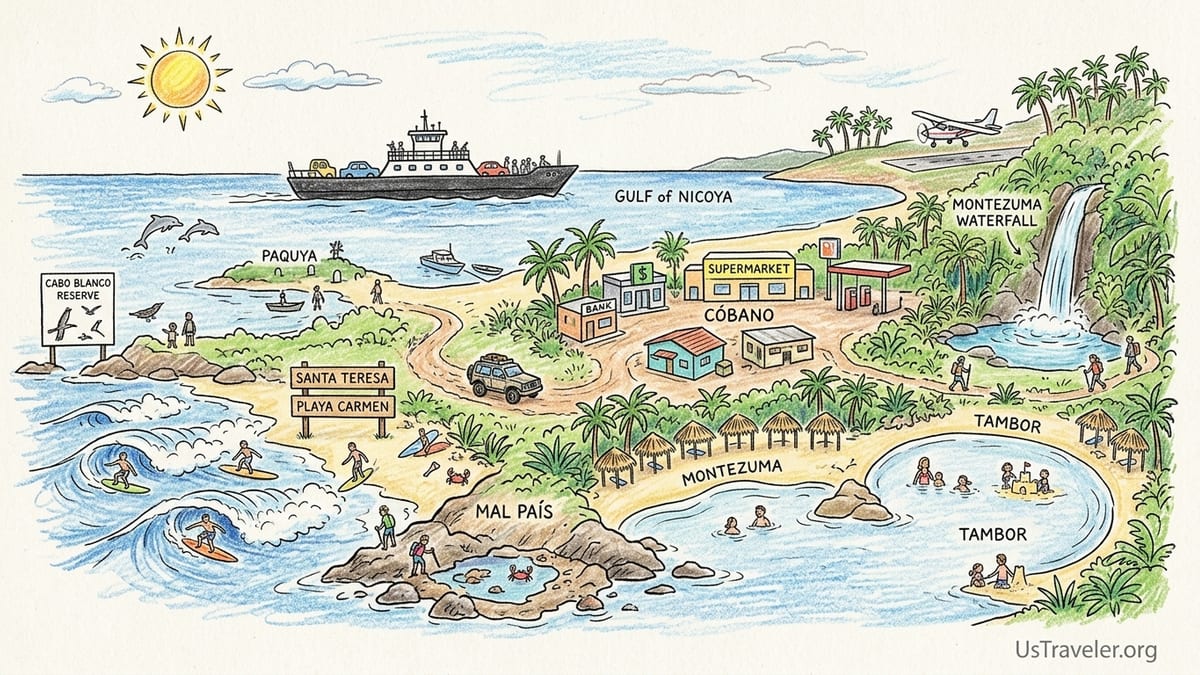
The beaches covered here sit on the southern end of the Nicoya Peninsula but are administratively part of Puntarenas Province. They cluster around the small service town of Cóbano, which is where you will find the gas station, larger supermarket and bank. Most travelers arrive either via the Puntarenas to Paquera ferry across the Gulf of Nicoya or on domestic flights into Tambor’s small airport, then continue by road to their chosen beach.
Conditions change quickly as you move along this short section of coast. Santa Teresa and Playa Carmen front straight onto the Pacific and pick up strong swell, which is why they have become synonymous with surfing. Mal País, just to the south, feels wilder again, with rocky points and fewer people. Montezuma, over on the more easterly side, faces the open gulf and offers a stitched-together string of coves backed by jungle and waterfalls. Tambor sits deep in a calm horseshoe bay, while Cabuya and the small beaches near Paquera are quieter and more local, often used as jumping-off points for reserves and boat trips.
Because everything is relatively close, it is entirely realistic to base in one town and sample the others. For example, many visitors who stay a week in Santa Teresa will rent a 4x4 for a day to drive the 45 minutes across to Montezuma’s waterfall and coves. Others will split their time, spending four nights in a surf-focused Santa Teresa lodge and then three nights at a mellow all-inclusive on Tambor Bay to unwind before flying back to San José from Tambor airport.
What unites the region is a sense of relative remoteness. Outside the small centers, most roads remain unpaved, street lighting is limited, and buses are infrequent. This is part of the charm but has implications for how you plan your trip, especially if you are traveling with children, older relatives or people who are not confident swimmers or drivers.
Surf Central: Santa Teresa, Playa Carmen and Mal País
If surfing is your priority, Santa Teresa and neighboring Playa Carmen are the obvious first choices. Long beach breaks grab almost any swell, and there are surf schools and board rentals every few hundred meters along the main road. A typical first-timer might pay the equivalent of around 60 to 70 US dollars for a 2-hour group lesson including board and rash guard, while intermediate surfers can rent a good-quality shortboard or funboard by the day. Santa Teresa in particular has multiple peaks along Playa Santa Teresa and Playa Hermosa, with punchy, faster waves at low tide and friendlier shoulders around mid-tide.
The flip side of all this energy is that Santa Teresa is not ideal if your main goal is casual swimming. There are no enclosed bays, and rip currents can be strong, especially in bigger swell. You will see people swimming where the sandbars are shallower, often at mid or high tide in front of beach access points with more people around, but this is still open-ocean surf. Families with younger kids often limit themselves to splashing in the whitewater, tide-pool exploring at lower tide, or swimming in hotel pools and using the beach mainly for walks and sunset.
Nightlife in Santa Teresa and Playa Carmen reflects the surf focus. Expect sunset cocktails at beachfront restaurants, a handful of late-night bars that cluster near the main intersection in Playa Carmen, and occasional live music or DJ nights. It is lively enough in the high season that solo travelers and digital nomads rarely feel bored, but it remains informal. Dress codes are nonexistent, dirt roads lead straight onto the sand, and people head home early when the morning surf report looks promising.
Mal País, a few kilometers south at the end of the main road, feels very different despite the short distance. Here rocky points and coves break up the sand, and there are fewer surf schools. Advanced surfers come for more secluded breaks that work best on specific tides and swells and often require local knowledge; visiting intermediates are better off basing in Santa Teresa and making exploratory trips south with a guide. For non-surfers, Mal País offers excellent tide pools at low tide and a quieter, more residential atmosphere, with small lodges tucked into the trees and the entrance to Cabo Blanco Absolute Reserve just beyond the village.
Swimming, Safety and Family-Friendly Beaches
For families and less confident swimmers, Tambor stands out within this region. The beach curves along a protected bay, so waves are typically smaller, and the slope into the water is more gradual. Resorts along Tambor Bay often promote the ability to swim year-round directly off the sand in front of the hotel, and you will see children playing in the shallows and locals wading out to fish at sunset. Currents still exist, and there may not be permanent lifeguards, so normal ocean caution is essential, but the feel is much calmer than the open surf coast around Santa Teresa.
In Montezuma, the main town beach can have stronger currents and, at times, runoff from the river that flows by the center. Many hotels and local guides instead send people a short walk north or south to smaller coves. Playa Las Manchas, around a kilometer south of town by road or path, is a favorite with locals for its white sand and turquoise water at lower tide, although even here currents can become tricky in certain spots. Families often combine a short waterfall hike with time on calmer stretches of sand rather than spending a whole day in front of the town center.
Cabuya’s coastline is more rugged, with a mix of sand, rock and reef. The shore near the village is popular for wading, shell hunting and launching kayaks rather than long swims, especially at low tide when rocky shelves are exposed. The big draw for families who enjoy nature is the proximity to Cabo Blanco Absolute Reserve and the tidal walk to the cemetery island just offshore, where locals and visitors can cross on foot at very low tide, guided by residents or local tour operators who know the schedule.
Around Paquera, several small beaches and islets offer sheltered conditions. Locals frequent spots within the Gulf of Nicoya for picnics and swimming, and many boat tours combine dolphin watching or bioluminescence excursions with a stop at a quiet beach where the water is typically flatter than on the outer coast. If you are traveling with young children or older relatives and are nervous about surf, booking a few nights near Paquera or Tambor and reserving day trips out to the wilder beaches can be a comfortable compromise.
Montezuma: Waterfalls, Coves and Bohemian Vibes
Montezuma appeals to travelers who want beach time but do not necessarily need world-class waves. The town grew from a small fishing village into a bohemian enclave, and it still feels compact and walkable, with a single main street lined with cafes, yoga studios, craft shops and casual restaurants. The beach immediately in front of town is narrow and can be rocky at higher tide, but a short walk in either direction reveals longer stretches of sand, shady palms and river mouths.
The Montezuma waterfall, just inland from town, is one of the signature experiences in the region. Guests typically walk in from road-side parking or join a guided hike, then swim in the large pool at the base. It is a natural site with no lifeguards and steep, often slippery rocks, so it is best suited to reasonably fit visitors wearing closed-toe shoes. Many travelers spend a full day alternating between waterfall pools and time on nearby beaches such as Playa Grande to the north, which is wide and open, with more surf and space to walk.
Montezuma’s currents and wave energy vary with the stretch of coast you choose. Some coves have relatively gentle water at certain tides that local families use for bathing, while beaches like Playa Las Manchas offer good snorkeling when the sea is calm but can also see rips form near the rocky edges. There are typically no permanent lifeguards on these smaller beaches, so you should always ask about conditions at your hotel or a local tour agency before committing to a longer swim, especially with children.
Accommodation in Montezuma spans small guesthouses in town, hillside boutique hotels with ocean views and a few eco-lodges deeper in the forest. Prices range from budget dorm beds in simple hostels to midrange rooms with breakfast included and air-conditioning. The town has enough restaurants that you can easily spend a week without repeating meals, with options from simple sodas serving casados to vegetarian cafes and beachfront seafood grills. Nightlife is more laid-back than in Santa Teresa, with occasional live music nights and low-key bars rather than a full club scene.
Tambor, Cabuya and Paquera: Calmer Corners of the Coast
Tambor differs sharply from the surf towns on the outer side of the peninsula. The bay shapes a wide, gently curving beach with more modest waves, which suits visitors looking for relaxed swimming, kayaking and stand-up paddleboarding. Several resorts and hotels line the shore or nearby hills, offering packages that might include domestic flights to Tambor’s airstrip, airport transfers, meals and activities such as horseback rides along the beach or boat trips into the gulf. This makes Tambor popular with families, honeymooners and travelers who prefer a more contained resort experience.
Cabuya has a distinctly local feel compared with Santa Teresa and Montezuma. Houses, small guesthouses and cabins are spaced along the main road, and the village doubles as a gateway to Cabo Blanco Absolute Reserve. Many visitors base themselves in simple eco-lodges or rental houses and spend their days hiking, birdwatching, kayaking or exploring the tidal walk to the cemetery island just offshore. The beaches here are less about long swims and more about nature: watching shorebirds, spying crabs and small fish in tide pools, and enjoying quieter sunsets with mostly local neighbors.
Paquera itself is best known as the main ferry port on the Nicoya side of the gulf, but the area hides smaller, low-key beaches and islands that reward those who stay a night or two instead of driving straight through. Some small hotels and lodges arrange evening bioluminescence tours in the gulf, where guests kayak or ride small boats into darker coves and watch the water glow around their paddles. Daytime tours might combine a stop on an offshore island with snorkeling in waters that are usually calmer than on the open Pacific, making this a good choice for families and first-time snorkelers.
Overall, Tambor, Cabuya and Paquera share a slower rhythm. The roads are quieter than the Santa Teresa strip, and you are more likely to fall asleep to insect noise than to bar music. Travelers who spend a week in the region often comment that splitting their time between a surf town like Santa Teresa or Playa Carmen and a calmer base such as Tambor or Paquera gives them the best of both worlds.
Access, Roads and Getting Around
Reaching this part of Puntarenas typically starts with either the Puntarenas to Paquera ferry across the Gulf of Nicoya or a domestic flight into Tambor. The ferry crossing takes around 70 minutes on the water, plus time to purchase tickets and drive on and off. In the high dry season from roughly December to April, vehicle spaces often sell out on popular departure times, so travelers driving from San José with a rental car should aim to book a ferry slot in advance and arrive at the terminal early. Foot passengers buy tickets separately and board by a different ramp, then disembark in Paquera and continue by shuttle, bus or pre-arranged taxi.
From Paquera, the main road to Cóbano and on to Santa Teresa and Montezuma has been steadily improving, with more sections paved in recent years. Even so, many access roads to beaches and hotels remain unpaved, and heavy rains between May and November can leave potholes and muddy stretches. While it is technically possible to do the trip in a small sedan in dry months if you drive slowly and avoid the roughest shortcuts, a compact SUV or 4x4 offers more clearance and peace of mind. Shuttles and local taxis are usually familiar with the conditions and can advise on whether a specific track is passable.
Within Santa Teresa and Playa Carmen, traffic has increased sharply in recent high seasons, with a mix of cars, delivery trucks and the ubiquitous ATVs and scooters used by visitors. The main strip is dusty and bumpy in dry months, muddy in wet months, and lighting is limited at night. Many visitors choose accommodation within walking distance of food and the beach so they can leave the car parked most days. In Montezuma, Tambor, Cabuya and Paquera, traffic is lighter, and it is easier to get around on foot, though you may still want a taxi or rental vehicle for longer day trips to waterfalls or reserves.
Public buses do run between key points such as Paquera, Cóbano, Santa Teresa and Montezuma, but schedules are limited and can change seasonally. They work well if you have a flexible itinerary and are comfortable with delays, but most short-stay visitors opt for shared or private shuttles, especially when catching onward ferries or flights. For example, a family of four might reserve a private shuttle from their Santa Teresa hotel back to Paquera ferry for a morning sailing, allowing extra time to queue and board without juggling multiple bus connections.
Nightlife, Dining and Accommodation Styles
Santa Teresa and Playa Carmen have the most developed dining and nightlife scene in this region. You will find international cafes serving espresso and smoothie bowls in the morning, casual lunch spots with poke bowls and burritos, and higher-end restaurants offering wood-fired seafood, homemade pasta and tasting menus. Beach clubs set up daybeds and run happy hours timed to sunset, and a handful of bars and hostels host weekly party nights. Budget travelers often self-cater using small supermarkets and fruit stands, while midrange guests might choose hotels that include breakfast but leave lunch and dinner open so they can sample different places each day.
Mal País, although very close, is noticeably quieter once the sun sets. Accommodation here skews toward small boutique hotels, villas and yoga retreats built among the trees, many of which offer their own dinners or communal meals. Montezuma falls somewhere between: there are enough beach bars and small venues that you can find live music on certain nights, but the general mood is relaxed. Travelers often linger over dinner in a restaurant terrace overlooking the sea, then head back to their guesthouse rather than staying out until dawn.
Tambor’s accommodation includes both all-inclusive style resorts and smaller hotels. In an all-inclusive, you might pay a per-night rate that covers buffet meals, snacks, non-motorized water sports and evening shows, which can simplify budgeting for families who plan to spend most of their time on-site. Independent hotels and vacation rentals around Tambor and Cabuya cater more to self-sufficient travelers who prefer to cook some meals themselves or drive out to local sodas and small restaurants in Cóbano or Montezuma.
Paquera’s offerings are more limited but growing. A few lodges and guesthouses cater to travelers specifically interested in bioluminescence tours, kayaking, birdwatching and quiet beaches. Because the town is small, eating options are mostly casual sodas, bakeries and a couple of simple restaurants around the main street and road toward the ferry. Many visitors here end up booking tours that include a basic lunch on the boat or on an offshore island beach, such as rice and beans with grilled fish and salad eaten under a palm-thatched shelter.
Choosing Your Base: Matching Beaches to Travelers
When you narrow the region down to real choices, the trade-offs become clearer. Santa Teresa and Playa Carmen reward travelers who prioritize surf, a social scene and a wide range of cafes and restaurants. You should be comfortable with dust, limited sidewalks, and the need to be cautious in the water. Advanced surfers often visit in shoulder seasons when the swell is still consistent but the crowds thin slightly, staying in surf hostels or apartments within walking distance of their preferred break.
Montezuma suits visitors who want more varied nature without giving up a town center. It is a strong choice if your dream day includes a waterfall hike in the morning, reading in a hammock in the afternoon and a quiet dinner at a small restaurant rather than a bar crawl. The beaches are visually dramatic, with jungle pushing right down to the sand, and while swimming is possible at certain spots and tides, you will spend at least as much time exploring rivers and coves as you will in the open sea. Montezuma also works well for travelers without cars, as many tours and walks start from the center.
Tambor is the logical pick for families with young children, older travelers and anyone whose priority is being able to wade out into relatively gentle water straight from their hotel. Accommodation tends to be more resort-style, with on-site pools, kids’ activities and organized excursions. Cabuya and Paquera make sense if you are seeking quiet, nature-heavy days with fewer people and are willing to organize your own transport and tours. They also pair well with a few days on the wilder surf coast, giving you a softer landing at the start or end of your trip.
Because distances are moderate, you do not necessarily need to commit to one base. A two-week itinerary might include five nights in Santa Teresa or Playa Carmen for surf and restaurant-hopping, three nights in Montezuma for waterfalls and bohemian streets, and four nights in Tambor or Paquera for calm bay swims and kayak trips. By thinking of these beaches as complementary rather than competitive, you can shape your route around how you actually like to spend your days.
FAQ
Q1. Which beach in this region is best for beginner surfers?
Santa Teresa and Playa Carmen are the best bases for beginner surfers because they have long beach breaks, multiple surf schools, and plenty of instructors used to teaching first-timers in waist- to chest-high waves when conditions allow.
Q2. Where should I stay if I want calm water for swimming with kids?
Tambor is usually the top choice for families, as its protected bay tends to have smaller waves and a gentler slope, and many hotels are set directly on the sand so you can move easily between the pool and the sea.
Q3. Is Montezuma a good option if I do not have a rental car?
Yes, Montezuma works relatively well without a car because many waterfalls, beaches and boat tours are reachable on foot from town or include pick-up, though you may still want the occasional taxi for steeper hills or nighttime returns.
Q4. How difficult are the roads between Paquera, Cóbano and Santa Teresa?
The main route has improved with more paving, but there are still rough sections and unpaved side roads; in dry season a small car can manage with care, while in rainy months a compact SUV or 4x4 is more comfortable and flexible.
Q5. Which area has the most nightlife and restaurant choice?
Santa Teresa and Playa Carmen have the liveliest scene, with a dense strip of cafes, international restaurants, beach bars and a few late-night spots, while Montezuma offers a quieter mix of small bars and live music evenings.
Q6. Are there lifeguards on these beaches?
Lifeguard presence is limited and inconsistent across the region, so you should not rely on it in Santa Teresa, Montezuma, Tambor or smaller coves, and it is important to ask locals about current conditions before swimming.
Q7. What is the easiest way to reach these beaches from San José?
Most visitors either drive or take a shuttle to Puntarenas and then board the ferry to Paquera before continuing by road, or book a domestic flight to Tambor airport and connect by taxi or hotel transfer to their chosen beach.
Q8. Is Mal País suitable for non-surfers?
Mal País can be enjoyable for non-surfers who appreciate quiet coves, tide pools and easy access to Cabo Blanco Reserve, but swimming is more limited and you will likely spend more time walking, exploring and relaxing than in the water.
Q9. Can I visit multiple beaches in one trip without changing hotels?
Yes, many travelers base themselves in Santa Teresa or Montezuma and make day trips by rental car, ATV or taxi to nearby spots like Mal País, Cabuya or Tambor, though road conditions and travel times should be factored in.
Q10. When is the best time of year to visit this region?
The dry season from roughly December to April offers the sunniest weather and easier road conditions, while the green season from May to November brings more rain, lusher landscapes and fewer crowds but can complicate transport and some activities.