

The South Pacific coast of Costa Rica rewards travelers who are willing to go a little farther for wilder rainforest, emptier beaches and more intimate wildlife encounters. Over several weeks based between Drake Bay, Uvita and Dominical, I focused on experiences that made the most of the region’s national parks and marine reserves. What follows is not a theoretical wish list but a practical report: what I actually did, what it cost, how I booked, what worked and what I would skip next time.
Rainforest Wildlife Watching in Corcovado National Park
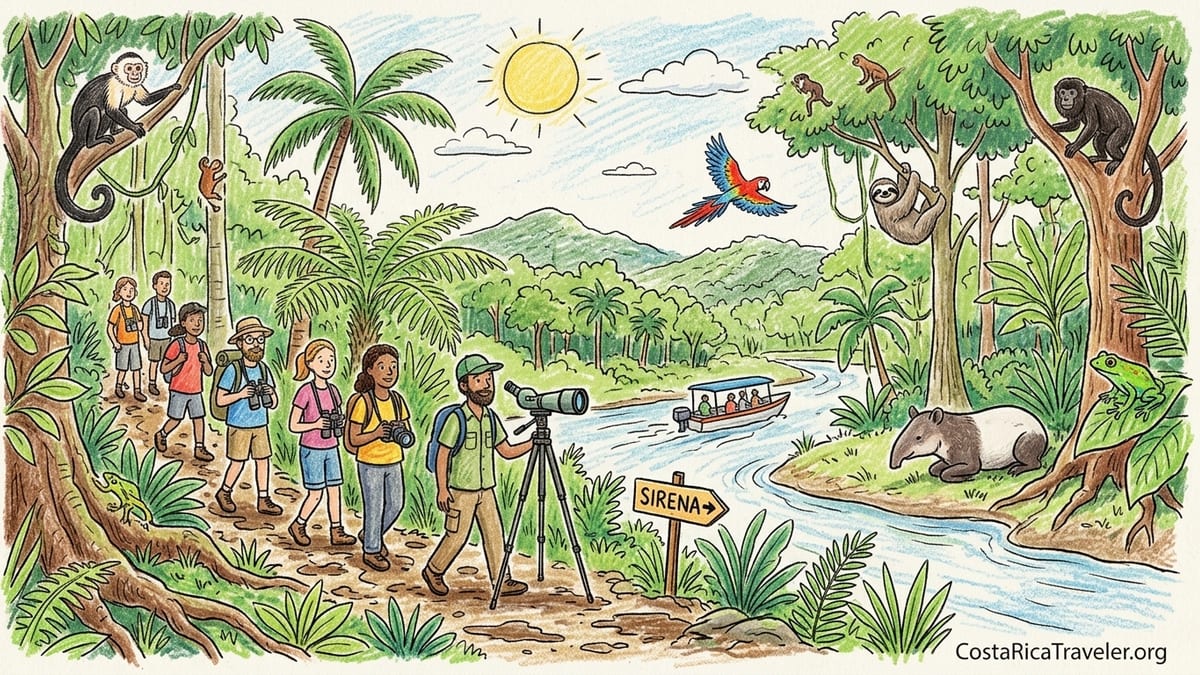
My most memorable wildlife experience anywhere in Costa Rica was a full-day hike into Corcovado National Park from Drake Bay, focusing on the Sirena sector. Corcovado is widely described by biologists as one of the most biodiverse places on earth, and once you are on the trails the claim feels realistic. On my trip, I joined a small group booked through my Drake Bay lodge, which arranged the mandatory park permits, boat transport and guide. The total price in 2024 was approximately 190 to 220 US dollars per person depending on group size, including lunch and park fees, for a group of eight plus one naturalist guide. The day ran from about 6:00 a.m. to 2:30 p.m., with a 75-minute open-boat ride each way and roughly five hours on the ground.
The guiding quality was outstanding and justified the high price. Our guide carried a high-quality spotting scope and had an impressive ability to pick out camouflaged animals at distance. During the day we observed all four monkey species found on the Osa Peninsula, multiple sloths, peccaries, a tapir resting in a river bend and several species of poison dart frog. He was clear about trail etiquette, conservation rules and safety around potentially dangerous animals like peccaries. Physical difficulty was moderate rather than extreme, with mostly flat but sometimes muddy trails in hot, humid conditions. I was glad to have light long sleeves, plenty of water and a change of shirt for the boat ride home.
Not everything about the Corcovado day was perfect. The experience is expensive and logistically rigid. You must commit in advance, respect strict park entry times and travel in a guided group; this is not a place for casual unguided wanderings. In my case, the boat ride from Drake Bay to the Sirena station was choppy with regular spray, and one passenger felt seasick before we even reached the park. The Sirena ranger station area itself can feel busier than the “lost world” marketing suggests, with several groups converging on the same riverside clearings. Still, the density and visibility of wildlife more than compensated. Of all the paid tours I did in the South Pacific, this is the one I would unhesitatingly repeat even at the same price.
If you are planning a similar Corcovado day from Drake Bay, it is simplest to book directly with your lodge or hotel rather than shopping around once you arrive. In this region, accommodations and tour operators are closely linked and share limited daily park permits. I booked via email about six weeks before arrival, paid a deposit by card and settled the balance at the lodge. Weather in the wet season can lead to rougher seas and muddier trails, so if your dates fall between August and November it is worth building in flexibility in case departures are shifted or canceled.
Mangrove Trips in the Térraba–Sierpe Wetlands
The other standout wildlife experience for me was a half-day boat trip into the Térraba–Sierpe National Wetlands, a vast mangrove system north of Drake Bay. I based in the small riverside town of Sierpe for one night specifically to do this tour, booking with a local operator recommended by my guesthouse. The price in 2024 was about 70 to 90 US dollars per person for a four-hour shared trip in a covered fiberglass river launch with an outboard engine, with a minimum of four passengers. Including tips and a simple lunch in town afterwards, the day came to just over 100 dollars per person.
The guide here was very good, though not quite at the level of my Corcovado naturalist. He spoke clear English, used a handheld spotlight in shaded channels to point out camouflaged iguanas and bats, and maneuvered the boat carefully to avoid disturbing nesting birds. Over the course of the morning we saw multiple species of heron, kingfishers, scarlet macaws, howler monkeys, white-faced capuchins and at least half a dozen crocodiles at close but safe distances along the muddy banks. The main channels can feel busy at departure, with several tour boats leaving Sierpe at the same time, but traffic thins quickly once you disperse into side arms of the river.
Physically, the mangrove tour is very easy: you remain seated in the boat, and boarding is from a simple but stable floating dock in Sierpe. The biggest variables are sun and rain. On my trip in the shoulder of the rainy season, we started under hazy sun, then had a twenty-minute downpour that actually amplified the feeling of being deep in an amphibious forest. The boat had a roof but open sides, so a light rain jacket was useful. The operator supplied water and fruit but not insect repellent, so packing your own is important. Overall, this is a trip I would happily repeat, especially in different tide conditions, since low and high tides expose different parts of the mangrove ecosystem.
One caveat: if you are already doing several boat-based wildlife trips on the Osa Peninsula, such as Golfo Dulce dolphin watching or multiple days in Corcovado, you may find that the mangrove tour begins to feel thematically similar. For travelers with limited time or budget, I would prioritize Corcovado first, then a Sierpe mangrove excursion as an excellent add-on if you have an extra day between Uvita and Drake Bay.
Whale and Dolphin Watching out of Uvita
From Uvita, I joined a half-day whale and dolphin watching tour inside Marino Ballena National Park. Uvita is the main gateway town for the park, which protects a coastal section of the South Pacific famous for its “whale tail” sandbar and seasonal humpback whale migrations. I booked my tour the afternoon before departure through a small storefront agency on Uvita’s main road, which arranged the park entry fee, boat spot and a shared shuttle from my guesthouse to the beach. In 2024, the package cost approximately 95 US dollars per person for foreigners, including the mandatory national park ticket, with around ten guests per boat and two crew.
The experience itself was mixed. On the positive side, the crew were professional and safety focused, with a clear briefing before launching the open fiberglass boat through small surf. Once past the breakers, we cruised for about three hours along the coast and out toward deeper water. Conditions were partly cloudy with a moderate swell. During our outing we had one extended encounter with a small group of spotted dolphins that rode the bow wave and surfaced repeatedly close to the boat. We also had several distant blows from what the guide identified as humpback whales, but the animals remained far enough away that we never saw much beyond a tail fluke against the horizon.
My disappointment was less about the crew and more about expectations versus reality. Marketing materials around Uvita prominently feature dramatic shots of breaching whales and close encounters that are not guaranteed on any given day. Regulations rightly limit how closely boats can approach the animals, so your view may be more distant than you imagine from the brochures. Sea conditions matter too; on our outing, the rolling swell made it harder to spot subtle surface signs. If you are prone to motion sickness, this is the tour where medication and a light breakfast become important. I felt slightly queasy by the end despite generally handling boats well.
Would I repeat the Uvita whale tour? Yes, but only during peak whale season and with calibrated expectations. The outing also includes a scenic view of the Whale Tail sandbar from the water and a quick pass by sea caves near Playa Ventanas, which partially redeem a slow cetacean day. If reliable megafauna sightings are your top priority, however, Corcovado’s terrestrial wildlife or a dedicated dolphin trip in the more sheltered Golfo Dulce might deliver more predictable returns for a similar outlay.
Researched experience, not personally tried: Some high-end lodges and tour agencies in Uvita and Ojochal offer more expensive private whale watching charters in smaller boats with flexible departure times. These often cost 140 to 180 US dollars per person, depending on group size and season, and can target early morning or late afternoon windows when seas are calmer. While I did not personally take a private trip, speaking with fellow travelers at my guesthouse suggested that guests on these charters enjoyed quieter encounters, though not necessarily closer approaches, given the same regulations.
Snorkeling and Diving around Caño Island
Caño Island Biological Reserve, reached by boat from Drake Bay, delivered some of the clearest tropical Pacific snorkeling I have experienced. I booked a combined snorkeling and beach day through a Drake Bay operator my lodge works with regularly. The full-day shared tour cost around 130 to 150 US dollars per person in 2024, including the island reserve fee, basic equipment, two guided snorkel sessions from the boat and lunch on a mainland beach on the way back. There were eleven clients on our boat, two in-water guides and a captain, which felt like the upper end of comfortable for sharing space on the small dive platform.
The day started with an early beach boarding in Drake Bay, where we waded through knee-deep water to climb into the open fiberglass launch. The ride to Caño Island took just under an hour in fairly calm seas. Water clarity around the island was excellent, with visibility of fifteen to twenty meters. In two forty-minute sessions we snorkeled above mixed rocky and coral substrates, observing whitetip reef sharks resting under ledges, large schools of snapper and grunts, several hawksbill turtles and countless sergeant majors and damselfish. Our in-water guide was attentive, repeatedly checking on less confident swimmers and pointing out camouflaged species I would have missed.
There were two drawbacks. First, the Caño Island landing rules are strict, and on my day the small beach area was closed to visitors to protect nesting seabirds. That meant all breaks happened on the boat, which can be fatiguing if you are not comfortable in open water. Second, although our operator provided decent masks and fins, the short-sleeved rash guards on offer were limited in size and worn. I was glad to have brought my own long-sleeved top to protect against sun and incidental stings. Physical difficulty is moderate if you are a competent swimmer; those less comfortable in swell may find the open-ocean context intimidating, even with life jackets available.
Researched experience, not personally tried: Several Drake Bay dive centers offer two-tank scuba trips to Caño Island that use the same transit route but spend more time at deeper sites. As of 2024, certified divers typically pay in the 180 to 220 US dollar range for a day including gear rental, with groups usually capped around six to eight divers per guide. Speaking with divers at my lodge, the consistent feedback was that marine life density, especially of reef sharks and large schools of fish, made the high per-day cost acceptable, though some felt surface intervals on small boats were cramped on busy days.
Surfing and Beach Days near Dominical and Uvita
For a change of pace from boats and jungle, I scheduled several surf lessons and unstructured beach days between Dominical and Uvita. Dominical is well known within Costa Rica as a consistent beach break, and its long sandy stretch felt like the natural place to learn. I booked a beginner surf lesson through a Dominical-based outfitter with an office just off the main beach road. A two-hour group lesson in 2024 cost around 70 US dollars per person, including soft-top board rental, rash guard and coaching, with a maximum of four students per instructor. On the day, there were three of us and one instructor.
The lesson followed a familiar structure: a short land-based briefing on safety, paddling technique and pop-up mechanics, followed by about ninety minutes in the water. Conditions in the late morning were forgiving, with waist- to chest-high waves and light winds. As an athletic but very inexperienced surfer, I was able to stand and ride a few whitewater waves within the first half hour under the instructor’s guidance. He stayed close, rotated between students and was quick to call a break when sets became messier. Physical difficulty felt moderate; you need a base level of cardio fitness and comfort in shore break but no prior surf skills.
What I appreciated about Dominical was the combination of instruction options and flexibility. After the initial lesson, I rented a board from the same shop on two additional afternoons for around 15 to 20 US dollars per half day and practiced independently in smaller surf. The atmosphere on the beach was relaxed but not entirely tranquil; there is a visible surfer scene with beach bars, food trucks and vendors. Sun exposure is intense, so shade from scattered palms and small beach shacks becomes valuable between sessions. From a value perspective, the surf instruction felt fairly priced and is something I would repeat, ideally with an earlier start to avoid the strongest midday sun.
By contrast, one of my most underwhelming outings in the region was a planned full beach day at Playa Hermosa near Uvita. This broad, palm-lined stretch inside Marino Ballena National Park is often photographed for its wild beauty, but on the day I visited conditions were stiflingly hot with almost no breeze. Shade options are limited if you do not bring your own umbrella, and facilities are minimal aside from basic restrooms near the parking entrance. After paying the national park entry fee and walking fifteen minutes along flat sand, I found the beach almost empty, which was initially appealing but quickly felt monotonous. With surf too rough for relaxed swimming and no natural headlands or tidal pools to break up the landscape, I ended up leaving after two hours.
That experience was not a failure of the place so much as a mismatch with what I enjoy. Travelers seeking solitude and long, meditative walks may love Playa Hermosa on a calm day. Personally, I preferred the slightly more compact beaches around Dominical and the small coves you encounter when hiking the coastal trail out of Drake Bay, where rocky points, jungle backdrop and occasional freshwater streams add variety. If I returned to Uvita, I would still include beach time but schedule it early in the morning or late in the afternoon and pair it with a short activity, such as a guided bird walk along the mangrove edge, rather than planning an entire day around lying on open sand.
Waterfalls and Guided Jungle Hikes Inland
Beyond the headline attractions of Corcovado and Caño Island, some of my favorite hours in the South Pacific were spent on smaller-scale waterfall and jungle hikes inland from the coast. From Uvita I booked a guided visit to a nearby waterfall through my guesthouse. The half-day outing cost about 60 US dollars per person in 2024, including transport in a high-clearance 4x4, guide and a simple snack. The group consisted of five guests and one local guide, who also acted as driver. The hike itself was short but steep in sections, descending on muddy single-track for about thirty minutes to reach a clear pool and cascade, where we spent another hour swimming and exploring before climbing back out.
This was not a famous Instagram location and that was exactly its charm. The guide focused as much on pointing out plants, leafcutter ant trails and bird calls as on the waterfall photo moment. We saw toucans at medium distance, several small tanagers and a coiled but non-venomous snake along the path. The physical difficulty felt moderate because of heat, humidity and slippery footing rather than distance. Good tread on footwear mattered more than cardio fitness. Weather cooperated, with overcast skies that kept temperatures tolerable and a brief shower that increased water flow without spiking levels dangerously.
I also joined a night jungle walk along a private reserve near Drake Bay, booked directly through my lodge for a price of around 55 US dollars per person. The group that evening was small, with four guests and one specialist guide carrying a strong headlamp and portable light. Over two and a half hours we slowly threaded narrow forest trails, focusing on insects, spiders, frogs and nocturnal mammals. Highlights included red-eyed tree frogs, several species of walking stick insects, a sleeping hummingbird and a kinkajou moving through the canopy. The guide’s enthusiasm for smaller creatures was infectious and shifted my appreciation of the forest beyond the big charismatic mammals of the daytime Corcovado tour.
There were a few minor drawbacks. The night walk was extremely humid, and even slow movement made my shirt cling with sweat within minutes. Biting insects were more noticeable than on daytime hikes, particularly around ankles, making proper socks and repellent important. Trail footing can be uneven, with roots and narrow bridges that require attention under headlamp light. If you have any issues with balance, informing your guide at the start helps them choose appropriate routes. Despite these considerations, I would absolutely repeat a guided night hike in the Osa region; the perspective on rainforest life after dark is uniquely memorable and difficult to get safely on your own.
Birding and Sport Fishing along the South Pacific Coast
Although I am not a dedicated birder, the South Pacific’s diversity drew me into two informal bird-focused outings that were rewarding even for a casual observer. The first was an early morning bird walk on the edges of Marino Ballena National Park near Uvita, arranged through the same agency that organized my whale tour. The cost was about 55 US dollars per person for a three-hour walk, with a group of six plus one birding guide equipped with a spotting scope. Starting just after sunrise, we slowly followed gravel roads and narrow paths along secondary forest and pasture edges, where visibility into the canopy is better than in dense primary jungle.
In that short window we logged dozens of species, including toucans, aracaris, motmots, several parrots, flycatchers and hummingbirds. The guide’s ability to identify birds first by call, then visually, made a huge difference compared with my untrained eye. Physical difficulty was easy: flat ground, short distances and frequent stops. Weather was cooperative, with diffused sun through morning cloud. If I returned, I might pay a bit extra for an even smaller group or private guide to maximize time on sightings rather than waiting while everyone cycled through the scope.
My experience with sport fishing was more tentative. Out of Drake Bay I split the cost of a half-day inshore charter with three other travelers staying at my lodge. The total boat price was the equivalent of around 550 to 600 US dollars in 2024, so my share came to roughly 140 US dollars including a tip. The vessel was an open panga-style fishing boat with a bimini shade, captain and one mate. We targeted roosterfish and snapper along rocky points and nearshore reefs over four and a half hours. Sea state was moderate with a light chop.
Fishing success was limited. One guest landed a modest snapper and we had several missed strikes, but there were long stretches of trolling with little action. The captain worked hard to adjust tactics and moved repeatedly between spots, so I did not feel shortchanged by effort. Still, by the time we returned to the bay, I personally questioned whether the high per-person cost was justified given my lukewarm interest in fishing to begin with. For dedicated anglers who value the chance at a trophy roosterfish or simply love hours on the water, the charter could make sense, especially if split among four. For others, similar money might be better invested in another guided wildlife or dive day.
Researched experience, not personally tried: In the Golfo Dulce near Puerto Jiménez, several operators specialize in catch-and-release sport fishing with more stable cabin cruisers and options for multi-day packages. Prices there commonly start around 900 to 1,200 US dollars per day per boat for inshore trips, excluding lodging. Conversations with travelers who had fished both Golfo Dulce and Drake Bay suggested that the gulf’s sheltered waters can provide a more comfortable ride and slightly higher encounter rates with dolphins and sea turtles during transits, even if fishing results vary day to day.
The Takeaway
Traveling along Costa Rica’s South Pacific coast, from Dominical down through Uvita, Sierpe and Drake Bay, is less about ticking off a list of towns and more about stringing together complementary experiences. Looking back at what I actually did and would repeat, a pattern emerges. Corcovado day hikes and Caño Island snorkeling justify their cost through sheer wildlife density and the sense of entering protected, difficult-to-reach ecosystems. Sierpe mangrove tours and night jungle walks add texture, revealing quieter corners of the same broader conservation mosaic. Surf lessons and inland waterfall hikes offer active resets between more structured nature days.
At the same time, not every widely promoted activity landed equally for me. Whale watching from Uvita delivered professional guiding but only distant whale views on my specific day, making it feel like a gamble at nearly 100 US dollars a person. A planned full beach day at Playa Hermosa in Marino Ballena left me more sunburned than inspired, highlighting how personal preference, weather and daily conditions can transform a postcard-perfect setting into something underwhelming. Shared sport fishing from Drake Bay was enjoyable as boat time but felt expensive relative to my moderate enthusiasm for the sport.
If you are sketching your own South Pacific itinerary, I would build from the experiences I would most readily repeat: a Corcovado day or overnight, Caño Island snorkel or dive trip, a Sierpe mangrove excursion, at least one guided night walk, a surf lesson in Dominical and a modest number of targeted beach and waterfall stops rather than long, unstructured days in the sun. Book key national park and marine reserve tours through your lodging several weeks in advance, accept that weather may shuffle plans and budget realistically for high but often worthwhile tour prices. The reward is a stretch of Costa Rica where rainforest, river and sea still feel closely intertwined and where, more often than not, the loudest sound is not traffic but howler monkeys and surf.
FAQ
Q1. When is the best time of year to visit South Pacific Costa Rica for wildlife?
The most reliable months for a mix of wildlife and workable weather are roughly December through April, with slightly drier conditions and calmer seas, though rain is possible year-round and humpback whales have distinct migration windows that vary by hemisphere.
Q2. Do I really need a guide for Corcovado National Park and Caño Island?
Yes. Access to Corcovado’s main sectors and Caño Island Biological Reserve is restricted to visitors accompanied by licensed guides working with approved operators, and your lodge or a reputable agency usually arranges permits, transport and guiding as a package.
Q3. How far in advance should I book popular tours like Corcovado and Caño Island?
In the high season from about late December to March, it is wise to reserve core tours at least four to six weeks in advance, since daily visitor quotas and boat capacities are limited and can sell out, especially for Sirena station in Corcovado.
Q4. Is a 4x4 vehicle essential for visiting places like Uvita, Sierpe and Drake Bay?
A standard car is generally adequate for reaching Dominical and Uvita on paved highways, but a 4x4 is advisable for many smaller side roads, for getting to some remote waterfalls and, depending on season, for attempting the overland route toward Drake Bay rather than taking the more common boat transfer from Sierpe.
Q5. How physically demanding are the main rainforest and mangrove tours?
Corcovado day hikes involve several hours of walking in heat and humidity on mostly flat but sometimes muddy trails, while Sierpe mangrove trips are largely boat-based and easy; night walks and short waterfall hikes fall somewhere in between and require comfort on uneven, sometimes slippery ground.
Q6. What should I budget per person for key activities in the South Pacific region?
As of 2024, full-day Corcovado and Caño Island tours commonly fall in the 130 to 220 US dollar range per person, while shorter outings such as mangrove boat trips, surf lessons, night walks and birding excursions often range between 50 and 100 US dollars.
Q7. Is the South Pacific suitable for first-time visitors to Costa Rica?
Yes, but it suits travelers comfortable with a bit more logistical complexity, such as boat transfers and early starts, since infrastructure is less developed than in areas like Manuel Antonio; pairing the South Pacific with a more straightforward destination can work well for a first trip.
Q8. Are there good options for travelers who do not swim confidently?
Non-swimmers can still enjoy Corcovado hikes, mangrove boat tours, bird walks, night jungle outings and many waterfalls viewed from safe banks, but open-ocean activities such as Caño Island snorkeling and some whale watching trips can feel uncomfortable if you are uneasy on boats or in swell.
Q9. How can I reduce the environmental impact of my visit to the South Pacific coast?
Choosing established local operators, respecting park rules, minimizing single-use plastics, using reef-safe sunscreen, staying on marked trails and keeping appropriate distances from wildlife all help ensure that your presence supports rather than harms the ecosystems you have come to see.
Q10. Is it necessary to speak Spanish to travel around the South Pacific region?
It is not strictly necessary, as staff at lodges and tour agencies in places like Drake Bay, Uvita and Dominical usually speak functional English, but learning basic Spanish phrases improves interactions, eases logistics in smaller towns such as Sierpe and shows respect for local communities.