


I went to Costa Rica’s South Pacific coast determined not to drive. No rental SUV, no river crossings, no worrying about where to leave a car while I disappeared into boat-only jungle lodges. Instead, I stitched together the same routes locals and lodge staff use every day: public buses, shared shuttles, domestic flights, taxis and, most of all, boats. In a region where rivers and ocean are often the only roads that matter, I found that traveling without a car was sometimes easier, sometimes limiting, and always defined by the next boat departure.
Why Sierpe Is the True Gateway to the South Pacific
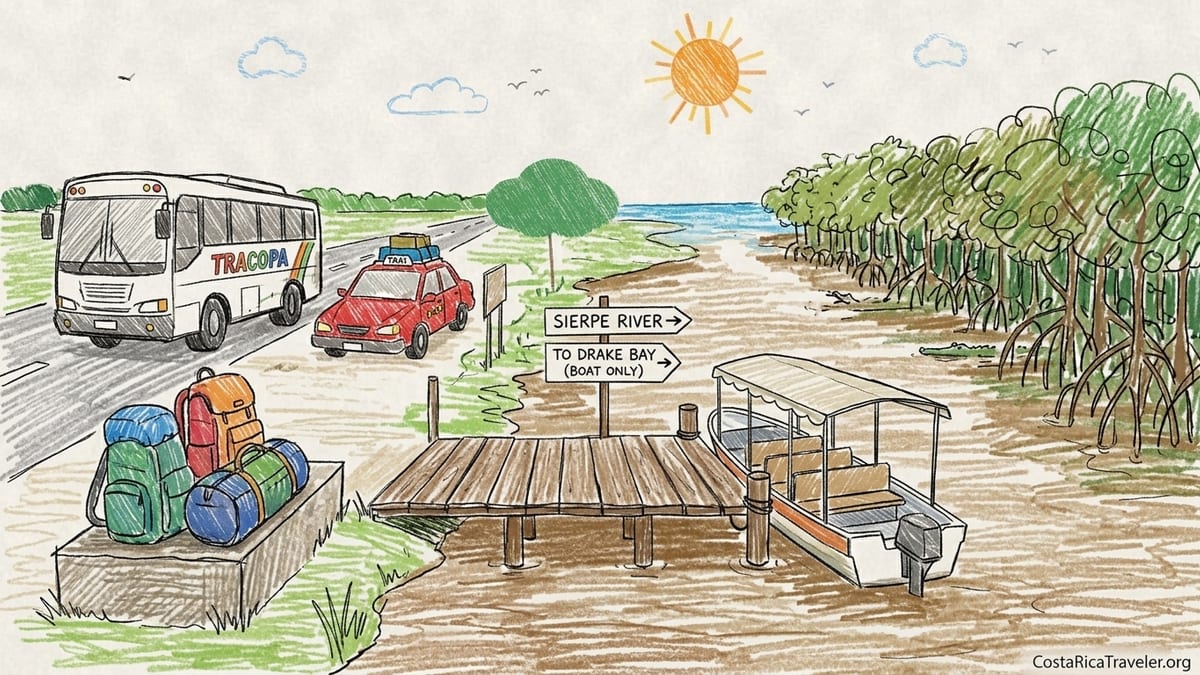
On paper, the road map shows a highway curling down Costa Rica’s Pacific coast and a spur road heading toward Drake Bay. In practice, the real hinge point for the South Pacific is a quieter place inland: the river town of Sierpe. Official tourism material points to Sierpe as a primary access point for Drake Bay, Corcovado and Caño Island, because this is where pavement hands over to boats. Here the Sierpe River threads through dense mangroves before meeting the Pacific, and almost every traveler heading to Drake Bay’s boat-only lodges passes this dock at least once.
Arriving in Sierpe without a car did not feel like a handicap. When I stepped off the bus and walked down to the simple riverfront, the heart of the town was the dock itself. Restaurant terraces overlooked the brown water, captains shouted to each other across moored launches, and luggage piles grew at the edge of the planks as travelers waited for the late-morning boats. Knowing I did not have to worry about guarding or parking a rental car let me focus on one question only: Am I on the right boat with the right captain for my lodge.
Boat logistics here are not an accessory to the trip. They are the trip. Schedules, sea conditions at the river mouth and how wet you are willing to get shape your itinerary more than road distances. When you accept that Sierpe is a river port first and a town second, the whole South Pacific suddenly makes more sense, especially if you are traveling car-free.
On the flip side, Sierpe is also where you confront the main car-related dilemma in this region: if you do rent a vehicle, what do you do with it while you disappear downriver for three or four nights. That question, and the surprisingly smooth alternative of arriving by bus, framed almost everything I learned traveling here without driving.
San José to Sierpe by Bus, Shuttle and Taxi
My car-free journey started at the Tracopa bus terminal in San José. Tracopa is the main operator linking the capital to the southern Pacific zone. Current timetables list a daily morning service toward Sierpe and Palmar Norte, taking around six hours depending on traffic and roadworks. I bought my ticket at the counter the afternoon before, paid in colones, and chose a seat toward the front for easier bag handling. The bus had air conditioning, luggage stored underneath and a driver who was very clear that everyone connecting to Sierpe needed to tell him in advance.
The bus dropped me in Palmar Norte, a busy roadside town that functions as a regional crossroads. From here, car-free travelers have two options to reach Sierpe. The simplest is a taxi, a twenty to thirty minute ride on a paved secondary road. I joined two other travelers from the bus, and we split a red taxi that was already waiting near the Tracopa stop. We confirmed the price before leaving and asked to be dropped directly at the dock in Sierpe, which drivers are thoroughly used to. With three backpacks in the trunk and daypacks on our laps, there was no problem with luggage space.
On another trip along the Central Pacific, I tried a different approach: a shared shuttle from Playa Hermosa near Jacó to Sierpe dock. Shuttle companies based on the coast sell this as a through-service specifically to meet the Drake Bay boats. One operator was quoting around 95 US dollars per person in 2026 for the several-hour ride, timing arrival for late morning at the dock. The advantage of the shuttle was door-to-dock convenience and help with luggage, but compared with the bus and taxi combination it was a premium option rather than a necessity. The lesson for a car-free traveler is that you can match shuttle convenience with local transport if you are comfortable changing once in Palmar Norte.
If you are carrying large suitcases instead of backpacks, tell both the bus company and the shuttle or taxi in advance. No one blinked at my 60-liter backpack, but I watched one family struggle to maneuver hard-shell suitcases down the stairs of the bus and along the dock planks. On these routes, luggage that you can carry with one hand and lift quickly is more practical than something whose wheels are designed for airport tiles.
Sierpe to Drake Bay: How the Boat Journey Really Works
Boat logistics from Sierpe to Drake Bay are where not having a car felt like a superpower rather than a limitation. Multiple operators coordinate daily departures along the river, with late-morning departures around 11:30 am being the clear anchor. Some operators list additional afternoon boats in the dry season, and there are early-morning returns from Drake Bay around 6:30 or 7:30 am to connect with onward transport. Prices in 2026 were clustering in the range of the equivalent of 20 to 30 US dollars per person one-way for the shared passenger boats, with some local operators quoting their fares in colones but aligning roughly to this range.
I booked my ticket online a week ahead through one of the dedicated Sierpe to Drake boat services. The booking form asked for my hotel in Drake Bay, my date of travel and how many bags I would bring. In return I received a confirmation email explaining that the departure point was the dock in central Sierpe, alongside a riverside restaurant, and that I should check in at least thirty minutes before departure. When I arrived, I checked in at a small kiosk, handed over my name and was given a colored wristband corresponding to my boat and final lodge. This is crucial: boats leaving at the same time can serve different stops along the coast, so the color-coded system helps captains know who is getting off where.
Waiting at the dock, I watched crew members load plastic-wrapped boxes of supplies first, then backpacks and duffels. Hard suitcases were accepted, but staff made it clear that they might get splashed. Most boats are open launches with bench seating and a canvas roof, and luggage is stored both in the bow and along the center. Some operators keep tarps on board and will cover baggage if rain is likely, but this is not guaranteed. I put my main backpack in a thin waterproof liner bag and kept electronics in a roll-top dry bag inside my small daypack. That two-layer approach meant I did not care if the outside got wet.
Getting on board involved walking down a sloping concrete ramp to low floating docks or directly to the riverbank, depending on the water level. Staff were always there to steady people as they stepped into the boat. Water shoes or sandals with a strap were much more practical than sneakers because you often step into shallow water when boarding or disembarking. The river section of the journey was glassy calm, and we wound through mangrove channels for about forty minutes before approaching the river mouth where the Sierpe meets the Pacific. Here, the captain paused, watched the waves and then threaded the boat between swells at the right moment. The sea state at this point determines how bumpy the ride will be. On a calm day, passengers barely notice the transition. On a day with ocean swell, you feel the boat climb and slap down, and spray can soak the bow seats. Anyone worried about motion sickness should sit toward the back of the boat and keep their daypack under the bench, not on their lap.
Arriving in Drake Bay and Reaching Remote Lodges
Once along the coast, the boats begin to fan out to different stops. Drake Bay town itself, often labeled Agujitas, has a simple beach landing. There is no pier. The captain runs the bow as close to the sand as the waves allow, then crew and sometimes local porters wade in shin- to knee-deep and start passing luggage ashore. Passengers usually disembark barefoot or in sandals, timing their jump between waves. On my first arrival, the tide was moderate, and with the crew guiding us, it felt adventurous rather than risky. Families with small children went first, and staff did not hesitate to carry heavy bags through the surf.
For lodges beyond Drake town, such as those toward San Josecito Beach or closer to Corcovado’s park sectors, the boat simply continues along the coastline, stopping at pre-arranged coves. This is where advance communication with your lodge matters. When I booked a small eco-lodge south of Drake, the owner asked me to send my boat reservation. They then contacted the boat company to confirm that I should be dropped on their particular beach. As we approached, the captain pointed with his arm, shouted the lodge name over the engine and looked for a nod. There was no sign on the beach, just a break in the trees and a couple of staff members waiting in rubber boots.
From the sand to the rooms, transfers vary from a five-minute uphill walk with staff carrying your larger bag to another quick ride in a smaller local launch that can get closer at low tide. In my case, we climbed a short but steep path while lodge staff slung my backpack and a cooler of vegetables across their shoulders. Had I brought a rigid suitcase, this would have been awkward. At a neighboring property, I saw guests arrive by the same river boat, then transfer into a narrow panga that shuttled them across a small estuary to the lodge’s private dock. Again, everything depended on the tide. Without a car, all of this felt logical; the dock or beach was the front door.
For travelers who do drive, this is where the rental car becomes a liability. You cannot take it to a beach with no road, so you have to leave it behind in Sierpe or in Drake town while you stay at boat-only lodges. In Sierpe, riverside guesthouses and guarded parking lots offer paid overnight parking, and some will even shuttle you to the dock. But you are still paying the daily rental rate for a vehicle that sits idle, and you must time your return to match boat schedules before you can leave. Watching boat-only lodge staff handle every piece of logistics from the dock onward made me appreciate how frictionless it is to let them plan around the river instead of worrying about a parked car uptown.
Boats Versus Roads: When Car-Free Travel Is Easier
In theory, improved roads now allow a 4x4 to reach Drake Bay town overland. In practice, the decision between driving and boating is often made for you by where you are staying and by the season. Many of the most atmospheric lodges along this stretch of coast do not sit in the town itself but on small coves and points only accessible by boat. Corcovado National Park entrances on this coastline, and day trips to Caño Island for snorkeling or diving, all assume guests will arrive by boat in the early morning and depart the same way. Staying car-free meant I was naturally aligned with the region’s water-based rhythm.
The clearest example of where having no car made life easier was planning a Corcovado day tour. Operators in Drake Bay coordinate tightly with the boat schedule. On a typical day, I would have breakfast at first light, walk down to the beach where the same style of open launches waited, and ride along the coast to the park sector my guide had arranged permits with. At the end of the hike, we would return by boat to the same landing. There was no question of driving to a different trailhead or worrying about where I had left keys. My only logistics were dry bags for my camera and making sure my shoes could handle beach landings as well as muddy trails.
Another area where boats made car-free travel feel simpler was itinerary planning between coastal bases. From Drake Bay back to Sierpe, it is straightforward to connect directly onward to buses heading toward Uvita or San Isidro, or to private transfers arranged by shuttle companies that meet the morning boats. I once stepped off the 7:30 am Drake Bay boat to Sierpe and was met by a prebooked car that took me directly to a lodge near Dominical. Everything was timed around the river, not the road. Had I had my own car, I would have been watching river levels, wet-season closures and the stress of getting out before heavy rain instead of simply booking a boat seat and an onward ride.
Of course, during the wettest weeks, river levels and ocean swell at the mouth can affect comfort and even cause temporary delays. Boat captains and tour operators are used to watching conditions and will postpone departures if safety is a concern. On one occasion in shoulder season, our departure from Drake Bay was briefly held while the captain studied the waves at the river mouth, then made a fast, committed crossing between sets. Passengers in the bow got moderately wet. This is where layered waterproofing and keeping important items in sealed bags has real value. Even then, I felt that my risks were managed better by captains who run this mouth every day than they would have been by my own driving on clay roads after heavy rain.
Where Car-Free Travel Limits You: Beaches and Dining Access
Traveling without a car in the South Pacific is liberating on river-and-boat based segments, but it does come with real constraints once you are based in Drake Bay town or at nearby beaches. Within Drake town, everything is technically walkable. The main beach, a cluster of sodas and restaurants, a mini-supermarket and a few tour desks line steep gravel roads radiating up from the shoreline. However, gradients are serious, and in the mid-day heat even short distances feel long. A car would shorten these walks, and some locally owned guesthouses on the hillsides cater more naturally to guests with vehicles.
At night, the lack of street lighting and the presence of muddy patches after rain made me less inclined to walk to the farthest restaurants, particularly on solo travel. I ended up eating where I could reach on foot within ten to fifteen minutes of my guesthouse. Had I had a car, I might have explored more widely across the hilly backstreets and outlying viewpoints. Taxis exist, but they are informal and sparse, coordinated by hotels or through WhatsApp rather than by flagging them on the street. That meant every dinner beyond a short walk involved preplanning.
Beach access is another area where no car limits flexibility. The classic coastal hike from Drake Bay to San Josecito Beach is a beautiful route along forested headlands and small coves, and you can do it car-free by starting from town. But if you want to hop between lesser-known beaches or visit spots north of Drake that are not served by regular boats, the lack of a vehicle narrows your options to long walks, occasional horseback rides or hiring a boat taxi at significant cost. I met one couple who had driven to Drake Bay town in a 4x4 and used it to reach trailheads and viewpoints well outside normal walking distance, something I could not easily replicate.
In Sierpe itself, though, I felt no restriction from being car-free. The town is compact enough that you can walk between riverside accommodations, small eateries and basic stores in minutes. If you overnight before your boat, you can eat dinner at a restaurant overlooking the river and watch the taxi boats heading up and down at dusk. The dock is the social center, and lodging owners think in terms of guests arriving by bus or being dropped off by parking-lot shuttles as often as they do of guests pulling up in private cars.
Domestic Flights: Time Saver or Unnecessary Luxury
At some point, most travelers planning a South Pacific itinerary wonder whether to fly instead of combining buses and boats. Drake Bay has a small airstrip served by domestic carriers such as Sansa, which in 2026 was operating around one flight per day in each direction between San José’s main international airport and Drake Bay, with scheduled flight times of under an hour. On one trip, I chose to fly in and boat out, to directly compare the two approaches.
Flying in saved several hours. Instead of a six hour bus ride plus taxi and boat, I took a thirty to forty minute hop from San José to Drake Bay. The aircraft were small single-turboprop planes with limited luggage capacity and strict weight limits. At check in, bags were weighed individually, and there were clear caps on both checked and carry-on allowances. Oversized or overweight luggage cost extra and could be bumped to a later flight. This is an important consideration for travelers bringing heavy diving gear or large camera setups. I traveled with a soft-sided 40-liter backpack and a small daypack and had no issues, but fellow passengers with multiple large bags had to reorganize on the spot.
On arrival at Drake Bay airstrip, we disembarked onto a simple tarmac, collected bags from a handcart and met pre-arranged 4x4 taxis and lodge trucks waiting at the edge of the strip. My lodge had sent a pick-up that combined guests from the flight with those who had arrived by the morning boat. The drive from the airstrip into town took under fifteen minutes on a rutted dirt road, and then we transferred to a boat at the main beach for the final leg to the lodge. Even when you fly, boats are still part of the picture if you are not staying in Drake town itself.
Was the flight worth the extra price compared with bus and boat. For a short trip where every half day counts, probably yes. A one-way fare on the San José to Drake Bay route in 2026 could easily cost several times what a bus ticket plus boat transfer does, but it compresses a full day of road travel into a morning. For longer trips where you have the time to enjoy the landscape unfolding along the highway and river, the value proposition is less clear. I came away thinking that flying one way and boating the other gives you the best of both: you see the mangroves and river mouth once, but you also experience the aerial perspective of the Osa coastline.
What to Do With a Rental Car if You Still Get One
Even after experiencing how viable car-free travel is in this region, some travelers will still choose to rent a vehicle for flexibility in other parts of the country. The key question is then what to do with the car while you spend nights in boat-access areas like Drake Bay’s outer coves. The most practical solution, and one that local tourism information quietly assumes, is to park the car in Sierpe and proceed by boat as if you were traveling car-free.
Several businesses in Sierpe offer paid, fenced parking specifically for travelers heading to Drake Bay, often attached to small hotels or restaurants. You drive into town, follow signs or directions from your parking provider, park inside their gated lot and either walk or get a short shuttle to the dock. Daily rates vary, but travelers commonly report paying an amount that, over three or four nights, adds noticeably to the cost of having the car at all. Meanwhile, while you are at a boat-only lodge, the car sits unused. If your itinerary includes a long driving segment before or after Drake, this trade-off can still make sense. If you are only driving from San José to Sierpe, you may find that combining a bus and local taxi both ways is simpler and cheaper.
The less attractive option is to take the rental car all the way to Drake Bay town. Even assuming you have a high-clearance 4x4 and the road conditions are favorable, this still leaves you with the same logistical puzzle when you move on to a lodge that requires boat access. You end up either leaving the car in town while you stay further along the coast, then backtracking later, or skipping boat-only properties altogether. More than one local guide shrugged when I asked about this and said that for the really special jungle lodges, visitors almost always come by boat from Sierpe regardless of whether they rented a car for elsewhere.
From a purely car-free travel perspective, I came to think of Sierpe as the place where you should mentally “shed” your vehicle, whether that means stepping off a bus or locking a rented SUV in a guarded lot. Beyond Sierpe, the geography and culture of getting around pivot to water. Keeping that frame in mind can help you design an itinerary that does not pay for a car during days when the steering wheel is meaningless.
Itinerary Styles That Work Well Without Driving
Over multiple trips, I road-tested several itinerary patterns that rely on boats, buses and occasional flights rather than rental cars. One of the most satisfying began in San José, used the morning Tracopa bus to reach Palmar Norte, transferred by taxi to Sierpe, then took the midday boat to Drake Bay for three nights. From there, I returned by morning boat, continued by bus up the coast to Uvita for a few days of whale watching and surfing, then finished in Manuel Antonio before heading back to the capital. At no point did I need a private vehicle, yet I reached both remote and more developed beach towns.
Another car-free style that worked well combined a flight in one direction and overland travel in the other. I flew from San José to Drake Bay, stayed at a mix of in-town and boat-only lodges, then returned via the river boat to Sierpe. From the dock, a pre-booked shared shuttle met the boat and delivered me to a hotel near Dominical on the same afternoon. This pattern is powerful: you save time at the start of your vacation when you may be tired from an international flight, and then you travel back more slowly when you have mentally settled into Costa Rica’s pace.
For travelers who want to minimize domestic flight costs yet avoid the longest bus segments, there is a hybrid option that pairs shared shuttles with boats. One example is traveling by shuttle from the Central Pacific coast, such as Jacó or Manuel Antonio, directly to Sierpe dock, then continuing by river boat. In high season, shuttle companies schedule departures that align with the 11:30 am Sierpe boat. On my trip from Playa Hermosa, the shuttle picked up guests at several hotels, then aimed to reach Sierpe around 10:30 am. We had enough time to use restrooms, buy snacks and organize dry bags before boarding. This approach costs more than the pure bus route but trades money for simplicity and door-to-dock continuity.
The common thread across these itineraries is that they flow in the direction of the boats rather than fighting them. You plan nights in Sierpe when needed to match morning departures, accept that some days are built around a single 11:30 am river boat or a 6:30 am coastal launch, and reserve your domestic flight only after you have confirmed park tour permits and boat times. Far from feeling restrictive, this created a pleasing rhythm to the trip, like catching trains in a country where rail is the default.
The Takeaway
Traveling the South Pacific of Costa Rica without a car forces you to engage with the routes and schedules that actually structure local life. Boats from Sierpe to Drake Bay, shared launches skimming along the coast to jungle lodges, early morning returns timed for buses or shuttles and small domestic planes hopping in and out of a grassy airstrip all work together as an ecosystem. You are not inventing a car-free path so much as stepping into a pattern that already exists.
I learned that in places where a boat is required anyway, a rental car is at best a bystander and at worst an expensive anchor you must leave behind in a parking lot. In those segments, being car-free is a strength. Your focus shifts from where to park to how to waterproof your bags and whether you want the bow spray or the calmer stern seats. On the other hand, in and around Drake Bay town itself, and for exploring minor beaches and viewpoints, the absence of a car does limit spontaneous movement and dining choices, especially after dark or in heavy rain.
Ultimately, the decision is less about whether you like driving and more about where you plan to sleep. If your dream is a multi-night stay at a boat-only lodge near Corcovado or along the wild coast toward San Josecito, build your itinerary around Sierpe, the river and the sea, and skip the car entirely or leave it behind there. If you mostly want to base in Drake town and sample day trips, a vehicle can add comfort but is not essential. Either way, understanding the boat logistics first and fitting buses, shuttles and flights around them will make the South Pacific feel less like a remote frontier and more like a well-connected water world that just happens not to have many roads.
FAQ
Q1. Can I reach Drake Bay and nearby lodges entirely without renting a car.
Yes. You can travel from San José to Palmar Norte by Tracopa bus, take a taxi from there to Sierpe, and continue by scheduled passenger boat to Drake Bay and on to boat-access lodges. Many travelers and volunteers use exactly this combination without ever driving themselves.
Q2. How far in advance should I book the Sierpe to Drake Bay boat.
In high season and around holidays, it is wise to book at least several days in advance, especially for midday departures that connect with park tours or domestic flights. Outside peak periods, you can often secure a seat one or two days ahead, but walk-up spots are not guaranteed, particularly if your lodge needs the boat company to make a special stop for you.
Q3. Do I really need waterproof bags for the river and coastal boats.
You do not need fully specialized expedition gear, but having at least a lightweight liner bag for your main backpack and a small roll-top dry bag for electronics is very helpful. Boarding and disembarking often involve stepping into shallow water, and the open launches can throw spray near the river mouth or in choppy seas. Simple plastic liners and dry bags prevent a surprise wave from turning into a serious problem.
Q4. What happens to my luggage when I transfer from boat to lodge.
Crew members and lodge staff are used to handling luggage across beaches, steep paths and small secondary boat transfers. They typically pass backpacks and duffels hand-to-hand from the boat, then carry them up to reception. You will be asked to keep valuables and breakables in your daypack, which you carry yourself. Rigid, heavy suitcases are accepted but can be awkward on uneven trails.
Q5. Is flying to Drake Bay worth the extra cost compared with bus and boat.
It depends on your schedule and budget. A domestic flight from San José to Drake Bay can compress a full day of road travel into under an hour, which is valuable on short vacations. However, tickets are several times more expensive than a bus plus boat combination, luggage allowances are stricter and you will still need at least one boat transfer if you are staying outside Drake Bay town.
Q6. Where should I leave a rental car if I stay at a boat-only lodge.
The most practical place is Sierpe, where guarded parking lots and some riverside guesthouses offer paid overnight parking and short transfers to the dock. This avoids taking the vehicle on rougher roads toward Drake Bay and leaves it in a place you are guaranteed to pass through again when you return by boat.
Q7. Are boat departures affected a lot by weather and sea conditions.
Operators run boats year-round, but heavy rain and large ocean swell at the Sierpe river mouth can cause delays or bumpy crossings. Captains monitor conditions closely and will wait for suitable gaps between waves or adjust schedules if necessary. Building some flexibility into your itinerary and avoiding same-day international flight connections after a long boat and bus chain is sensible.
Q8. Can I explore beaches around Drake Bay without a car.
Yes, but with limits. You can walk the coastal trail from Drake Bay to San Josecito Beach and access several coves on foot. However, reaching more distant beaches or viewpoints usually requires either a long hike, a horseback excursion arranged through local guides or hiring a boat taxi. Without a vehicle, spontaneous beach-hopping is less practical.
Q9. How do I coordinate Corcovado and Caño Island tours with car-free transport.
Tour operators in Drake Bay are very accustomed to guests arriving by boat and bus. When you book, tell them your arrival and departure dates and how you are traveling. They will schedule your park and island trips around the morning and afternoon boat windows, and lodges typically build tour pick-ups directly into their own boat and meal routines.
Q10. Is traveling around the South Pacific car-free safe for solo travelers.
Overall, yes, provided you follow basic precautions. Bus and boat routes used by locals and visitors are well established, and towns like Sierpe and Drake Bay are used to solo travelers on foot. As with any rural area, avoid walking long distances on dark roads at night, keep valuables in a money belt or hidden pouch during transit and use accommodations that offer clear guidance on meeting boat captains and transfers.