


When travelers ask how much a Costa Rica trip costs, most averages ignore one of the country’s most expensive corners: the remote South Pacific around the Osa Peninsula, Drake Bay, Corcovado National Park and Caño Island. This is mainland travel that behaves like island travel. Getting there means boats, small planes, limited road access and logistics that quietly multiply costs. On my recent trip I tracked every colon I spent, then compared it with prices from local operators and lodges in 2024 and 2025 to see what a realistic budget looks like today.
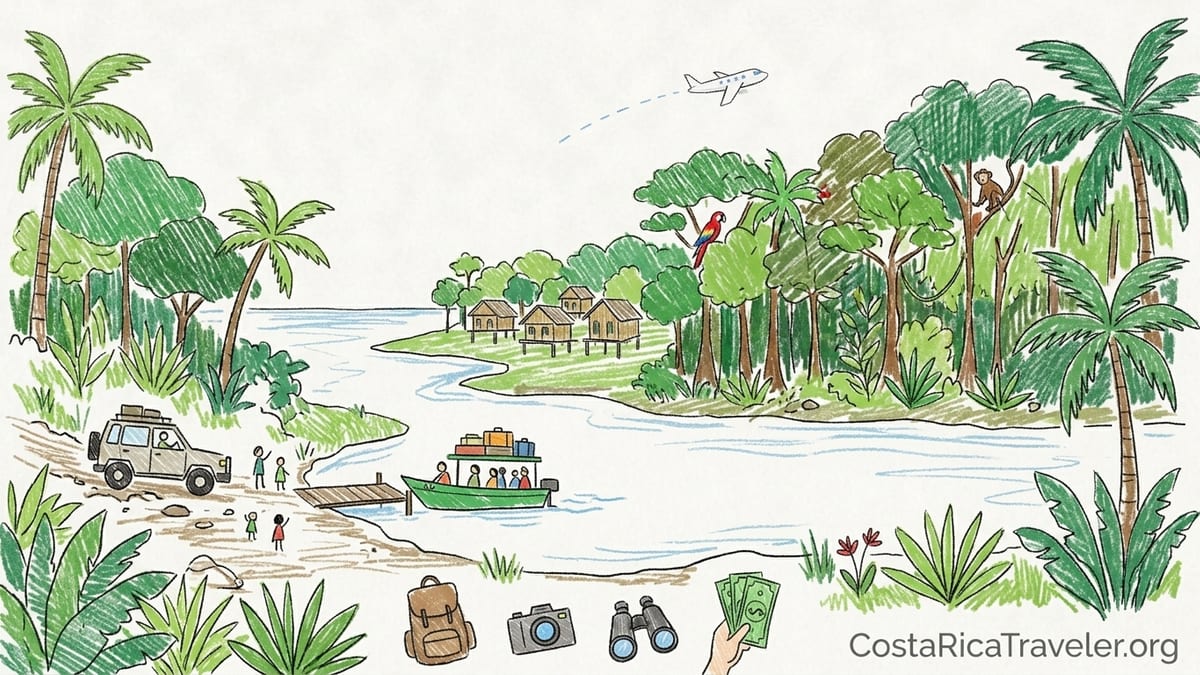
Trip Overview and Method: What This Cost Story Covers
For this article I am focusing on a very typical South Pacific route: starting in San José, flying or driving down to the Osa region, using the river boat from Sierpe to Drake Bay, then day trips into Corcovado National Park and out to Caño Island for snorkeling and wildlife. My own most recent trip was in February 2024, combined with updated price checks from local operators and lodges through mid 2025, which I cross-checked against official park information and current tour listings. Wherever possible I am using precise prices and dates and noting whether those figures came from my own receipts or from current published rates.
I traveled as a couple, mid-range style, not backpacker-cheap but not luxury either. We mixed one simple hotel in Sierpe with a full-board jungle lodge in Drake Bay and used both public boat transfers and organized tours. Car rental, domestic flights, boat transfers, guides, park fees, meals, tips, laundry and incidental costs are all included. The goal is not to present a bargain itinerary but to show how remoteness itself shapes the budget and where high prices actually replace other expenses rather than simply adding to them.
Because prices in Costa Rica are typically quoted in US dollars and most tourism businesses accept dollars alongside colones, all figures below are listed in USD for clarity. When I quote a price, it reflects what I paid on the ground in early 2024 or what a local operator was publicly advertising as of mid 2025. Taxes, which are significant in Costa Rica, are usually folded into the final advertised price for consumer services, so I use the total amount I actually paid, not a pre-tax teaser.
Finally, this is specifically about the South Pacific and the Osa region. The Osa is regularly described by Costa Rican tourism authorities as one of the most biodiverse corners of the country, and it remains hard to reach compared with places like La Fortuna or Manuel Antonio. That remoteness is exactly what you are paying for.
Getting There: Flights, Driving and the True Cost of Reaching Remote Osa
Your first major decision is how to get from San José to the South Pacific. On my February 2024 trip, I priced two options. Option one was a domestic flight from San José’s main airport to Drake Bay. Around that time, one-way fares on local carriers for San José to Drake Bay in high season were commonly in the range of about 130 to 180 USD per person, depending on date and luggage. For two people, that meant roughly 260 to 360 USD one way. This looks expensive, but it skips an entire day of driving, car rental days you might not fully use and overnight stops in the Central or South Pacific that you might otherwise pay for.
Option two was to rent a car in San José and drive to Sierpe, then take the river boat to Drake Bay. In early 2024, quotes I received from major local brands for a small 4x4 suitable for Osa were in the range of about 55 to 75 USD per day including the mandatory liability insurance, with full coverage packages sometimes pushing it into the 80 to 90 USD range on peak dates. Travelers on recent trips who shared their receipts publicly in 2024 and 2025 reported similar figures for fully insured 4x4 rentals in Costa Rica, often landing in the 50 to 80 USD per day band once the mandatory insurances are added.
On my trip we took the slower but cheaper path: a 4x4 rental at 62 USD per day including basic insurance for 9 days, starting and ending in San José, for a total of 558 USD. Fuel for the full loop (San José to the South Pacific and back with a side trip to Uvita) came to around 140 USD at early 2024 pump prices. We based in Sierpe for one night each way at a simple hotel near the dock for 70 USD per room per night including breakfast, adding 140 USD. Spread across nine days for two people, the combined transport and transit-night costs worked out to roughly 49 USD per person per day. Compared with flying directly to Drake Bay and skipping Sierpe, we saved some cash but traded it for a day and a half of driving, plus parking and extra hotel nights.
This is a good example of how remoteness multiplies specific costs. The last stretch to Osa is either a short and scenic but relatively expensive domestic flight, or a long road trip that pushes up rental days and fuel. The “cheaper” road option looks attractive per person only if you are a group of three or four sharing one vehicle and you are comfortable with long drives and occasional rough patches near Osa. If you are a solo traveler or a couple and short on time, flying can be the more efficient use of money even if the ticket price feels high.
Boats and Transfers: Sierpe, Drake Bay and Hidden Transport Costs
Once you reach Sierpe, the only practical way to Drake Bay for most travelers is by river boat. As of 2025, shared public boats on the classic Sierpe to Drake Bay route typically cost around 20 to 25 USD per person each way, with two departures per day. When I took this trip in February 2024 I paid 20 USD per person each way, booked through my Sierpe hotel a day in advance and paid in cash at the dock. Parking at a private lot near the dock cost 6 USD per day, paid in cash to the lot owner when dropping off the car.
In contrast, some upscale lodges in Drake Bay sell private or semi-private boat transfers directly as part of their packages. For example, one mid to high-end Drake Bay lodge publishing 2025 rates charges around 95 to 120 USD per person each way for boat transfers from Sierpe when booked as private lodge transport, with higher rates when there are only one or two passengers. This is significantly more than the shared public boat, but these lodge transfers often include direct pickup at the dock, luggage handling and delivery straight to the lodge’s beach without any logistics to manage yourself.
Here, remoteness does two things to your budget. First, it adds extra legs. You are not simply booking a taxi from a bus station to your hotel; you are chaining a rental car or shuttle to a river boat, then either a tractor taxi or a wet landing on the beach. Each leg has a price, and if you are not careful you may find yourself paying twice for overlapping services, such as both a private boat through the lodge and a separate shared boat you booked before realizing your package already included a transfer.
Second, remote logistics can sometimes replace other transport costs. For instance, one eco-lodge in Drake Bay that I checked in mid 2025 advertised a high-season rate of about 630 USD per night for one or two people including full board meals and round-trip transportation from Sierpe or Drake Bay airstrip. At that price you are no longer paying separately for daily boats, taxis around the village, or repeated river transfers. The cost is very high, but it consolidates several lines of your transport budget into one. On my own trip we chose a simpler lodge and used the shared public boat transfers, which kept per-person costs reasonable but required more coordination and left room for small mistakes.
Where Remoteness Hits Hardest: Lodging, Full Board and Park Access
Accommodation is where the “island-style” economics of Drake Bay and the broader Osa Peninsula really show up. On my February 2024 visit, we divided our time between a modest guesthouse inside the village of Drake and a small eco-lodge located on a hillside ten minutes outside the village by boat. The village guesthouse cost 85 USD per night for a private room with fan and simple breakfast. Dinners in town at small sodas and beachfront restaurants ran between 12 and 22 USD per person including a main dish and a drink, so for two people we could comfortably handle meals for about 40 to 45 USD per day if we chose simpler places.
At the eco-lodge we paid 260 USD per night in February 2024 for a double cabin on a full-board basis that included breakfast, a packed or lodge lunch and set-menu dinner, plus filtered water and coffee. Transport to and from the village by the lodge’s own small boat was free but scheduled. On paper the jump from 85 to 260 USD per night looks enormous, but when you factor in that the 260 USD rate eliminated separate spending on breakfast, most lunches, and two-thirds of dinners, along with taxi boats and the logistical cost of finding food in a sparsely populated area, the difference narrowed.
Here are approximate four-night totals for two people in February 2024 using my receipts and realistic meal estimates. Four nights at the village guesthouse: 340 USD in lodging plus around 180 USD for meals in town (assuming 45 USD per day for food and drinks), for a total of about 520 USD. Four nights at the eco-lodge: 1,040 USD including all meals and basic transport. Functionally the lodge option cost about 520 USD more across four nights, or roughly 130 USD extra per night for two people. The price premium bought us better food, easier logistics, quieter surroundings and more flexible early starts for tours. Whether that is worth it depends on your travel style, but it is not accurate to compare an 85 USD room-only rate in town to a 260 USD full-board lodge and treat the entire difference as pure extra cost. Remoteness changes what is included.
Park access is another area where remote logistics influence cost more than the base ticket price itself. Most national parks in Costa Rica now use a standardized online ticketing system run by the park service, and as of 2024 typical day entry fees for international visitors landed somewhere in the 15 to 20 USD range. Corcovado National Park and Caño Island Biological Reserve are important exceptions. For those two, individual travelers cannot simply go online, buy a ticket and walk in. Instead, you must reserve your space in advance, and nearly all visitors enter through guided tours organized by licensed local operators who secure the permits on your behalf.
In practice, this means fewer do-it-yourself savings. In early 2024 I inquired directly by email with the Corcovado National Park reservations office about independent entry and received confirmation that while the reservation system is managed centrally by the park service, spaces and required guides are generally handled through authorized tour operators and local associations. The official brochures published for the Golfito conservation area, which includes Corcovado, continue to emphasize advance reservations and coordinated access. For most travelers staying in Drake Bay or Puerto Jiménez, the realistic way into Corcovado is through a package that bundles the park fee with boat, guide and often meals.
Tours, Guides and Whales: Real Prices from Drake Bay
Tours and guiding are where South Pacific budgets can drift far above countrywide averages. In Drake Bay I booked a full-day group tour to Corcovado’s Sirena station in February 2024 at 120 USD per person. The rate included the return boat from Drake Bay to Sirena, licensed naturalist guide, park permit, breakfast snack and a simple boxed lunch. That 120 USD aligns closely with price lists published in 2025 by local operators based in Drake Bay, which typically list Corcovado Sirena day tours around 110 to 130 USD per person depending on the season and exact inclusions.
For Caño Island, I joined a classic snorkeling tour from Drake Bay in February 2024 for 105 USD per person. This included the boat, snorkel gear, guide in the water, reserve entrance fee, fruit on the boat and a cooked lunch on a nearby beach. Current price lists from Drake Bay tour companies checked in mid 2025 show Caño Island snorkeling tours commonly priced around 100 USD per person with similar inclusions. A dedicated whales and dolphins tour out of Drake Bay in 2024 cost me 110 USD per person for a three-hour excursion, which lines up with 2025 published price ranges of approximately 100 to 135 USD per person depending on duration.
These figures illustrate two important realities. First, because access to Corcovado and Caño Island is limited and requires boats and licensed guides, there are few ultra-low-budget options. You can choose between shorter and longer tours or between slightly simpler and more inclusive packages, but you are unlikely to find a legitimate Corcovado day tour for half the going rate. Second, your daily cost on these days is high but concentrated. On our Corcovado and Caño days, we spent very little beyond the tour price and small incidental tips. Meals were included, we did not need any other paid activity, and we were too tired afterward to do much more than drink a juice on the beach and walk back to the lodge.
What about independent hiking with cheaper park entry only? For Corcovado, these options are extremely limited. Communication from the park in 2024 made clear that while certain sectors might allow limited access without a dedicated guide under specific conditions, the vast majority of visitors enter as part of a guided arrangement that combines transport, permit and supervision in one. For Caño Island, the biological reserve structure and mandatory boat access make independent day trips essentially impractical for most visitors. Guides and boats are not add-ons. They are the basic cost of entry into the ecosystems you have come so far to see.
Daily Life Costs: Food, Laundry and Little Extras in a Remote Village
When you strip out the big costs of boats and tours, day-to-day expenses in Drake Bay and the surrounding area are not wildly higher than in other Costa Rican beach villages, but remoteness means fewer choices and less room to game the system with bargain hunting. In February 2024 a simple casado plate with fish or chicken, rice, beans, salad and plantains in a village soda cost me 8 to 10 USD. A fresh fruit smoothie or natural juice was usually 3 to 4 USD. At slightly more tourist-oriented beachfront restaurants, mains were more like 15 to 22 USD and cocktails 8 to 10 USD.
Because there is no supermarket in Drake Bay on the scale of those in Uvita or Quepos, self-catering options are limited. A small pulpería near the main dock sold snacks, water and basic groceries at prices a little higher than in San José, but not outrageously so. A 1.5-liter bottle of water cost about 1.50 USD and a bag of plantain chips under 2 USD. We spent around 12 to 15 USD per day on shared snacks and drinks for two people, in addition to sit-down meals. At our full-board eco-lodge, coffee, filtered water and basic snacks between meals were included, which reduced our impulse purchases in the village to almost zero on lodge-based days.
Laundry is an underappreciated but surprisingly important cost in the South Pacific’s humid climate. On my trip I paid 12 USD for a medium load of laundry dropped at a village guesthouse, washed and line-dried within 24 hours. Some lodges priced laundry by the piece, which could reach 15 to 20 USD if you sent a large bag. After one heavy laundry day early in the trip we were more deliberate about quick sink washes for light items and sent out only heavier clothes. In hindsight, I would have budgeted about 30 USD per person for laundry over ten days in the South Pacific, and I would have been happy to pay every cent again. Clean, dry clothes after muddy trail days are more than comfort. They protect your skin and reduce the urge to overpack extra outfits that add to your baggage costs.
Incidental costs accumulated in familiar ways. We tipped our Corcovado and Caño guides 10 to 20 USD per day between the two of us, depending on group size and the level of personal attention. Beachside drinks and occasional desserts added around 10 USD per day on average. One small unexpected expense was waterproof dry bags, which we bought in San José for about 20 USD each after realizing how frequently we would board and exit boats in shallow water. Unlike a souvenir, those dry bags will travel with us again, so I mentally spread their cost across future trips, not just this one.
Reservations, Insurance and Other Invisible Line Items
Reserving park spaces, boats and guides for the South Pacific takes more coordination than for other parts of Costa Rica. By early 2024 most standard national parks, such as Manuel Antonio, had fully normalized online reservations through the official booking platform, with visitors buying timed tickets directly and scanning them at the gate. Corcovado National Park and Caño Island Biological Reserve still used special procedures. Even though the reservation policies are approved centrally by Costa Rica’s national park service, spaces for these areas are largely managed through local offices and tour operators.
For my February 2024 Corcovado Sirena day tour I reserved via a Drake Bay operator by email six weeks in advance. They handled the park reservation, guide assignment and boat spaces in one step. I made a 30 percent deposit by bank transfer and paid the remainder in cash on arrival in Drake Bay. Later, when I checked the Golfito region park brochure and the Corcovado information sheet from the tourism board, both documents emphasized that visitors should coordinate with local offices or tour companies well in advance because of strict daily limits on visitor numbers. This means your ability to shop for last-minute deals is limited. In peak months like December to March, leaving Corcovado or Caño bookings until the week before arrival can easily result in sold-out days or only the most expensive options being left.
Insurance is another invisible line that directly affects your budget. For car rental, Costa Rica requires a specific type of liability coverage that must be provided through the rental company or an approved equivalent. On my February 2024 rental, mandatory liability coverage represented about 18 USD per day of the 62 USD total. I declined the optional collision damage waiver because my primary credit card provided comprehensive rental coverage in Costa Rica, backed by a letter of coverage that I printed out and showed at the counter. Other travelers I spoke to on the Osa during that trip reported daily car rental insurance add-ons anywhere from 15 to 30 USD if they accepted the company’s full coverage, which can quickly double a low headline rate.
Travel insurance for the overall trip was a separate purchase. For a ten-day Costa Rica itinerary including the South Pacific, my comprehensive policy purchased in January 2024 cost 88 USD per person. That policy covered medical care, emergency evacuation and certain adventure activities such as guided hiking and snorkeling. Given the remoteness of the Osa Peninsula and the fact that serious injuries might require evacuation by boat or small plane, I consider this money well spent. It did not feel like a wasted expense even though we thankfully never needed to use it.
One area where I did waste money was in overlapping transfers. Before realizing our eco-lodge included its own village boat pick up and drop off, I pre-booked a private taxi boat to take us from the main dock to the lodge’s cove for 25 USD. On arrival we were met at the dock by the lodge boat, and the private taxi became unnecessary. The operator honored the non-refundable booking and we decided to use the taxi anyway for a short extra ride along the coast, but from a budget perspective this was 25 USD that proper reading of lodge inclusions would have saved.
The Takeaway
Looking back over my February 2024 South Pacific Costa Rica trip and the updated prices I have cross-checked through mid 2025, it is clear that what makes this region expensive is not some abstract idea of Costa Rica being “pricey.” It is the very concrete effect of island-style logistics embedded in a mainland landscape. Boats stand in for buses. Small planes stand in for long highway stretches. Guides and packaged tours are not luxuries; they are the basic means of entering Corcovado and Caño Island at all.
On my ten-day itinerary with four full days in the Osa region, total spending for two people including car rental, fuel, domestic transport, mid-range lodging, a short full-board lodge stay, Corcovado and Caño tours, whales and dolphins excursion, food, tips, laundry, park fees and travel insurance worked out to roughly 3,300 USD, or about 165 USD per person per day. Of that, more than half could be traced directly to remote logistics and guided wildlife access: domestic-scale flights or additional rental days, Sierpe river boats, lodge boat transfers, and the high but richly rewarding costs of guided days in Corcovado and around Caño Island.
Yet many of the most expensive line items also replaced others. Full-board lodge stays removed the need to budget for separate restaurant meals, daily boats and taxis. High-priced Corcovado and Caño tours eliminated any temptation to stack on more paid activities those days. Travel insurance and robust car coverage bought peace of mind in a region where road and weather conditions can change quickly. The truly wasted costs on my trip were small and preventable: an unnecessary private taxi boat transfer, an extra overnight back in San José caused by not aligning return flights with domestic connections, and a few forgotten items repurchased at tourist prices.
If you are planning your own South Pacific Costa Rica journey, the most effective levers you control are the number of bases you use, how many times you repeat the complex transport chain, and whether you opt for simple village lodging plus pay-as-you-go tours or a full-board lodge that consolidates much of your spending. Instead of comparing your Osa budget to generic “Costa Rica average daily costs,” recognize that you are entering a part of the country where time, fuel and skilled guiding are the real currencies. Spend them deliberately, and the region’s higher price tag can feel less like a shock and more like an honest reflection of the wild, remote experience you came for.
FAQ
Q1. How much should I budget per day for a South Pacific Costa Rica trip?
For a mid-range traveler visiting the Osa region with a mix of village lodging, at least one full-day Corcovado tour and a Caño Island snorkel trip, a realistic average is often in the range of 150 to 200 USD per person per day, including transport, lodging, food and key activities. Very careful budgeting with shared rooms and fewer tours can bring this down, while full-board lodges and multiple guided days will push it higher.
Q2. Is it cheaper to fly or drive from San José to the Osa Peninsula?
For a solo traveler or couple on a short trip, flying is often better value relative to time, with one-way domestic fares commonly over 100 USD per person. For groups of three or four traveling for longer periods, renting a 4x4 and driving to Sierpe or Puerto Jiménez can reduce the cost per person per day, though you will pay in extra driving hours and rental days.
Q3. How far in advance should I book Corcovado and Caño Island tours?
In the high season months from December to March, it is prudent to book Corcovado and Caño Island tours at least four to six weeks in advance through a reputable operator or your lodge, since daily visitor numbers are limited and spaces combine boat, guide and permits. Outside peak periods you may find spots with shorter notice, but Corcovado especially should never be treated as a last-minute add-on.
Q4. Do I need a guide to visit Corcovado National Park?
For almost all visitors accessing Corcovado from Drake Bay or Puerto Jiménez, a licensed guide arranged through a tour operator or lodge is effectively mandatory, because the same reservation that secures your place in the park also links you with a guide and transport. While certain sectors may technically allow independent entry under specific conditions, the practical route for travelers is to join a guided tour that includes permits and logistics.
Q5. What are typical prices for Corcovado and Caño Island tours from Drake Bay?
As of 2024 and 2025, full-day group tours to Corcovado’s Sirena station from Drake Bay often run between about 110 and 130 USD per person, including boat, guide, park fee and simple meals. Caño Island snorkeling tours commonly cost around 100 to 110 USD per person with boat, gear, reserve fee, guide and lunch included.
Q6. How much does the Sierpe to Drake Bay boat cost and how do I book it?
The shared river boat between Sierpe and Drake Bay typically costs in the area of 20 to 25 USD per person each way, with two daily departures. Many travelers book through their hotel in Sierpe or Drake Bay a day or two in advance. Payment is usually made in cash at the dock, so carry enough dollars or colones for the transfer.
Q7. Are full-board lodges in Drake Bay worth the price?
Full-board lodges often appear extremely expensive at first glance, with nightly rates several times higher than simple village guesthouses. However, they usually include three meals daily, coffee and water, boat transfers and closer proximity to trailheads or tour pick ups. For travelers who prioritize comfort, wildlife access and logistical simplicity, the premium can be worth it. Those who prefer to dine around and manage their own time may be happier with a simpler base in the village.
Q8. How much should I expect to spend on food each day if I do not stay at a full-board lodge?
In Drake Bay village in 2024, a basic breakfast and two simple restaurant meals per person could easily total 25 to 35 USD daily, not including snacks and drinks. Adding smoothies, beachside drinks and an occasional nicer dinner could bring a realistic daily food budget to around 35 to 50 USD per person if you are not cooking for yourself.
Q9. Do I really need travel insurance for the Osa Peninsula?
While not legally required, comprehensive travel insurance is strongly recommended for the South Pacific because of its remoteness and the need for boat or plane evacuation in serious emergencies. A policy that covers medical care, evacuation and guided activities may cost under 100 USD per person for a ten-day trip, which is a small fraction of overall expenses and offers important financial protection.
Q10. What are the most common budget mistakes travelers make in the South Pacific?
Common mistakes include underestimating how many transfers they will pay for, double-booking transport that was already included in a lodge package, leaving Corcovado and Caño reservations too late, and assuming that rental car headline rates include all mandatory insurance. Clarifying inclusions with lodges and tour operators, booking key tours early and reading rental contracts carefully all help avoid surprise expenses.