

I have spent multiple trips working my way down Costa Rica’s Pacific coast, from Guanacaste’s dry, sun-bleached beaches to the humid rainforests around Uvita and the wild Osa Peninsula. What follows is not a catalogue of everything you could do, but a filter of what I have actually done, paid for in full, and would (or would not) repeat. Where I describe experiences I have only researched, they are clearly labeled so you can weigh them differently when planning your own trip.
Swimming Days I Still Think About
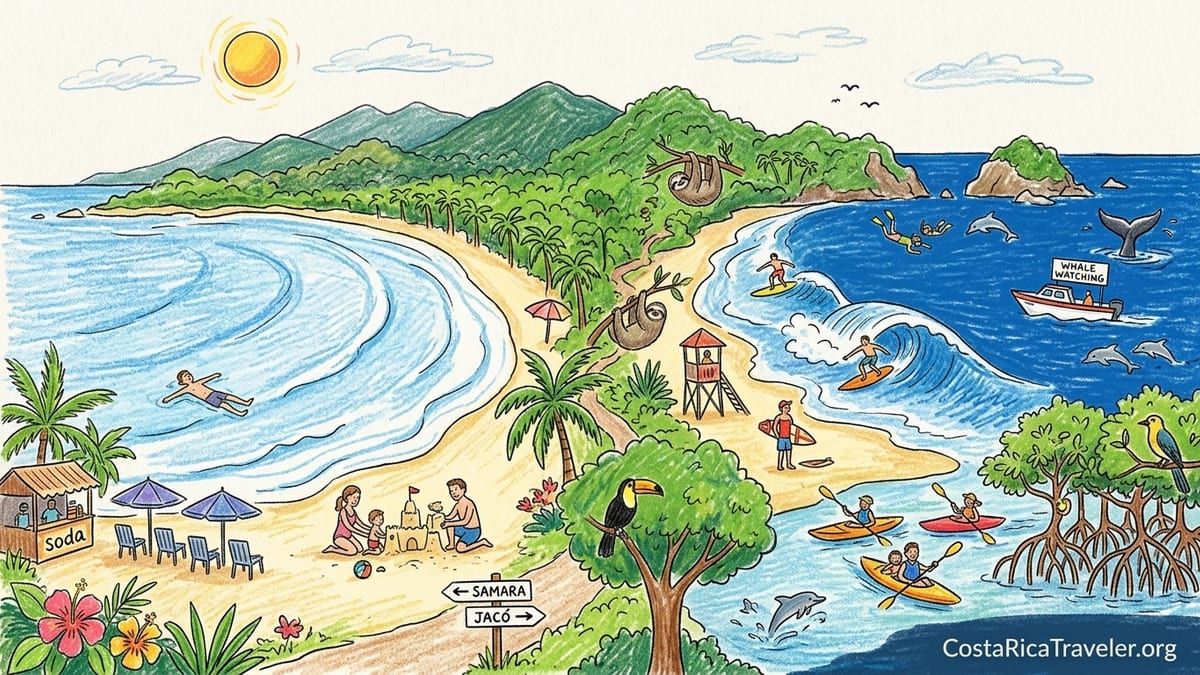
The most satisfying swimming I have done on the Pacific coast was not in a hotel pool but at Playa Samara on the Nicoya Peninsula. The bay is shallow and protected, with small, rolling waves and a mostly sandy bottom, which made it perfect for long, relaxed sessions in the water at mid to high tide. I stayed in town and walked onto the beach, so there was no booking involved and the only cost was a few thousand colones for shaded chairs and drinks from a local soda. I would estimate the water sessions themselves at two to three hours each afternoon, with air temperatures in the high 80s Fahrenheit and bath-warm sea temperatures that never felt chilly. There was virtually no current on the days I visited, which made it comfortable for weaker swimmers, and I would repeat those simple, unstructured beach days without hesitation.
In contrast, a swimming afternoon at Jacó Beach on the Central Pacific reminded me how quickly conditions can change along this coast. Jacó’s long, dark-sand bay is famous for surfing rather than casual swimming, and I could feel a stronger shore break and a noticeable pull in the mid-tide whitewater. I did go in, but I limited it to shallow-water cooling dips of 20 to 30 minutes at a time, staying in front of a busy lifeguard tower and avoiding days when the red flags were up. There was no guide, group, or booking, but the physical effort felt higher because each wave hit with more force and demanded more bracing. I would not go back to Jacó specifically to swim, but I would still stay there again for its surf schools and city conveniences, treating swimming as a side benefit instead of the main event.
On a later trip I sought out Playa Biesanz near Manuel Antonio after several locals described it as a calmer alternative for swimming. Getting there required a short uphill taxi ride from Quepos and a ten to fifteen minute walk down a dirt path through low forest, which already filtered out the biggest crowds. The small bay was dotted with kayaks and stand-up paddleboards for rent, but the real draw for me was the glassy water close to shore during the morning high tide. I swam for about an hour with almost no wave action, just gentle ripples, before afternoon winds picked up and small chop formed. I paid for a day bed and a coconut from beach vendors, but did not hire a guide. This is a spot I would absolutely return to for relaxed swimming, particularly with less confident companions.
One lesson I took from these contrasting beaches is that paying nothing can sometimes produce a richer experience than an organized excursion. My most memorable Pacific swims involved choosing bays with natural protection from swell, visiting in the morning before wind and crowds, and being willing to walk ten extra minutes from the parking area. While tour desks in Guanacaste and the Central Pacific will offer you everything from catamarans to ATV rides, do not underestimate the value of a low-cost day that revolves around picking the right swimming beach and simply staying put.
Surf Lessons Worth the Money
Surfing is where Costa Rica’s Pacific coast really shines, and I have taken beginner and improver lessons in both Tamarindo in Guanacaste and Jacó in the Central Pacific. In Tamarindo I joined a group lesson that I booked in person the day before through a walk-in surf school along the main strip. It cost the equivalent of around 60 to 70 US dollars for a two-hour session, including board rental and rash guard, with a group size of four students to one instructor. Conditions on the day were classic Tamarindo: small to medium beach break waves, sandy bottom, light offshore wind in the morning and waist to chest high sets. The physical effort was moderate; the paddling burned my shoulders and the pop-ups demanded some core strength, but we spent part of the class on the sand practicing technique, which helped. The instructor spent the first half pushing us into waves and the second half encouraging us to start paddling on our own. I would happily repeat this type of lesson because the structure and gentle waves made visible progress feel achievable in a single morning.
My Jacó surf lesson felt different enough that it is worth contrasting. I booked it online a few days before arrival with a well-known local camp that operates directly on the beach. Recent pricing guides show two-hour group lessons in Jacó in the range of 50 to 70 US dollars per person, with many schools capping groups at about four students per instructor. When I went out, the Central Pacific’s heavier beach break was obvious. Waves were a bit steeper and closed out more quickly, and the dark sand and stronger shore break required closer attention from the instructor. We spent nearly the entire two hours in the water, with less on-beach coaching. By the end I was exhausted in a way I had not been in Tamarindo, even though the lesson length and group size were similar. I would still repeat a Jacó lesson as an intermediate surfer, but for true first-timers or nervous swimmers I would personally steer them toward Guanacaste’s gentler bays.
One paid experience that surprised me with its value was a semi-private coaching session in Tamarindo that I booked after already doing a group class. I arranged it in person through the same surf shop two days in advance and paid roughly 85 to 95 US dollars for a one-on-two lesson that lasted just under two hours. Conditions that morning offered clean, shoulder-high sets at mid tide. The instructor paddled out with us to the lineup, sat next to us, and called out which waves to take, correcting small mistakes in positioning and stance between rides. The physical effort was high because we were no longer in the whitewater and needed to paddle through sets to reach the peak. Still, the focused feedback dramatically improved my confidence in reading waves and catching them earlier. Although it was more expensive than a basic beginner class, this is a surf lesson format I would absolutely repeat when I want to advance a level in a short time.
Based on both trips, my rule of thumb for Pacific coast surfing is to pay for instruction at least for your first few sessions, rather than simply renting a board. The right instructor can steer you to the safest part of the break, explain the local etiquette, and read shifting winds and tides in real time. On beaches like Tamarindo or Playa Hermosa near Jacó, where the lineup can be crowded, that guidance goes a long way toward making your first waves feel exhilarating instead of intimidating.
Wildlife Watching and National Park Hiking
Some of the most rewarding Pacific coast experiences I have had involved trading the beach for nearby protected areas. In Manuel Antonio National Park on the Central Pacific, I tried hiking without a guide on my first visit, then returned with a licensed naturalist on my second, and the difference was dramatic. On the unguided day I paid the park entrance fee in advance, walked the main trails to the beaches, and saw a few monkeys and iguanas, but I had no idea how much I was missing. Hiking alone took about three hours, including swim breaks, and required only light to moderate effort on mostly flat, well-maintained paths.
On my second visit I booked a morning group tour through a local agency in Quepos, which paired us with a certified guide. The cost was roughly 60 to 70 US dollars per person, including park entrance, a spotting scope, and transfers from my hotel, with a group of eight travelers. Over a similar three-hour period we saw sloths that I would never have noticed without a scope, tiny bats lined up under a tree trunk, several bird species, and leafcutter ants marching along the trail. The guide’s ability to explain animal behavior and plant uses transformed what would have been a pleasant walk into an absorbing natural history lesson. The physical effort was still light, but the mental engagement was much higher, and I would call a guided visit to Manuel Antonio one of those rare cases where paying extra is close to indispensable if you care about wildlife.
Farther south, I joined a guided night walk in a private forest reserve near Uvita. I booked through my guesthouse reception in the afternoon for that same evening, paid in cash upon arrival, and joined a small group of six participants with one bilingual guide. The tour lasted around two hours and cost the equivalent of 35 to 45 US dollars, including transport from the meeting point to the trailhead. Conditions were warm and humid with light drizzle, and we walked slowly along a relatively flat loop, stopping often while the guide scanned foliage with her flashlight. Over the course of the walk we spotted several frogs, a sleeping bird, large insects, and the glowing eyes of a mammal high in the canopy. Physically the walk was easy but required comfort with darkness, mud, and the possibility of sudden rain. This is the kind of wildlife experience I would gladly repeat in the South Pacific region, where the forest feels dense and alive even a short drive from the ocean.
For balance, it is worth mentioning one Pacific-side park visit that felt more obligatory than essential. In Carara National Park near the Tarcoles River, I opted for a short, self-guided walk on the universal access trail during a midday heat window. I paid the entrance fee at the ranger station and followed the loop for about an hour. The path was beautifully maintained, but the combination of high temperatures, strong sun at the edges of the forest, and limited visible wildlife made the outing feel more like a box ticked than a meaningful encounter with nature. Had I hired a guide, started at dawn, and built it into a full-day birding itinerary, I suspect it would have been different. As it was, this is not an experience I am in a hurry to repeat in the same way, and it reinforced my tendency to either commit fully to a guided wildlife experience or save my time for other coastal activities.
Whale, Dolphin and Boat Trips
The headline marine wildlife experience on Costa Rica’s South Pacific coast is humpback whale watching around Marino Ballena National Park near Uvita. I joined a small-group tour during the northern-hemisphere whale season, booking through a local operator recommended by my guesthouse. The price was a little under 100 US dollars per person, inclusive of park fees, lifejackets, a bilingual guide, drinks, and light snacks. There were around ten guests on the boat, which gave everyone space along the railings. We spent close to three hours on the water, motoring out from the famous whale-tail sandbar into deeper blue water where we eventually saw blows and the fluke of a humpback as it dove. Conditions that morning began glassy and calm, then built to a light chop as wind picked up toward midday. The physical effort was low, but those prone to seasickness would want medication because of the rolling motion in open water. This is a whale and dolphin trip I would absolutely repeat, provided I was visiting during one of the main migration windows and could book with an operator that emphasizes slow approaches and respectful distances.
By contrast, a sunset catamaran cruise I took from the Tamarindo area left me conflicted. I booked through a tour desk in town the day before, paying roughly 80 to 90 US dollars for a half-day outing that promised snorkeling, open bar, snacks, and a Pacific sunset. There were more than sixty people on board, music played at high volume, and while the crew remained professional, the atmosphere was closer to a floating party than a nature experience. The boat anchored in a small bay for about forty-five minutes of swimming and snorkeling, but visibility was limited and the number of people entering the water at once made it feel crowded. We did spot a few dolphins on the ride out and enjoyed a colorful sunset on the return, with golden light reflecting off the sails and the coastline. Physically the day involved little more than periodic swimming and climbing the ladder back onto the boat. I would not repeat this specific type of large-party cruise, though I might consider a smaller, more intimate sailing charter if I returned with a group of friends.
On a later visit to the Nicoya Peninsula I joined a more modest mangrove and estuary boat tour near Tamarindo. I booked it at a kiosk near the beach that specialized in estuary trips and paid around 45 to 55 US dollars for a two-hour excursion, with six guests plus the captain-guide in a shallow-draft boat. We motored quietly up the brackish channels at mid tide, watching for birds among the mangrove roots and spotting an occasional crocodile lying motionless near the waterline. The weather was hot but the canopy provided shade, and the flatwater ride was suitable for all ages with very little physical strain. While it lacked the drama of breaching whales or crashing surf, the tour gave a calmer, more intimate look at a different side of Pacific coastal ecosystems. I would repeat a small-boat mangrove excursion like this, especially for families or travelers who want wildlife without long hikes.
These three boat-based experiences illustrate the spectrum of what “Pacific coast boat trip” can mean in Costa Rica. Before you book, clarify whether the emphasis is on wildlife, drinking and socializing, or quiet scenery. Group size, time of day, and season all matter. I am glad I tried both the large catamaran and the smaller whale and mangrove tours, but for my own future travels I will put my money toward smaller groups and operators that keep the focus on the ocean and its inhabitants.
Snorkeling, Diving and Fishing
The clearest water I have personally encountered on Costa Rica’s Pacific side was around Isla del Caño off the Osa Peninsula. I booked a snorkeling trip from Drake Bay through my lodge, which arranged the tour with a licensed local operator. The price was in the range of 100 US dollars per person for a full-day outing that included boat transport, two guided snorkeling sessions near the island, park fees, equipment, and a simple lunch. Our group consisted of ten guests and two guides. The boat ride took about an hour each way across open water, with moderate swells and some spray. At the island the guides split us into smaller subgroups, gave a safety briefing, and led us along the reef, pointing out schools of fish, rays, and the occasional reef shark in water clear enough to see the bottom several meters below. The physical effort was moderate, with about forty-five minutes of snorkeling per session, and the main challenge was staying relaxed in rolling swells rather than any strong current. This is a trip I would very gladly repeat and is one of the few Pacific snorkeling outings that genuinely rivals the clarity of places better known for reefs.
On a different visit, I tried a near-shore snorkeling stop as part of the large Tamarindo catamaran cruise described earlier. Technically it offered masks and fins, and the crew encouraged guests to explore the rocky edges of the bay where we anchored for under an hour. In practice, visibility was murky, stirred up by waves and so many swimmers, and I saw little beyond a few small fish and rocks. There was no dedicated snorkeling guide in the water, and the atmosphere remained focused on the boat’s bar and music. This felt like snorkeling as an add-on rather than the core of the experience. I would not book such a cruise for the snorkeling alone, and if clear-water marine life is a priority, I would instead allocate time and budget to a more focused excursion like Isla del Caño.
I have also sampled inshore fishing out of the Central Pacific, joining a small charter from near Herradura and Jacó that a friend organized. We negotiated the trip directly with the captain the afternoon before, settling on a half-day rate that worked out to roughly 120 to 150 US dollars per person once split among four anglers. The open fiberglass boat had shade and basic rods and tackle, and we trolled and bottom-fished for several hours in relatively calm seas with low swell. The physical effort involved more standing and balancing than strenuous hauling, and although we did not land any trophy-sized catches, we brought in several table fish that the captain cleaned for us to cook later. While serious sport-fishing enthusiasts often head to larger marinas with fully equipped offshore boats, I found this smaller inshore outing a satisfying and more affordable way to experience Pacific fishing. It is an activity I would repeat selectively, particularly with a group interested in the process as much as the catch.
For travelers who dive, the Pacific coast offers additional options that I have only researched rather than personally tried. In Drake Bay and Uvita, for example, local dive centers organize two-tank trips to Isla del Caño, with 2025 price lists showing rates in the approximate range of 160 to 180 US dollars including tanks, weights, and guide. Operators limit group sizes and must follow park rules on daily visitor quotas, which means advance booking in high season is strongly recommended. Because I have not yet dived these sites myself, I cannot assess guide quality from experience, but I include them here as researched possibilities for certified divers planning a future trip.
Mangroves, Sunsets and Simple Beach Time
Some of my most satisfying Pacific coast memories are not big-ticket tours at all but slow moments at the edge of day. In Tamarindo, for example, I came to appreciate sunset as a daily ritual rather than a one-off event. Each evening, locals and visitors drifted onto the sand with beach towels, surfboards, or takeaway food. I would walk the length of the bay for thirty to forty-five minutes as the light shifted from harsh brightness to soft gold, eventually finding a spot near the rivermouth to sit and watch surfers framing themselves against the horizon. There was no cost beyond perhaps a cold drink from a vendor, no guide, and no fixed duration, but it grounded the whole day. Physically the effort was low, but the emotional payoff was high enough that I now treat at least one unstructured sunset on any Pacific trip as non-negotiable, worth more than a rushed excursion squeezed in before dark.
In the Nicoya Peninsula mangroves near Playa Grande and the Tamarindo estuary, I joined a simple kayak outing that blurred the line between exercise and wildlife watching. I booked the trip through a small local operator that specialized in estuary tours, paying around 45 to 60 US dollars for a guided session of roughly two hours. There were six of us plus a guide, each in single or double kayaks. We paddled with the incoming tide into side channels lined with mangroves, pausing when the guide spotted birds or iguanas among the roots. The physical effort was moderate, especially when turning against small currents, and the heat built quickly in the still air. We wore hats, long-sleeved shirts, and plenty of sunscreen, and the guide provided dry bags for phones. This is an outing I would repeat in a heartbeat, both for the sense of exploration and for the different perspective it gives on a coastline otherwise dominated by surf culture.
In Manuel Antonio, a low-cost but memorable day involved nothing more complicated than walking into the national park as early as possible and spending most of the time on the park’s internal beaches. After spotting some wildlife on the trails in the cool of the morning, I settled on the sand with a book, alternating between shaded reading sessions and short swims in the bay’s calm water. The beaches inside the park felt more sheltered and scenic than many free-access stretches outside, thanks to the surrounding forest and the ban on loud music and vendors. The main costs were the park entrance fee and simple snacks I carried in, and the physical effort was light beyond the initial walk in. Given a choice between this and a crowded commercial beach with jet skis, I would choose the quiet park beach day almost every time.
These kinds of mixed experiences underscore that Costa Rica’s Pacific coast does not have to be approached as a checklist of adrenaline tours. A carefully chosen mangrove paddle, a sequence of sunsets, or a day that combines a guided morning wildlife walk with a lazy afternoon on a shaded beach can anchor a trip just as powerfully as more expensive excursions. Balancing a few high-cost, high-impact activities with deliberately simple days helps keep both your budget and your sense of wonder intact.
The Takeaway
Across multiple trips up and down Costa Rica’s Pacific coast, the experiences I would genuinely repeat share a few traits. They either connect directly to the region’s strengths in surf, marine wildlife, and protected forest, or they deliberately slow things down to let the landscape sink in. Gentle surf lessons in Tamarindo, guided wildlife walks in Manuel Antonio, small-boat whale watching from Uvita, focused snorkeling at Isla del Caño, and quiet mangrove paddles near estuaries all fall into that category for me. So do unscripted evenings watching the sky change color over a dark-sand bay.
The outings I am less eager to repeat tend to be those that felt overly commercial or mismatched to their selling points: a huge party catamaran marketed equally to snorkelers and sunset seekers, or a hot midday park visit without a guide when the real action was happening at dawn. None of them were disasters, but they reminded me to ask sharper questions before booking. How many people will be on the boat? Is the focus on wildlife, scenery, or socializing? What time of day gives you the best conditions rather than just filling a schedule gap?
If you are planning your own Pacific itinerary, you might start by deciding which experience categories matter most to you: swimming in calm bays, learning to surf, seeing whales and dolphins, hiking in rainforest, diving clear reefs, or simply being on the water at golden hour. For each category, consider investing in one or two well-chosen paid experiences, especially where expert guides or specialized boats make a clear difference, and then intentionally pair them with free or low-cost days that let you enjoy the same coast at your own pace.
In the end, Costa Rica’s Pacific side rewards both the traveler who chases bucket-list moments and the one who sits still long enough to hear the forest and surf in between. The trick is to curate, not collect, so that the money and time you do spend leave you eager to come back, not ticking off what you think you are supposed to enjoy.
FAQ
Q1. When is the best time of year to visit Costa Rica’s Pacific coast for surfing and wildlife?
The dry season from roughly December to April offers the most consistent sun and reliable surf conditions in places like Tamarindo and Jacó, while humpback whale watching around Marino Ballena near Uvita peaks during specific migration windows that often fall between about August and October and again in the first months of the year. Shoulder seasons can bring fewer crowds and lower prices but more rain and occasional stormy seas.
Q2. Do I really need a guide for national park visits such as Manuel Antonio?
You can enter and walk the main trails of parks like Manuel Antonio on your own, but hiring a licensed naturalist guide dramatically increases how much wildlife you actually see and understand. In my experience, a three-hour guided walk using a spotting scope revealed far more animals than a self-guided visit of similar length, which made the extra cost worthwhile.
Q3. How much should I budget for a beginner surf lesson on the Pacific coast?
Recent rates for group beginner lessons in major surf towns such as Tamarindo and Jacó often fall in the approximate range of 50 to 70 US dollars per person for a two-hour session, including board rental. Semi-private or private coaching typically costs more but can accelerate progress if you already have basic skills and want more intensive feedback.
Q4. Is the Pacific coast safe for casual swimming?
Many beaches along the Pacific coast have strong currents, powerful shore breaks, or sudden drop-offs, so safety depends heavily on location, tide, and conditions. Calmer bays like Samara or the protected beaches inside Manuel Antonio National Park generally offer more relaxed swimming, while surf-focused spots such as Jacó can be challenging. Always pay attention to local advice, flags, and lifeguard guidance before entering the water.
Q5. Are whale watching and dolphin tours in Uvita and the South Pacific suitable for people prone to seasickness?
Small boats heading out from Uvita toward Marino Ballena National Park and beyond often encounter rolling swells, even on otherwise calm days. If you are prone to seasickness, it helps to choose morning departures when seas are usually smoother, take recommended medication, sit near the stern in the fresh air, and focus on the horizon. The tours themselves are usually low in physical effort but can feel demanding if you feel unwell.
Q6. How far in advance should I book popular activities like Isla del Caño snorkeling or national park tours?
For high-demand experiences that have daily visitor limits, such as Isla del Caño marine tours or guided entries into heavily visited parks, it is wise to book at least several days ahead in the dry season and even earlier during major holiday weeks. Lodges and local operators can often secure spots if you contact them before arrival, but last-minute requests during peak times sometimes find tours fully booked.
Q7. What kind of physical condition should I be in for typical boat, snorkel, and surf trips?
Most standard boat and wildlife tours require only basic mobility, such as climbing a ladder from the water or stepping from dock to boat. Snorkeling trips ask you to feel comfortable floating, breathing through a snorkel, and swimming short distances in waves or light current. Beginner surf lessons demand moderate fitness, particularly in the shoulders and core, but instructors usually adapt to different ages and abilities.
Q8. Are there good low-cost or free alternatives to organized tours on the Pacific coast?
Yes, some of the most rewarding days can be nearly free, especially if you choose beaches with naturally calm water for swimming, walk into national parks and focus on their internal beaches, or spend evenings watching sunset from the sand. Simple estuary walks, tide-pool exploring where safe, and self-guided hikes on clearly marked trails near coastal towns can all add variety without requiring a tour budget.
Q9. How should I decide between a large catamaran cruise and a smaller boat excursion?
Large catamarans often emphasize social atmosphere, open bars, and music, which can be fun for groups but less ideal if your priority is quiet wildlife viewing or serious snorkeling. Smaller boats usually feel more intimate, with fewer passengers and a closer connection to guides, though they may ride rougher in swells. Think about whether you value space, silence, and flexibility over party energy when making your choice.
Q10. Is Costa Rica’s Pacific coast a good choice for families with children?
The Pacific coast can work very well for families, provided you choose destinations and activities suited to your children’s ages and comfort levels. Gentle surf towns, calmer swimming bays, short guided wildlife walks, mangrove boat trips, and sunset beach time all tend to be hits with kids, while long offshore rides in big swells or all-day high-intensity tours may be better saved for when they are older.