


Traveling Costa Rica’s Pacific coast without a car sounds romantic and eco-friendly, but it becomes very real the first time you are standing at a highway bus stop with a surfboard and a 50-liter backpack while the rain comes sideways. I spent weeks moving from the surf towns of Guanacaste down through the Central Pacific and into the wild south using only public buses, shared and private shuttles, domestic flights, taxis and boat transfers. What follows is not theory but a coast-wide logistics report: what actually ran, how I booked it, what it cost compared with a rental car, and the moments when not having a vehicle made travel easier, and the moments it truly boxed me in.
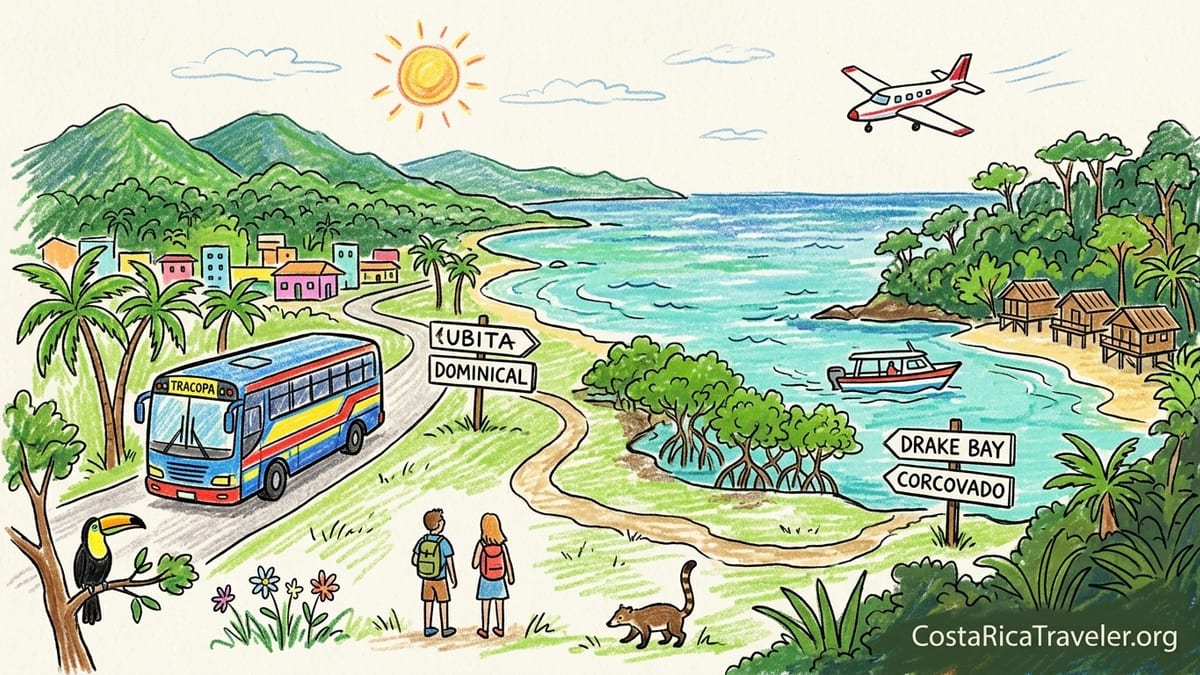
How Going Car Free Changes a Costa Rica Pacific Itinerary
The Pacific side of Costa Rica stretches from Papagayo and Tamarindo in the north to the Osa Peninsula and Golfito near the Panamanian border. On a map, it looks like one long coastal drive. Without a car, it becomes a chain of linked corridors: bus-served surf towns like Jacó and Dominical, shuttle-heavy hubs like Tamarindo and Santa Teresa, and flight or boat accessed corners such as Drake Bay and Carate. Planning without a car is not about one route, but about choosing which of these corridors fits your time, budget and risk tolerance for missed connections.
The first mental shift is pace. A Tracopa bus from San José to Dominical or Uvita on the central-southern coast takes about four hours and costs around 5,500–5,600 colones one way, a little over 10 US dollars, according to current fare tables and booking sites that track 2026 prices. That is incredibly good value, but you travel on the company’s schedule, not your own, and you still have to reach the bus terminal in San José and walk or taxi from the highway stop to your hotel once you arrive.
The second shift is acceptance that some “famous” routes are much more awkward without a car than others. Official tourism and surf guidance correctly notes that many Pacific surf beaches have bus access, but not all surf towns are created equal. Tamarindo, Jacó, Dominical, Uvita and Manuel Antonio have frequent public buses and compact centers where you can walk to restaurants, surf schools and tour agencies. In contrast, Playa Avellanas, Playa Hermosa south of Jacó, Nosara’s outer beaches or more remote breaks on the Osa Peninsula can require a mix of local bus, 4WD taxi, charter boat or a domestic flight.
Finally, going car free forces a decision about how many regions to combine. With a rental car it is common to link, for example, Tamarindo, Nosara, Santa Teresa and later Uvita or Osa in 10 to 14 days. Without a car, three separate coast sections in two weeks can feel like spending every second day in transit. I found that two bases worked far better: one hub in the north or central Pacific reached mostly by road, and one in the deep south accessed by boat or plane.
Public Buses: Cheap, Authentic and Surprisingly Reliable
For long stretches of the Pacific coast, buses are the spine of car-free travel. The state tourism institute publishes updated bus schedules and you can also cross-check routes on local platforms that aggregate times and prices. For example, in October 2026 schedules show multiple daily Tracopa departures from San José’s Tracopa terminal near Plaza Víquez down the Costanera Sur highway to Dominical and Uvita, with journey times listed at roughly four hours and fares just over 5,500 colones. Independent schedule aggregators list similar departures, with sample weekday services at 06:30 and 08:30 in the morning and additional afternoon buses.
On the ground, boarding Tracopa felt straightforward if you planned ahead. I bought one ticket in person at the Tracopa office in San José and another using an app that sells seats with a small markup. In both cases I received an assigned seat and a printed or digital ticket. Checked bags were tagged and placed in the underfloor compartment while small backpacks stayed with me in the cabin. Drivers routinely stopped at roadside restaurants on long routes, and despite Costa Rica’s legendary rain, my bags were dry every time I unloaded.
The main friction with buses is where they actually drop you. In Uvita, Tracopa uses a small roadside terminal on the inland side of the highway. Local information boards for 2026 show buses running north to Quepos and south to Palmar Norte, Sierpe and Ciudad Neily, but all of them use the Costanera Sur highway. If your cabina is up a hill nearer to the jungle or down a side road toward Playa Hermosa or Playa Chaman, you face a hot 15 to 25 minute walk with luggage or a short taxi ride. In heavy rain that “last mile” was where I most felt the lack of a car.
Elsewhere, local buses run shorter coastal hops that fill important gaps for car-free travelers. Updated community schedules for Uvita in 2026 list frequent buses between Uvita and Dominical, with journey times of about 20 minutes, plus services north to Quepos several times a day. These buses are not bookable online. You simply stand at marked stops or flag them down roadside, pay cash to the driver and keep your pack on your lap or in the small front luggage area. In exchange for that informality, you gain redundancy: miss a 05:15 northbound bus and another usually follows by late morning or early afternoon.
Shared and Private Shuttles Along the Northern and Central Coast
Between heavily touristed towns like Liberia, Tamarindo, Nosara, Sámara, Jacó, Manuel Antonio and Uvita, shared shuttle vans are the workhorses of car-free travel. Several brands operate similar services, using 10 to 20 seat air-conditioned minibuses that run fixed routes. Typical fares in late 2026 between major nodes fall in the 40 to 65 US dollar range per person for a one-way ride, significantly more expensive than public buses but cheaper than renting a car for short stays.
Booking shuttles in practice was digital first, analog second. From the United States before the trip I reserved seats on two coastal legs by filling out online forms with dates, hotel names and WhatsApp contact details, and received instant email confirmations. The evening before each trip, the operator messaged my local number with a narrower pickup window, usually a 15 to 30 minute band. On the day, the van pulled up directly outside the hotel or the nearest point it could safely stop, the driver checked my name on a printed list, loaded my main bag into the rear cargo area and we set off. There were usually one or two en route stops to pick up other passengers or for a bathroom break.
The main advantage compared with buses was not speed but simplicity and last-mile coverage. One ride between Tamarindo and Nosara, for instance, would have required multiple local buses via Santa Cruz and Nicoya, with departures that may or may not line up well. The shared shuttle did the coastal route in roughly three hours, door to door, and cut out the uncertainty of rural bus stops. In Jacó and Manuel Antonio, shared shuttles also connected directly to San José International Airport, which avoided having to taxi into central San José just to reach the public bus terminal.
Private shuttles enter the picture when your group is larger or your timing awkward. Quotes I received for private transfers in 2026 on routes like San José to Uvita, or Uvita to Sierpe, hovered between 180 and 260 US dollars per vehicle, up to eight passengers. For solo travelers that is poor value. For families or surf buddies splitting the bill, it offers the same on-demand flexibility as a rental car, but only at the start and end of the day.
Domestic Flights and Boat Transfers in the Deep South
Once you move into the southern Pacific, particularly the Osa Peninsula, boats and small planes become normal parts of travel rather than splurges. Updated route searches in late 2026 show domestic airlines operating flights between San José and Pacific airstrips such as Quepos for Manuel Antonio, Tambor for the Nicoya Peninsula, Nosara, Puerto Jiménez and Drake Bay. One-way fares often range from about 80 to 200 US dollars depending on season and advance purchase, with small 12 to 19 seat aircraft and tight luggage limits that matter to surfers and long-stay travelers.
In Quepos and Tambor, flying saved time but not necessarily hassle. After landing at Quepos La Managua Airport, you still need a taxi into Manuel Antonio or Quepos town, a 15 to 20 minute ride. For Tambor, many Santa Teresa visitors land and then continue by private shuttle or prearranged hotel transport for the final hour of rough road. The luggage limits, often around 12 to 18 kilograms per person for checked bags, meant I had to repack and leave my heaviest items in San José when I used these flights.
Where air and water truly excelled was Drake Bay. The overland road into Drake has unbridged river crossings and road conditions so inconsistent that even locals, boat operators and current travel writers often warn rental car drivers away from attempting it, especially in the rainy season. Instead, most travelers reach Drake Bay either by domestic flight or by boat from the river town of Sierpe. Boat companies that operate the Sierpe to Drake route publish schedules indicating morning and early afternoon departures, with sample fares around 20 to 30 US dollars per person for the shared boats as of late 2026.
The booking routine to Drake is particular. I reserved a boat seat ahead of time using a simple online form and WhatsApp message with the company, then arranged a private taxi from Uvita to Sierpe for the morning of departure. In Sierpe, taxis and buses from Palmar Norte drop you directly at the dock area behind riverside restaurants. Boat staff stacked backpacks and rolling suitcases at the back of the boat under a tarp and loaded lighter daypacks near passengers’ feet. You wade a few steps from the concrete dock into the shallow water to climb aboard, so dry bags and sandals became non-negotiable. On arrival at Drake’s main beach, many lodges met guests with tractors, 4WD trucks or wheelbarrows for luggage, but if your accommodation is further along the coast, you may transfer to a smaller boat right there in the bay.
Last-Mile Logistics: From Highway Stop to Beachfront Cabina
The “real last-mile problem” of Costa Rica’s Pacific coast rarely appears on glossy brochures, but it shapes day-to-day life without a car. Public buses, shuttles and even some boats drop you at a sensible, central or highway location; beaches, hostels and boutique hotels are seldom right on that point. Across the coast, my experiences fell into three broad patterns: true walkable beach towns, semi-walkable strips where taxis fill the gap, and remote stays where your host effectively becomes your transport planner.
Jacó was the cleanest example of a true walkable beach town. The public bus from San José pulls into a centrally located terminal, and from there most hotels, surf schools, supermarkets and restaurants line the parallel main street and beach road. I rolled my bag for ten minutes and needed no cab. Once checked in, it took less than five minutes to reach the sand on foot. Not having a car in Jacó was a relief; parking can be tight, and everything I wanted, including board rental and day tours, was within a flat walking radius.
Uvita and Dominical were hybrids. The beach at Uvita and the famous whale-tail sandbar sit a good distance from the highway. Many guesthouses cluster along steep side roads rising toward the mountains. In practice that meant I used a short taxi ride, usually 5 to 10 minutes, to get between the Tracopa terminal or main supermarket and my hillside cabina or the national park entrance. Taxi prices in 2026 for these short hops often fell in the 3 to 8 US dollar range depending on distance and time of day. In Dominical, by contrast, the tiny beach town sits closer to the road and river, so if you choose accommodation in the core, you can walk almost everywhere, though you still need a ride for visits to nearby waterfalls or more remote beaches.
Drake Bay and the wider Osa Peninsula illustrated the third pattern. Once I stepped off the boat in Drake, there were no public buses and almost no casual taxis. My lodge arranged both arriving and departing boat transfers as part of the room rate and coordinated any day tours or local 4WD rides. The final approach involved a short wet landing on a smaller beach and a steep path up to wooden cabins. With no road access, not having a car stopped being a choice and instead became simply “how things are done”. If I wanted to leave, I had to plan two logistics steps at once: a boat back to Sierpe or a domestic flight, and then a connecting bus or shuttle onward along the coast.
When Not Having a Car Helped, and When It Hurt
There were days on this trip when I was grateful not to be behind a wheel on narrow, rain-slick Pacific roads. In Tamarindo, Jacó, Dominical, Uvita and Manuel Antonio, walking or using occasional taxis made the trip feel more relaxed and safer. I could hop on a public bus from Uvita to Dominical for a surfing day trip for the equivalent of a few US dollars, nap on the way back and never think about parking or break-ins. In Jacó and Tamarindo, the simple loop of surf, eat, siesta and sunset required nothing with an engine.
Costs in these hubs also favored going car free if you were willing to accept slower travel between regions. Public buses from San José to Uvita for about 12 US dollars, local buses between nearby towns for small change, and a couple of shared shuttles in the 50 to 60 US dollar range each still added up to less than two weeks of rental car fees during high season, which in 2026 often exceed 60 to 80 US dollars per day once insurance is included. Add the trend of paid parking at popular beaches and the value proposition of having your own wheels began to look less compelling for a slow, one or two base itinerary.
The limitations registered most strongly in three situations. The first was dawn patrol surfing at less central breaks. Without a car, I was realistically limited to beaches directly in front of town or those accessible by daylight buses or prearranged taxis. Spots that required pre-dawn drives, four-wheel-drive vehicles or flexible timing to catch specific tides became difficult to justify unless I based myself in a surf camp that provided transport.
The second friction point was spontaneous detours. With a car it is easy to add an unplanned waterfall stop or change towns at the last minute. On public transport, my days had to orbit around fixed departure times. If I missed the morning bus from Uvita to Sierpe that connected to the Drake boat, I might be looking at an unplanned night in Palmar Norte or Sierpe. In the deep south especially, that connection between bus and boat or flight is not something you want to risk casually.
The final constraint was luggage freedom. Dragging a rolling suitcase over gravel in Nosara, lifting it into boats at Sierpe and Drake, and squeezing it into shared shuttle cargo holds made it clear that the more minimal the packing list, the more pleasant car-free travel becomes. Travelers with several large suitcases or full-size surfboard quivers often ended up defaulting to private shuttles or flights simply because moving that much gear through public systems became unwieldy.
Cost and Convenience Compared with Renting a Car
At the level of pure numbers, renting a car still looks simple. By autumn 2026, small rental vehicles in Costa Rica commonly price in the 30 to 50 US dollar per day range at first glance, but mandatory insurance and taxes often push the real daily cost into the 60 to 90 dollar band, especially if you want coverage on rougher roads. Fuel along the Pacific coast is not cheap either, though distances between major towns are modest. For a two-week coastal loop, it is realistic to budget well over 900 to 1,200 US dollars for a rental, plus fuel and parking.
In contrast, a two-week car-free itinerary that uses a mix of Tracopa and other public buses, a couple of shared shuttles and one boat transfer to the Osa can easily come in at half that total for one traveler, even with a domestic flight added in. An example pattern might be: public bus San José to Jacó, local bus to Quepos for Manuel Antonio, Tracopa south to Uvita, taxi to Sierpe, shared boat to Drake Bay, and a domestic flight from Drake or Puerto Jiménez back to San José. The long segments are between 10 and 60 US dollars each, and the short connectors cost only a few dollars more.
What the rental car buys is control. You are no longer bound by a bus that leaves San José at 06:30 or a boat that leaves Sierpe at 11:30. You can surf until the last light in Esterillos, stay for a second sunset drink in Dominical, or choose a hillside eco-lodge outside Uvita’s walkable core without caring how dark the road might be when you drive back. For families carrying small children, elderly relatives or complex medical needs, that control and comfort can outweigh the financial savings and lower carbon footprint of public transport.
It is also worth factoring in risk in the deep south. Several sources, from boat operators to recent travelers, continue to caution against driving to Drake Bay in anything but a high-clearance 4WD, especially in the green season. The route includes river crossings where flooding can total a rental car and leave you stranded. If your dream is Corcovado and Drake, the car advantage diminishes there and shifts back toward boats and planes.
Practical Itineraries Without a Car
For a one-base beach holiday on the Pacific coast without a car, the most relaxing options are compact towns with dense services. Jacó, Dominical, Tamarindo and Manuel Antonio all fit this description in slightly different ways. You can reach them by direct or one-change bus from San José, or by shared shuttle from the international airport, then spend a week or more walking to the surf, eating at different sodas and restaurants each night, and joining guided tours that include transport. In these places I barely noticed not having a vehicle beyond the initial arrival and departure days.
For multi-region trips that stitch together north, central and south, the key is to design around the few fixed points where schedules matter most: the early Tracopa buses leaving San José, the inland to coastal transfers at hubs such as Quepos and Uvita, and the Sierpe to Drake boats or domestic flight times. A realistic two-week car-free loop might look like this: arrive San José, bus or shuttle to Jacó, local bus to Quepos for two or three nights, long-distance bus to Uvita for several nights and a day trip to Dominical, taxi to Sierpe and boat to Drake Bay for three nights, then fly or boat-and-bus back to San José. This still offers varied surf, rainforest hikes and wildlife without more than one true “marathon” travel day.
Surf-focused trips without a car work best when you either stay at a surf camp that handles transport or commit to beaches on public bus routes. Official and community surfing guidance stating that many Pacific surf beaches have bus access proved accurate in places like Jacó, Tamarindo and Dominical, where you can ride the same break daily and occasionally hop a bus to a neighboring town for variety. More remote or technical spots, especially reef or river-mouth breaks down gravel roads, really do favor either a rental 4WD or a guided trip from a local surf operator who has one.
For remote Osa-style travel, my clearest recommendation is to embrace boats and flights rather than fight them. Plan your route around the Sierpe to Drake boat times or the departure board at San José’s domestic terminal, and build a buffer night in Uvita, Sierpe or San José at the start and end of your Osa section in case of weather disruptions. Communicate early with your lodge so they know your arrival method and can line up their own boat or 4WD connections. In this part of the coast, trying to recreate the independence of a road trip usually adds stress rather than freedom.
The Takeaway
Crossing Costa Rica’s Pacific coast without a car is entirely feasible in 2026, but it is not the same trip as driving. It is slower, more linear and more dependent on a few daily departure times. In exchange, you gain a lighter footprint, lower costs if you are traveling solo or as a couple, and a closer look at the rhythms of local life on buses, ferries and small-town streets. You also avoid some of the trickiest driving conditions on the Osa and the stress of protecting a rental vehicle in busy beach towns.
If your priority is one relaxed beach base with restaurants, tours and surf in easy reach, or a north-to-south journey that feels like an unfolding coastline rather than a checklist of pins on a map, car-free travel can be the better choice. If instead your dream is to chase obscure surf breaks, pack heavy camera gear for dawn landscape shoots, or move between three or four distinct regions in under two weeks, the flexibility of a rental car starts to justify its cost and complexity.
Whichever path you take, keep one principle central. In Costa Rica, especially on the Pacific, current schedules always matter more than guesswork. Before committing to any car-free route, double-check the latest bus times, boat departures and domestic flight availability, ideally in the week or two before you travel. Then accept that the rest of the journey will unfold in the slow, humid, sometimes chaotic but very real tempo of the coast itself.
FAQ
Q1. Can I travel the entire Costa Rica Pacific coast using only public buses?
It is possible to link most major Pacific towns by public bus, especially between San José, Jacó, Quepos, Dominical, Uvita and down toward Palmar Norte and Sierpe, but the more remote ends of the coast such as Drake Bay or Carate still require a boat, domestic flight or private transfer.
Q2. How far in advance should I book Tracopa and other long-distance buses?
For popular routes like San José to Uvita or San José to Quepos in high season, booking at least a few days ahead is wise, either in person at the terminal or through authorized apps and resellers; for less busy periods, buying a day or two before departure is usually enough.
Q3. Are shared shuttles worth the extra cost compared with buses?
Shared shuttles cost several times more than public buses, but they pick you up at your hotel and drop you directly at the next, which can save one or two taxi rides and a lot of confusion if you are carrying surfboards or traveling with children.
Q4. How do luggage limits work on domestic flights along the Pacific coast?
Most small airlines operating routes to Quepos, Tambor, Nosara, Puerto Jiménez and Drake Bay impose strict weight limits on checked and carry-on bags, often around 12 to 18 kilograms checked plus a small cabin item, with excess baggage fees or cargo-only options if you go over.
Q5. What is the safest way to reach Drake Bay without a car?
The safest and most common approaches are either a domestic flight from San José to Drake Bay’s airstrip or a combination of bus or shuttle to Sierpe and a prebooked boat taxi down the river and along the coast, coordinated in advance with your lodge.
Q6. Will I need taxis inside towns like Jacó, Tamarindo or Dominical?
In compact beach towns the main streets and seafront are walkable, but you may still use short taxi rides for hillside accommodations, trips to supermarkets on the highway, or late-night returns if you prefer not to walk in the dark.
Q7. Is car-free travel practical for families with young children?
It can be, especially if you base yourselves in one or two well-served towns and rely on shared shuttles rather than multiple public buses, but families that need frequent naps, gear-heavy excursions or very flexible meal times may still find a rental car more comfortable.
Q8. How easy is it to carry a surfboard on buses and shuttles?
Shortboards and soft-tops in day bags are commonly accepted on many buses and shuttles if there is space, sometimes with a small surcharge, whereas longboards or multiple-board bags are harder to accommodate and may require private shuttles or arranging rentals at your destination instead of bringing your own.
Q9. What should I do if I miss a key bus or boat connection?
If you miss a scheduled departure that links to a boat or flight, speak immediately with staff at the terminal or dock, contact your accommodation, and be prepared to spend the night in the nearest hub town while rebooking the next day’s services.
Q10. When does renting a car make more sense than going car free?
Renting a car makes more sense if you want to visit several regions in a short time, chase less accessible surf breaks, stay in scattered Airbnbs or rural lodges, or you are traveling as a group that can share the daily cost without being overly stretched.