


I planned my most recent Costa Rica trip with one clear experiment in mind: instead of chasing every beach and rainforest by hopping towns every night or two, I wanted to test a smarter base-camp strategy along the Pacific coast. In the end, I split my time between three distinct sections of the coast: a northern Guanacaste beach base near Liberia, a Central Pacific base close to Jacó and Manuel Antonio, and a wilder South Pacific stay near Dominical and the gateway to the Osa Peninsula. Across 16 nights, with stays of 4 to 7 nights in each place, I learned where frequent moves helped, where they just created road fatigue, and how much beach frontage, jungle immersion and airport proximity are actually worth paying for.
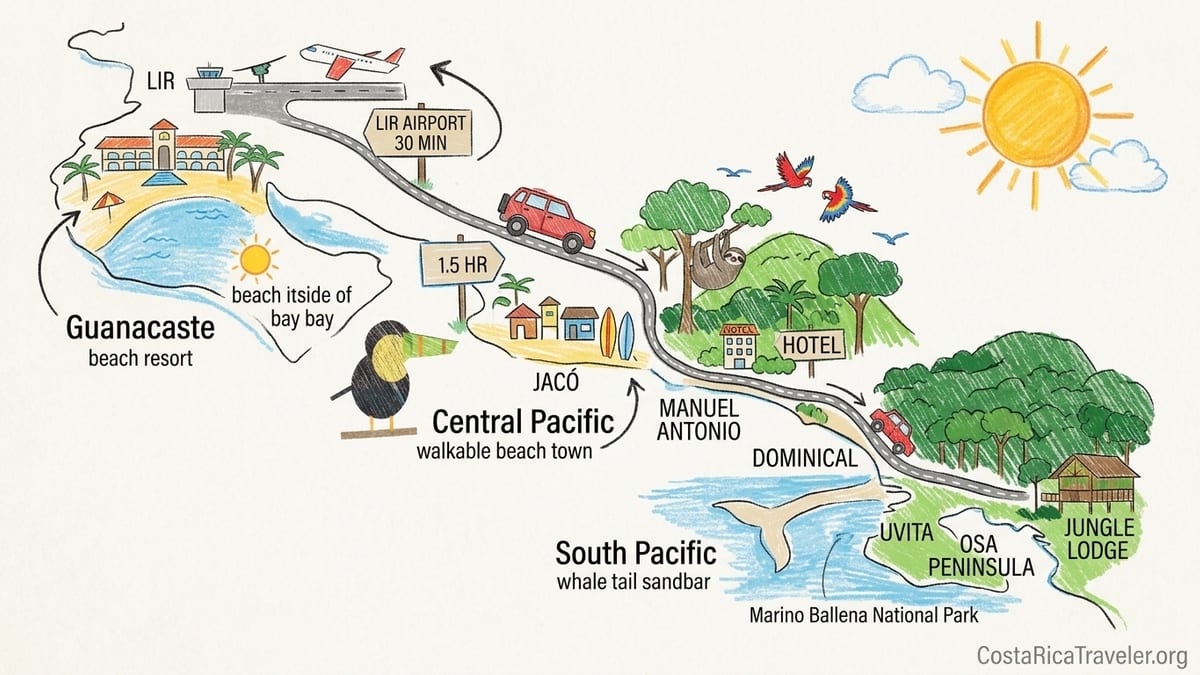
How I Actually Structured My Pacific Coast Trip
On this trip I used three bases along Costa Rica’s Pacific coast, all on the mainland: one in northern Guanacaste within about 30 minutes’ drive of Liberia airport, one on the Central Pacific roughly 1 hour 45 minutes from San José, and one in the South Pacific near Dominical. I stayed 5 nights in Guanacaste, 6 nights in the Central Pacific and 5 in the South, renting a compact SUV for the entire time. Instead of constantly changing hotels, I made day trips along each stretch and accepted that I would not “see it all.” What I gained was more time in the water, more meals at places I actually liked, and far less time repacking.
Driving distances shaped everything. From Liberia airport to Playas del Coco and nearby beaches it was about 25 to 35 minutes on paved roads, according to local driving guides and my own odometer. From San José to Jacó on Highway 27 and Route 34 took just under 2 hours on a clear weekday, which matches current tourism and government travel guidance that put the drive in the 1.5 to 2 hour range. From Jacó to Manuel Antonio took about another 1.5 hours, and continuing south to Dominical added roughly 1.5 hours more. That meant transfers between bases were half-day affairs once fuel, a supermarket stop and a lunch break were included.
I deliberately chose regional “stay types” rather than chasing specific hotels. In Guanacaste I stayed in a mid-sized resort near Playas del Coco instead of one of the mega-resorts on the Papagayo Peninsula but visited Papagayo for comparison. On the Central Pacific coast I split time between a walkable beach town setting near Jacó and a hillside boutique property near Manuel Antonio, where rainforest runs right down to the sea. In the South Pacific I chose a rainforest-and-beach base near Dominical with easy access to Marino Ballena National Park, then did a long day trip into the fringes of the Osa Peninsula to understand what staying at a remote lodge would actually involve in terms of transport and isolation.
Moving every few days turned out to be a bad idea anywhere traffic funnels onto the same coastal highway. Dominical to Jacó looks short on the map, but the combination of two-lane roads, trucks and rain meant that this 140 kilometer stretch easily took 3 hours in practice. Friends who rushed from Papagayo to Manuel Antonio or down to the Osa in just one week reported feeling like shuttle drivers rather than travelers. My conclusion after this trip is simple: along Costa Rica’s Pacific coast, two to three well-chosen bases are plenty for most itineraries up to two weeks long, and within each base it is better to upgrade location slightly than to “commute” daily to what you came to see.
Guanacaste’s Northern Beach Base: Resorts, Dry Heat and Easy Airports
Guanacaste’s northern Pacific coast, anchored by Liberia’s Daniel Oduber Quirós International Airport, is where Costa Rica leans hardest into the classic sun-and-sand beach holiday. The area known as the Gulf of Papagayo and neighboring beaches like Playas del Coco and Playa Hermosa combine short airport transfers with a mix of large all-inclusive resorts and smaller hotels and condos. Recent route guides from local operators confirm that Coco is roughly 25 minutes from the airport, Hermosa and most Papagayo resorts about 30 minutes, on fully paved roads. That short transfer is a major reason families and long-weekend travelers choose this region.
My strategy here was to accept that Guanacaste is more about reliable sunshine and swimmable bays than dense rainforest or wildlife variety, and to prioritize convenience. I based in a resort a short walk from the beach in the Coco area, with onsite parking and a supermarket and several restaurants within a 10 to 15 minute walk. Coco itself has a compact center lined with small grocery stores, pharmacies, casual seafood restaurants and tour desks. It felt very much like a beach town built around services for visitors and seasonal residents, with nightlife that runs to sports bars and sunset happy hours rather than clubs. Playas del Coco and nearby bays are also common starting points for boat dives, sport fishing and trips to famous surf breaks like Witch’s Rock and Ollie’s Point, which gives the town an active marina feel.
Paying a premium for absolute beachfront in this part of Guanacaste only felt essential when I wanted to minimize driving altogether. Because so many hillsides drop close to the bays, a “second row” or hilltop hotel can still offer wide ocean views, but then you are locked into either steep walks or a short drive to the sand. For travelers with mobility challenges or those with young children hauling beach gear, or anyone who plans to swim several times a day, the extra nightly rate for a ground-level beachfront room or condo makes sense. For others, a five-minute drive and free parking at public beach access points kept costs lower without really hurting the experience.
Where Guanacaste underwhelms some travelers is wildlife and rainforest feel. The climate here is markedly drier than further south and much of the immediate coastline near Coco and Papagayo is surrounded by scrubby tropical dry forest. Howler monkeys are common, iguanas sun themselves around hotel pools, and rays and turtles may appear on boat trips, but you will not wake up in dense jungle. To reach cloud forest or volcanic landscapes, day trips run to places like Rincón de la Vieja National Park, about 1.5 hours from the coast, where you can hike past fumaroles and waterfalls. That makes Guanacaste a very comfortable and low-friction base, particularly when proximity to Liberia airport matters, but not the best single base for travelers whose priority is lush rainforest and wildlife on the doorstep.
Nicoya-style Surf and Boutique Beach Towns
While my main northern base was near Coco and Papagayo, I also built in time to explore parts of the Nicoya Peninsula that have become shorthand for Costa Rica’s boutique surf and wellness scene. Towns such as Tamarindo and Nosara are on many travelers’ radar, and from Liberia airport current road information puts Tamarindo at around 1 hour 15 minutes by car and Nosara at roughly 2.5 hours, depending on the chosen route and seasonal road conditions. Paved highways cover most of the distance to Tamarindo, but moving between coastal towns on smaller roads still involves potholes, gravel stretches and occasional river crossings in the wetter months.
These Nicoya towns feel very different from the Papagayo resort belt. Tamarindo is a busy, walkable surf town with plenty of restaurants, cafes, surf schools and nightlife packed into a few blocks behind a long sandy bay. It is easy to spend a week here without a car, walking from a beachfront condo or hotel to surf lessons in the morning, lunch at a shaded soda or burger bar in the afternoon, and sunset drinks at one of the beach clubs. Supermarkets are concentrated in town, making self-catering apartments attractive, and the mix of budget hostels, mid-range hotels and a few higher-end boutique properties makes it a flexible base for groups of friends.
Nosara, by contrast, has more of a low-rise, wellness-forward atmosphere. Roads in the Playa Guiones area are unpaved, and people often rent bicycles or golf carts instead of full-size cars to get between their rental homes, yoga studios, organic cafes and the beach. The whole town is set slightly back from the shore behind a strip of protected forest, so true absolute beachfront stays are rare. Instead, you pay a premium to be within a flat five- to ten-minute walk of a beach path. This is a case where not being on the sand can actually improve the experience, as the preserved trees lend Nosara a cooler, wilder feel and keep wildlife like monkeys and tropical birds very present even in built-up areas.
If you are comparing Nicoya surf towns to other coast sections, the key trade-off is remoteness versus atmosphere. It takes meaningfully longer to reach these towns than Coco or Papagayo, and road conditions make frequent transfers along the peninsula impractical. Yet for travelers who want to plant themselves for 5 to 7 nights in one place with a predictable surf break, a cluster of independent eateries and boutique guesthouses, and a mostly car-free rhythm of life, Nicoya can be one of the most satisfying bases in the country. It works particularly well as a single-spot beach holiday combined with a separate inland stay around La Fortuna or Monteverde.
Central Pacific: Accessible Base for Beaches, Rainforest and Nightlife
The Central Pacific region, roughly between the port city of Puntarenas and the gateway town of Dominical, is one of Costa Rica’s most popular coastal corridors. It offers a blend of beach towns, rainforest-covered hills and protected areas within relatively easy reach of the capital. Tourism and regional planning documents describe Jacó as the country’s most accessible Pacific beach town, located about 1.5 to 2 hours from San José, with a full complement of restaurants, hotels, surf schools, banks and one of the liveliest nightlife strips on the coast. The town sits on a long curve of dark volcanic sand with consistent surf, but the surrounding hills remain green and largely undeveloped.
For this trip I treated the Central Pacific as my “do it all” base. I stayed first in a small hotel on the quieter southern end of Jacó, close enough to walk along the sand or side streets to the main strip in 15 to 20 minutes, but far enough from the densest cluster of bars and casinos to sleep without earplugs. Supermarkets were less than a 10 minute walk, surf schools lined the beachfront, and there were dozens of casual restaurants serving everything from ceviche to wood-fired pizza. Parking is straightforward at most hotels, and I felt comfortable leaving a rental car in gated lots while walking around in the evenings.
After Jacó I moved an hour south to a hillside boutique property near Manuel Antonio, outside the town of Quepos. Official tourism materials describe Manuel Antonio National Park as one of the country’s most visited parks, and that popularity shows in the density of hotels and restaurants lining the steep 7 kilometer road between Quepos and the park entrance. Staying on the hillside here meant trading walkability for rainforest immersion and elevated ocean views. I needed a short shuttle ride or a 20 to 30 minute walk down to the nearest beach, but woke to monkeys leaping through the canopy, scarlet macaws screeching overhead and sloths visible in trees right off the hotel deck.
In terms of logistics, the Central Pacific is where proximity to San José pays off most dramatically. A morning arrival at the capital’s airport can realistically have you on Jacó’s beach for a late lunch, even allowing for a supermarket stop in the town or in a highway-side plaza near Orotina. Similarly, travelers who end their trips in Jacó or Herradura can often leave for the airport on the same day as their flight, though it is wise to allow extra time on Sundays and holidays when city residents drive back en masse. That same centrality makes the area busy on weekends, and Jacó’s nightlife is no secret. For visitors who want a more low-key version of the same accessible coast, villages like Herradura and Esterillos, 20 to 40 minutes away, provide a quieter base with easy day-trip access to both Jacó and Manuel Antonio.
This is also the section of coast where paying for beachfront or near-beach lodging often made the biggest difference to my quality of stay. Central Pacific beaches can be very hot in the middle of the day, and surf conditions change with the tides. Being able to walk back to a pool or air-conditioned room in five minutes, then return to the water or to a beachfront restaurant as the light softened, encouraged more spontaneous swims and sunset walks. In busy parts of Jacó and near Manuel Antonio’s main public beach, not having to deal with parking close to the sand felt like a luxury in itself.
Rainforest-and-Beach Bases in the South Pacific
South of Quepos and Manuel Antonio, development thins and the coastline becomes noticeably greener. Towns like Dominical and Uvita sit where forested hills drop almost directly into the Pacific, with smaller communities and lodges tucked into the jungle-clad slopes behind them. Regional profiles describe Dominical as a small coastal town known for year-round surf, while Marino Ballena National Park, centered on the “whale tail” sandbar near Uvita, has become one of the country’s whale watching hubs, especially between roughly August and October and again around January to March, when humpback whales migrate through.
I chose a base near Dominical partly to break up the drive between the Central Pacific and the Osa Peninsula and partly to experience the rainforest-and-beach blend without going fully off-grid. From Jacó it took me about 3 hours to reach Dominical by car, driving on the well-surfaced coastal highway. The town itself is compact, with a single main street near the beach lined with small hotels, hostels, cafes and surf shops. A newer small supermarket on the edge of town made self-catering for breakfasts and picnic lunches easy, and most restaurants were within a 10 minute walk of where I stayed. Nightlife ran to low-key bars and live music a few nights a week rather than clubs.
Here, the decision about where to stay was less about beachfront versus second row and more about elevation. Properties right on or just off the beach offered easy access to the surf but sat in the full heat and humidity, with less breeze. Lodges and villas set on the hills behind Dominical often required a car and sometimes four-wheel drive to reach along steep concrete or gravel roads, but they caught the wind, felt cooler at night and came with sweeping views over forest and ocean. Wildlife was far more visible here than around Coco or even Jacó. In a single morning I could see toucans, parrots, monkeys and the occasional coati from a balcony overlooking the trees.
Day trips from a Dominical or Uvita base ranged from waterfall hikes inland to boat tours searching for dolphins and whales along the coast to visits to Marino Ballena National Park’s beaches. Road conditions improved dramatically in recent years with the completion of the coastal highway, making this stretch far more accessible than when it required detours inland. For travelers willing to handle 3 to 4 hour drives from San José or 4 to 5 hours from Liberia, these rainforest-and-beach bases deliver much of what people picture when they imagine Costa Rica: lush hills, relatively uncrowded beaches, and wildlife still very present around town.
Remote Southern Lodges and the Edge of the Osa Peninsula
The final “stay type” I considered on this trip was the remote southern lodge, particularly around the Osa Peninsula and access points to Corcovado National Park. Instead of basing fully on the peninsula, I opted for a long exploratory day trip south from Dominical toward the launch points used by travelers heading to Drake Bay and Carate. Guidebooks and official park information make it clear that reaching true wilderness lodges here involves either a domestic flight, a boat transfer, a long 4x4 road, or sometimes a combination of all three.
For lodges around Drake Bay on the northwest side of the Osa, most travelers either fly from San José to the small Drake Bay airstrip in about 40 minutes or take a bus or car to the town of Sierpe, then travel 1 to 1.5 hours by boat down the Río Sierpe and along the coast. Park authorities describe this as one of the main access routes for visitors to Corcovado. For lodges on the southern and eastern side near Carate and La Leona, people typically travel to Puerto Jiménez by bus, shuttle, flight or car, then continue by 4x4 taxi or a local “colectivo” truck that runs a couple of times per day along a rough road toward Carate, stopping at lodges on request. These journeys can each absorb the better part of a day.
From a logistics standpoint, that level of isolation means remote southern lodges work best when you can dedicate at least 3 or 4 nights to the experience. With anything less, you spend too much time in transit compared to the time you actually spend walking rainforest trails, watching scarlet macaws feeding in almond trees or listening to howler monkeys before dawn. Because many lodges include meals and guided activities in their nightly rates, they also change the financial rhythm of a trip. You might spend much more per night than in a Dominical guesthouse, but you will not be paying separately for restaurants, national park guides and boat tours, because they are bundled into packages.
Where my exploratory day was helpful was in confirming that full jungle isolation has real trade-offs. Internet connections were weaker or non-existent, phone coverage patchy, and choices for restaurants or supermarkets essentially disappeared once I left the larger towns. Travelers with strict dietary needs, very young children or medical conditions that require easy access to pharmacies should factor that into their plans. On the other hand, for wildlife-focused travelers, birders and photographers, a remote Osa lodge is arguably the most rewarding single base on Costa Rica’s Pacific coast, with multi-day access to some of the most biodiverse lowland rainforest left in Central America.
Personally, I decided that on my next trip I would either commit fully and spend 4 or 5 nights at one of these lodges after a few nights in the Central Pacific, or skip the Osa entirely in favor of more time in the Dominical and Uvita area. What did not make sense, given current transport realities, was the idea of popping in and out of the Osa between other coastal bases for just a night or two.
When Beachfront, Jungle Immersion and Airport Proximity Really Matter
Across these sections of coast, certain patterns emerged about when it was worth paying extra for location and when it was smarter to save and accept a short drive. In highly built-up areas such as central Jacó or the busiest parts of Tamarindo, beachfront and immediate back-row properties command a premium because they eliminate parking hassles and put you within a few minutes’ walk of both the surf and the town’s main restaurants and bars. When I stayed a few blocks inland in these towns on previous trips, I noticed I went to the beach less often, simply because I had to lock up the car and cross hotter pavement for every swim.
In quieter or more spacious areas, such as stretches of the Papagayo coastline or around Dominical, being a short drive from the beach did not hurt my experience and sometimes improved it. A hillside villa overlooking the Gulf of Papagayo with on-site parking and a 10 minute drive to a beach access combined better breezes with lower rates than equivalent rooms right on the sand. Similarly, in the South Pacific, a lodge up a short but steep concrete road above Dominical offered more wildlife sightings and cooler nights than anything at sea level.
Jungle immersion is where Central and South Pacific stays consistently outran Guanacaste. Around Manuel Antonio, Dominical and even quieter villages like Esterillos, it was normal to see monkeys, sloths and a wide range of birds from hotel balconies and restaurant terraces. In Guanacaste, wildlife was more often something you drove to on excursions. Yet full jungle isolation, as I observed near the Osa, only suited me when I was intentionally unplugging from work and city life. For trips where I wanted to mix beach time with some remote work, or where constant connectivity mattered, I found the semi-immersed hillside hotels of Manuel Antonio and Dominical a better compromise than the most remote lodges.
Airport convenience played a surprisingly large role in shaping realistic itineraries. Flying into Liberia clearly favors Guanacaste beach bases such as Coco, Hermosa, Flamingo and Papagayo, with travel times often under an hour. Attempting to land in San José and drive directly to these northern beaches adds 4 to 5 hours on busy highways before you even see the ocean. By contrast, itineraries that focus on Manuel Antonio, Jacó, Dominical or the Osa almost always work better through San José’s airport. Direct shuttles, domestic flights and bus services fan out from the capital, and the main coastal highway south has been upgraded to the point where most of the Central and South Pacific is reachable within half a day’s travel.
The Takeaway: How Many Bases for 7, 10 and 14 Days
After using three different coastal bases and testing transfer days between them, my strongest recommendation is to under-schedule your moves. Costa Rica’s Pacific coast looks compact on the map, but between surface roads, weather and traffic, even apparently modest drives stretch. With that in mind, here is how I would structure coast-focused trips in the future.
For a 7 day Pacific coast trip, I would choose a single base and possibly pair it with a night near your arrival or departure airport if flight times demand it. Flying into Liberia, that might mean a full week in a Papagayo-area resort or a Nicoya surf town like Tamarindo or Nosara, with car-based day trips to neighboring beaches and perhaps one inland excursion. Flying into San José, I would opt for either the Central Pacific around Jacó and Manuel Antonio or the South Pacific around Dominical and Uvita, not both. Seven nights in one of those regions lets you settle into a rhythm: alternate beach days and activities, return to favorite restaurants, and avoid repacking.
For a 10 day trip, two bases start to make sense. One strong pattern is to combine 4 or 5 nights in the Central Pacific with 5 or 6 nights in the South Pacific, using a rental car or shuttle to link them along the coast. That gives you one base with greater walkability, more nightlife and easier access to supermarkets, and another that tilts toward quieter beaches and denser rainforest. Another option is to mix a week on a Guanacaste beach with 3 nights inland near a volcano or cloud forest rather than trying to cover Guanacaste plus Manuel Antonio plus the South in a single circuit.
For a 14 day trip that is truly focused on the Pacific coast, two or at most three bases are plenty. One logical triangle is Guanacaste near Liberia for 4 or 5 nights, Central Pacific near Manuel Antonio for another 4 or 5, and then the South Pacific or even a remote Osa lodge for the final 4 or 5 nights. In that scenario, I would arrange flights into Liberia and out of San José or vice versa, to avoid backtracking six or seven hours up the same roads, and I would protect at least two full uninterrupted days in each base between travel days. The goal is not to collect town names but to actually inhabit each stretch of coast long enough that you learn where to find your morning coffee, recognize the pattern of afternoon rain, and remember which trees the local sloths favor.
Costa Rica’s Pacific coast rewards this kind of slower, base-focused strategy. Whether you choose a northern resort bay, a Nicoya surf town, an accessible Central Pacific beach, a rainforest-and-beach village further south or a true off-grid lodge, thinking in terms of two or three carefully chosen bases will almost always deliver a richer, less rushed trip than trying to sprint the whole coastline in a single week.
FAQ
Q1. Is it better to fly into Liberia or San José for a Pacific coast trip?
For Guanacaste beach bases such as Papagayo, Playas del Coco, Playa Hermosa, Flamingo or Tamarindo, Liberia almost always makes more sense because most of these towns are within about an hour’s drive on paved roads. For Central and South Pacific destinations like Jacó, Manuel Antonio, Dominical, Uvita or the Osa Peninsula, San José works better thanks to shorter coastal drives and more frequent shuttles and domestic flights.
Q2. Do I really need a car on Costa Rica’s Pacific coast?
You can manage without a car if you stay in compact, walkable beach towns like Jacó, Tamarindo, parts of Manuel Antonio, or certain areas of Nosara, and rely on shuttles and local taxis for transfers and excursions. A rental car, preferably with some clearance, is very helpful if you want to explore smaller beaches around Dominical and Uvita, stay on hilltops, or visit more than one region in a single trip.
Q3. How many different towns should I stay in for a one-week visit?
For a 7 day trip, staying in one main Pacific coast base works best, possibly with an extra airport hotel night if flight times require it. Trying to sleep in three or more different towns in a week usually means too much time packing, checking in and driving, and not enough time actually on the beach or in the rainforest.
Q4. Which area has the best nightlife on the Pacific coast?
Jacó is widely considered the liveliest beach town on the Pacific coast, with a concentration of bars, restaurants and clubs along its main strip. Tamarindo in Guanacaste also has a fairly active bar scene, while most other Pacific towns, including Dominical and Uvita, have more low-key nightlife focused on a few bars, live music venues and sunset restaurants.
Q5. Where is the best place to see wildlife without going fully off-grid?
For strong wildlife sightings combined with reasonable comfort and access to services, the hillsides around Manuel Antonio and the rainforest-and-beach corridor near Dominical and Uvita are excellent choices. Monkeys, sloths, toucans and scarlet macaws are regularly visible from hotels and restaurants, and national parks and reserves are within short drives.
Q6. Are remote Osa Peninsula lodges worth the extra travel?
Remote lodges around the Osa Peninsula offer some of the most immersive rainforest experiences in Costa Rica and are especially rewarding for wildlife lovers and hikers. They involve longer transfers by small plane, boat or 4x4 and usually work best when you can stay 3 or 4 nights, since travel in and out can each take the better part of a day.
Q7. Is paying for a beachfront room really necessary?
Paying for beachfront or near-beach lodging matters most in developed towns where parking near the sand is difficult and heat makes mid-day walks uncomfortable, such as central Jacó or busy parts of Tamarindo and Manuel Antonio. In quieter areas with easy parking, like some Papagayo bays or the Dominical area, staying a short drive or uphill walk from the beach can save money and sometimes offer better views and breezes.
Q8. What is driving like between the Central and South Pacific coasts?
The main coastal highway between Jacó, Manuel Antonio and Dominical is paved and in good condition, but it is mostly two lanes and shared with trucks and local traffic. Driving from Jacó to Dominical takes around 3 hours in typical conditions, and it is wise to avoid starting long drives late in the afternoon during the rainy season, when heavy showers can reduce visibility.
Q9. Is Guanacaste too dry compared to the Central and South Pacific?
Guanacaste has a drier tropical climate, especially in the heart of the dry season from around December to April, so the hillsides near Coco or Papagayo often look browner than the lush forests further south. If lush rainforest and wildlife around your hotel are essential priorities, you may prefer the Central or South Pacific, but if your focus is sunshine, easy swimming beaches and short airport transfers, Guanacaste is very appealing.
Q10. How far in advance should I book coastal hotels in Costa Rica?
For peak travel periods such as late December to March and around Easter, it is wise to book popular Pacific coast areas several months in advance, especially if you want specific stay types such as beachfront condos, hillside boutique hotels or remote Osa lodges. In shoulder seasons and the green season, you can often find good options closer to your dates, but the smallest boutique properties and most convenient beachfront rooms still tend to fill first.