


Costa Rica’s Central Valley is far more than a gateway on the way to beaches and jungles. Stretching across San José, Alajuela, Heredia and Cartago, and spilling into the highland valleys of Turrialba, Orosi and Los Santos, this elevated basin combines museums and markets with active volcanoes, cloud forest, coffee plantations and colonial towns. For first-time visitors who fly into San José’s Juan Santamaría International Airport (SJO), the Central Valley can deliver an astonishing amount of Costa Rica in just a few days, if you know where to go and when to stay overnight rather than day-tripping.
Understanding Costa Rica’s Central Valley
The Central Valley is a broad plateau cupped between volcanic ranges in the middle of Costa Rica, home to most of the country’s population and its main urban centers: San José, Alajuela, Heredia and Cartago. The official tourism board highlights this region as the country’s cultural and political heart, where visitors can tour national museums in the morning and reach active volcano craters or coffee farms in less than two hours. Elevations typically sit between 900 and 1,600 meters, which keeps temperatures pleasantly spring-like for much of the year, cooler than the coasts and with misty afternoons common in the rainy season.
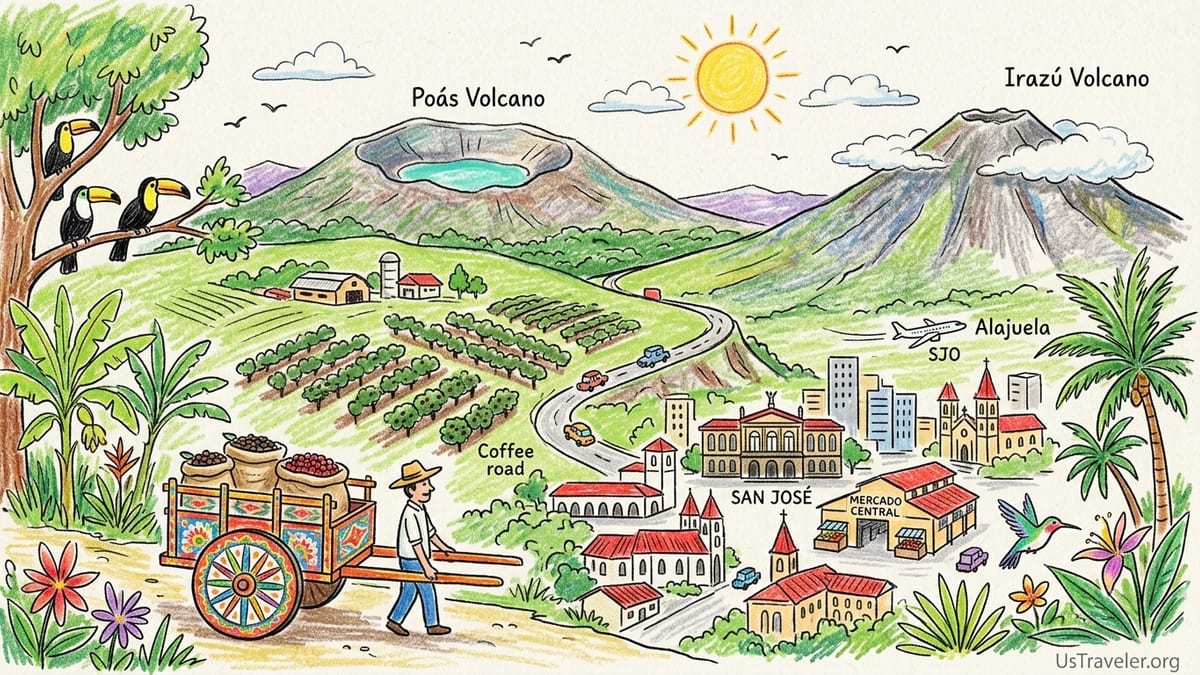
For trip planning, it helps to think of the Central Valley as a hub-and-spoke system. San José and nearby Alajuela, Heredia and Cartago act as bases around the basin, while satellite destinations like Poás and Irazú volcanoes, the coffee highlands, cloud forests such as Braulio Carrillo and the agricultural valleys of Orosi, Turrialba and Los Santos sit on the surrounding ridges. Many of these places work well as full-day trips from the city, but some reward at least one night, especially if you want quiet mornings for birdwatching or clear volcano views before clouds build.
Distances are short but travel times can be deceptive. A drive that looks like 35 kilometers on a map can easily take 75 to 90 minutes thanks to traffic leaving San José or winding mountain roads. As a rule of thumb, assume at least one hour each way to major volcanoes like Poás and Irazú, and closer to two hours to reach valleys like Orosi or Turrialba by car. Public buses are inexpensive but slower and less direct; first-time visitors who want to maximize limited days often combine a couple of local experiences by booking organized day tours from San José or hiring a private driver.
Because the Central Valley is the country’s air gateway, most international travelers pass through, even if only in transit. Rather than racing straight to the beaches after landing, consider spending one to three nights in or around the valley at the start or end of your trip. That window is enough time to see flagship museums, visit at least one volcano, tour a working coffee farm and dip into rural life in a nearby valley, which together provide a strong introduction to Costa Rican history and landscapes.
San José: Museums, Markets and Urban Energy
San José, the national capital, often divides opinion. It is not a showpiece colonial city, but it does house some of Central America’s most impressive museums and a concentration of restaurants, bars and cultural venues that you will not find in smaller towns. For many first-time visitors, one or two nights are enough to get oriented, recover from the flight and see a curated slice of city life. Staying in central neighborhoods such as Barrio Amón or Barrio Escalante places you within a short taxi ride of the main sights and the busy central market.
Three institutions stand out for museum-goers. The Pre-Columbian Gold Museum below the Plaza de la Cultura holds an extensive collection of indigenous goldwork, including tiny animal figurines and ceremonial pieces that help explain how Costa Rica fit into wider trade networks before the Spanish arrived. The nearby Jade Museum showcases what is considered the largest pre-Columbian jade collection in the Americas, housed in a modern building with clear, bilingual exhibits. Just a few blocks away, the late 19th-century National Theater offers guided tours that walk visitors through its European-inspired interior; even if you do not stay for a performance, seeing the ornate foyer and painted ceiling is worthwhile.
Daily life unfolds at street level around the Mercado Central, a covered maze of produce stalls, coffee vendors and simple counters serving casados, the classic plate of rice, beans, salad, plantains and a choice of meat or fish. A casual lunch here typically costs the equivalent of a few US dollars, and the bustle of commuters, schoolkids and office workers offers a more grounded impression of the city than any viewpoint. In the evening, many locals and visitors drift to Barrio Escalante, where a cluster of gastropubs, small-plate restaurants and craft beer bars line a handful of streets. Expect prices comparable to a mid-range US city, with mains ranging from budget-friendly local dishes to contemporary Latin fusion.
On logistics, San José works well as an early base if you want quick access to organized day tours. Many operators pick up at central hotels around 6:30 or 7:00 in the morning before heading out to Poás, Irazú, nearby waterfalls or coffee estates, returning to the city by late afternoon. If you prefer to travel independently, taxis and rideshares connect San José with neighboring Alajuela and Heredia in under an hour outside rush periods, and the city’s bus terminals offer frequent services to Cartago, the Orosi Valley and Turrialba.
Alajuela and Poás: Volcano Views and Coffee Country
Alajuela, just northwest of San José, is both a city and a province that includes Juan Santamaría International Airport (SJO) and the highland slopes leading up to Poás Volcano. Many visitors choose to stay near Alajuela rather than in downtown San José on arrival or departure nights because airport hotels can be as close as a five to ten minute shuttle ride from the terminal. Simple business-style properties cluster near the airport road, while a short drive up into the hills reveals small lodges and guesthouses looking over the valley, popular with travelers who want cooler air and quiet views but still need easy access to flights.
Poás Volcano National Park is one of Costa Rica’s most accessible active volcanoes. Reaching the main crater involves a paved walk of roughly ten minutes from the parking area, making it feasible even for travelers with modest mobility. Visitor numbers are controlled through timed entries, and recent practice has been to limit crater viewing to short windows, so advance online reservations are strongly recommended. Many travelers aim for early-morning slots between 8:00 and 10:00, when the odds of seeing the turquoise crater lake before clouds roll in are highest, although conditions can change quickly in any season.
Surrounding the volcano are fertile highlands planted with coffee, strawberries and dairy farms. Working coffee estates near Alajuela offer half-day tours that walk you through shaded rows of coffee bushes, small processing plants and roasting facilities, usually ending with a tasting session. Prices vary by operator, but first-time visitors can expect to pay a moderate per-person fee that often includes transport from central hotels. Combining a morning at Poás with an afternoon coffee tour is a classic Central Valley day trip, and some itineraries add in a waterfall garden park with wildlife enclosures on the same route for a full 10- to 12-hour outing.
As a base, Alajuela city feels more small-town than San José, with a central park and cathedral that draw local families on weekend evenings. For travelers, its main advantages are convenience and proximity to Poás and the coffee zone. If your priorities are volcanoes, rural scenery and a stress-free airport transfer, consider spending your first or final night here, then using a taxi, shuttle or rental car to connect onward to the coasts or cloud forests.
Heredia and Braulio Carrillo: Cloud Forest on the City’s Doorstep
North of San José, Heredia is a smaller city with a strong university presence and a more relaxed pace than the capital. Its historic core wraps around a leafy central park and church, and residential areas extend into coffee-covered hills where you will find homestays, boutique lodges and family-run restaurants. Travelers often use Heredia as a quieter base while still staying within easy reach of San José’s bus terminals and museums, especially if they are interested in Spanish schools, coffee tours or nearby nature reserves.
The main natural draw in this direction is Braulio Carrillo National Park, one of the country’s largest protected areas, rising from lowland rainforest to mossy, cloud-draped ridges. While much of the park is roadless and best left to experienced hikers, several outfits operate aerial trams and guided walks along its fringes. A typical day starts with a morning pickup in the Central Valley, a drive of roughly an hour to the park’s edge, followed by a combination of canopy tram rides and short interpretive trails. It is a gentler introduction to cloud forest than more distant destinations like Monteverde and works well for travelers with limited time or mobility.
In the hills above Heredia, secondary roads lead to smaller private reserves and viewpoints that overlook the entire Central Valley at night, a constellation of lights backed by black volcanic silhouettes. Many locals head to simple mountain restaurants for weekend lunches of trout, tortillas and fresh cheese; visitors are welcome as long as they are prepared for cool, damp conditions and occasionally rough road surfaces. This is one corner of the Central Valley where having your own vehicle or hiring a driver is more practical than relying solely on public buses.
For first-time visitors who want a more lived-in feel than touristy beach towns, a few nights in or around Heredia can be rewarding. You can alternate museum days in San José with cloud forest, coffee country and evenings in small local bars, without having to change hotels between each experience.
Cartago, Irazú and Turrialba: Highlands, Ruins and Rural Valleys
Cartago, east of San José, was Costa Rica’s colonial capital and remains an important religious center. Its focal point is the Basilica of Our Lady of the Angels, a large church and pilgrimage site whose interior mixes European and local influences. Nearby lie the partially restored ruins of an older parish church in the central park, as well as quieter streets with traditional homes and bakeries. A day in Cartago pairs easily with excursions to the surrounding highlands, which contain some of Costa Rica’s most dramatic volcanic landscapes and rural valleys.
Irazú Volcano, rising above Cartago to over 3,400 meters, is the country’s highest active volcano accessible by road. The main crater viewpoints sit above the treeline, so on rare clear days you can see both the Caribbean and Pacific coasts from the upper parking area. More often, clouds sweep in by late morning and temperatures drop close to single digits Celsius, so warm layers and early starts are essential. The drive from San José takes roughly 90 minutes in light traffic; organized tours usually combine Irazú with stops at Cartago’s basilica and either hot springs or viewpoints in the Orosi Valley on the return.
Further east, the Turrialba Valley offers a softer, greener landscape of dairy farms, sugarcane fields and rainforest-fringed hills. The Turrialba Volcano itself has gone through periods of increased activity in recent years, which can affect access to its national park; at times, hiking to the crater is restricted or closed altogether, so conditions should be checked locally before planning a visit. Even when crater access is limited, the broader region caters to whitewater rafting on the Pacuare River, visits to the Guayabo National Monument with its pre-Columbian stone structures and aqueducts, and homestays on farms or small eco-lodges. Reaching Turrialba town from San José typically takes about two to two and a half hours by car or bus, which makes an overnight stay more comfortable than a rushed day trip if you want to see more than a single site.
For first-time visitors short on time, a classic Central Valley route is a full-day circuit combining Irazú, Cartago and a loop through the Orosi Valley before returning to San José in the evening. Travelers with extra days might instead base themselves in or near Turrialba for rafting and Guayabo, using local guides and shuttle services to avoid driving mountain roads after dark. Spending at least one night in this region also lets you experience quiet evenings in small-town Costa Rica, which contrasts sharply with the energy of San José or the resort feel of coastal hubs.
Orosi and Los Santos: Lakes, Hot Springs and Quetzal Country
South of Cartago, the Orosi Valley is a deep, green bowl carved by the Reventazón River, dotted with coffee farms, forest patches and a reservoir lake. The small town of Orosi itself has one of the country’s oldest functioning colonial churches open to visitors, and a modest but atmospheric square. Nearby, simple hot spring complexes line the riverbanks, offering warm pools fed by mineral-rich waters. These springs tend to be casual and family-oriented rather than spa-like; admission is generally affordable, and facilities range from rustic concrete pools to slightly more developed bathing areas with changing rooms and snack bars.
Driving the Orosi loop road gives visitors an easy taste of rural life and scenic viewpoints without requiring serious hiking. The route circles the reservoir, passing coffee and sugarcane fields, small villages and roadside sodas where you can stop for gallo pinto or fresh fruit juices. Many organized tours include a visit to Lankester Botanical Garden, a research garden known for its orchids, on the way between Cartago and Orosi, making the day a diverse mix of volcano views, botany, hot springs and colonial architecture compressed into less than 100 kilometers.
Further south along the Inter-American Highway, the highland region collectively called Los Santos occupies a cooler, cloud-shrouded plateau famous for high-quality coffee and birdlife. Towns such as San Gerardo de Dota sit in steep side valleys, where lodges cater to visitors hoping to spot the resplendent quetzal among the oaks and aguacatillo trees. Mornings here can be crisp, with mist rising off the Savegre River and temperatures dropping to around 10 degrees Celsius; accommodations typically provide thick blankets and sometimes wood stoves rather than air conditioning.
Los Santos deserves at least one overnight, ideally two, if you are serious about birdwatching or hiking. While it is technically possible to drive from San José, take a morning birding walk and return the same day, the winding mountain highway and frequent fog make night driving unappealing for unfamiliar visitors. Most first-timers either rent a car and stay in a valley lodge that includes guided walks in their rates, or arrange private transfers from San José or Cartago. Compared to beach resorts, lodging here is more about nature immersion than luxury; rooms range from simple cabins to comfortable eco-lodges with good local cuisine and extensive trail networks.
Waterfalls, Cloud Forests and Other Central Valley Naturalscapes
Beyond the headline volcanoes, the Central Valley hides a surprising density of waterfalls, forest reserves and river canyons. Several private reserves, particularly in the hills north of Alajuela and Heredia, have built trail systems and viewing platforms around multi-tiered falls, combining short hikes with wildlife exhibits. These venues typically sell day passes and can be reached on combined tours that include Poás Volcano or coffee estates. Entry prices are higher than public national parks but often include maintained paths, safety railings and on-site restaurants.
Cloud forest experiences within the Central Valley tend to be gentler and less developed than Monteverde but far closer in travel time. Braulio Carrillo, the Los Santos highlands and smaller private reserves above Heredia and Cartago offer moss-draped trees, abundant epiphytes and regular bird sightings, including hummingbirds and tanagers. Trails range from flat, paved circuits suitable for families to steeper, muddier routes that require waterproof footwear. Conditions can change quickly, so visitors should pack light rain jackets even in the so-called dry season from December to April.
Water-based adventures center on the rivers cutting out of the valley. The Pacuare, accessed from the Turrialba area, is widely regarded as one of Central America’s most scenic whitewater runs, with canyon walls draped in jungle and class III to IV rapids. Most first-time visitors book full-day rafting trips that include transport from San José, breakfast, a run down the river and a late return to the city, or they opt for overnight packages with a night at a riverside lodge reachable only by raft. Closer to San José, gentler rafting and tubing options exist on smaller rivers, usually marketed toward families and beginners.
For travelers who prefer self-guided sightseeing, simply driving the secondary roads that lace the Central Valley can feel like an attraction in itself. Viewpoints along the ring roads above San José and Heredia reveal patchwork farmland, church spires and the silhouettes of Poás, Irazú and Turrialba on a clear day. Small roadside stands sell seasonal fruit like strawberries and blackberries, while basic mirador cafés offer coffee and pastries with sweeping panoramas. It is in these unplanned stops that many visitors feel they encounter the everyday Central Valley rather than its curated tourist sites.
SJO Airport, Transport and Practical Trip Planning
Most international visitors arrive at Juan Santamaría International Airport, commonly called SJO, located near Alajuela about 20 kilometers from central San José. Official airport taxis queue directly outside the terminal and operate on fixed or metered fares, with typical rides to central San José taking 30 to 45 minutes in light traffic, longer during rush hours. Several major car rental brands maintain offices just beyond the airport perimeter, usually reached by complimentary shuttle; it is common for staff to walk renters around vehicles to photograph existing scratches given the region’s narrow roads and frequent rain.
Budget-conscious travelers can use local buses that stop on the main road outside the airport to reach San José or Alajuela, paying the equivalent of a couple of US dollars or less, but this option involves crossing busy roads, handling luggage and potentially standing in crowded vehicles. Rideshare services operate in the Central Valley and are widely used by locals, though pickups at the terminal may require meeting drivers at designated spots outside the main arrivals area. For late-night arrivals or travelers with large baggage, pre-booked private transfers or airport taxis are generally the easiest and safest options.
Within the Central Valley, public buses link all the major cities and many of the smaller valleys at low cost, but schedules can be sparse in the early morning or evening. To visit Poás or Irazú independently in a single day without rushing, having your own vehicle or joining a tour is often more practical. Driving is on the right-hand side of the road; main highways between the cities are paved and straightforward, while rural spurs toward volcanoes or Los Santos can be steep and foggy. First-time visitors should avoid driving unfamiliar mountain routes after dark, especially in the rainy season when landslides and reduced visibility are more common.
In terms of how long to stay, allocating two to four nights in the Central Valley works well for most first-time trips of 10 to 14 days. One sample plan might include two nights in San José or Alajuela for museums and a Poás or Irazú day trip, followed by one or two nights in Orosi, Turrialba or Los Santos for rural scenery and slower-paced exploration. From there, travelers can continue to the Pacific or Caribbean coasts, already having a solid grounding in Costa Rican history, agriculture and highland ecosystems.
The Takeaway
For many travelers, Costa Rica’s Central Valley is an afterthought, a place glimpsed through an airplane window before heading to well-known beaches or rainforests. Yet the region that encompasses San José, Alajuela, Heredia, Cartago and the surrounding highland valleys distills much of what makes the country distinctive: volcanic peaks, fertile coffee lands, living indigenous and colonial history, and a culture that bridges urban and rural life. With careful planning, a few days here at the start or end of a trip can feel less like a transit stop and more like a concentrated introduction to the country.
Look beyond San José’s traffic to its world-class museums and markets, treat Poás and Irazú as accessible ways to stand on the rim of active volcanoes, and give yourself time to breathe in the quieter air of Orosi, Turrialba or Los Santos. Deciding which experiences should be day trips and which deserve an overnight stay will depend on your pace, but as a rule, volcano craters and nearby cities work well as long days while rural valleys and cloud forest hamlets are better appreciated over unhurried mornings and cool, misty evenings. Approach the Central Valley not just as Costa Rica’s transport hub, but as a destination in its own right, and you will leave with a richer, more layered sense of the country as a whole.
FAQ
Q1. Is San José worth visiting for first-time travelers, or should I skip straight to the beaches?
San José is worth at least one full day for first-time visitors who are interested in culture and history. The city’s Gold and Jade museums, National Theater and central market provide a compact introduction to Costa Rican art, archaeology and daily life. If your time is very limited and you prefer nature to cities, you might shorten your stay, but skipping the capital entirely means missing the easiest access to these museums and many organized day trips.
Q2. How many days should I spend in the Central Valley on a typical Costa Rica itinerary?
On a 10- to 14-day trip, two to four nights in the Central Valley is a good starting point. This allows for one or two nights in San José or Alajuela for museums and a Poás or Irazú day trip, plus one or two nights in a rural valley such as Orosi, Turrialba or Los Santos. Travelers on shorter trips of a week or less often choose two nights, combining a city stay with a single volcano or coffee country excursion.
Q3. Can I visit Poás or Irazú volcano as a day trip without renting a car?
Yes, both Poás and Irazú are popular day trips from San José and Alajuela using organized tours, which include transport and guided visits. Public buses also run toward both volcanoes, but schedules can be limiting for same-day returns and require early starts. For most first-time visitors who are not driving, joining a reputable tour is the simplest way to see either crater and combine it with nearby attractions like coffee farms, botanical gardens or Cartago’s basilica.
Q4. Is the Central Valley a good place to see wildlife, or should I focus on the coasts?
The Central Valley is more about landscapes, culture and agriculture than concentrated wildlife, but you can still see a variety of birds, butterflies and small mammals, especially in cloud forest reserves like Braulio Carrillo and the Los Santos highlands. For dense rainforest wildlife such as monkeys, sloths and toucans, coastal and lowland regions like the Pacific, Caribbean or northern plains are stronger bets. Many travelers use the Central Valley to experience volcanoes, coffee and cultural sites, then head to other regions for more intensive wildlife viewing.
Q5. Where is the best base near the airport: San José or Alajuela?
If your priority is quick access to flights and Poás Volcano or nearby coffee farms, Alajuela is generally the more convenient base, with hotels just minutes from SJO and in the surrounding hills. If you want to visit museums, theaters and a broader range of restaurants, staying in central San José makes more sense, accepting a slightly longer transfer from the airport. Some itineraries use Alajuela on arrival night and San José later in the trip to balance convenience and culture.
Q6. Do I need to book volcano and museum tickets in advance?
For Poás Volcano National Park, advance reservations are strongly recommended because visitor numbers are capped and entry is managed in timed slots. Irazú can be more flexible, but purchasing tickets ahead of time where available can still save delays at the gate, especially on weekends and holidays. Major museums in San José, such as the Gold and Jade museums, usually allow walk-in visits, though checking opening hours and any temporary exhibition closures before you go is wise.
Q7. Is driving in the Central Valley difficult for foreign visitors?
Driving between main cities on highways is straightforward, but traffic congestion, aggressive lane changes and limited signage can feel stressful for those unused to Latin American urban driving. Mountain roads to volcanoes, Orosi and Los Santos are paved but winding, with sharp curves, fog and occasional landslides in the rainy season. Confident drivers who avoid nighttime mountain driving tend to manage well; others may prefer to rely on transfers and day tours for longer or more challenging segments.
Q8. What is the best time of year to visit the Central Valley for volcano and valley views?
The drier months from roughly December to April generally offer the clearest mornings on volcano summits and less rain for valley drives, though afternoon clouds are still common. During the wetter months, landscapes are lush and crowds thinner, but visibility at high elevations can be unpredictable, and showers may be heavier. Regardless of season, aiming for early-morning visits to Poás, Irazú and highland viewpoints gives you the best chance of clear views before cloud cover increases.
Q9. Are Orosi, Turrialba and Los Santos suitable for children and less active travelers?
Yes, these valleys can be enjoyed at a gentle pace. Orosi offers short walks, hot springs and scenic drives without demanding hikes. Turrialba has farm visits and archaeological sites like Guayabo in addition to more adventurous rafting, and many operators offer family-friendly river trips. Los Santos involves hillier terrain, but lodges often provide graded trails and birdwatching from terraces or nearby roads, making it easy to tailor activities to different energy levels and abilities.
Q10. Is it safe to stay in Central Valley cities and travel by bus or taxi?
Central Valley cities such as San José, Alajuela, Heredia and Cartago are broadly safe for visitors who take common-sense precautions: keeping valuables secure, using registered taxis or reputable rideshares, and avoiding poorly lit areas late at night. Intercity buses are widely used by locals and are generally safe during the day, though pickpocketing can occur on crowded routes, so it is wise to keep bags on your lap and avoid displaying expensive electronics. As in any urban area, staying aware of your surroundings and asking hotel staff for local advice goes a long way toward a smooth visit.