


Few trip-planning questions cause more second-guessing in Costa Rica than this one: should you head to the Pacific coast or the Caribbean coast? Both sides offer palm-fringed beaches, wildlife and warm water, but the feel of your trip changes dramatically depending on which you choose. This guide compares Costa Rica’s Pacific hotspots such as Guanacaste, the Nicoya Peninsula and Manuel Antonio with the Caribbean standouts of Tortuguero, Cahuita, Puerto Viejo, Cocles and Punta Uva, so you can match the right coast to your travel style and season.
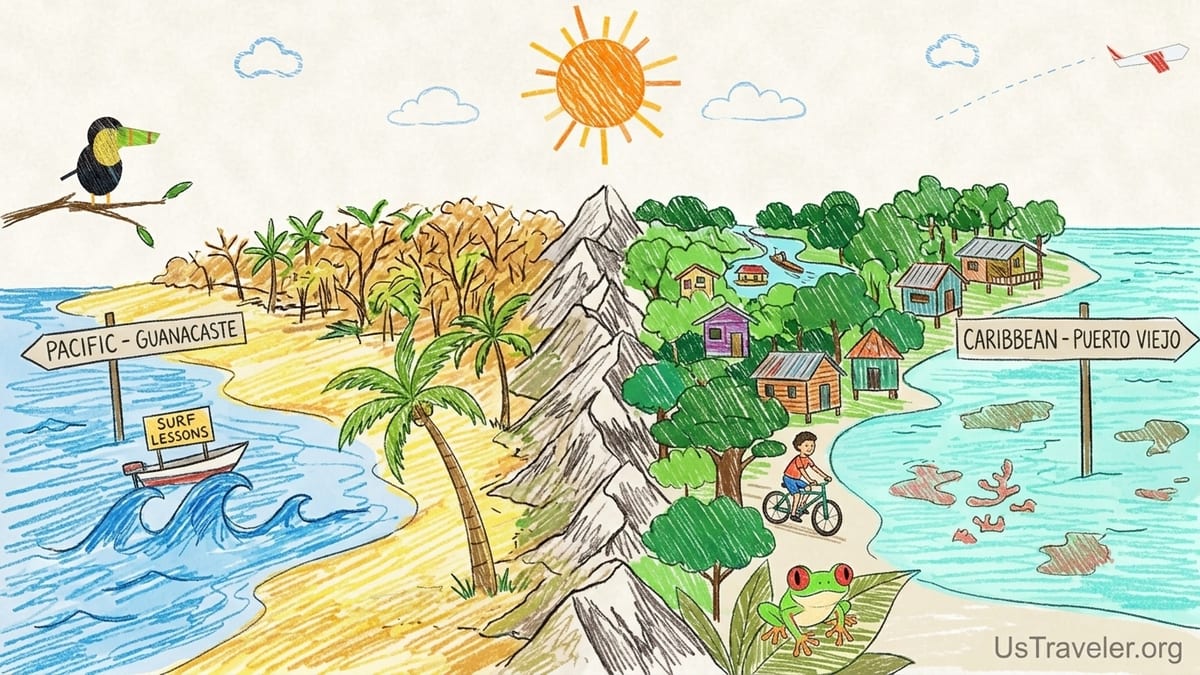
Geography and Travel Time: How the Two Coasts Fit Into a Trip
Costa Rica’s mountain spine cleanly splits the country into two very different coasts. The Pacific side wraps from the dry plains of Guanacaste and the Nicoya Peninsula in the northwest down through the rainforested Central Pacific around Manuel Antonio and on toward the wild southern Pacific. The Caribbean side runs from the remote canals of Tortuguero in the north to the laid-back beach towns of Cahuita, Puerto Viejo, Cocles and Punta Uva near the Panama border in the south.
From a logistics standpoint, the Pacific is easier to integrate into classic itineraries. Many travelers fly into Liberia for quick access to Guanacaste and Nicoya, or into San José and then continue four to five hours by paved highway to Manuel Antonio. Public buses and shared shuttles run these routes daily, and private transfers are common. For example, a private shuttle from San José to Manuel Antonio typically takes about 3 to 3.5 hours in light traffic, while a shared shuttle often quotes around 4 to 5 hours because of hotel stops.
The Caribbean coast feels more remote. Tortuguero is famously boat-in or fly-in only; most visitors reach it by a combined shuttle and boat journey that can easily consume half a day each way. The southern Caribbean beach strip around Puerto Viejo and Cocles lies roughly a six to seven hour drive from San José in normal conditions. Travelers regularly report this run stretching to eight or more hours when there are roadworks or landslides on the highway over the mountains, which is not unusual in the rainy months.
Visiting both coasts on one trip is very possible, but it eats into your vacation time. Going, for example, from Manuel Antonio on the Central Pacific to Puerto Viejo on the Caribbean generally requires returning to the Central Valley near San José and then crossing the country again, which can amount to a full day on the road even with a private driver. For trips of seven to ten days, most travelers find it more relaxing to focus on one coast and combine it with interior highlights such as La Fortuna or Monteverde rather than shuttling back and forth between oceans.
Weather Patterns: Dry Pacific vs Always-Green Caribbean
Weather is one of the clearest differences between the two coasts and should heavily influence your choice. The Pacific side, especially Guanacaste and much of the Nicoya Peninsula, has a well-defined dry season from roughly December through April. During these months, rain can be rare for weeks, hillsides turn golden, dusty roads become normal and sunsets are reliably clear. The Central Pacific around Manuel Antonio stays greener thanks to more frequent showers, but it still follows the same broad dry season pattern with mostly sunny days from about January to March.
The rainy or “green” season on the Pacific usually runs from May through November, with the heaviest downpours often in September and October. In places like Nosara or Tamarindo, this can mean daily afternoon thunderstorms, muddy unpaved roads and occasional localized flooding. Many travelers still visit in June and July and enjoy long sunny mornings followed by dramatic evening storms, but beach time becomes less predictable. Surf can be excellent in these months, yet casual ocean swimmers sometimes find the waves and currents rougher.
The Caribbean side runs on a different calendar. It is humid and green year-round and lacks a true pronounced dry season. Towns like Puerto Viejo and Cahuita see significant rain in most months, but they often enjoy their sunniest spells in September and October, which are some of the wettest months on the Pacific. Many Costa Rica specialists quietly recommend the Caribbean for late September trips when travelers would otherwise find Guanacaste soggy and overcast. Another relatively favorable window on the Caribbean is often February to March, when conditions can line up well for combining a few days in Puerto Viejo with time on the Pacific.
Because both coasts operate with microclimates and occasional anomalies, it is wise to build a flexible attitude into your plan. If you are committed to hot, dry, poolside weather and dramatic sunsets in January or February, the Pacific, particularly Guanacaste and parts of Nicoya, remains the safer bet. If you are traveling in late September or early October and want the best odds of clear, calm sea and bright mornings, the Caribbean around Cahuita, Cocles and Punta Uva often has an advantage.
Beaches and Scenery: Classic Sunsets vs Palm-Fringed Coves
Costa Rica’s Pacific beaches tend to be wide, sweeping and sunset-facing. In Guanacaste, you find long arcs of sand backed by dry tropical forest and low, scrubby hills, such as Tamarindo, Playa Flamingo and Playa Hermosa. The Nicoya Peninsula adds more rugged charm, with beaches like Santa Teresa and Samara often reached via dusty roads, framed by rocky headlands and backed by boutique hotels, yoga retreats and surf schools. Around Manuel Antonio, the coastline becomes more dramatic: jungle-covered cliffs and tiny coves sit within walking distance of the national park’s well-known white-sand beach.
The Caribbean beaches feel different from the moment you arrive. Around Cahuita, Puerto Viejo, Cocles and Punta Uva, the sand is often a lighter golden color, coconut palms lean over the water and small, intimate coves replace miles-long open bays. Many visitors consider the stretch between Cocles and Punta Uva one of the most visually striking coastlines in the country, with shallow turquoise water, coral heads visible from shore on calm days and low-key beach bars or simple sodas set just back from the sand instead of large hotels.
Development patterns also shape your beach experience. Pacific hotspots like Tamarindo and parts of Guanacaste are lined with larger hotels, condo complexes and beach clubs, with paved promenades and frequent vendors on the sand. In contrast, much of the Caribbean south of Puerto Viejo is threaded by a single coastal road where small guesthouses and jungle lodges peek through thick vegetation. In Punta Uva, it is still common to park a bicycle under a tree, walk a minute through the greenery and emerge on a nearly empty cove, even in high season.
If you imagine your ideal Costa Rican beach with a wide shoreline, plenty of beachfront restaurants and a lively sunset scene, Pacific hubs like the Nicoya Peninsula or Manuel Antonio are likely to fit. If your dream is a quieter strip of sand, hammocks under sea grapes and reggae floating from a simple beach shack near Cocles or Manzanillo, the Caribbean is more aligned with that picture.
Wildlife, Snorkeling and Surfing: Choosing Your Ocean Activities
Both coasts teem with wildlife, but the experiences differ. On the Pacific, Manuel Antonio National Park is one of the most accessible wildlife hotspots in the country, where guided walks regularly reveal sloths, capuchin monkeys and colorful birds within a compact area. Boat tours from Pacific hubs such as Quepos or Uvita focus on dolphins, seasonal humpback whales and coastal mangroves. The Nicoya Peninsula and Guanacaste also offer sea turtle nesting in season, particularly at protected beaches like Ostional, usually best arranged with local guides who track nesting windows.
The Caribbean wildlife experience feels more overtly jungle and water-based. Tortuguero National Park, often nicknamed a miniature Amazon, is all about boat safaris through flooded forest and canals. From July to about October, night tours to see green sea turtles nesting on the beach are a main draw, and even outside peak turtle season, early-morning canoe trips can reveal caimans, toucans and howler monkeys. Farther south, Cahuita National Park combines a flat coastal trail, where it is common to spot sloths and monkeys, with offshore reefs that are snorkeled when sea conditions cooperate.
For snorkeling, the Caribbean generally has the edge, particularly around Cahuita and the Gandoca-Manzanillo area near Punta Uva. On glassy mornings with low swell, you can often join boat and snorkel excursions that visit living coral reef just off the beach, with reasonable chances of seeing parrotfish, rays and healthy coral gardens. There is also casual from-shore snorkeling on calm days around rocky points near Playa Chiquita and Punta Uva, although visibility is highly dependent on recent rainfall and wave action. On the Pacific, snorkeling is more focused around specific rocky islands or coves; from Manuel Antonio or Guanacaste, many operators run half-day boat trips to offshore sites where visibility can be excellent in the dry season but more variable in the rains.
Surfing tilts strongly in favor of the Pacific for consistency and range. Guanacaste and the Nicoya Peninsula are home to some of the country’s most reliable breaks, such as Playa Tamarindo, Playa Grande and Playa Guiones in Nosara, where multiple surf schools offer beginner lessons and board rentals lined up along the sand. Advanced surfers seek heavier waves at spots like Santa Teresa or Witch’s Rock. Manuel Antonio has smaller, friendlier waves suitable for learners, especially at nearby beaches like Playa Espadilla. On the Caribbean, the most famous wave is Salsa Brava near Puerto Viejo, a powerful reef break suitable only for experienced surfers. More moderate surf can be found along Cocles and Playa Negra, but the number of beginner-friendly, forgiving spots is smaller than on the Pacific.
Hotels, Prices, Nightlife and Overall Vibe
The Pacific, especially Guanacaste and the Nicoya Peninsula, has a larger and more mature tourism infrastructure. You will find everything from large all-inclusive resorts near Playa Conchal or Papagayo to mid-range beachfront hotels in Tamarindo and boutique eco-lodges tucked into the hills above Nosara or Santa Teresa. Manuel Antonio offers a dense cluster of hotels and vacation rentals perched along the ridge road between the town of Quepos and the national park, many with ocean views and pool decks that fill up at sunset. This breadth of options caters well to families, honeymooners and groups looking for comfort, pools and full-service amenities.
The Caribbean coast around Cahuita, Puerto Viejo, Cocles and Punta Uva is more low-rise and locally owned. Accommodation skews toward small guesthouses, rustic jungle cabins, design-forward eco-lodges and a scattering of modest boutique hotels. It is still possible to find beachfront rooms under or around 100 US dollars per night in simple properties, especially outside peak holiday weeks, although rates in popular pockets like Cocles have been creeping up. Food prices in local sodas, such as plates of rice and beans with fish in coconut sauce, are often slightly lower than in comparable Pacific beach towns, where imported ingredients and heavier resort demand can nudge menu costs higher.
Nightlife is also distinct. Pacific hubs such as Tamarindo, Jacó and to a lesser extent Manuel Antonio have established bar strips, organized pub crawls, loud beach clubs and live music that can run late into the night. These areas attract younger backpackers, digital nomads and domestic tourists from San José seeking a classic weekend away. In contrast, Puerto Viejo’s nightlife centers on reggae bars, Caribbean-style sound systems and small venues where travelers, expatriates and locals mingle. Cocles and Punta Uva are quieter still, with a handful of beach bars and fire pits but far fewer large venues. In both regions, many visitors simply end evenings on their hotel balcony or around a pool with a view.
Overall, the Pacific feels busier, better lit and more polished, while the Caribbean side leans bohemian and unhurried. If you want a resort experience with multiple restaurant options within a short walk, the Pacific is easier. If your priority is a hammock outside a bungalow under the trees, breakfast at a café that does vegan Caribbean plates and days shaped by bike rides between small beaches, the southern Caribbean will likely resonate more.
Culture and Trip Style: Tico Pacific vs Afro-Caribbean Flavor
The Pacific coast reflects mainstream Costa Rican culture as it has grown into its tourism role. In Guanacaste and the Nicoya Peninsula, you meet plenty of local families, domestic vacationers and North American residents. The food leans toward classic Costa Rican dishes such as casados, grilled fish and ceviche, alongside international menus oriented to visitors: Italian pizza places, sushi bars and burger joints are common in hubs like Tamarindo or Nosara. Many Pacific towns have a visible wellness and surf culture, with yoga studios, smoothie bars and surf-focused hostels forming part of the landscape.
The Caribbean, especially around Limón province and the Puerto Viejo area, overlays this with a strong Afro-Caribbean identity. Here you are more likely to hear reggae and calypso than Latin pop, and menus often feature coconut rice and beans, spicy stews and dishes seasoned with Scotch bonnet peppers. English is more widely spoken alongside Spanish and local creole, and the pace of daily life tends to be slower. Community events such as the annual carnival in Limón or festivals in Cahuita reflect this history and add extra color at certain times of year, though visitors should confirm dates for specific events as they can shift.
These cultural differences shape how a trip feels. Time on the Pacific, especially if you move between Guanacaste, Nicoya and Manuel Antonio, can feel like a string of active beach towns with strong connections to the country’s national-park circuit and interior highlights. It is common to see itineraries like La Fortuna, Monteverde and then a Pacific beach where you close the loop with sunset cocktails and day trips. On the Caribbean, many visitors settle into one or two bases, such as a week split between Tortuguero and the Puerto Viejo area, and focus on slow exploration by bicycle, long beach days and unstructured time.
If your image of Costa Rica centers on seeing the classic wildlife parks, checking national-park highlights off your list and mixing in a range of guided tours, the Pacific meshes effortlessly with that style. If you are equally interested in experiencing a different side of the country’s culture, with more Afro-Caribbean influence, street food shacks and music-driven evenings, the southern Caribbean in particular offers something you will not find elsewhere in Costa Rica.
Road Access, Safety and Practical Considerations
Access and road conditions are often smoother on the Pacific, but each coast has its quirks. The main highways connecting San José with Guanacaste and the Central Pacific are mostly paved and in decent condition, with toll sections that help keep surfaces reasonable. Secondary roads on the Nicoya Peninsula, however, can be unpaved and dusty in the dry season and muddy with potholes during the rains, so renting a higher-clearance vehicle is common if you plan to explore more remote beaches. Manuel Antonio itself is straightforward to reach on paved roads, though traffic can back up near Quepos in holiday periods.
Reaching the Caribbean south coast is generally straightforward but slower. The highway from San José to Limón has been the focus of repeated construction and improvement projects, yet the route still sees heavy truck traffic, fog and occasional landslide-related delays over the mountain passes. Once you pass Limón, the coastal road to Cahuita, Puerto Viejo, Cocles and Punta Uva is paved and mostly easy to drive, but it is narrower, with speed bumps and pedestrians crossing unexpectedly. Many visitors opt for shared shuttles or private drivers rather than renting a car here, especially if they plan to use bicycles around the beach towns instead of driving.
In terms of general safety, both coasts are broadly similar. Petty theft is the most common issue; you should avoid leaving valuables in parked cars at beach access points and watch bags on the sand whether you are in Tamarindo or Cocles. At night, taking licensed taxis or using reputable ride services where available, walking in small groups and avoiding dark, empty stretches is sensible on both coasts. Travelers often report feeling especially relaxed in smaller villages like Punta Uva or in family-oriented Pacific areas, but crime can occur anywhere, usually tied to unattended belongings or late-night situations around bars.
Finally, consider how each coast fits your energy level. A typical Pacific itinerary might involve several hotel changes as you hop between Guanacaste, Nicoya and Manuel Antonio, with a different tour or activity most days. On the Caribbean, many people check into a jungle lodge near Cocles or Punta Uva and barely move for five or six days, resetting only for a day trip to Cahuita National Park or a cacao farm. Neither is inherently better; it simply depends on whether you want a structured, active vacation or a slower, more meandering stay.
The Takeaway
There is no single “better” coast in Costa Rica, only a better fit for your goals, season and travel style. If you are visiting between December and April, want the highest odds of sustained sunshine, love long, surfable beaches, appreciate a wide choice of hotels and do not mind a livelier, more developed scene, then basing your trip on the Pacific, using Guanacaste, the Nicoya Peninsula and Manuel Antonio as anchors, is often the smarter choice.
If you are traveling in September or October, are drawn to quieter coves and turquoise water, would like to mix beaches with a strong Afro-Caribbean cultural flavor, and are comfortable with a bit more rain and a slower pace, then the Caribbean coast around Tortuguero, Cahuita, Puerto Viejo, Cocles and Punta Uva could deliver the Costa Rica you are imagining. Snorkeling, canal wildlife trips and reggae-tinged evenings are where this side shines.
For trips of ten days or less, focusing on one coast plus an inland stop like La Fortuna or Monteverde tends to maximize your time actually on the beach or in the forest rather than in transit vehicles. With two weeks or more, adding a second coast is feasible if you accept that a full day might be devoted to crossing the country. However you structure it, deciding between Pacific and Caribbean forces you to clarify what kind of vacation you want: high-energy and activity-filled, or slow, sensory and coastal village focused.
Once you are honest about your priorities, the choice usually becomes much clearer. Costa Rica rewards both approaches. The key is to resist trying to do everything in one short trip and instead choose the coast that best matches the version of Costa Rica you most want to experience now, knowing that the other side will be waiting for a future return.
FAQ
Q1. Is it realistic to visit both the Pacific and Caribbean coasts in one week?
It is technically possible, but not ideal. Travel between coasts can easily consume a full day each way once you account for road time, meal stops and potential delays. In a seven-day trip, dedicating two of those days to transit usually leaves you feeling rushed. Most travelers are happier choosing one coast and pairing it with an inland destination rather than shuttling back and forth.
Q2. Which coast is better for families with young children?
For short trips, the Pacific often works better for families because of easier access, a wider range of family-oriented hotels and more structured tour offerings. Areas like Guanacaste and Manuel Antonio have many resorts with kids’ pools, on-site restaurants and tour desks used to organizing child-friendly boat trips or wildlife walks. The Caribbean can still be wonderful with children, especially in calmer spots around Cocles or Punta Uva, but services are more dispersed and travel time from the airport is longer.
Q3. Where should I go if snorkeling is my top priority?
If snorkeling is central to your trip, the Caribbean coast generally has the advantage, particularly near Cahuita National Park and the reefs around Gandoca-Manzanillo near Punta Uva. On calm mornings with low swell, local guides run boat trips to healthy coral where you can often see colorful reef fish and other marine life. The Pacific offers good snorkeling on specific boat tours from places like Manuel Antonio or parts of Guanacaste, but conditions are more dependent on season and swell, and many beaches have stronger waves and less visibility right off shore.
Q4. Which side is more affordable for budget travelers?
Costs vary by property, but the Caribbean around Puerto Viejo, Cahuita and Cocles is often slightly more budget-friendly than the most popular Pacific hotspots. You can still find simple cabinas and small guesthouses at relatively modest nightly rates, and local Caribbean food such as rice and beans with coconut milk is typically good value. Pacific hubs like Tamarindo or some parts of Nicoya and Manuel Antonio tend to have higher average room rates and restaurant prices due to stronger resort development and higher demand, although basic hostels and budget hotels exist there too.
Q5. How do I choose between Guanacaste, Nicoya and Manuel Antonio on the Pacific?
Think about what matters most to you. Guanacaste is known for its long, sunny dry season, large resorts and easier access from Liberia Airport. The Nicoya Peninsula feels a bit wilder and trendier, with strong surf and yoga scenes in towns like Nosara and Santa Teresa. Manuel Antonio combines a compact national park, abundant wildlife and a dense strip of hotels on steep hillsides with ocean views, accessible from San José in roughly three to four hours. All three share Pacific sunsets and beach culture, but the style and level of development differ.
Q6. What makes Tortuguero different from other Caribbean destinations like Puerto Viejo?
Tortuguero is primarily a wildlife and canal destination rather than a classic beach town. It is accessible only by boat or small plane, and most activities center on guided boat safaris through rainforest-lined waterways and, in season, nighttime turtle nesting walks. Puerto Viejo, Cocles and Punta Uva, by contrast, are road-accessible beach communities where travelers spend more time cycling between beaches, eating at small restaurants and enjoying low-key nightlife. Many visitors pair Tortuguero with a second base further south to experience both jungle canals and relaxed beach time.
Q7. Which coast is better in September and October?
In many years, September and October are some of the wettest months on the Pacific side, particularly in the Central and southern Pacific regions. The Caribbean often experiences one of its relatively drier and sunnier spells in this same window. As a result, travelers visiting in late September or early October who want the best chance of clear mornings and calm sea often favor the Caribbean around Cahuita, Puerto Viejo, Cocles and Punta Uva, accepting that showers are still possible but that overall conditions may be more favorable than on the Pacific.
Q8. Is driving on either coast safe for first-time visitors to Costa Rica?
Many first-time visitors drive on both coasts without incident, but conditions differ. Main Pacific highways are usually in better shape and more straightforward, though secondary roads on the Nicoya Peninsula can be rough or muddy. The route to the Caribbean passes through mountainous areas where heavy rain, fog and truck traffic can slow progress. If you are an inexperienced driver in tropical conditions, you may find it less stressful to use shared shuttles or private transfers to reach your base, then rent bicycles or use local taxis for getting around once you are there.
Q9. Where will I find stronger nightlife: Pacific or Caribbean?
For classic beach-town nightlife with bar crawls, clubs and a wide choice of late-opening venues, the Pacific has the stronger reputation. Tamarindo and Jacó in particular are known for busy evening scenes, and Manuel Antonio has a solid selection of bars and live music for its size. The Caribbean nightlife around Puerto Viejo is more compact and leans strongly into reggae and Afro-Caribbean culture, with a handful of busy bars and dance spots. Cocles and Punta Uva are generally quieter. If nightlife is a primary focus, choosing a lively Pacific hub usually provides more options.
Q10. If I want a slower, wellness-focused trip, which side should I choose?
Both coasts can host a wellness-focused trip, but they feel different. The Nicoya Peninsula on the Pacific has well-established yoga and retreat centers, health-conscious cafés and surf schools that combine physical activity with a social, international scene. The Caribbean around Cocles and Punta Uva offers a more low-key, jungle-surrounded environment, with smaller yoga shalas, plant-based restaurants and quiet bungalows under the trees. If you want a gentle rhythm, daily swims and long bike rides with fewer crowds, the southern Caribbean may appeal; if you prefer structured classes and a larger wellness community, certain Pacific towns might be the better fit.