


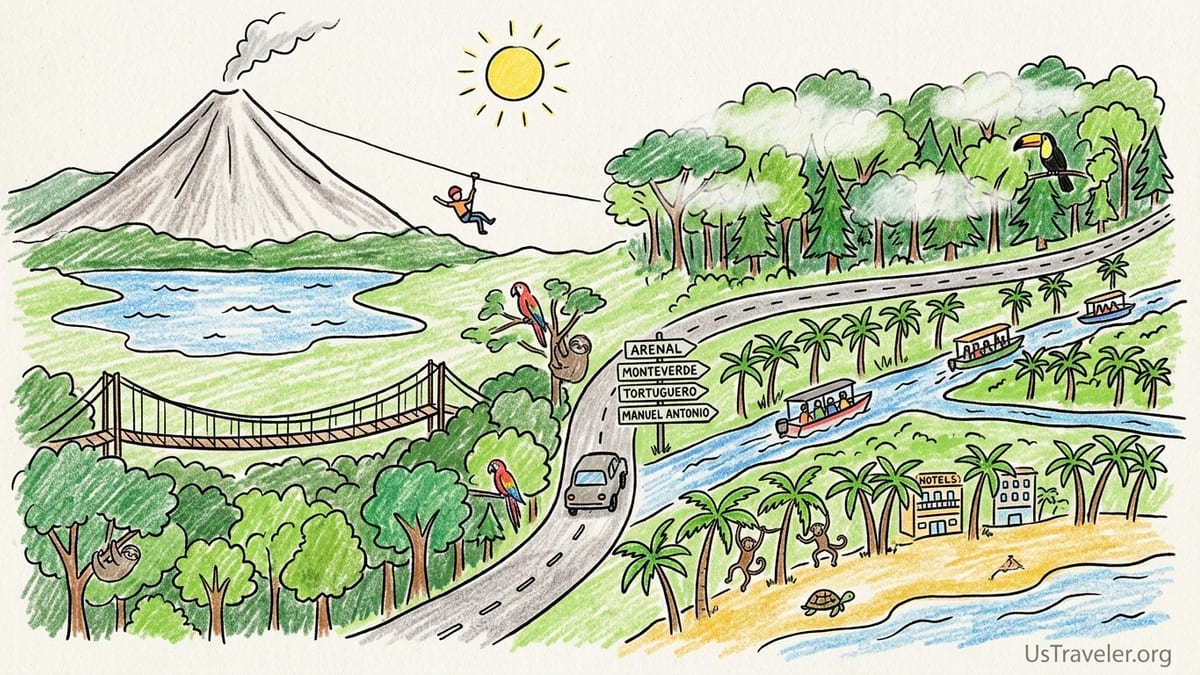
Costa Rica’s classic loop of Arenal, Monteverde, Tortuguero and Manuel Antonio has become the backbone of many itineraries for good reason. These hubs string together volcano views, cloud forest, jungle canals, beaches and abundant wildlife, with a menu of tours ranging from ziplining and hanging bridges to Pacuare River rafting and offshore snorkeling. Choosing between group and private tours, deciding when a guide is essential and understanding how much driving is involved can make the difference between a rushed checklist and a smooth, memorable trip.
How Most Travelers Structure Costa Rica’s “Big Four” Circuit
Tour operators and independent travelers alike tend to organize Costa Rica trips around four bases: Arenal/La Fortuna, Monteverde, Tortuguero and Manuel Antonio. A typical 9 to 12 day itinerary might start with two or three nights in Arenal for volcano views, hot springs, hanging bridges and ziplining, continue with two nights in Monteverde for the cloud forest, detour to Tortuguero for canals and nesting turtles in season, and finish with three nights in Manuel Antonio for beaches and easy wildlife viewing. Many multi-day packages sold by well known operators mirror this pattern because it balances travel time and variety without requiring internal flights.
Driving between these hubs is where many travelers underestimate the logistics. San Jose to La Fortuna (Arenal) is usually about 3 to 3.5 hours by shared shuttle under normal conditions. The cloud forest section from Arenal to Monteverde can take 3.5 to 4.5 hours on winding, sometimes rough roads, even if the distance looks short on a map. Monteverde to Manuel Antonio is often 4.5 to 5.5 hours with a stop. Tortuguero, reached by road and boat on the Caribbean side, typically requires a shared shuttle and river boat combination of 3.5 to 5 hours from San Jose, depending on the dock used. Building these transfer days into your tour planning matters just as much as picking activities.
Many current tour operators have bundled these movements into small group programs that include transportation, especially between Arenal, Monteverde, Tortuguero and Manuel Antonio. This is particularly helpful if you do not want to drive yourself. Shared shuttles and boat transfers are scheduled to link common routes, so a traveler might book a La Fortuna to Monteverde shuttle plus a Monteverde to Manuel Antonio shuttle as add ons to individual day tours, or choose a package where those segments are embedded in a single price. In practice this often reduces stress and leaves more time for guided activities where a specialist really adds value, such as wildlife walks and rafting.
Arenal: Volcano Views, Hot Springs, Hanging Bridges and Ziplining
Arenal, anchored by the town of La Fortuna, is Costa Rica’s most developed adventure hub. Most visitors book a combination of volcano viewpoint hikes, natural hot springs, hanging bridge walks and zipline canopy tours. Well known hot spring resorts near Arenal Volcano sell evening passes that include dinner and several hours soaking in thermal pools, often for a per person price in the moderate range, while budget travelers choose simpler hot spring complexes at lower cost. Many day tours bundle a gentle volcano hike, a visit to La Fortuna Waterfall and an evening at hot springs with transportation from La Fortuna hotels included, which can be worthwhile if you are not renting a car.
Hanging bridge tours around Arenal take you through mid elevation rainforest on a network of long suspension bridges and forest trails. You can visit on your own if you arrive at opening time and pay the entrance fee, but a guided hanging bridges tour with a naturalist often doubles or triples the wildlife you notice. Guides carry high quality spotting scopes to reveal sloths, toucans, poison dart frogs and distant howler monkeys that most people would walk past. Group bridge tours commonly run around three hours, with hotel pickup and drop off in La Fortuna, and make a good half day that pairs with an afternoon hot springs visit.
Zipline canopy tours in the Arenal area are strongly infrastructure driven, so the guide’s role is more about safety and photography than wildlife interpretation. Operators provide helmets, harnesses and safety briefings, and runs range from family friendly to very high and fast. For ziplining, a reputable operator and well maintained cables matter more than paying for a private guide, so a small group tour is usually fine. Transport from La Fortuna hotels is often included, and the time commitment is typically a half day with 20 to 40 minutes of driving each way depending on your lodge’s location.
Waterfall excursions round out many Arenal stays. The La Fortuna Waterfall is the classic example, reachable by a steep staircase from the official entrance. Some visitors simply take a taxi and pay the entrance fee, but packaged tours may bundle the waterfall with a guided rainforest hike or a visit to a local farm, plus transport. A guided visit is not essential here unless you prefer having the logistics managed and want commentary on local ecology, but older travelers and families with young children may appreciate having a guide who sets a comfortable pace and arranges return transport at a fixed time.
Monteverde: Cloud Forest Walks, Hanging Bridges and Night Tours
Monteverde’s appeal lies in cool, misty cloud forest and rich birdlife. Daytime cloud forest tours typically visit reserves such as the Monteverde Cloud Forest Reserve, Santa Elena Cloud Forest Reserve or Curi Cancha. Entrance fees are paid per person, and guided nature walks of two to three hours often cost an additional moderate amount per adult. Recent price guides suggest that guided cloud forest walks commonly fall in a band from around 30 to 80 US dollars per person depending on group size and length, with small group options often capping at about eight travelers. In practice, the added cost of a guide in Monteverde is frequently described by visitors as worthwhile because spotting wildlife among dense vegetation without a trained eye can be challenging.
Night walks are where a guide materially changes your experience. Cloud forest night tours are designed specifically to reveal the 80 percent or more of forest life that becomes active after dark. Operators provide flashlights and a local naturalist leads you along easy trails looking for glass frogs, kinkajous, sloths, owls and a range of insects and reptiles. Small group night walks with a spotting scope are commonly priced around the mid 30 to low 40 dollars per person range, with slightly cheaper options at higher group sizes or without transport. Since wildlife is cryptic and you rely on shared light and optics, private or genuinely small group tours are generally worth the premium if night photography or a quieter experience is important to you.
Monteverde also offers its own hanging bridges and zipline systems, often combined in one property. Many travelers choose a combo ticket that includes a canopy zipline circuit, a hanging bridges loop and sometimes a butterfly or hummingbird garden. Again, the structures guide the experience, so a group tour is usually adequate. A guide can be more useful on bridge circuits that focus on natural history, where someone helps you find resplendent quetzals, trogons or troops of capuchin monkeys moving through the canopy. Driving times within Monteverde are relatively short, but the approach roads from Arenal or the Pacific remain slow and winding, so a shared shuttle or driver guide is often preferable to self driving at night or in heavy rain.
Coffee and chocolate tours are a practical rainy afternoon choice in Monteverde, where some farms host visitors for short walks in the fields, demonstrations of processing and tastings. These tours are inherently guided because you are accessing private agricultural property, and group sizes are usually comfortable. Prices are often in the modest range per adult, sometimes with discounts for children. Transportation from central Monteverde hotels may be included or added for a small surcharge. Booking coffee tours as part of a package that includes a morning cloud forest walk and an evening night tour allows you to keep one base while experiencing three distinct sides of the region in a single full day without driving yourself.
Tortuguero: Canal Safaris, Sea Turtles and Lodge Packages
Tortuguero, on Costa Rica’s northern Caribbean coast, operates differently from Arenal or Monteverde. You cannot drive directly into the village. Instead, you reach it by a combination of road transfer and boat along narrow canals bordered by lowland rainforest. Most visitors stay in lodges that sell two or three night packages including round trip boat transfers from a dock near Guapiles or La Pavona, lodging, meals and a set of guided canal tours. Because of this structure, guides are central to the experience rather than an optional extra.
Canal safaris in Tortuguero usually take place on small motorboats or, in quieter backwaters, on paddled canoes. A local guide sits or stands at the front, scanning for caimans, river turtles, monkeys and birdlife such as herons, toucans and macaws. The slow, winding channels mean you would see some wildlife on your own, but guides who know specific perches and rest sites dramatically increase sightings. Lodges typically include a morning and an afternoon boat tour in their base packages, with the option to add more specialized birdwatching outings at extra cost. Group sizes vary; if you value space for photography, request a small boat or pay for a private canal tour.
Sea turtle nesting is Tortuguero’s signature seasonal attraction, especially green turtles from roughly July through October, with some variation by year. Turtle walks must follow park regulations, and certified local guides are required. Tours usually run at night in small groups that depart from the village or lodge docks and head to designated beach sectors. Prices are often structured as a flat fee per person plus a national park or conservation permit. Here, paying for a reputable guide is non negotiable, both for conservation reasons and because guides communicate rules about red light use, flash restrictions and where to stand. They also coordinate with beach spotters so your group is guided to active nests rather than walking blindly in the dark.
Because Tortuguero is reached by boat and has no road access, joining a package that bundles transport, lodging, meals and guiding is generally more efficient than trying to assemble day tours independently. Many itineraries build in two nights, which is usually enough time for a couple of canal trips, at least one turtle walk in season and a short village visit. Transfers from San Jose to Tortuguero and onward toward La Fortuna or back to the capital are often handled by the lodge shuttle and boat network, so travelers who do not want to rent a 4x4 can still access this remote feeling corner without managing multiple local buses.
Manuel Antonio: Wildlife Walks, Beaches and Catamaran Trips
Manuel Antonio National Park on the central Pacific coast is one of Costa Rica’s most popular parks, combining relatively compact size with rich biodiversity and white sand beaches. Wildlife walks here are where a guide almost always improves the experience. Dense secondary forest and coastal thickets are home to sloths, white faced capuchin monkeys, squirrel monkeys and a wide range of birds and reptiles. Experienced guides cluster at the park entrance each morning and also operate on pre booked basis through local agencies and hotels. They carry spotting scopes and know where groups of monkeys, sloths and iguanas typically rest. In practice, many independent travelers who enter the park without a guide find themselves informally following guided groups because the naked eye misses so much.
Park admission must be purchased in advance through the official online system, and visitor numbers per day are capped. Pricing is per person, with separate fees for parking at private lots near the entrance. Guided tours, bookable as shared groups or as private experiences, generally include park entry in the quoted rate plus use of a spotting scope. Shared tours are suitable for most visitors and can be significantly cheaper, though groups may grow to a dozen or more. Private tours cost more but allow you to move at your own pace, which is useful for families with small children, photographers or travelers sensitive to heat and humidity who need more breaks.
Outside the park, the Manuel Antonio and Quepos area is a base for catamaran cruises and snorkeling trips. Catamaran tours usually depart in the morning or mid afternoon, last about four hours and may include a simple meal, open bar, and time for snorkeling or swimming near offshore rock formations. Marine life here can include schooling fish and occasional sea turtles or dolphins, though underwater visibility is variable and tends to be best in the dry season months. Catamaran trips are inherently group activities, and private charters are available at a higher price point for small groups celebrating special occasions. These outings usually include transportation from most Manuel Antonio hotels to the marina.
For travelers focused on relaxation, Manuel Antonio is also where many itineraries build in free days with no structured tours beyond a single guided park visit. The town’s steep hills and dispersed hotels mean that taxis or hotel shuttles are often needed to reach restaurants and beaches. When comparing tours, pay attention to whether round trip transportation from your specific hotel zone is included, as some cheaper options expect you to meet at a central office near the main road or marina, which can add taxi costs and time.
Pacuare River Rafting, Coffee Tours and Other Add On Adventures
While Arenal, Monteverde, Tortuguero and Manuel Antonio form the backbone of many programs, rafting and cultural excursions often shape travelers’ favorite days. The Pacuare River, widely regarded as one of Central America’s classic white water runs, is a common highlight. Commercial rafting companies based in San Jose or the Turrialba region offer full day Pacuare trips that include early morning pickup from hotels in San Jose, Puerto Viejo or La Fortuna on some routes, a breakfast stop, about 3 to 4 hours of rafting through rainforest clad canyons and a simple lunch served riverside or at a base facility. Many trips are structured so your luggage travels on the bus and meets you at your next hotel if you are changing bases, turning the rafting day into both an adventure and a transfer.
On Pacuare, guides are essential for safety and river navigation. Each raft typically has a bilingual river guide who explains paddle commands, evaluates water levels and coordinates with a safety kayaker in more technical sections. Group sizes per raft are usually about four to six guests, and paying for a private raft is generally unnecessary unless your group already fills one. Because rafting is physically demanding and subject to weather and river flow conditions, joining a reputable operator that adheres to safety standards is more important than fine tuning whether your tour is private or shared. Transport is almost always included, and the day can easily run 10 to 12 hours door to door from San Jose.
Coffee tours, available in several regions including Monteverde, the Central Valley near San Jose and some parts of Arenal, give a window into Costa Rican agricultural life. Typical tours last about two hours, covering planting, harvesting, processing and tasting. They are almost always guided in small groups by farm staff, and per person prices are usually moderate. Some coffee experiences bundle chocolate or sugar cane demonstrations, particularly in Monteverde and La Fortuna. Because these tours take place on private property and include equipment and tastings, do not expect to visit independently without a reservation. Transport can be included if you book through a local tour operator or hotel concierge, which is useful for travelers without cars staying in rural lodges.
Waterfall and canyoning adventures, such as rappelling down waterfalls in the hills around Arenal, are similarly guide intensive. Operators provide gear, instruction and safety systems, and participants usually travel in small groups from a central meeting point or hotel pickup. Snorkeling add ons, beyond the catamaran trips from Manuel Antonio, are also offered from destinations like Guanacaste and the Nicoya Peninsula if you extend your trip. In these cases, local knowledge of tides, currents and visibility means guided boat based snorkeling tours are generally preferable to ad hoc shore snorkeling unless you are experienced and understand the conditions.
Group vs Private Tours, Driving Time and When Guides Matter Most
Across Costa Rica’s main tours, the decision between shared and private guiding hinges on three main factors: wildlife spotting, logistics and personal comfort. For wildlife heavy experiences in dense rainforest or cloud forest, such as Manuel Antonio park walks, Monteverde cloud forest tours and Tortuguero canal safaris, a guide with a spotting scope can transform what you see. In these cases even a shared tour is a major upgrade over walking alone. Private guiding is most valuable for families with children who move at different speeds, photographers who want extra time at sightings, and travelers with mobility or sensory needs who benefit from a custom pace and route.
For infrastructure driven adventures like ziplining, hanging bridges that are more scenic than strictly wildlife focused, hot springs and coffee farm visits, a small group is usually sufficient. Here the guide’s main roles are safety, storytelling and basic logistics rather than intense wildlife tracking. The marginal benefit of paying for a private tour is lower unless you are in a larger private group or have specific interests. Rafting on the Pacuare or similar rivers falls into a hybrid category: guides are absolutely essential, but the standard model of one guide per raft is already semi private given the limited number of seats.
Transportation is another key element when comparing tours. Many Arenal and Monteverde activities include hotel pickup within a defined radius, but cheaper rates may require you to meet at the tour office. Tortuguero is most efficiently visited on packages that include boat and road transfers. Pacuare rafting almost always bundles long distance transport into the price. Self driving between hubs like San Jose, La Fortuna, Monteverde and Manuel Antonio is feasible for confident drivers, yet the combination of narrow roads, rain and limited street lighting leads many travelers to prefer shuttles and guided transfers. Using shared shuttles also allows you to join day tours that start early without navigating in the dark.
Driving time between signature destinations is often longer than many first time visitors expect. San Jose to Arenal or Manuel Antonio routinely consumes half a day when you include breaks. Arenal to Monteverde and Monteverde to Manuel Antonio combine twisting mountain roads and occasional construction delays. When booking tours, think of transfer days as lightly programmed. Morning shuttles or private transfers let you enjoy an afternoon hot springs visit in Arenal or a sunset viewpoint in Manuel Antonio, but full scale adventure tours on travel days can be exhausting. Multi day packages sold by Costa Rican operators that repeatedly build programs around Arenal, Monteverde, Tortuguero and Manuel Antonio typically reflect this by alternating heavier activity days with lighter transfer days.
In practical terms, the tours where a guide makes a material difference in both enjoyment and value are: wildlife walks in Manuel Antonio and other dense forests, Monteverde day and night cloud forest tours, Tortuguero canal and turtle tours, and Pacuare or other serious white water rafting. Experiences where a guide is more about convenience include hot springs visits, some hanging bridge circuits, coffee tours and straightforward waterfall visits. Balancing a mix of both types, while being realistic about driving times and transfer logistics, leads to an itinerary that feels rich rather than rushed.
FAQ
Q1. Do I need a guide for Manuel Antonio National Park, or can I visit on my own?
Most travelers benefit significantly from hiring a guide at Manuel Antonio because dense vegetation makes wildlife hard to spot. Guides carry spotting scopes and know where animals like sloths and monkeys usually rest. You can enter without a guide, but many independent visitors end up shadowing guided groups informally, so booking a shared tour up front is usually a better experience.
Q2. Is a guided cloud forest tour in Monteverde worth the extra cost?
Yes, in most cases a guided walk in Monteverde is worth the added fee. Cloud forest wildlife is cryptic, and guides are adept at finding birds, frogs and mammals that casual visitors rarely notice. With a small group guide and spotting scope, many travelers report seeing several times more species than on self guided walks, making the moderate extra cost a strong value.
Q3. How long does it take to drive between Arenal, Monteverde and Manuel Antonio?
Under typical conditions, San Jose to Arenal takes around 3 to 3.5 hours, Arenal to Monteverde roughly 3.5 to 4.5 hours on winding roads, and Monteverde to Manuel Antonio about 4.5 to 5.5 hours with a break. Traffic, construction and weather can stretch these times, so it is smart to treat transfer days as half travel, half light activity rather than packing in major tours.
Q4. Are Pacuare River rafting trips safe for beginners?
Commercial Pacuare trips are designed with first time rafters in mind, using professional guides, safety briefings and support kayakers when conditions warrant. That said, it is still a genuine white water river, so you should be comfortable in water and prepared for physical exertion. Choosing an established operator and being honest about your fitness level helps match you to appropriate water levels and dates.
Q5. What is the best season to visit Tortuguero for wildlife and canals?
Tortuguero’s canals offer wildlife year round, with early morning and late afternoon boat tours generally most productive. If seeing nesting sea turtles is a priority, the core green turtle season typically runs from about July through October, with some variation. Outside turtle season, you still get rich birdlife, monkeys and reptiles along the waterways.
Q6. Should I book tours like hanging bridges and ziplining in advance?
For peak travel periods such as Christmas, New Year, Easter week and mid year school holidays, advance booking is strongly recommended for popular Arenal and Monteverde activities, especially morning hanging bridge tours and top rated ziplines. In shoulder seasons you can often reserve a day or two ahead once you see the weather forecast, but last minute spots around weekends can still fill.
Q7. Are coffee tours better in Monteverde, Arenal or near San Jose?
You can find good coffee tours in all three regions, but the style differs. Around San Jose, many farms are working estates with a stronger focus on production scale and export. In Monteverde, tours often combine coffee, chocolate and sugar cane, with cooler mountain scenery. Around Arenal, coffee experiences are typically part of broader farm visits. If you already plan time in Monteverde, doing a combo coffee and chocolate tour there is convenient and fits well into an afternoon after a morning forest walk.
Q8. Is renting a car necessary for this kind of multi stop Costa Rica itinerary?
Renting a car offers flexibility, especially in Arenal and around the Pacific beaches, but it is not strictly necessary. Shared shuttle networks and tour operator transfers link San Jose, La Fortuna, Monteverde, Tortuguero docks and Manuel Antonio effectively. Many travelers who prefer not to drive in unfamiliar conditions opt for shuttles between bases and rely on included transport for day tours, which works well for a first visit.
Q9. How far in advance should I reserve a guide for Monteverde night tours?
Monteverde night walks are among the most popular tours in the region. In high season it is wise to reserve at least several days, and preferably a week or more, in advance, especially if you want a small group or private guide. In quieter months you may find same day availability, but specific time slots and top rated guides can still book up quickly.
Q10. Are catamaran and snorkeling trips from Manuel Antonio suitable for children?
Many catamaran cruises from Manuel Antonio welcome families and provide life vests, easy access ladders and calm snorkeling spots when conditions allow. Morning departures are usually better for younger children who tire in the afternoon heat. If your child is prone to seasickness, choose a larger, more stable catamaran and consider motion sickness precautions, as Pacific swells can make the ride choppy at times.