


On October 6, 2026, I learned the hard way that the classic advice about Costa Rica’s Caribbean coast is wrong. I had been told the journey from San José to Puerto Viejo de Talamanca was an easy four or five hours. My plan was simple: land at Juan Santamaría International Airport at 10:45 a.m., clear immigration in under an hour, meet a shared shuttle at 12:15 p.m., reach Puerto Viejo by late afternoon, then continue to Tortuguero the next morning via La Pavona. Instead, a landslide closure on Route 32 in the Zurquí sector, followed by missed connections and a final boat that left without me, turned a seamless two-day transfer into thirty-one hours of patchwork travel and an unplanned 110 dollar hotel bill in Guápiles.
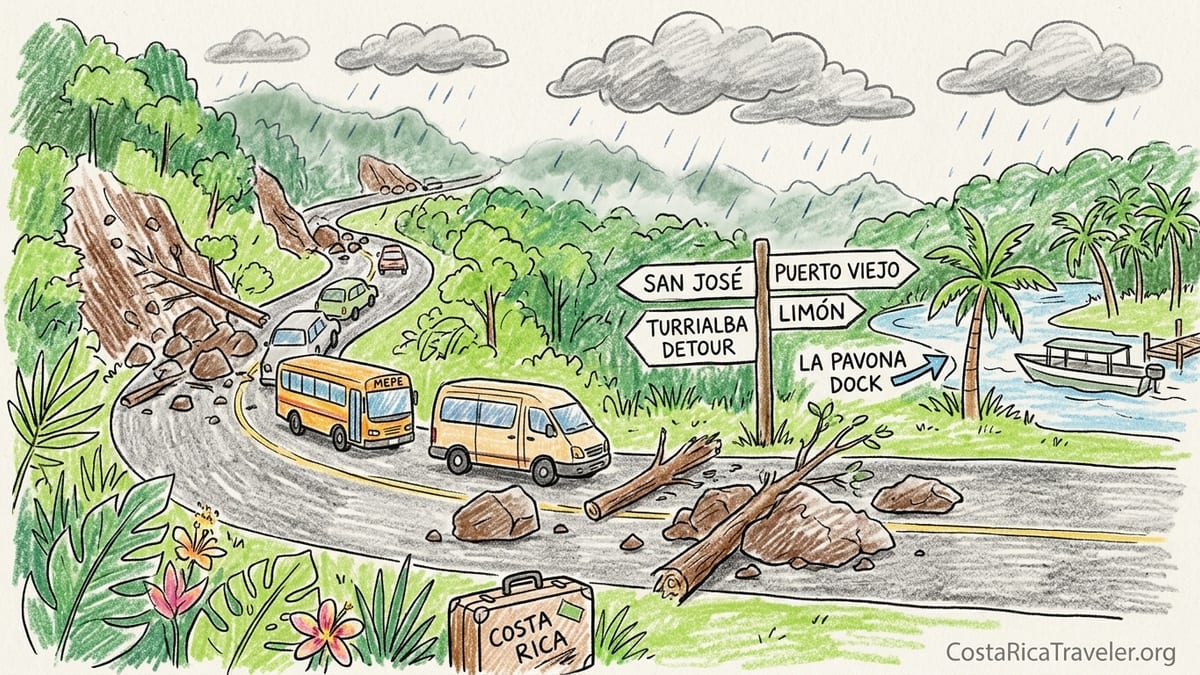
When “Four Hours” Turned Into Thirty-One
The first sign that my plan was unravelling came while I was still in the immigration line on October 6. My shared shuttle company texted that Route 32, the main highway linking the Central Valley to the Caribbean, had just closed near kilometer 33 in the Zurquí sector because of a landslide. They were “monitoring the situation” and might have to cancel the transfer entirely if the road did not reopen by midday. On paper, San José to Puerto Viejo is about 220 kilometers by paved highway. In practice, that relatively short distance hides one of Costa Rica’s most fragile transport corridors.
By the time I exited customs, the situation had worsened. The highway remained closed and my shuttle operator offered two options: wait at the airport for an indefinite reopening, or pay extra to detour in a private minivan via Route 10 and secondary roads through Turrialba. The supplementary cost was 60 dollars for my seat alone. That detour would also add at least two hours to the normal five-hour estimate and jeopardize my connection the next morning to La Pavona, the dock used by public boats to Tortuguero on the northern Caribbean coast.
In an attempt to salvage the itinerary, I chose the detour. We finally left the airport at 1:10 p.m., crawled through San José traffic on Route 27, then looped east through Cartago and Turrialba before dropping down toward Siquirres and connecting back to the Caribbean corridor near Guápiles. What should have been a mid-afternoon arrival in Puerto Viejo became a 9:20 p.m. check-in, for a door-to-door time of almost eight and a half hours. The financial impact was not only the 60 dollar surcharge; by the time I reached Puerto Viejo it was too late to buy next-day bus tickets to Cariari and La Pavona with any confidence, and heavy rain was still forecast for Braulio Carrillo National Park.
Two days later, the effects of that first disruption were still echoing. Because the detour had exhausted me and pushed everything back, I moved my Tortuguero visit by twenty-four hours and tried to reach La Pavona from San José instead of from Puerto Viejo. A separate storm line then brought intense rain to the lowlands. The public bus leg from Cariari to La Pavona ran slowly on muddy stretches, and I reached the river dock just as the last public boat of the day pulled away, its captain shrugging apologetically. The next available ride was a private launch charging the equivalent of about 45 dollars per person, more than five times the regulated public fare that local operators quote at around 4,000 colones. Faced with that surprise cost, I decided to stay overnight in Guápiles for roughly 110 dollars and try again the next morning.
Route 32 Through Braulio Carrillo: Beautiful, Essential and Vulnerable
To understand why these cascading problems are not just bad luck, it helps to look closely at Route 32 itself. National Route 32 runs about 157 kilometers between San José and Limón and is the primary corridor for freight and passengers between the Central Valley and the Caribbean coast. For roughly forty kilometers it passes through Braulio Carrillo National Park, a mountainous protected area of more than 44,000 hectares where steep slopes and constant rain make landslides a recurring hazard.
Within the park, the road threads through the Zurquí sector, a dramatic stretch of deep ravines, cloud forest and narrow bridges. This section is scenic, but it concentrates risk. The combination of high annual rainfall, unstable slopes and relatively narrow cuts in the mountainside means that intense storms can quickly send mud, rocks and trees onto the asphalt. Costa Rica’s transport authorities have long acknowledged that landslides are common here during the rainy season. In 2026, that vulnerability became particularly visible.
In early March 2026, the Ministry of Public Works and Transport began stabilisation work on a slope at kilometer 27 of Route 32 in the Braulio Carrillo sector. The aim was explicitly to reduce the risk of falling material and improve safety for road users. Work was scheduled between 6 a.m. and 5 p.m., in daylight only, and was always subject to weather conditions. While that project targeted one known problem point, it also meant intermittent lane closures and slower traffic just as the annual rains intensified.
By July and August 2026 the region experienced several episodes of heavy rainfall that caused multiple slides along the highway. One August report from national media described eight separate landslides cutting the road at kilometers 20, 23, 25, 27, 31, 32, 33 and 37, all within the Braulio Carrillo section. On those days, traffic between the Central Valley and Limón stopped completely for hours at a time while crews worked to clear debris and assess slope stability. The October 6 closure that derailed my own plan was part of this same pattern, again concentrated around kilometer 33 near Zurquí.
None of this means that Route 32 is unusable or that travelers should avoid the Caribbean coast. The highway carries thousands of vehicles every week, and most days buses, shuttles and private cars make it through the park with no more than typical mountain delays. What these documented closures do show is that the comforting promise of “four hours, maybe five with a coffee stop” glosses over a complex, weather-dependent reality. When rain is heavy enough, there is no reliable way to predict whether the road will be open at the exact time your shuttle or bus needs to cross the most fragile slopes.
How Closures Hit Buses, Shuttles, Rentals and Private Transfers
Route 32 disruptions do not affect all types of transport equally. The MEPE public buses that run between San José’s Terminal Atlántico Norte and Puerto Viejo de Talamanca work on fixed timetables, with departures around 6 a.m., 8 a.m., 10 a.m., 2 p.m. and 4 p.m. according to 2026 schedules confirmed by local guides and bus information services. The regulated fare for this route is just over 7,000 colones, roughly 14 dollars, which makes the bus by far the most economical option for solo travelers.
When the highway closes for landslides, MEPE buses are generally stuck like everyone else. They may wait at safe pullouts, turn back to San José or Limón if instructed by authorities, or detour via Route 10 if conditions permit. The advantage for passengers is that the fare does not change and there is no risk of an unexpected surcharge. The trade-off is a loss of control. If your bus spends two hours idling behind a line of trucks at Zurquí, there is little real-time communication and no option to push for alternate routes.
Shared shuttles, which typically cost somewhere around 60 to 80 dollars per person for San José to Puerto Viejo with door-to-door hotel pickup, can respond more flexibly. Operators sometimes coordinate with each other by phone or messaging apps to share information from drivers already on the road. On my October journey, this meant the company could decide within an hour to use the longer detour via Cartago and Turrialba. The downside is that the extra distance and fuel are often passed directly to passengers as a supplement. For solo travelers, a 60 dollar detour fee can nearly double the cost of that leg.
Private transfers and rental cars offer the most autonomy. A family of four paying about 260 dollars for a private van from the airport to Puerto Viejo might still be delayed by a closure, but they can decide exactly how long to wait at a roadside soda, whether to try the parallel Route 10, and how often to stop along the way. In a rental car, a couple might pay 55 to 80 dollars per day plus fuel and insurance. That can be cost-effective compared with four shuttle seats, but it pushes the responsibility for route decision-making and safety entirely onto the driver, including in heavy rain, fog and night conditions.
In my case, the flexibility of the shuttle became a double-edged sword. I appreciated the decision to detour instead of simply cancelling, but the late departure and added hours still cost me a night of rest and, indirectly, my original plan to sequence Puerto Viejo and Tortuguero back-to-back. Watching the minutes slip by at a gas station near Turrialba while rain hammered the canopy, it became obvious that no transport mode can fully insulate you from the knock-on effects of Route 32’s geography.
Door-to-Door Reality: Airport Lines, City Traffic and Mountain Weather
One of the most misleading aspects of the “four or five hours” claim is that it usually refers to time on the road between San José city and Puerto Viejo, with no allowance for the steps before and after. My October trip underscored how many small delays accumulate. From plane door opening to meeting a driver at the arrivals curb, it took me 55 minutes, despite traveling only with carry-on luggage and using the automated immigration kiosks. In high season or with checked bags, that segment can easily take 90 minutes.
From the airport to the eastern side of San José where the MEPE terminal is located, traffic plays an outsize role. Midday on a weekday, it can take 45 minutes to an hour simply to cross the metropolitan area, especially with construction and school traffic. Once on Route 32, the climb to the Zurquí tunnel and descent toward Guápiles are often slowed by heavy trucks, fog and rain. Even with no closures, drivers report that the city-to-Guápiles stretch commonly takes two hours or more, not the optimistic ninety minutes some brochures still cite.
On my shuttle detour, an additional thirty-minute fuel and bathroom stop was necessary near Siquirres, both to comply with driver rest requirements and because passengers needed a break after several hours of winding secondary roads. In Puerto Viejo itself, navigating narrow streets, one-way traffic and multiple hotel drop-offs added another forty minutes before everyone reached their accommodation. When I later retraced the route with a notebook in hand, the math was stark. From scheduled flight arrival at 10:45 a.m. to hotel room door at 9:20 p.m., my day involved roughly three and a half hours of formalities and urban driving and about seven hours of highway and secondary-road travel, including stops and the detour.
For travelers continuing beyond Puerto Viejo to villages like Manzanillo or to river docks like La Pavona, these compounded delays have real consequences. Missing the last MEPE bus from San José because your flight landed late, arriving in Guápiles after the last convenient bus to Cariari, or reaching La Pavona too late for the final public boat to Tortuguero can all turn an expected travel day into an unexpected overnight expenses and reshuffled bookings. The 31 hours it ultimately took me to go from an airport hotel in Alajuela to a cabina in Tortuguero were not the result of any single dramatic failure, but of many ordinary delays that stacked up once Route 32 became unstable.
The La Pavona Bottleneck: Boats, Rain and the Cost of Missing the Last Departure
The road is only half the challenge of reaching Costa Rica’s northern Caribbean coast. Tortuguero village has no road access; everyone arrives either by boat along canals and rivers or by small aircraft. The most common route for independent travelers is via the La Pavona dock, reached first by bus or road transfer through Guápiles and Cariari and then by river launch along the La Suerte and Tortuguero canals.
Official tourism publications and several local boat operators describe a cluster of public departures from La Pavona starting early in the morning. Schedules published in 2026 list multiple daily boats between roughly 6:00 a.m. and mid-afternoon, with a strong recommendation to arrive at the dock by around 4 p.m. at the latest if you hope to catch the final public service. Some operators, including companies like Transporte Smith and Rankin-based services, advertise shared boats at set times such as 9:00 a.m., 11:00 a.m., 1:00 p.m. and 3:00 p.m., often coordinated with arriving buses from Cariari.
On the ground, there is variation. Locals confirm that there is usually more than one boat leaving in the morning and around midday, and that captains sometimes hold the departure a few minutes for a nearly-arrived bus. The public fare is quoted by residents and recent travelers at about 4,000 colones per person for the one-and-a-half-hour journey, which keeps this leg accessible even for budget backpackers. The real risk lies later in the day. After about 3:00 or 4:00 p.m., departures become sporadic. At that point you are no longer within the reliable window for public boats that serve people commuting to and from Tortuguero village.
On the day I missed my connection, my bus from Cariari left on time under grey skies, but steady rain along the secondary road slowed progress. The driver navigated deep puddles and soft edges where previous storms had chewed at the gravel. We arrived at La Pavona around 3:55 p.m., only to see the last public boat of the day already backing away from the dock. There were still local passengers aboard, but the captain had no reason to delay departure to accommodate a single late tourist, particularly with rainclouds piling up over the lowlands and daylight beginning to fade.
In that moment, the choices narrowed and became expensive. One boatman offered a private ride to Tortuguero for about 45 dollars per person if at least two people would commit. Another suggested I could wait and see if a private tour group with prepaid arrangements had spare seats, but could not guarantee anything. Faced with the prospect of being on the river after dark in worsening weather and paying far more than the public fare, I backtracked to Guápiles instead, where last-minute hotel options near the highway clustered in the 90 to 120 dollar range. A missed boat therefore translated directly into a three-figure unplanned cost.
Comparing MEPE Buses, Shuttles, Private Transfers and Rentals for Different Travelers
After this chain of experiences, I have come to view transport options between the Central Valley, Puerto Viejo and Tortuguero in far more nuanced terms. For solo travelers on a tight budget, the MEPE bus from San José to Puerto Viejo is hard to beat in pure cost terms, at roughly 14 dollars for a direct service that, on a clear day, can still reach the coast in about five and a half hours. Combined with the public bus network from Guápiles to Cariari and on to La Pavona, plus the regulated low-cost boat fare, a determined backpacker can reach Tortuguero for under 30 dollars in transport costs.
The trade-off is vulnerability to each bottleneck. A single late arrival at Terminal Atlántico Norte, a road closure in Braulio Carrillo, a saturated departure around national holidays, or a rain-slowed connection to La Pavona can unravel a carefully stacked series of public-transport legs. Language skills and comfort navigating crowded bus stations matter as well. A solo traveler who speaks Spanish and has time padding can work around these issues; one who does not may find the stress level high.
Shared shuttles occupy the middle ground for couples and small groups. At typical prices around 60 to 80 dollars per person from San José hotels or SJO airport to Puerto Viejo, a couple might pay 120 to 160 dollars for a door-to-door ride that picks them up at their guesthouse in Alajuela and drops them directly at a hotel in Cocles or Playa Chiquita. For families with two or three children, however, that per-seat pricing quickly overtakes the cost of a private transfer. Shuttles also do not eliminate weather risk. On days when Route 32 is open but slow, they may reach Puerto Viejo only marginally faster than a MEPE bus, simply with added comfort and fewer intermediate stops.
Private transfers become appealing for families or for travelers with tight but important commitments, such as early-morning turtle nesting tours in Tortuguero or onward flights. A private van from San José to Puerto Viejo for up to four or five passengers can cost in the region of 240 to 300 dollars, with higher rates for very late-night departures or pickups at far-flung accommodations. From Guápiles or La Pavona back to San José, similar prices apply. Divided among four adults, this can approach or even undercut the cost of four shared shuttle seats, while allowing the group to choose departure times, bathroom stops and food breaks.
Rental cars add another layer of independence but come with specific cautions on this corridor. Typical 2026 rates for a basic compact car with mandatory insurance range from roughly 55 to 80 dollars per day, with SUVs starting higher. While this looks attractive over several days, especially if combining the Caribbean coast with other regions, the driver must be prepared for heavy rain, reduced visibility and truck traffic in Braulio Carrillo, as well as potholes and standing water on some secondary roads to docks like La Pavona. Night driving is widely discouraged by both locals and official tourism materials because of limited lighting, wandering animals and the speed of other drivers.
Practical Precautions: Road Alerts, Timetables and Daylight Windows
After experiencing how quickly a neat itinerary can unravel, I now treat certain precautions as non-negotiable. The first is to check official road alerts the same morning you plan to cross Braulio Carrillo on Route 32. Costa Rica’s transport ministry and emergency commission regularly publish updates about closures and landslides, and local news outlets amplify those notices during major weather events. While these sources cannot predict sudden rockfalls, they do signal when the risk level is elevated or when crews are already working at multiple kilometers, as they were in August 2026.
The second precaution is to avoid tight connections. If my October flight had landed a day earlier, I would not have tried to combine an international arrival, a cross-country shuttle and a next-morning multi-leg journey to Tortuguero. I now recommend building at least one buffer night in the Central Valley or in Guápiles before attempting the La Pavona boat. Similarly, if you must use same-day connections, aim for the earliest possible services. A 6 a.m. MEPE bus from San José gives far more margin for landslide clearing, traffic, and slow stretches than a 2 p.m. departure that will inevitably reach the lowlands in the heaviest afternoon rain.
Refundable or at least flexible bookings are another line of defense. Some shuttle companies allow date changes without penalty if Route 32 is officially closed. Certain mid-range hotels in Puerto Viejo, Cahuita and Guápiles offer free cancellation until 24 hours before arrival, which allows you to pivot if heavy rain or official alerts make a planned crossing inadvisable. By contrast, prepaid non-refundable packages that bundle transport and accommodation leave you few options besides absorbing the loss if nature intervenes.
Finally, I now consider daytime travel across the Caribbean corridor essential whenever possible. Tropical dusk comes early in Costa Rica, and by 5:30 p.m. in October it was effectively dark as my shuttle inched past Guápiles and into the final two hours toward Puerto Viejo. Heavy rain, fog, truck spray and occasional unlit cyclists on the shoulder turned that last segment into the most stressful part of the day. Had we been able to leave San José before 9 a.m., much more of the journey would have unfolded in daylight, with better visibility of road hazards and landslide-prone slopes.
The Takeaway
Looking back at the chain of delays, detours and missed boats that defined my October 2026 journey, I no longer treat the San José to Caribbean transfers as simple half-day hops. The assumption that “it is always four or five hours” between the Central Valley and Puerto Viejo, and that La Pavona will reliably offer a boat whenever you happen to arrive, overlooks both the region’s rugged geography and the structure of its transport network. In a landscape where a single night of heavy rain can send mud onto Route 32 at multiple kilometers, as happened repeatedly in July and August 2026, and where the October 6 closure at kilometer 33 could halt a whole corridor, travel plans must build in slack.
On future trips, I will avoid scheduling same-day combinations of long road legs and critical water connections. I would not again book a midday flight into SJO and expect to reach Tortuguero the following morning without at least one buffer night, either in San José or in Guápiles. For the San José to Puerto Viejo route, I will still consider MEPE buses when cost matters, but I would reserve a seat in advance when possible, travel on the earliest departure, and accept that the real door-to-door time can reach seven or eight hours when urban transfers and weather delays are counted.
For couples and families, my bias has shifted toward private transfers for the mountain crossing and shared boats only within the earlier part of the La Pavona schedule. I would avoid late-afternoon arrivals at the dock, reliance on the very last public boat, and any plan that assumes Route 32 will behave like a predictable, all-weather freeway. Instead, I now treat the Caribbean coast as a region that rewards patience. A full extra day of schedule flexibility feels like the minimum. Two days is better. In exchange, when the road is open and the rivers are calm, the journey through Braulio Carrillo’s misty slopes and along Tortuguero’s quiet canals regains what every traveler hopes for: not just arrival, but a sense of having moved carefully through a living, changing landscape.
FAQ
Q1. How long does it really take to travel from San José to Puerto Viejo by bus?
On a clear day with no major delays, the direct MEPE bus can take around five and a half hours of road time. Once you include getting to Terminal Atlántico Norte, buying tickets, city traffic and reaching your final hotel, the door-to-door journey often stretches to six or seven hours, and can be longer in heavy rain or when Route 32 is slow.
Q2. Is Route 32 too dangerous to use during the rainy season?
Route 32 is not inherently too dangerous to use, and thousands of vehicles travel it safely every week. However, during the rainy season it does experience periodic landslides and temporary closures in the Braulio Carrillo and Zurquí sectors. Checking official road alerts on the day of travel and aiming for daytime crossings significantly reduces risk and stress.
Q3. What is the cheapest way to get from San José to Tortuguero?
The lowest-cost option is a series of public buses combined with the public boat from La Pavona. Typically this involves a bus from San José to Guápiles, another to Cariari, a third to La Pavona and then the shared river launch, with total transport costs usually under 30 dollars. This route demands time, flexibility and a willingness to manage several transfers.
Q4. How early should I arrive at La Pavona dock for the last boat to Tortuguero?
Tourism materials and local operators advise reaching La Pavona by mid-afternoon, ideally no later than about 3:30 or 4:00 p.m., if you hope to catch the final public boat. Arriving earlier provides a buffer for slow buses, rain or queues at the dock and reduces the risk of needing an expensive private launch or unplanned hotel stay.
Q5. Are shared shuttles from San José to Puerto Viejo worth the extra cost?
For many travelers, shared shuttles justify their higher price with hotel pickups, more comfortable vehicles and fewer stops than public buses. They can also respond more flexibly to closures by detouring, although this sometimes comes with extra fees. Solo backpackers focused on budget may prefer the bus, while couples and small groups often appreciate the added convenience of a shuttle.
Q6. Should families driving a rental car attempt the Route 32 crossing at night?
Night driving across Route 32 is generally discouraged, especially for visitors in rental cars. Limited lighting, heavy truck traffic, fog, rain and occasional debris on the road all become more difficult to manage after dark. Families are better off planning morning or late-morning departures so that the Braulio Carrillo section is crossed in full daylight.
Q7. How can I reduce the chances of missing my Tortuguero boat connection?
To protect your Tortuguero connection, travel as early as possible in the day, build at least several hours of buffer between your arrival in Guápiles or Cariari and the last reliable boats from La Pavona, and avoid planning critical legs immediately after international flights. If budget allows, consider staying a night in Guápiles so that you can reach the dock on a morning bus or private transfer.
Q8. What happens if Route 32 closes while I am already on the bus?
If a closure occurs while you are en route, the bus will typically wait in a safe location until authorities clear the road or instruct drivers to turn back. In some cases, especially during prolonged closures, services may return to the nearest terminal. Passengers must then decide whether to wait, rebook for another day or pursue an alternative route such as the longer road via Turrialba, if transport is available.
Q9. Are private transfers from the airport to Puerto Viejo a good idea for late arrivals?
Private transfers from the airport offer flexibility and door-to-door service, which can be valuable for evening landings. However, if your flight arrives very late and heavy rain is forecast, crossing Braulio Carrillo at night may not be ideal even with a professional driver. In those cases, an overnight near the airport followed by a daylight transfer is a safer, less stressful choice.
Q10. How much schedule flexibility should I build into a Caribbean coast itinerary?
Based on 2026 conditions, a minimum of one spare day in your overall itinerary is advisable if you plan to combine San José, Puerto Viejo and Tortuguero. Two flexible days provide a much more comfortable buffer against Route 32 closures, slow travel in heavy rain and limited boat departures. That extra margin can be the difference between a relaxed journey and a trip dominated by missed connections and unexpected costs.