


The first time I tried to "do" Costa Rica’s South Pacific in a single trip, I treated the map like a buffet menu. Uvita for whales, Drake Bay for Caño Island, Corcovado for wildlife, Puerto Jiménez for Golfo Dulce, maybe Golfito on the way out. On paper, it fit. In reality, boat schedules, rain, early wildlife departures, hotel changes and plain old fatigue tore the plan apart. This guide unpacks what actually happened on the ground and how I would now divide 4, 7 and 10 days between the South Pacific and the Osa Peninsula, without pretending you can be everywhere at once.
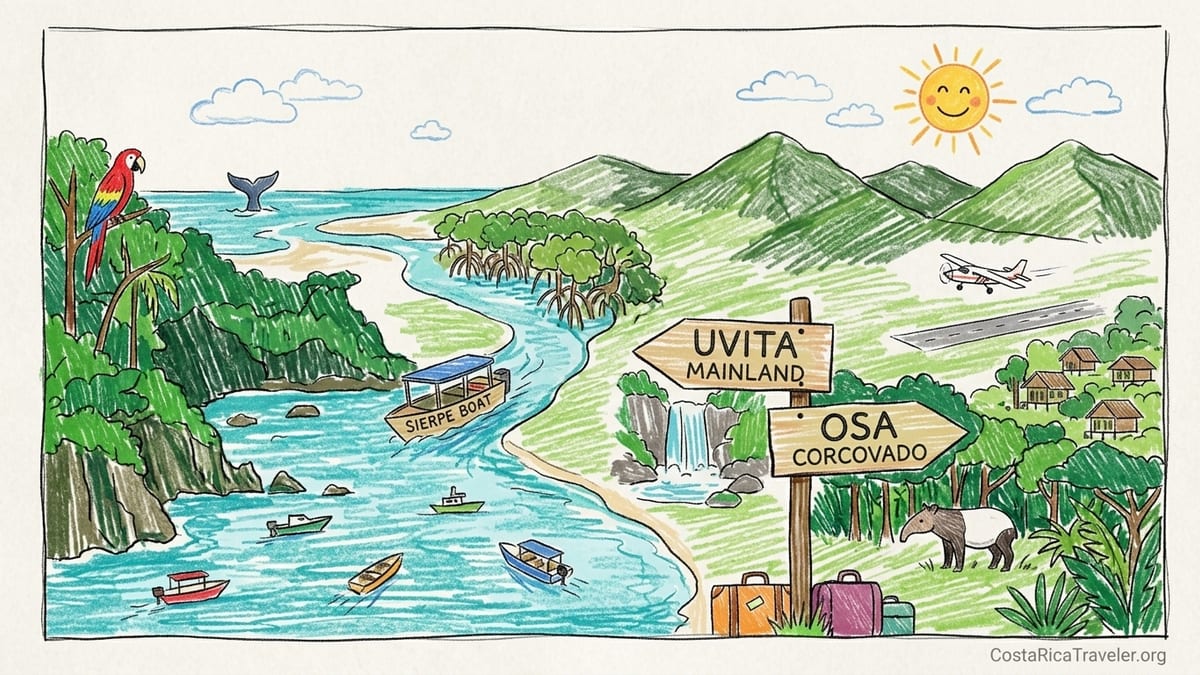
Understanding Costa Rica’s South Pacific and Osa “Puzzle”
Official tourism maps define Costa Rica’s South Pacific as far more than the Osa Peninsula. It runs down the Pacific coast from Dominical and Uvita past the Térraba-Sierpe wetlands to Golfito and the Golfo Dulce, wrapping around the Osa Peninsula with its famous Corcovado National Park and Drake Bay. Corcovado alone protects tens of thousands of hectares of lowland rainforest and over 40 kilometers of wild coastline, and park authorities and tourism boards describe it as one of the country’s crown jewels that warrants several days, not a quick stop. That matters for itinerary design: you are not choosing between “a beach town and a park,” you are choosing between multiple, spread-out ecosystems.
On my first South Pacific loop, I tried to stitch together Uvita, Drake Bay, a Corcovado overnight, Puerto Jiménez and Golfito in eight days. The outline looked efficient: drive San José to Uvita, boat from Sierpe to Drake, day trip to Corcovado, transfer to Puerto Jiménez by boat across the Golfo Dulce, then out via Golfito. Each move was theoretically three or four hours. Reality introduced friction at every step: restricted public boat times, rain that shut down gravel connectors, early-morning wildlife departures that clashed with hotel check-out, and the mental load of packing and unpacking every night.
To put the logistics in context, consider just two anchors. Driving from San José to Uvita is commonly quoted at around three and a half to four hours in light traffic via Route 27 and the coastal highway. In practice, with airport delays, rental pickup, a quick supermarket stop and slower trucks on the Costanera, many travelers report closer to four and a half or even five hours door to door in busy seasons. The boat from Sierpe up the river and out along the coast to Drake Bay typically runs around 1.5 hours and is tied to fixed departure windows around late morning and mid-afternoon. Miss the 11:30 departure because your bus or car was late, and you are not arriving in Drake until close to sunset, if at all.
These are not minor details. They dictate how many bases you can reasonably include. Corcovado itself requires advance reservations and the use of certified guides, with day tours that often depart at 6 a.m. or 7 a.m. from Puerto Jiménez or Drake Bay. When you are changing hotels the night before, you are suddenly trying to check out at dawn, catch a transfer in the dark and still be on a beach or trailhead at first light. My original route tried to thread too many of these needles at once.
What My Original South Pacific Route Tried to Cram In
The core mistake of my first South Pacific trip was not misunderstanding distances, it was underestimating transitions. I aimed for Uvita, then Drake Bay, then an overnight into Corcovado, then Puerto Jiménez, then Golfito, all in one week. On paper, it was tidy. Day 1: land in San José around midday and drive to Uvita. Day 2: explore Marino Ballena National Park and Nauyaca Falls. Day 3: drive to Sierpe for the boat to Drake Bay. Day 4: Caño Island snorkeling. Day 5: Corcovado day tour. Day 6: boat to Puerto Jiménez. Day 7: Golfo Dulce kayaking and out through Golfito.
Here is how that played out. My flight into San José was delayed by about an hour, immigration took longer than expected, and the rental car process added another 60 to 90 minutes. By the time I cleared the city and hit Route 27, afternoon traffic through Escazú and on the toll road was clogging up. Instead of a smooth afternoon drive, I arrived in Uvita after dark, tired and tense from watching for unmarked speed bumps and slow trucks in heavy rain. The evening I had allocated for a sunset walk at Marino Ballena’s famous sandbar was gone.
Two days later, I left Uvita for Sierpe with what I thought was a generous cushion before the late-morning boat to Drake Bay. A coffee stop and roadworks on the bridge near Palmar Norte ate that buffer quickly. I reached the Sierpe dock just as the first boats were casting off, parked in a secure lot, rushed my bags to the pier and made it aboard. Travelers who arrived even 30 minutes later were pushed to the mid-afternoon boat, which meant docking in Drake near sunset, with no time to orient, swim or book activities before tours closed for the day.
Once in Drake, my plan to do both Caño Island and Corcovado across two days immediately ran into weather and energy limits. Caño Island tours left around 7 a.m. and returned mid-afternoon, after choppy crossings and full days in the sun. Corcovado day tours were similar, often longer. With just three nights in Drake, busy seas on one morning and a forecast of heavy afternoon rain forced a reshuffle. The result was two back-to-back 10-hour boat and hiking days. By the time I stepped on the shared boat over the Golfo Dulce toward Puerto Jiménez, I had not had a single slow morning or unstructured evening in one of the most beautiful coastal villages in Costa Rica.
Where Transfer Times, Boats, Rain and Fatigue Broke the Plan
On that loop, the cracks showed up in five specific places: transfer time, boat schedules, hotel changes, weather and early wildlife departures. Each on its own was manageable. Together, they turned what looked like a rich route into a nearly continuous transit day. Transfer time is the most obvious. Between San José and any South Pacific base, you should now treat the full half-day as a travel day, not an arrival-and-activity day. If your flight lands in the afternoon in San José and you are driving to Uvita or beyond, you will likely reach your accommodation in the evening, especially in rainy season when heavy showers slow traffic further and reduce visibility.
Boat schedules are the second bottleneck. Public and shuttle boats that connect Sierpe to Drake Bay, or Golfito to Puerto Jiménez across the Golfo Dulce, tend to bunch their departures into a small number of runs. The Sierpe to Drake route is widely advertised with late morning and afternoon departures, and the crossing itself is part river safari, part coastal ride. It is beautiful, but it is not flexible. If heavy rain or low tide alters the launch time, or if a road delay into Sierpe costs you your slot, you are simply stuck. Across the Golfo Dulce, the ferries and smaller boats likewise follow fixed timetables, often one to several times per day. Planning a same-day transfer that chains these legs together is like trying to make tight airline connections on separate tickets.
Hotel changes amplify the problem. In Drake Bay, Puerto Jiménez and Golfito, lodges are often up steep gravel roads or require coordination with local taxis or boat pickups. Check-out is typically around 11 a.m. and check-in at the next place not before mid-afternoon. Add a boat leg or a winding coastal drive under heavy rain, and what looked like a simple move burns most of the daylight. On my original route, a planned half-day of kayaking on the Golfo Dulce became a quick sunset paddle from the lodge’s pier because the morning was consumed by waiting for the boat in Drake and repositioning in Puerto Jiménez.
Finally, wildlife and weather do not operate on your timetable. Premier experiences in the South Pacific are timed early. Corcovado day tours commonly depart before 7 a.m., with lodges arranging coffee and simple breakfasts before first light. Whale-watching in Marino Ballena around Uvita and Dominicalos, birding circuits in the mangroves and many snorkeling trips also leave very early to catch calmer seas and more active animals. If you are changing bases the day before or after those tours, you are automatically compressing either your arrival or your recovery window. After two consecutive pre-dawn departures for Caño Island and a Corcovado sector, I found myself skipping an afternoon hike I had long looked forward to simply because another 5 a.m. alarm felt unsustainable.
How I’d Now Divide a 4-Day Trip: One Strong Base, Not a Greatest Hits
With just four days for the South Pacific, I would now make one strong choice. Either anchor in Uvita for a mainland marine park and waterfall experience, or commit to Drake Bay or another Osa base and accept that the journey in and out will consume most of two days. Trying to link Uvita, Drake Bay, Corcovado, Puerto Jiménez and Golfito in four days is logistically impossible without reducing each place to a blur from a car or boat window.
If your flight logistics or previous plans already bring you south along the coastal highway, Uvita is the most time-efficient four-day base. Treat Day 1 as a true travel day from San José, with realistic expectations that you may only have energy for a late swim or a relaxed dinner. That leaves you three full days to walk the whale-tail sandbar in Marino Ballena at low tide, drive or take a tour to Nauyaca Falls or nearby smaller cascades, and perhaps book a boat trip to look for humpback whales in season. Everything is reachable without repacking your bags. Leaving a loose half-day in that four-day window lets you adapt to an afternoon thunderstorm or a road delay without panic.
If you want that remote wilderness feel and iconic South Pacific wildlife in a four-day window, I would instead fly in and out of Drake Bay or Puerto Jiménez, ideally on a regional airline from San José. In that scenario, Day 1 is the flight and boat transfer to your lodge, Day 2 and Day 3 are your major activities, and Day 4 is largely the journey out again. On such a tight visit, I would personally insist on at least two full nights on the ground in Drake or an Osa lodge, preferably three. One night is simply not worth the logistics of flights, boats, permits and guide coordination. With only one full day, any canceled tour due to rough seas, heavy rain or a sick guide wipes out your entire reason for going.
In a four-day South Pacific trip, my personal rule now is one base only. No exceptions. You can layer in variety within that base, such as a mix of boat and hiking days from Drake, or waterfalls and beach time from Uvita, but you should not be changing hotels. The time you lose in check-outs, transfers, unforeseen delays and constant orientation is exactly the time you came for quiet coves, scarlet macaws overhead and long, unhurried swims.
How I’d Divide 7 Days: Two Bases That Contrast, With Space to Breathe
Seven days is the first point at which splitting your time across two South Pacific bases makes sense, provided you respect transfer days and work with boat schedules instead of against them. In a week, you can realistically weave one mainland base such as Uvita or Dominical with one Osa base such as Drake Bay or Puerto Jiménez. The key is to treat Days 1 and 7 as almost entirely travel, and one middle day primarily as a transfer when you change coasts or boats.
One option that reflects my revised approach is to start with three nights in Uvita and then move to Drake Bay for three or four nights, depending on your flights. You would land in San José, spend your first night either in the Central Valley or press on to Uvita if your arrival is truly early, then have two full days for the whale-tail beach, local waterfalls and cloud forest or mangrove day trips. On Day 4, you drive or take a shuttle about 90 minutes south to Sierpe, park securely near the dock and ride the late morning river and ocean boat to Drake Bay. By the time you reach your lodge and settle in, most of the day has gone. Your remaining three days give you enough room to schedule one day on Caño Island for snorkeling or diving, one day in a sector of Corcovado and one flexible day for a local hike, night walk or rest.
Another solid seven-day pattern is to forget the mainland beaches entirely and divide time between Drake Bay and Puerto Jiménez or the Cabo Matapalo area. You might fly into Puerto Jiménez, spend three nights on the Golfo Dulce side visiting mangrove areas or simply enjoying calm inlets and scarlet macaws around rustic beaches like Platanares, then take a boat or surface transfer around to Drake for three more nights. This leans heavily into wildlife and forest rather than classic beach towns. It does, however, make your days even more boat-dependent, so it is best suited to dry-season windows when seas are generally calmer.
In a seven-day trip, my minimum stay rule shifts slightly. I still would not book fewer than three nights in any Osa base that requires a boat or small-plane arrival. That gives you at least two full days in the area with a realistic chance to rebook if weather cancels a Corcovado or Caño Island outing. If you do include the Uvita region, you can get value from two nights there, but three slows the pace significantly and gives you the margin you need if your initial flight into San José or your drive south is hit by rain or traffic. The net effect is that in seven days, two bases work, three do not. Each move will cost at least half a day, often more.
How I’d Divide 10 Days: Deeper Mainland plus Osa, With Weather Buffers
At 10 days, you finally have enough time to explore the South Pacific and the Osa Peninsula without constantly glancing at your watch. This is where a mainland-plus-Osa itinerary makes the most sense. You might, for example, plan four nights in Uvita or Dominical, four nights in Drake Bay or Puerto Jiménez and one or two nights in the Central Valley at either end to absorb long-haul flight delays and domestic connection hiccups.
In practice, that could look like arriving in San José and staying one night near the airport. The next morning, you drive roughly four hours to Uvita in daylight, taking your time along the coastal highway and arriving with enough afternoon left to dip into Marino Ballena or simply decompress at your lodge. Three more nights there allow for a waterfall excursion, a day on the whale-tail sandbar timed to low tide, and either a cloud forest day trip inland or a boat-based whale and dolphin watching tour in season. You then dedicate an entire day to transitioning to the Osa, either by driving to Sierpe and boating into Drake Bay or returning to San José for a short domestic flight to Drake or Puerto Jiménez if your budget allows.
Once in the Osa, four nights are, in my view, the minimum to justify the journey in a 10-day window. With that span, you can separate your long days. One day for Caño Island or a full Corcovado sector, one day for a lighter half-day hike or mangrove kayak and one completely flexible day with no pre-booked tours. That unstructured day is not wasted; it is how you absorb the realities of tropical weather. In the heart of the rainy season, it is common for heavy afternoon storms to build, especially in the mountains around Uvita and deep forest areas of Corcovado. If a day tour is cut short by lightning or if sea swell makes a snorkeling site unsafe, having a spare day lets you roll your plans rather than accept that you came all this way and missed the very experience you chose the Osa for.
With 10 days, I am also stricter about treating travel days as non-negotiable. The day you drive back to San José or connect through Golfito or another regional hub should not carry any must-do wildlife or cultural experiences. Between packing, unpredictable road delays, refueling and food stops, and the possibility of police checkpoints or construction, that day’s main goal should simply be to arrive safely and in time for your onward connection. Any extra sunset walk or final swim you fit in is a bonus, not an expectation.
On a 10-day itinerary, my revised rule of thumb is three bases at the absolute maximum, and only if one is a simple overnight near the airport. Two substantial bases, each with at least four nights, will almost always give you more depth, more wildlife and more real South Pacific immersion than trying to shoehorn four different dots of coastline into your timeline.
Minimum Nights, Travel Days and When “Just One Night” Is Not Worth It
Looking back at my missteps around Drake Bay and Puerto Jiménez, the pattern is obvious: I consistently underestimated the cost of adding “just one night” in a new place. The Osa Peninsula in particular does not reward sampling. Many lodges are only reachable by boat or long 4x4 tracks, with luggage transfers timed to tides or specific vehicles. Guides for Corcovado must be booked well in advance with your passport details, and permits are linked to exact dates. Boats from river towns like Sierpe or ferries over the Golfo Dulce are not something you can casually reschedule on the whim of a late breakfast.
As a result, my personal minimum for remote South Pacific bases is now three nights if arrival is by road and four nights if arrival is by boat or bush plane. That ensures at least two full days not spent partly in transit. Anything less, and any delay or weather disruption compresses you into one frantic full day of activity, or forces you to skip what you came for. I would not knowingly book one night in Drake Bay, Carate, Cabo Matapalo or a similar Osa location, regardless of how tempting a lodge may look or how often it appears on “must see” lists.
Travel days themselves deserve promotion from background logistics to headline items on your itinerary. The day you move from Uvita to Sierpe and on to Drake, or from Drake around to Puerto Jiménez, or from Puerto Jiménez back to San José, should sit on your plan as a full “Travel” entry, not a half-day. Yes, the actual driving time between some of these points may be only a few hours, but when you fold in slow sections behind trucks, sudden downpours, unsecured baggage loading at docks, immigration checks if you are close to the Panamanian border and the simple need to eat, stretch and regroup, those hours fill the day. When you respect that, you stop promising yourself afternoon hikes you will never have the energy or daylight for.
Weather buffers belong in every South Pacific schedule of a week or more, not just in peak rainy months. Even in the “drier” season, isolated storms can roll in over Corcovado or the Golfo Dulce, and high swell can make river mouths and coastal boat landings tricky. For a 7-day trip that includes a big-ticket Corcovado or Caño Island tour, I would aim for at least one flexible day, ideally two, in that same base with no fixed commitments. On a 10-day itinerary, two loose half-days or one full unscheduled day in each major base is enough to handle most surprises, from a power outage to a windier-than-expected morning at sea.
The Takeaway
Costa Rica’s South Pacific is one of those regions that punishes box-ticking and rewards lingering. After trying to hop between Uvita, Drake Bay, Corcovado, Puerto Jiménez and Golfito in too few days, my perspective shifted from “how many dots can I connect” to “how many dawns and dusks can I actually live in one place.” Official tourism boards talk about spending several days around the Osa and Corcovado for good reason. The density of wildlife, the long approach roads, the dependence on river and coastal boats and the early starts all demand real time on the ground.
If you have four days to spare, the honest answer is that only one South Pacific base truly fits. Choose Uvita for easier road access and a marine park focus, or fly into an Osa base for a compressed but intense wilderness stay. With seven days, two bases become viable, so long as you treat travel days and boat schedules with respect and commit to at least three nights in each place. At 10 days, you unlock the classic mainland-plus-Osa combination, with the luxury of leaving weather buffers and unstructured hours to simply listen to howler monkeys at dawn or watch storms build over the Golfo Dulce.
My revised rule, after traveling there and revisiting my own mistakes, is simple. For 4 days in the South Pacific, plan on one base. For 7 days, plan on two contrasting bases, never three. For 10 days, hold yourself to two substantial bases plus, at most, a practical overnight near the airport. That framework does not generate an impressive checklist, but it does something more valuable: it gives you the time and calm you need to actually experience the South Pacific and the Osa Peninsula you came for, instead of just passing through.
FAQ
Q1. Is it realistic to visit Uvita, Drake Bay and Corcovado in just four days?
In practice, no. Reaching even one South Pacific base from San José can take most of a day, and both boat schedules and early wildlife tours mean you would spend more time in transit than actually on trails or beaches. Four days is better spent in a single base such as Uvita or flying into one Osa location and staying put.
Q2. How many nights should I spend in Drake Bay or a similar Osa base?
I would plan a minimum of three nights, and ideally four, if you are coming in by boat or small plane. That gives you at least two full days for major activities like Caño Island snorkeling and a Corcovado sector, plus some flexibility if weather forces a change.
Q3. Are the boat trips from Sierpe to Drake Bay safe and suitable for families?
The Sierpe to Drake crossing is widely used by locals and visitors and is generally considered safe when operated by licensed boats. It involves a river section and a short open-ocean stretch that can be bumpy, so families with small children or anyone prone to seasickness should bring waterproof layers and motion sickness remedies and choose departures during calmer weather whenever possible.
Q4. Is renting a 4x4 necessary for the South Pacific and Osa Peninsula?
A 4x4 is very helpful for reaching more remote lodges, side roads and viewpoints, especially in the rainy season, but not strictly required for every itinerary. If you are focusing on Uvita and using organized transfers or boats for Drake Bay or Puerto Jiménez, a regular rental and local shuttles can work well, while those planning to explore secondary roads or head toward Cabo Matapalo or Carate will appreciate the extra clearance and traction.
Q5. Can I visit Corcovado National Park without a guide?
No, visits to Corcovado require advance reservations and the use of certified guides through authorized operators. This system helps protect sensitive ecosystems and manage visitor numbers, and it means you should secure your preferred sector and dates before finalizing hotel bookings, especially in peak seasons.
Q6. When is the best time of year to plan an Osa Peninsula trip?
The drier months, typically from about December through April, offer more reliable trail and sea conditions, which is helpful for first-time visitors and anyone with tight schedules. The wetter months can bring lusher forest and fewer visitors, but increased rain, muddy tracks and rougher seas make schedule flexibility and extra weather buffers even more important.
Q7. Is one night in Golfito or Puerto Jiménez worth adding just to “see it”?
Only if it clearly simplifies your transport, such as breaking up a long drive or fitting an early flight. For the sake of experience alone, one night gives you very little time to explore the Golfo Dulce or nearby forests, so it is usually better either to commit several nights to one of these towns or to keep your itinerary focused on fewer bases.
Q8. How far in advance should I book tours like Caño Island or Corcovado?
For high season dates and limited-capacity activities, it is wise to reserve several weeks, and often a couple of months, in advance, especially if your dates are fixed. For shoulder seasons or more flexible travelers, shorter lead times can work, but leaving bookings until you arrive increases the risk that the only available spots fall on days with poor weather or clash with your transfers.
Q9. Are there ATM and banking facilities in Drake Bay and Puerto Jiménez?
Puerto Jiménez has more services, including banking and ATMs, although machines can occasionally run out of cash or go offline. Drake Bay has more limited financial infrastructure, so it is sensible to arrive with enough local currency to cover tips, small purchases and any situations where cards are not accepted.
Q10. How many South Pacific bases fit comfortably into a 10-day itinerary?
For most travelers, two substantial bases are ideal, for example Uvita and Drake Bay or Uvita and Puerto Jiménez, plus at most a functional overnight in the Central Valley. That balance provides variety between mainland and Osa experiences without turning your holiday into a continuous sequence of transfers and repacking.