


I arrived on Costa Rica’s South Pacific coast with a notebook full of other people’s superlatives. Words like “most biologically intense place on Earth” were easy to find. Reliable, recent, first‑hand accounts that matched current park rules and logistics were not. So I set myself a simple ground rule for this trip: I would only write later about animals I had personally seen, and I would record exactly how, where and under what conditions those encounters happened.
Setting the Scene: Why the South Pacific Is Different
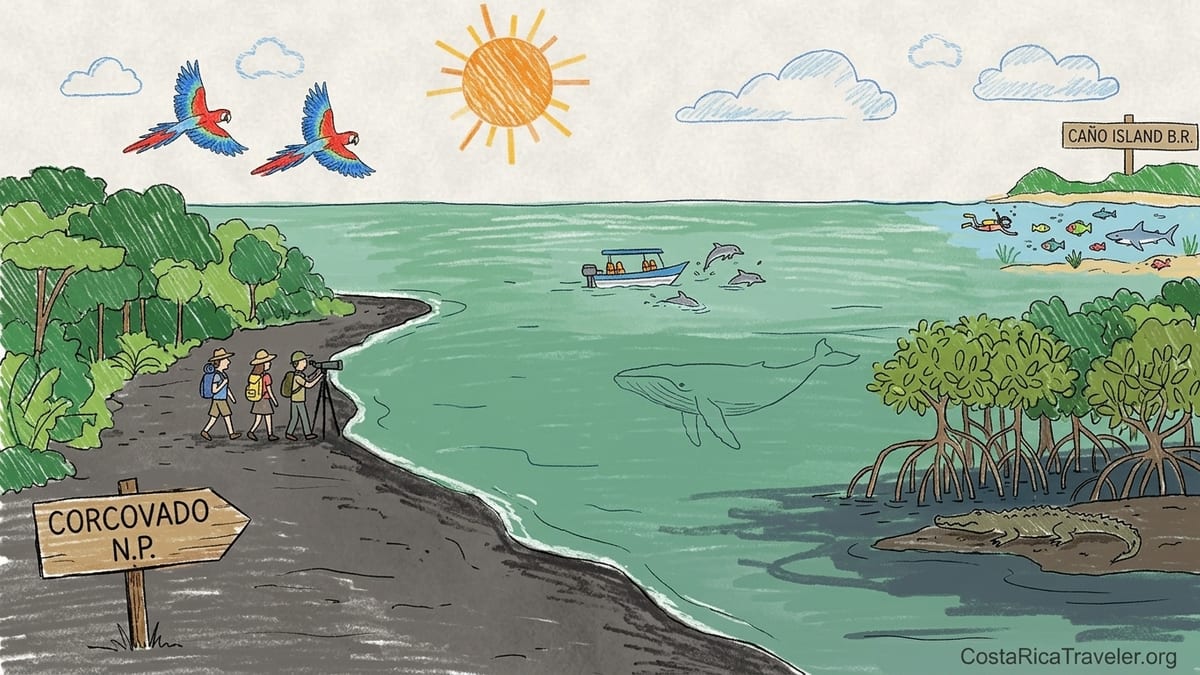
My South Pacific circuit focused on four core areas: Corcovado National Park, Piedras Blancas National Park on the Golfo Dulce coast, the mangroves near Sierpe, and the marine world around Caño Island Biological Reserve. Corcovado, Piedras Blancas and Caño are all managed under the ACOSA regional office of SINAC, and their reservation systems now run differently from many other Costa Rican parks. Before I even packed binoculars, I spent time on SINAC’s online services portal and the official park pages to confirm the latest rules, especially for Corcovado and Caño Island, where reservations are handled by email with payment by bank transfer rather than the standard online checkout system.
On the ground, this region feels more remote than the better‑known central Pacific. Distances are not huge, but road conditions, river crossings, boat transfers and tidal schedules turn a simple map into a day’s worth of logistics. What kept me committed through all of that was the promise of seeing intact lowland rainforest running all the way down to black‑sand beaches, mangroves threaded with quiet side channels, and a sheltered tropical gulf that still has resident dolphins and seasonal humpback whales. Each ecosystem offered different wildlife, and some demanded more effort than others.
Throughout this article, every sighting I mention is one I personally logged in my field notebook, usually with a time stamp. I will not claim jaguars, tapirs, monkeys or macaws simply because they live here. In my case, I did not see a jaguar or a tapir, and my macaw and monkey encounters happened only in specific places under specific conditions. The point is not to undersell the region, but to provide a clear, honest picture of what one careful visitor actually experienced.
Navigating Corcovado’s Rules and Realities
Corcovado National Park currently has six visitor sectors listed in official material: Sirena, San Pedrillo, La Leona, Los Patos, El Tigre and Los Planes. SINAC’s current English‑language page groups the first five as the core sectors open to visitors, and notes that Sirena usually closes to tourism for maintenance in October. All sectors require advance reservation, handled by email through the Corcovado reservations address, except El Tigre, which is arranged through a community association in Dos Brazos. A key rule that surprised some travelers I met is the explicit prohibition on swimming at park beaches because of strong currents; rangers repeated this on arrival and there were signs near the stations reinforcing it.
I entered Corcovado twice, both times with a registered local guide. The first visit was a long day hike into the La Leona sector in the dry season. Our group was four travelers plus the guide. We left Carate on foot at 6:05 a.m., walked roughly 3 kilometers along the beach at a leisurely pace, and then entered the official trail at the La Leona ranger station after checking permits. The trail itself was mostly flat, alternating between shaded forest and short stretches of open sand. Temperatures climbed quickly, and we were dripping with sweat by 8:30 a.m.
The second visit was an overnight at Sirena station arranged months ahead, again with a guide and with the correct SINAC reservation. Sirena sits in lowland rainforest near the middle of the park, reachable by boat from Drake Bay at mid‑tide. Our small group of five plus guide departed Drake Bay at 5:45 a.m. in a fiberglass boat with twin outboards, lifejackets on, dry bags stacked between our feet. The captain hugged the coast, and we landed through mild surf under the supervision of rangers. There was no swimming allowed, even though the long sweep of beach looked inviting.
In both sectors the rule that visitors should enter only through official access points was strictly applied. We met independent backpackers in Puerto Jiménez who were turned back because they had no guide and no confirmed reservation. SINAC staff in Puerto Jiménez emphasized that, for Corcovado, visitors should plan months ahead, especially for Sirena, and should expect to travel with a registered guide, even though the English wording technically phrases it as “preferably with a guide.” In practice, every visitor I saw on the interior trails was with a guide, and the rangers were clearly coordinating closely with the guiding community.
What I Actually Saw in Corcovado’s Lowland Rainforest
I will start with mammals, because they are what many travelers quietly hope for. On the La Leona hike, the only medium‑sized mammal I saw clearly was a northern tamandua, a small arboreal anteater with a cream body and black vest pattern. The sighting happened at 9:40 a.m. on a shady section of trail about 45 minutes past the station, with the animal about 7 meters up a vine‑tangled tree. My guide spotted it first with the naked eye and then set up a compact spotting scope. Alone, I would have walked past, because to me the animal looked at first like a dark knot in the canopy until it shifted its weight.
Bird life was much richer. Near La Leona station just after 7:00 a.m. we saw a pair of scarlet macaws flying over the beach, their calls arriving before their red and blue bodies crossed a patch of pale sky. That was my only macaw sighting inside Corcovado on this trip. On the Sirena trails later in the week, I saw a Baird’s trogon and a black‑cheeked ant‑tanager in dark understory close to the Sirena station. Both required help from the guide; in each case he heard the call first, then used a combination of hand signals and whispered directions to get the group to see the bird through binoculars. Without him, I would have listed them as “heard only.”
Monkeys were more cooperative near Sirena. Over the course of a morning loop that left the station at 5:30 a.m. and returned at 9:15 a.m., I saw white‑faced capuchins three times, all within 1 kilometer of the station along the Sirena and Espavel trails. One group crossed overhead, using vines as if they were horizontal ladders, at a distance of perhaps 15 meters. A second group was feeding quietly in a cecropia tree, and a third small group appeared near the airstrip clearing. Howler monkeys were heard before dawn but remained high in the canopy, seen only as moving silhouettes against a brightening sky. I did not see spider monkeys inside Corcovado on this visit, and I did not see tapirs, even on an evening walk to the Rio Claro. My guide mentioned that tapir sightings are currently less predictable than some online trip reports suggest.
Trail conditions in Sirena were muddy but manageable. We walked about 10 kilometers in total that first day, crossing several shallow streams in rubber boots. The guide carried a spotting scope, a laser pointer used briefly to direct our gaze, and a tablet with bird calls downloaded for identification. The one animal I am certain I would not have spotted alone was a spectacled owl roosting in deep shade about 20 meters off the trail. The guide knew a traditional roost site, scanned silently with binoculars for several minutes and then invited each of us to look through the scope. To my naked eye even the general shape of the roost tree blended into the forest wall.
Golfo Dulce and Piedras Blancas: Wildlife Along the Sweet Gulf
From Puerto Jiménez I crossed the Golfo Dulce by boat to a small lodge along the Piedras Blancas National Park coastline. The gulf itself is a deep, sheltered tropical embayment framed by Corcovado on one side and Piedras Blancas and other protected areas on the other. Several operators based around the gulf advertise dolphin and whale watching. I chose a modest half‑day boat tour arranged through a local outfit that works along the Piedras Blancas shore rather than a large catamaran from Golfito.
We left the lodge’s small dock at 7:15 a.m. in calm conditions, with four guests plus captain and naturalist guide. Within 40 minutes, about halfway across the gulf, we encountered a small group of pantropical spotted dolphins. The captain cut the engine to idle as the animals approached the bow, surfacing and diving in loose synchrony. The guide estimated roughly 20 individuals, but I saw at most 10 at once. Later that morning, closer to the Piedras Blancas coast, we saw a second group of bottlenose dolphins traveling parallel to our boat. No whales appeared on this particular morning, although operators in the area reported humpback sightings during the same season.
The shoreline of Piedras Blancas delivered some of my best birding of the trip. Cruising slowly along forested points around 9:30 a.m., we watched brown pelicans plunge‑diving for fish, magnificent frigatebirds circling higher overhead, and several pairs of black hawks perched on rocky outcrops. The guide carried only binoculars, no scope, but the birds were close. At one small inlet he pointed out a pair of yellow‑crowned night herons stalking the tide line, something I would have missed while scanning the deeper water for dolphins.
On land, I joined a guided hike into Piedras Blancas proper. The entrance we used was effectively a backdoor reached by boat, landing on a gravel beach and stepping directly into lowland rainforest. Our group was just three guests with one guide. We started hiking at 2:00 p.m., a hot hour that kept bird activity modest, but the forest felt denser and less trafficked than the Sirena trails. Within 20 minutes the guide located a small group of spider monkeys moving through the middle canopy, about 25 meters up. This was my only clear spider monkey sighting of the entire South Pacific trip, and it happened outside Corcovado, not inside.
The trail here was narrow, at times slippery with leaf litter and exposed roots, but there were few steep sections. We walked for roughly 3 hours, covering approximately 5 kilometers in an out‑and‑back route with frequent stops. The animal I most likely would have missed alone was a tiny glass frog clinging to the underside of a broad leaf near a creek crossing. The guide used a handheld flashlight to highlight its translucent skin against the dark background and explained that he checks this particular patch of vegetation on most afternoon walks. Without that micro‑local knowledge, I would never have thought to look there.
Mangroves and River Mouths: Quiet Water, Subtle Wildlife
From the busy pier near the town of Sierpe I joined a small‑boat tour into the surrounding mangrove estuary. This area is a major jumping‑off point for travelers heading to Drake Bay and Caño Island, but it is also worth its own slow exploration. We departed at 7:00 a.m. on a covered fiberglass boat with a shallow draft, carrying eight guests and one naturalist guide. The first part of the route followed the main river channel, then veered into narrower side creeks flanked by red and black mangroves whose roots formed tangled lattices above the tidal mud.
Mangroves rarely deliver the charismatic megafauna that forests and reefs can provide, but they reward patience. Our most dramatic sighting came within the first hour, when the guide pointed out an American crocodile hauled out on a sunny bank, about 20 meters from the boat. The animal was perhaps 2 to 2.5 meters long, though I did not attempt to measure it. The captain kept a respectful distance and reduced speed to a crawl. Later, in a shaded creek, we watched a trio of boat‑billed herons perched motionless above the water, their oversized bills and hunched posture giving them a slightly prehistoric look.
Bird life continued to accumulate in my notebook: a ringed kingfisher streaking low over the water, several white ibises probing the shallows, and a yellow‑headed caracara patrolling the edge of cattle pasture where the mangroves gave way to drier land. None of these birds are rare, but the combination of close range and the guide’s practiced eye made them feel newly interesting. He carried only binoculars and a laminated bird chart, and yet he consistently called out species long before the rest of us noticed movement.
The water was calm, with only minor chop where the river neared its mouth and met Pacific swells. Trail conditions did not apply here, but the equivalent factors were tides and boat traffic. The guide had scheduled our departure to catch a medium tide, enough water to navigate narrow creeks without leaving too late in the day, when motor noise and heat tend to mute wildlife activity. Traveling alone in a rental kayak, I might have enjoyed the solitude, but I doubt I would have located the exact side channels where the boat‑billed herons roosted or the sandbanks favored by basking crocodiles.
Caño Island Marine Life: What Lived Under the Surface
Caño Island Biological Reserve is tightly regulated under SINAC. Current information from both SINAC and the national tourism board confirms that visitors must secure a reservation in advance via the same Corcovado reservations email address, and that entry is only allowed with a local guide registered under ACOSA’s sustainable tourism program. Operators in Drake Bay and Uvita typically bundle the reserve fee, boat transport and guiding into a single day tour. Picnic food is not allowed on the island, and access is usually limited to a small beach area and nearby trails, with strict time slots for snorkeling or diving.
I joined a snorkel trip from Drake Bay that included two water sessions and a brief landing on the island for a controlled walk. Our group was 10 snorkelers plus captain and two guides, one of whom stayed in the water with us. We left Drake Bay around 7:30 a.m. under overcast skies that gradually cleared. The crossing took about an hour in moderate swell. Park rules required that everyone wear a lifejacket while the boat was underway and that we remain with the guide during all activity inside the reserve boundaries.
The first snorkel site lay just off a rocky point on the south side of the island. In the first five minutes I saw a white‑tip reef shark, about 1.2 meters long, resting on the sandy bottom at an estimated depth of 10 meters. The in‑water guide was the first to signal it, diving to point gently in the shark’s direction. I would not have noticed it unaided, because its body color nearly matched the substrate. Over the course of a 35‑minute session, I also saw several Pacific sergeant majors, blue‑and‑yellow surgeonfish, a pair of Moorish idols, and a small school of big‑eye jacks flickering in mid‑water. Coral cover was patchy but present, with boulder corals and scattered branching structures.
The second site, on the north side of the island, offered clearer water but stronger surface chop. There I saw a hawksbill sea turtle cruising along the reef slope at arm’s length from the guide, who maintained a respectful distance and reminded the group not to attempt to touch or chase it. The turtle surfaced for air twice within 10 meters of our cluster of snorkelers before descending again. I also saw a spotted pufferfish and several pairs of butterflyfish grazing near the coral. No dolphins or large pelagic species appeared during our visit, although other boats reported occasional encounters in the general area during the same season.
On land at Caño Island, the guided walk was tightly timed. We followed a short loop trail through low forest in a group of about 12, staying on a well‑maintained path with some stone steps. The guide pointed out hermit crabs at the forest edge, a pair of ruddy ground doves on the path, and one small anole lizard on a tree trunk. The wildlife highlight on land was auditory rather than visual: the overlapping calls of various birds in the canopy created a layered soundscape, but with our limited time and the group size we identified only a few species with confidence.
Night Walks, Trail Conditions and What Guides Really Added
Across the region, the fullest wildlife experiences often happened in the dark. I joined a night walk near Drake Bay, technically outside the national park boundaries but in contiguous forest that functions as part of the same ecological corridor. We set out at 7:15 p.m. in a group of six with one local guide. Each participant carried a headlamp, and the guide used a brighter handheld light with a narrow beam. The trail was a simple farm track, muddy in places, with short inclines and stream crossings.
In a two‑hour circuit, I saw two species of tree frog, including a red‑eyed tree frog clinging to the underside of a broad leaf about 1 meter off the ground. I also saw a kinkajou moving rapidly through the mid‑canopy, visible only as a backlit outline and reflected eyes when caught in the beam. The guide was responsible for every single sighting. He knew which drainage ditches to check for frogs, he could read the rustling of leaves above us and separate wind from an animal’s passage, and he adjusted the group’s pace constantly to keep noise low.
Trail conditions throughout the trip varied from firm sand to ankle‑deep mud. In Corcovado’s Sirena sector, rubber boots were essential during the wettest parts of the day, whereas on the La Leona coastal trail sturdy hiking shoes were enough. Around Golfo Dulce and Piedras Blancas, even short trails could be slick after a passing shower, and many lodges now keep a rack of loaner boots for guests. The combination of heat, humidity and uneven footing made even modest distances feel longer than the map suggested. A 10‑kilometer day in this environment demanded far more effort than the same distance on a maintained trail in a temperate park.
Looking back at my field notes, I can see clearly which sightings would not have happened if I had walked alone. In Corcovado, the spectacled owl, the black‑cheeked ant‑tanager and the northern tamandua were all guide‑dependent. In Piedras Blancas, the glass frog and the spider monkeys would likely have gone undetected. In the mangroves, the boat‑billed herons and distant crocodile would simply have been indistinct shapes without context. Underwater at Caño Island, the reef shark and turtle both required a guide’s gestured directions at first. Guides also navigated the human side of the experience, from checking in at ranger stations with the correct paperwork to adjusting routes when a sector closure or tide made the original plan impractical.
The Takeaway
Traveling the South Pacific coast of Costa Rica is not logistically simple. Corcovado’s reservation‑by‑email system for key sectors, the separate handling of Caño Island permits, the requirement to work with registered guides, and the combination of boat, 4x4 and foot travel can make a short itinerary feel like a small expedition. Weather and tides add more variables. At several points in my planning process I considered switching to an easier region with online reservations and paved access roads.
What justified the effort was not a single dramatic encounter but a sustained immersion in intact ecosystems that still function on their own terms. In Corcovado’s lowland rainforest I saw monkeys moving along unbroken canopy, owls that still have deep shade to vanish into, and beaches where human activity is limited enough that authorities can credibly enforce a no‑swimming rule for safety. Around Golfo Dulce and Piedras Blancas I watched dolphins hunting in calm, green water backed by continuous forest, and I walked trails where a glass frog, a kinkajou or a troop of spider monkeys could appear without feeling like staged attractions.
On Caño Island, the mix of reef fish, sharks and turtles in relatively clear water reminded me that pockets of healthy marine life still exist in heavily visited parts of the tropics, provided that strict limits on access and behavior are respected. The mangroves near Sierpe, with their quiet side channels and patient herons, illustrated how much wildlife can persist when an estuary is allowed to flood and drain on its natural schedule rather than being converted entirely to pasture or shrimp ponds.
If you are considering this region, the most important step is to align expectations with reality. You may not see a jaguar or a tapir. You may, as I did, have mornings where the forest feels mostly quiet apart from cicadas and far‑off howlers. But if you are willing to move at the slow pace that the climate and trail conditions demand, to accept the structure of guided access that SINAC currently requires for Corcovado, Piedras Blancas and Caño Island, and to keep meticulous track of what you actually see rather than what you hoped to see, the South Pacific can still deliver one of the most grounded wildlife experiences in Central America.
FAQ
Q1. Do I really need a guide to visit Corcovado National Park?
For interior sectors such as Sirena, San Pedrillo, La Leona and Los Patos, every visitor I saw was with a registered local guide, and official information strongly recommends guided access. Reservations are managed directly through SINAC rather than the general online portal, and guides are closely integrated into that process. In practical terms, if you want to hike interior trails and maximize wildlife sightings, you should budget for a guide as essential, not optional.
Q2. How far in advance should I book Corcovado and Caño Island?
For Sirena overnights and high‑season dates, operators and local guides in Puerto Jiménez and Drake Bay advised planning several months ahead, especially between December and April. Caño Island reservations are currently handled by email through the same SINAC office that manages Corcovado, with a separate payment process. Space is limited each day, so once you know your travel window it is wise to secure spots before arranging nonrefundable flights or hotels.
Q3. Is swimming allowed on the beaches inside Corcovado?
No. SINAC’s current rules and on‑site signage clearly state that swimming at park beaches is prohibited because of strong currents and safety concerns. Rangers at La Leona and Sirena reiterated this rule during my visits. You can walk the beaches, but you should plan to cool off with showers at ranger stations or at your accommodation outside the park rather than in the surf.
Q4. What kind of physical condition do I need for the La Leona and Sirena hikes?
The La Leona sector day hike involves several hours of walking on a mix of sand and forest trail in hot, humid conditions. Sirena’s interior trails are mostly flat but can be muddy, with stream crossings and slippery roots. If you can comfortably walk 10 to 12 kilometers on uneven ground in warm weather, you should manage with a guide’s pacing and regular water breaks. People with knee or balance issues may find the combination of heat and mud particularly challenging.
Q5. What gear made the biggest difference for wildlife viewing?
Lightweight binoculars and rubber boots were the most useful items. Guides often carry spotting scopes, but having your own binoculars lets you linger on birds and mammals after the group has moved on. Rubber boots, which many lodges loan, turn deep puddles and shallow stream crossings into minor inconveniences rather than trip‑ending obstacles. A headlamp is essential for night walks, and a dry bag keeps cameras and notebooks safe on boat transfers to Sirena, Golfo Dulce and Caño Island.
Q6. Is Golfo Dulce worth visiting if I already plan to see Corcovado?
Yes. Golfo Dulce offers a different perspective on the region’s wildlife, especially marine mammals and coastal birds. On a single morning boat trip I saw pantropical spotted dolphins, bottlenose dolphins, pelicans, frigatebirds and coastal raptors along the forested shoreline of Piedras Blancas National Park. The gulf is also significantly calmer than open Pacific waters, which can make wildlife viewing more comfortable for visitors prone to seasickness.
Q7. How strict are the rules at Caño Island Biological Reserve?
They are taken seriously. Access is limited to visitors with advance reservations, traveling with registered local guides. Boats anchor only in designated areas, snorkeling and diving happen within set zones and time windows, and picnics are not allowed. During my visit, guides enforced no‑touch policies around marine life and kept the group together at all times. These restrictions can feel formal, but they help protect a relatively healthy reef and keep the experience from turning into a crowded free‑for‑all.
Q8. Can I visit mangroves and still see interesting wildlife without a park entry?
Yes. The Sierpe mangrove estuary, for example, can be explored on guided boat tours that do not require a separate SINAC park ticket. On my morning trip there I saw an American crocodile, boat‑billed herons, kingfishers, ibises and various raptors from the comfort of a small covered boat. While the scenery is less dramatic than Corcovado’s interior, the close‑range views and gentle pace make it a rewarding complement to more strenuous hikes.
Q9. What surprised you most about wildlife expectations versus reality?
I was surprised by how variable high‑profile species were. Despite Corcovado’s reputation, I did not see tapirs or cats, and my macaw sightings inside the park were limited to a single flyover pair near La Leona. In contrast, I had excellent views of spider monkeys in Piedras Blancas and a wide range of frogs, reptiles and birds on night walks and mangrove tours. The region delivered rich biodiversity, but not always in the headline species or locations I had expected.
Q10. If I have limited time, which single base makes the most sense?
For a first‑time visitor with 4 to 5 days, Drake Bay is a strong all‑around base. From there you can access Corcovado’s Sirena or San Pedrillo sectors with a guide, take day trips to Caño Island for snorkeling, and join nearby night walks in secondary and primary forest. If your priority is Golfo Dulce and Piedras Blancas, basing near Puerto Jiménez or along the gulf’s eastern shore can work better. In all cases, plan logistics around current SINAC reservation rules and tide‑dependent boat schedules rather than trying to improvise on arrival.