


On a clear October morning in 2026 I finally booked the Cahuita reef snorkeling trip I had seen romanticized for years in brochures and social media posts. In those images, the Caribbean off Costa Rica’s southern coast was always a pane of turquoise glass over brilliant coral gardens and slow-gliding turtles. What I found in the water was more complicated, sometimes beautiful, sometimes unsettling, and far less polished than the marketing suggested.
A Real Snorkel Trip: Date, Operator, Cost And First Impressions
On October 24, 2026, I joined a morning community-operated snorkeling tour from Puerto Viejo to Cahuita National Park on Costa Rica’s southern Caribbean coast. The operator was a small local company that runs several daily departures to the park and posts regular visibility and safety updates for the area. Recent posts that week mentioned visibility above 90 percent and calm conditions inside the reef, enough to convince me this was the moment to see what the hype was about.
The tour cost 55 US dollars per person, in line with independent price checks that put authorized Cahuita reef snorkel trips in the 35 to 55 dollar range in 2026 for foreigners, including mask, snorkel, fins, life jacket and national-park certified guide. I paid in cash at the operator’s small office near the main street in Puerto Viejo, though card payment was also possible. The price covered transport to Cahuita town, the boat, an in-water guide and fruit afterward. Park entry itself is handled separately through the community contribution at the Playa Blanca entrance, a system that directs funds back into Cahuita’s local management of the park.
We left Puerto Viejo shortly after 8:00 a.m. in a van for the 20-minute drive to Cahuita, arriving at the small riverside dock near the Kelly Creek ranger station. The mood in the group of eight was upbeat. Several guests talked excitedly about “seeing the big reef” and “all the colorful coral” they had seen in promotional images. No one mentioned disease, sediment or algae. It struck me that the sales language we had all absorbed framed this experience as a guaranteed postcard, not an encounter with a stressed ecosystem in flux.
At the dock, our two guides checked our names against a manifest and handed out gear. They emphasized that independent snorkeling from the beach is prohibited inside Cahuita National Park and that all snorkeling must be done by boat with a certified local guide. This is not a mere suggestion. It is written into park regulations and reinforced on official materials, both to protect fragile coral structures and to manage visitor impact in clearly defined zones.
The Boat Ride To Punta Cahuita And Water Conditions That Morning
By 8:45 a.m. we were skimming out of the small river mouth and turning southeast along the coast toward Punta Cahuita. The boat was a fiberglass panga with a sun canopy, bench seating, and racks for lifejackets. From the water, the national park’s shoreline looked serene: a continuous green wall of coastal forest over white sand, almost no buildings visible. It was easy, at this distance, to believe all the marketing about an untouched Caribbean paradise.
The ride to the reef took about 15 to 20 minutes. Sea conditions were moderate, with a gentle swell from the northeast and almost no wind. The captain aimed to keep us inside the protective arc of the reef where waves broke further offshore. The guides explained that on days with heavier swell, tours are either shortened or cancelled because the same waves that create dramatic whitewater outside also stir up the lagoon, reducing visibility and pushing inexperienced snorkelers onto coral.
As we approached the first snorkeling site off Punta Cahuita, the water changed from river-stained greenish brown near shore to a milky turquoise. From the boat, I could not clearly see the bottom even in water only three to four meters deep. The guide measured visibility with a weighted line and announced about eight to ten meters horizontally: good enough to run the tour, but not the crystal clarity implied in many Instagram photos. He mentioned that because this coast sits near river mouths and seagrass beds, even “good” days rarely match the gin-clear conditions of more remote Caribbean islands.
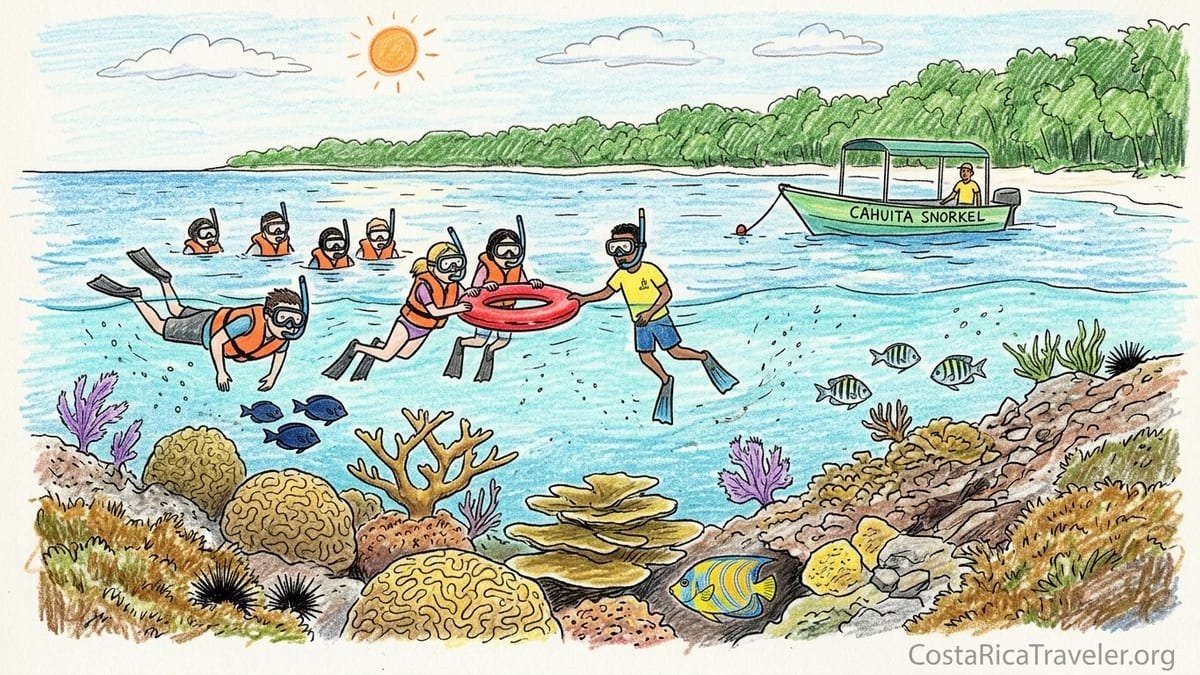
We anchored in a designated mooring area rather than dropping anchor on the reef itself. One guide stayed on the boat as captain, while the in-water guide entered first with fins and mask, carrying a bright flotation ring for less confident swimmers. Everyone wore lifejackets by default, though a few experienced snorkelers, myself included, were allowed to slip ours partially off once in the water for better mobility, as long as we kept them close and followed instructions.
What I Actually Saw Underwater: Coral Forms, Fish, Algae And Damage
Sliding off the side of the boat, my first visceral impression was temperature: the water felt warm, edging toward what snorkelers often describe as bath-like. That warmth is pleasant for tourists but is one of several stress factors for tropical corals when combined with global marine heatwaves. Still, I reminded myself not to diagnose anything based on feel alone. Warmth is a sensation, not a data set.
At roughly three to five meters deep, the reef structure was immediately visible as irregular mounds and ridges rather than a continuous wall. I recognized brain-like coral heads, branching elkhorn forms in scattered stands, and flat plates stacked like terraces. Many were clearly alive, with textured surfaces and muted browns, yellows and olives rather than the neon saturation you see in edited photographs. Between the coral blocks grew patches of seagrass and sponges, some barrel-shaped, others encrusting, along with dark purple sea fans swaying with the surge.
Fish life was present but not overwhelming. I followed a small school of blue tangs grazing near a boulder, watched sergeant majors patrol around us, and saw a couple of queen angelfish flash their yellow-and-blue pattern before disappearing into crevices. Parrotfish, the lawnmowers of Caribbean reefs, crunched audibly on the reef surface. Yet there were also long stretches where the substrate felt quieter, with fewer fish than the promotional photos that cluster charismatic species into one frame.
The less photogenic reality was in the substrate between the prettier coral heads. In some areas, the bottom looked carpeted by brown and green macroalgae, forming fuzzy mats on dead coral rock. In others, the coral skeletons were clearly eroded or broken, forming rubble slopes. Our guide pointed out storm damage from past swells and insisted we keep fins high to avoid stirring sediment onto living coral. In a few spots I saw pale or patchy areas on coral colonies. Without a scientific survey, it was impossible to know if these were active disease lesions, recovery scars, or some other condition. I was aware of recent research documenting coral diseases in the southern Caribbean of Costa Rica, including the presence of multiple disease types in 2023, but I could not label what I saw under my mask with any certainty.
Older Science, Current Pressures And What Has Changed At Cahuita
Cahuita’s reefs have been studied for decades. Long-term monitoring at Meager Shoal, one of the park’s well-known sites, began in the late 1990s as part of a Caribbean coral monitoring program. Those records showed changes in coral cover, macroalgae and herbivorous sea urchins over time. Earlier work described how increased sediment from rivers and coastal development affected the reef, along with episodes of coral mortality related to storms and warming events. At one point, the nearshore sections around Cahuita were already considered among the more impacted reefs in Costa Rica.
That historical context matters, because it means today’s snorkelers are not visiting an untouched system suddenly facing new problems. They are drifting above a reef that has been in a long negotiation with sediment, storms, thermal stress and human activities. Peer-reviewed studies from the 2000s and 2010s documented how terrigenous sediment from the mainland, carried by rivers, reduced water clarity and could smother coral if not flushed away by currents. Other research in the southern Caribbean pointed to macroalgae proliferation when grazing pressure or water quality shifted, and to the importance of herbivores like the black sea urchin Diadema antillarum in keeping algal biomass in check.
More recently, a 2023 study surveyed several southern Caribbean sites, including Cahuita, for coral disease and noted multiple disease types present across the region. The authors discussed links between disease prevalence and factors such as coral cover, local water quality and protection status. They also highlighted the arrival of Stony Coral Tissue Loss Disease in the broader Caribbean region, a fast-moving disease that has devastated reefs elsewhere, and recommended continuous monitoring of parameters like temperature, nutrients and sedimentation. That kind of science reinforces what you start to sense as a visitor: any snapshot view is just one moment in a long, ongoing stress story.
Crucially, what I saw on October 24, 2026 was not a direct reflection of those earlier measurements or even the 2023 disease surveys. Conditions on any given day at a specific snorkel site depend on very immediate factors: whether a river plume passed through the lagoon the night before, how strong the swell is breaking on the outer reef, and even how many boats have already visited that mooring that morning. Science helps interpret patterns and pressures, but it does not guarantee that a traveler in any particular week will see bright coral or degraded coral in the same proportions researchers measured in years past.
Visibility, Swell And Why Tours Sometimes Disappoint Or Cancel
Guides in Cahuita talk constantly about “visibilidad” for good reason. In September 2026, local operators publicly cancelled some snorkeling departures because river currents had pushed a heavy plume of sediment-laden water over parts of the reef, turning everything a murky brown and cutting visibility dramatically. In their updates they described visibility dropping enough that even on the reef itself, guests would see little beyond their own hands. On those days, running a tour would be taking people’s money for a frustrating swim over a brown haze.
Even in drier months or calmer spells, visibility is rarely as perfect as the images we are sold. On my October trip, horizontal visibility around ten meters meant I could see the guide and immediate surroundings, but the water had a constant suspended shimmer. Every kick of a fin near the sand sent a puff of silt upward that took several seconds to settle. In slightly deeper pockets or near channels, the water occasionally darkened with a passing cloud of sediment from elsewhere in the lagoon.
This matters in practical ways. On days with noticeable swell, guides may limit the number of sites visited or shorten in-water time to avoid fatigue and seasickness. When the swell angle and river outflow combine badly, some operators quietly shift focus to the national park trail and beach instead, or offer to reschedule. Cancellation policies reflect this uncertainty: many community-based operators will cancel morning departures if early safety checks show poor visibility, strong surge over the reef, electrical storms or heavy rain. Some, like the operator I used, post same-day updates about whether tours are running, while others inform guests by messaging apps.
As a traveler, it is easy to mistake this variability for poor service. In reality, it is an honest acknowledgement that the Caribbean here is an active, river-influenced nearshore system, not a resort pool. If you fix your expectations on “perfect blue” every day, even a responsible cancellation can feel like a broken promise. That disconnect between ecological reality and tourism marketing is where many complaints about Cahuita snorkeling begin.
Marketing Imagery Versus What Most Snorkelers Actually See
The brochures and hotel websites that first put Cahuita on my radar showed classic Caribbean fantasy scenes: a lone snorkeler hovering motionless over a technicolor coral garden in water so clear it seemed to glow from within. Large green turtles and eagle rays floated in from the edges, schools of vivid fish swarmed together in impossible density, and there was not a single particle of sediment visible in the frame.
Those images are not exactly fake, but they are curated moments taken under very specific conditions and often boosted by careful editing. They tend to be shot at the calmest time of year, at the clearest hour of the morning, on the most intact patches of reef, and then presented as if they represent the entire experience. In some cases, regional imagery from clearer Caribbean destinations is used generically to sell “Caribbean snorkeling” in Costa Rica without stating that the photo is not from Cahuita at all.
On my trip, I saw pretty coral heads and colorful fish. I also saw long stretches of algae-covered substrate, broken coral rubble and slightly cloudy water. I did not see a turtle or ray. The reef was still interesting, sometimes beautiful when a shaft of sun caught a sea fan just right, but it bore little resemblance to the hyper-saturated photos on the tour office wall. Had I come expecting those exact scenes, I would have left deeply disappointed. Instead, I left with questions about why we keep marketing aging, stressed reefs as eternal postcards.
There is a subtler issue too. When promotions imply that every snorkel session will yield perfect photos of iconic species, they encourage a form of check-list tourism that can be rough on fragile sites. Guests chase turtles for close-ups, stand on coral to steady themselves for photos, or cluster tightly over a single patch of reef. Park regulations explicitly remind visitors not to stand on corals and to follow guides, but the pressure to come home with images matching the brochure can nudge people to ignore that guidance. The marketing does not cause the ecological stress, but it shapes visitor behavior in ways that can worsen it.
How Community-Run Snorkeling Works: Guides, Rules, Gear And Group Size
Cahuita National Park is unusual in Costa Rica because its marine sector is co-managed with the local community. Official information from the park and recent Caribbean region tourism materials emphasize that local guides are trained through Costa Rica’s National Training Institute and accredited by the national tourism board. Snorkeling from the beach is forbidden; all visitors must use small boats operated by authorized community or regional companies, and they must be accompanied by a certified guide inside the water.
In practice, this means that most travelers book through either a Cahuita-based operator or a Puerto Viejo-based company that partners with local captains. Departures are usually in the morning, with check-in times around 8:00 or 8:15 a.m. for a several-hour combined snorkeling and hiking package. Group sizes tend to stay in the single digits or low teens per boat, often with one in-water guide for every six to eight guests and a separate boat captain. Some higher-priced tours advertise smaller groups, private departures and more flexible schedules.
Standard gear includes mask, snorkel, fins and mandatory flotation. Many operators provide full lifejackets; some use lighter snorkel vests. Guests who are not confident swimmers can hold onto a lifebuoy ring or floating line pulled by the guide. The emphasis on flotation is not only about safety but also about reducing contact with the reef. Good buoyancy is one of the most effective forms of coral conservation a casual snorkeler can practice, because a body held a few centimeters too low can mean fins scraping fragile structures with every kick.
Cancellation and rescheduling policies vary, but nearly all local operators reserve the right to cancel if conditions are judged unsafe or visibility is too poor to offer a meaningful experience. Some give partial refunds, others offer free rescheduling within a window of days. A few tours bundle park snorkeling with other activities, such as a guided hike or a visit to another attraction, which can proceed even if the water portion is shortened. Prospective guests should ask directly how operators handle river plumes, strong swell and early-morning rain, and should not interpret a weather-based cancellation as a scam. In a system this dynamic, honest no-go decisions are part of responsible guiding.
Snorkeling Value Versus Cahuita’s Rainforest Trail And Beaches
With a 55 dollar price tag for snorkeling on my specific tour and an additional voluntary park entrance contribution, the per-person cost of the marine experience is not trivial, especially for budget travelers. By contrast, walking the coastal trail inside Cahuita National Park from the Playa Blanca entrance costs only that voluntary contribution, often around 5 dollars, and offers several hours of wildlife-rich exploration if you move slowly. Guided hikes along the same trail, booked through local operators or independent guides, typically cost significantly less than a boat-based snorkel trip while delivering a high chance of seeing sloths, monkeys, raccoons, coatis and a wide range of birds.
On the afternoon after my snorkeling session, I walked a portion of the park trail from Kelly Creek toward Puerto Vargas. Within the first hour I had watched white-faced capuchin monkeys foraging in the canopy, seen two sloths (one moving, one a bundled silhouette), and spotted several species of herons along the mangrove edges. The trail hugged the beach, offering glimpses of the same reef line I had just floated above, but from the shade of coastal forest. If I had to measure experiences strictly by wildlife per dollar, the trail would win.
Yet comparing the two experiences purely on price misses what snorkeling still uniquely offers. Floating over Cahuita’s reef, even in its stressed state, gave me a visceral sense of how corals, seagrass, fish and algae fit together as a three-dimensional seascape. I saw parrotfish scraping at old coral skeletons, clouds of sediment billowing with each bite, and herbivores making space for new growth. I watched sea fans bending with the surge like underwater trees. The rainforest and beach show you one side of the park’s biodiversity; the reef, imperfect as it is, shows you another.
If your budget forces a choice, you will likely see more charismatic wildlife and enjoy more flexibility by investing in the rainforest trail and beach experience, possibly with a guide to deepen your understanding. If you can afford both, I would frame snorkeling not as a guarantee of colorful photos but as a chance to witness a living system under pressure. When marketed honestly and priced transparently, the reef experience still has value that is different from, not better than, the land-based side of Cahuita.
How To Snorkel Here Without Adding To The Damage
Walking back through Cahuita town after the tour, the contradiction was obvious: souvenir stands sell the park as an unblemished Eden, while the reef itself shows every sign of long-term stress. As a visitor, it is easy to feel powerless in the face of large-scale forces like climate warming and watershed management. Yet there are small, concrete behaviors each snorkeler can adopt to reduce direct harm.
First is buoyancy control. Whether you are a strong swimmer or not, listen carefully to the guide’s instructions on how to use the provided flotation. Keep your body horizontal at the surface, extend your legs behind you, and practice gentle kicks that move water backward, not downward. The goal is never to let your fins touch coral or even stir up sand over living structures. If you feel tired or unsteady, grab the guide’s flotation ring instead of trying to stand. In shallow areas, a single misplaced step can crush years of growth.
Second, keep your hands and gear away from the reef. Do not touch corals, sponges or sea fans, even if they look like rocks. Oils, sunscreen residues and physical pressure can all damage delicate tissues. Avoid standing on or holding onto coral heads while adjusting your mask. If you need to rest, signal the guide and move back toward deeper water or the boat. Choose reef-safe sunscreen applied well before entering the water, or better yet, rely on long-sleeve swim shirts and physical barriers to reduce chemical load in the lagoon.
Finally, follow local guidelines in spirit, not just in letter. If your guide asks the group to spread out, do it, even if it means you are farther from the best photo angle. Respect distance from wildlife, including turtles if you are lucky enough to see them, and do not chase or block their path to the surface. Remember that guides carry both livelihood and stewardship responsibilities. Supporting those who enforce good practices, even when it means fewer dramatic selfies, is one of the more meaningful contributions a short-term visitor can make.
The Takeaway
So, was Cahuita reef snorkeling worth it for me on that late-October morning in 2026? Financially, I felt the 55 dollars bought a mixed experience: solid guiding, a safe introduction to an important Caribbean reef, and an honest look at an ecosystem under cumulative stress, but not the vibrant “aquarium” that continues to appear in tourist marketing. If I had come only for postcard colors and guaranteed turtles, I would have been disappointed. Because I came curious about reality, I left thoughtful rather than thrilled.
The marketing claims that deserve the most skepticism are those that portray Cahuita’s reef as uniformly pristine, promise clear water and perfect visibility every day, or imply that iconic megafauna like turtles are a near certainty on any given tour. The reef I saw had living coral, schools of fish and underwater beauty in flashes, but it also had clouded water, damaged structures and signs of long-running pressure. None of that should be surprising given what science has documented about sedimentation, warming, disease and historical disturbance in the southern Caribbean.
Yet to dismiss Cahuita’s marine side entirely because it is not the fantasy version would be to miss its deeper value. Snorkeling here is a front-row seat to how a community-managed park navigates both tourism and conservation, and how a reef persists, changes and sometimes recovers in less-than-ideal conditions. It is also a reminder that honest expectations are a form of respect: for the ecosystem, for the guides who know it intimately, and for your own experience as a traveler. Go in expecting complexity, not perfection, and you may find that even an ecologically stressed reef can be worthwhile.
FAQ
Q1. Is snorkeling in Cahuita National Park still worth the money in 2026?
For travelers who value understanding real reef conditions and supporting community-led conservation, yes, it can be worth the 40 to 60 US dollars many operators charge today. If your only goal is postcard-perfect coral gardens and guaranteed turtles, you may feel that the price does not match the imagery you have seen.
Q2. How clear is the water usually for snorkeling at Cahuita?
Water clarity varies a lot because the reef sits near river mouths and shallow seagrass beds. On good days visibility can reach around 8 to 12 meters, but after heavy rain or strong river outflow it can drop sharply, leading some operators to cancel tours.
Q3. Why does some of the coral at Cahuita look brown, patchy or covered in algae?
What you see is the result of multiple pressures over time, including sedimentation, warming events, storm damage and competition with macroalgae. Without detailed scientific assessment, you cannot diagnose specific causes by appearance alone, but it is fair to say the reef shows signs of long-term stress.
Q4. Do I need a guide, or can I snorkel from the beach on my own?
You cannot legally snorkel the main reef independently from the beach inside Cahuita National Park. The marine sector requires visitors to use authorized boats and certified local guides, both for safety and to protect fragile coral areas.
Q5. How big are the snorkeling groups, and will I get personal attention?
Group sizes are typically small to medium, often around six to twelve people per boat, with one in-water guide and a captain. You will get basic supervision and safety support, but it is not a private lesson unless you specifically book a private or small-group tour.
Q6. What happens if swell or rain makes visibility poor on the day of my tour?
Responsible operators will cancel or shorten tours when visibility or sea conditions make snorkeling unsafe or unproductive, and they may offer rescheduling or partial refunds. Check the company’s policy before booking and monitor same-day updates if they provide them.
Q7. How does the snorkeling experience compare to walking the park’s rainforest trail?
The trail and beaches often provide more visible wildlife for less money, especially if you hire a local guide, while snorkeling reveals the underwater side of the ecosystem. They offer different kinds of value, and if you can afford both, combining them gives a fuller picture of Cahuita.
Q8. Are turtles and rays common sightings on Cahuita snorkel trips?
They are possible but by no means guaranteed. You may see turtles, rays or larger fish on a given day, but many snorkel sessions pass without encounters with big charismatic species, despite what some promotional photos suggest.
Q9. What can I personally do to minimize my impact while snorkeling?
Use the required flotation, keep your body at the surface with gentle kicks, avoid touching or standing on any reef structure, choose reef-safe sunscreen or sun-protective clothing, and follow your guide’s instructions about distance from wildlife and fragile areas.
Q10. If I only have one day, should I choose snorkeling or the hike and beach?
If budget and wildlife-viewing odds are your main concerns, the hike and beach with or without a guide may be the better choice. If you are especially interested in marine ecosystems and willing to accept variable conditions, snorkeling can add a valuable, if imperfect, perspective on Cahuita’s coastal environment.