


I arrived in Costa Rica thinking I could "do the whole Pacific" in two weeks. On paper it looked elegant: land in Liberia for Guanacaste’s dry, golden beaches, drop down to the Central Pacific around Manuel Antonio, then keep going south to the Osa Peninsula’s dense rainforest and remote bays. In practice, it meant six hotel changes in fourteen nights, three long transfer days and one brutally early domestic flight. By the time I flew home, I loved individual places but knew I would plan the time very differently.
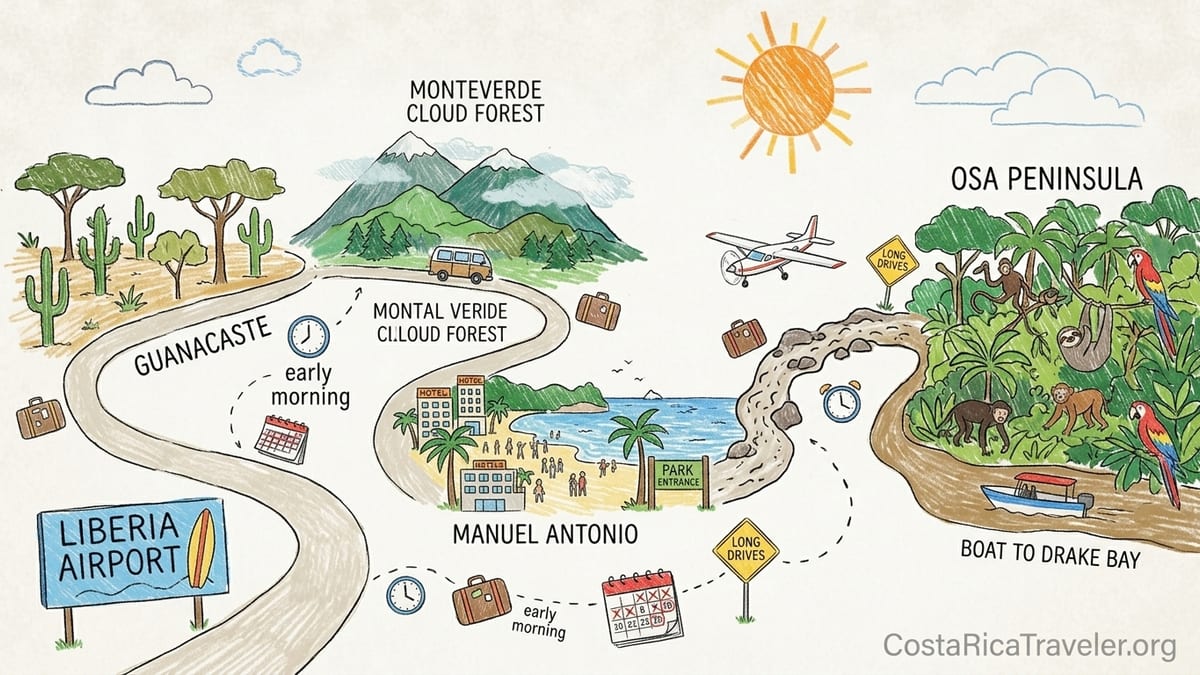
How I Actually Traveled the Pacific Coast
My real route ran north to south. I landed at Liberia’s Guanacaste Airport and started with Tamarindo, then headed inland briefly to Monteverde, before following the coast down through the Central Pacific around Manuel Antonio and finally into the South Pacific and the Osa Peninsula. That gave me four distinct Pacific regions in one trip: Guanacaste’s dry forest and surf towns, the cooler cloud forest hills behind the coast, the busier Central Pacific beach towns and the lowland jungle of the far south.
Across fourteen nights, I slept in six different hotels. In hindsight, I would cut that to four. Every move meant packing early, checking out by 11 a.m., sitting in a van or on a plane, then waiting for a 3 p.m. check-in at the next place. I underestimated how exhausting that rhythm becomes in tropical heat, especially after 6 a.m. wildlife walks or surf sessions that already stretch your energy.
Some transfers took much longer than I expected when I first traced them on a map. The drive from Liberia Airport to Tamarindo was the only truly easy one: about 1.5 to 2 hours on a paved road, with shared shuttles in 2026 commonly quoting around 25 to 30 US dollars per person and private transfers around 90 to 120 dollars for a couple, depending on the operator and season. Many visitors now reserve those shuttles in advance because late-day seats fill quickly around dry-season weekends.
The jump from Manuel Antonio to the Osa Peninsula proved the most deceptive. By road alone, Quepos to Puerto Jiménez or Drake Bay can become a full travel day of 5 to 7 hours once you factor in slower sections, a coffee stop and minor roadworks. I eventually chose a combination of a short road leg from Manuel Antonio back toward San José and a SANSA domestic flight to the Osa region, avoiding a long coastal slog but paying with a pre-dawn start and strict luggage limits around 25 pounds of checked baggage on the Cessna Caravan planes that operate routes like San José to Quepos and Puerto Jiménez.
Where Time Really Disappeared: Roads, Flights and Boats
Costa Rica’s Pacific map looks compact, which tempts travelers to stitch together Guanacaste, Manuel Antonio and the Osa Peninsula in one week. What the map does not show clearly enough is the combination of two-lane highways, mountain sections, trucks and town traffic that slow real-world driving. Even an ostensibly simple Central Pacific leg, such as Jaco to Manuel Antonio, can stretch from a two-hour promise to a three-hour reality if you hit roadworks or heavy truck traffic near the coastal highway junctions.
The longest overland day of my trip was the downward slide from Monteverde’s hills back to the coast and onward to the Dominical and Uvita area. A route that looked like 200 kilometers on screen turned into almost six hours in a shuttle with only short breaks. Winding descents, occasional potholes and slower local traffic add up, and every extra hour in the van is an hour not on the beach or trail. By the time we arrived, sunset was approaching and the only “activity” that day was watching road scenery.
Domestic flights helped in some segments but introduced their own compromises. Costa Rica’s main regional airline, SANSA, runs short hops from San José to coastal airstrips including Quepos and Puerto Jiménez. Those flights are usually under an hour in the air, but you must reach the small domestic terminal, check in 45 to 60 minutes early and pass luggage weight checks. Once you include check-in and ground transfers at both ends, the door-to-door journey often takes three hours, which still saves time compared with a six or seven hour road trip, but not as dramatically as the flight time alone suggests.
Boat legs, especially around the Osa Peninsula, demand even more scheduling care. If you choose the boat-in, boat-out route to Drake Bay via the Sierpe River mouth, you usually work around fixed morning and mid-afternoon boats designed to match the tides. Miss the morning boat from Sierpe and you do not simply take the “next one” an hour later. You either wait until mid-afternoon, improvise a costly private boat, or overnight inland. That tide logic forces you to protect the surrounding nights and leaves very little flexibility for last-minute changes.
Weather, Park Hours and Early Starts: The Invisible Framework
Another factor that quietly shapes any Pacific itinerary is the daily rhythm of weather and national park hours. Manuel Antonio National Park, the classic Central Pacific highlight, currently opens from 7 a.m. to the mid-afternoon and closes one day a week, with tickets sold for specific entry times that many travelers now book days or weeks in advance during peak months. Wildlife viewing is best in the first few hours after opening, when temperatures are lower and the walking trails feel quieter.
That early park logic means a Manuel Antonio stay only works if you have enough nights either side of your park morning. Arriving at 8 p.m., sleeping once and trying to visit the park the next day before catching a mid-afternoon shuttle is technically possible but both rushed and fragile. Any delay in arrival, any trouble printing or confirming your park ticket, or any heavy morning rain can break the plan. With two or three nights, by contrast, you can pick the earliest park slot on your middle day, recover by the pool later and still have a back-up half day on your final morning if something goes wrong.
Along the South Pacific and Osa coast, daylight and rain shape planning differently. During the heart of the rainy season, afternoons often bring downpours or thick cloud by 2 or 3 p.m., so most lodges and tour operators front-load boat trips, snorkeling, mangrove tours and guided rainforest walks into the morning. My Corcovado day started with a 5:30 a.m. breakfast and a 6 a.m. boat, returning by mid-afternoon for a long, hot shower and an early night. On paper that looks like one “activity day,” but my body counted it as one and a half. Anchoring that kind of day between long transfers is a mistake.
Surf towns like Tamarindo, Nosara or Santa Teresa add a separate rhythm. Surf schools tend to offer two main lesson windows, often early morning and late afternoon, to fit tides and avoid peak heat. If you enjoy the sport, you quickly fall into a pattern of one surf session, one mid-day rest, then perhaps a sunset walk or drink. That pattern suits a base where you stay three to five nights, not a town you barely get to know between two long road legs.
Why Seven Days Usually Means One Pacific Region
After trying to taste three Pacific regions in fourteen days, I would now design a seven-day Pacific itinerary with only one coastal hub, or one hub plus a short, clearly defined inland detour. The attraction of squeezing in Guanacaste, Manuel Antonio and the Osa Peninsula on a single week of vacation is obvious: you want both the wide, easy beaches and the dense jungle. The cost is equally clear the moment you start putting transfer times against your calendar.
A realistic example: you fly into Liberia on a Saturday afternoon, take a shared shuttle down to Tamarindo, check in around sunset and stay three nights. On Tuesday you move south. A shared shuttle from Tamarindo to Manuel Antonio typically involves a change near the Central Pacific highway and can easily consume six to seven hours with door-to-door stops and lunch, even though the straight-line distance looks manageable. You arrive tired, swim once and fall asleep. Wednesday you visit Manuel Antonio National Park with a 7 a.m. entry and spend the afternoon by the pool. Thursday morning you are back in a shuttle to San José or Quepos airport to make your way to the Osa Peninsula, where you arrive in time for dinner. Friday is your single full day in deep rainforest, and Saturday you start your international journey home.
That pattern gives you three full days in your first beach base and only one true full day in each of the complex destinations that follow. It also packs three long transfer days into a seven-day trip. If a road accident stalls traffic, or if heavy rain delays a boat connection to Drake Bay, you do not have any spare slack in the itinerary. One missed link could cost you an entire region.
By contrast, a single-region seven-day plan can breathe. Spend all seven nights in Guanacaste, for example, splitting time between a surf town like Tamarindo and a quieter bay near Playa Conchal, or base in Manuel Antonio with perhaps a single inland day trip to Nauyaca waterfalls or some additional beach time in nearby Dominical. With that approach, you lose at most one day to arrival and departure and enjoy five slow days that can absorb weather surprises, slow mornings and the inevitable afternoon nap.
There is also a financial angle. Shorter transfers like Liberia to Tamarindo, or San José to Jaco, often offer the best value in Costa Rica’s shared shuttle network, with prices on some 2026 routes in the 25 to 40 dollar per person range for runs of two to four hours. Once you start stitching together longer cross-country legs, the cumulative shuttle fares for two people can exceed the cost of simply staying put an extra night and enjoying a second surf lesson or a guided night walk instead of another day in transit.
Ten Days: The Sweet Spot for Two Distinct Areas
With ten days, I found the Pacific coast opens up in a more satisfying way. You can usually manage two genuinely different areas with enough time in each to understand their rhythm. The mistake is adding a third region just because you see a free night on the calendar. In my case, ten nights would have worked beautifully as five in Guanacaste and five in the Central Pacific, or four in Manuel Antonio and six in the Osa Peninsula, rather than spreading out across four regions.
One practical example is a ten-day route that pairs Tamarindo with Manuel Antonio. Fly into Liberia, take that 1.5 to 2 hour transfer to Tamarindo, and stay four nights. That gives you three full days for surf lessons, sailing, or a sunset catamaran trip. On day five, travel south on a shared shuttle or private transfer, accept that it will probably be a long transit day, and settle into a Manuel Antonio hotel for five nights. In that second base, devote one early morning to the national park, one to a coastal boat trip or mangrove tour, and leave the rest for pool time, short beach walks and simple meals in town.
Another ten-day pattern suits travelers who are less attached to Guanacaste’s drier climate and prefer deeper rainforest: combine Manuel Antonio and the Osa Peninsula, flying in and out of San José. Four or five nights around Manuel Antonio allow for the early park visit, a quieter beach day in nearby Dominical or Matapalo, and an unscheduled “do nothing” day that many itineraries forget to include. Then you add five nights in Drake Bay or near Puerto Jiménez on the Osa, reached by a regional flight plus a boat or road transfer. With five nights, you can comfortably fit one long Corcovado national park day, one coastal boat trip or snorkeling excursion, and still have at least two slower days for reading in a hammock or walking the nearby trails.
Ten days also changes how you think about one-night stops. On my fourteen-day trip, I tried a single night in a Central Pacific surf town between two longer stays. It felt pointless: we arrived mid-afternoon, walked the beach at sunset, ate dinner and left after breakfast. With a ten-day frame, I would now either turn that kind of place into a proper three-night base or skip it entirely and travel a little farther in one go. Every packing and unpacking cycle costs energy, even if the distances are not enormous.
Fourteen Days: When North-to-South Is Worth It
With fourteen days, a broad north-to-south Pacific journey that includes Guanacaste, the Central Pacific and the South Pacific or Osa Peninsula finally becomes possible. The question is whether it actually improves your holiday or just adds bragging rights. In my experience, fourteen days is the minimum for that scope, and even then only if you limit your accommodation bases to four and accept that some days will be dominated by transit.
A balanced structure might look like this in broad strokes: three or four nights in Guanacaste, three or four around Manuel Antonio or another Central Pacific hub, and five or six on the Osa Peninsula, with the remaining nights used in San José or Liberia to buffer flights. My mistake was adding Monteverde on top, which split those nights across six beds and inserted another long winding drive. That extra region gave me a single cloud forest hike and a pretty sunset, but it also turned what could have been a relaxed coastal progression into a constant forward march.
The longest perceived day of the entire fourteen came midway through this big sweep. I left a hotel near Manuel Antonio at dawn, reached a small airstrip for a morning domestic flight, landed near the Osa Peninsula before lunch, then rode in a minibus and boat to reach a remote lodge by mid-afternoon. Door to door, it was only eight hours, far less than a full overland drive. Yet because it involved four different vehicles, three check-in moments and constant attention to luggage, it felt more tiring than the simpler long road legs between Guanacaste beaches.
Where fourteen days did help was in building in true rest days. I had one full day in Tamarindo where I did nothing more demanding than two swims, a long beachfront lunch and a sunset walk. In the Osa Peninsula, a schedule of early starts for wildlife walks and boat trips forced me into mid-day naps, which would have felt indulgent on a shorter itinerary. Those genuine pauses kept the second week from feeling like a blur of photos and packing cubes.
Looking back, I would still traverse the coastline on a two-week trip, but I would firmly cap myself at four accommodation bases, skip my one-night experiment altogether and add a second true rest day around the midpoint. The Pacific coast rewards lingering in a bay or village, listening to howler monkeys at dawn and spotting repeat faces at breakfast. Moving every second day cuts off that sense of place just as it begins.
Minimum Nights per Base and When One-Night Stays Fail
Across the trip, a clear hierarchy emerged in my notes about how long each stop “needed” to feel worthwhile. In straightforward beach towns with easy access from an airport, such as Tamarindo or Playas del Coco, I would now set a personal minimum of three nights. One night vanishes in transit and check-in, another disappears into the “big early” of either a first surf lesson or a day sail, and only on the third day do you have the experience of waking up without any schedule pressure.
In more complex destinations that hinge on park entries, boat schedules or long guided days, the true minimum rises. Manuel Antonio deserves at least three nights, even if you think you are only there for the national park. That structure lets you arrive calmly, use the middle full day for a dawn park visit and then still have buffer time for an extra swim or a spontaneous mangrove tour. The Osa Peninsula pushes that logic further: given the combination of access flights, boat transfers and long activity days, I would personally not return for fewer than four or five nights in a single lodge or village.
By contrast, my one-night experiment on the Central Pacific taught me how little value a single sleep adds in most of Costa Rica’s Pacific settlements. I checked into a mid-range hotel in a surf town around 4 p.m., walked the beach for an hour, ate a casual dinner and left at 9 a.m. the next morning. I did not surf, did not take a tour and barely registered the personality of the place beyond a few shopfronts. In effect, I had paid for a hotel in order to shorten the next day’s drive by two hours. In future, I would simply accept that longer drive.
The hidden benefit of longer bases is how they interact with weather and the realities of the rainy season. In shoulder and wet months, having three or four nights in one Pacific location gives you multiple mornings and afternoons to catch good weather windows. Heavy rain on one planned national park or boat day becomes a story rather than a disaster, because you can swap activities around. With one or two nights, you have far less room to adapt.
The Takeaway
After driving, flying, boating and occasionally sprinting across Costa Rica’s Pacific coast, my revised rule of thumb is simple. For a seven-day trip, pick one Pacific region and give it space, perhaps with a short inland detour but no major extra coastal jump. Treat ten days as the sweet spot for two distinct bases such as Guanacaste and Manuel Antonio, or Manuel Antonio and the Osa Peninsula, provided you group nights sensibly and commit to at least three nights in each beach town and four to five in a remote rainforest base.
Fourteen days can support a north-to-south sweep that includes Guanacaste, the Central Pacific and the South Pacific, but only if you keep your accommodation bases to four and build in true rest days between long transfers or big park mornings. The hardest lesson from my own route was that every extra hotel change carries a hidden cost in energy, flexibility and money that rarely shows up when you first sketch lines on a map.
If you want to dive deeply into specific zones, it helps to treat the Pacific not as one coastline but as three distinct hubs. Guanacaste, with Liberia as its main international gateway, gives you wide, drier beaches and established surf and resort towns. The Central Pacific around Jaco and Manuel Antonio blends wildlife-rich parks with more developed seaside strips. The South Pacific and Osa Peninsula offer the most intense rainforest and the richest wildlife encounters, at the price of more involved logistics.
Once you decide which of those hubs best matches your interests and the time you have, you can then plan the details of where to stay and what to do within that region without feeling forced into a frantic dash along the entire western coastline.
FAQ
Q1. Can I visit Guanacaste, Manuel Antonio and the Osa Peninsula in just seven days?
In practical terms it is not a good idea. You would spend at least three of those days in transit between regions, leaving only brief glimpses of each place. Most travelers are better off choosing one region for a seven-day trip and exploring it properly instead of attempting the full north-to-south sweep.
Q2. How many hotel bases do you recommend for a ten-day Pacific coast trip?
For ten days, two main bases on the Pacific coast usually feel ideal, with an optional short stop near your arrival or departure airport. That might mean splitting time between Tamarindo and Manuel Antonio, or between Manuel Antonio and the Osa Peninsula. More than three bases in ten days tends to create a sense of constant motion rather than a holiday.
Q3. What is a realistic daily driving limit on Costa Rica’s Pacific side?
Most visitors find that four to five hours of road time in a day is the upper limit before fatigue and heat make the journey unpleasant. Distances that look short on a map can still take that long because of two-lane roads, trucks, curves and occasional roadworks. Planning for one or two longer transfer days across an entire itinerary is fine, but stringing several together quickly erodes your energy.
Q4. Are domestic flights worth the cost compared with shuttles?
On some routes, especially from San José to the Osa Peninsula or other far South Pacific points, regional flights can cut a full day of driving down to a few hours door to door. However the savings are less dramatic once you factor in check-in times, luggage weight limits and transfers on both ends. Flights are most valuable when they replace truly long or complicated road journeys, not when they mirror an easy coastal hop.
Q5. How early should I enter Manuel Antonio National Park?
Wildlife viewing and trail temperatures are best in the first two or three hours after opening, so aiming for the earliest entry slot you can comfortably make from your hotel is wise. That usually means staying nearby for at least two nights so that a 6 a.m. breakfast and 7 a.m. park arrival feels manageable rather than frantic.
Q6. What is the minimum number of nights you would give a surf town like Tamarindo?
I would personally plan a minimum of three nights, and four or five if surfing is a priority. That length lets you fit in several lessons or independent sessions, a rest day, and perhaps a sunset boat trip without compressing everything into back-to-back early mornings.
Q7. How long should I stay on the Osa Peninsula?
Because reaching the Osa Peninsula usually involves a combination of domestic flights, road transfers and sometimes boats, I would not go for less than four nights in one base. Five or six nights feels ideal, allowing for one or two big park or boat days, a rest day, and flexibility for weather changes without anxiety.
Q8. Are one-night stops ever a good idea on the Pacific coast?
One-night stops can make sense near an international airport before an early flight, or in a city where you are simply connecting. In most Pacific beach or rainforest towns, however, a single night rarely gives you time to enjoy both an activity and some rest. It often functions as an expensive way to break up a drive without delivering a real sense of place.
Q9. How does the rainy season affect Pacific coast itinerary planning?
During the main rainy months, mornings are usually clearer and afternoons often bring heavy showers or storms, especially in the south. That pattern favours longer stays in each region so you can schedule hikes, boat trips and park visits in early time slots across several days rather than banking everything on a single clear window.
Q10. If I have fourteen days, how many Pacific regions should I realistically include?
With fourteen days, three main Pacific regions are usually enough: one in Guanacaste, one in the Central Pacific and one in the South Pacific or Osa, plus perhaps a night near your arrival or departure airport. Keeping the total number of hotel bases to four makes the trip feel like a journey rather than a permanent check-out line.