


Caribbean Costa Rica packs a surprising amount of variety into a short stretch of coast. Within about 20 kilometers between Cahuita and Manzanillo, the beaches change from reef-protected national park coves to surf-friendly beach breaks and sleepy palm-fringed bays ideal for families. Understanding how each beach actually feels on the ground is the key to planning days that match your style, whether you are chasing waves, calm water, wildlife encounters or a quiet hammock with sand a few steps away.
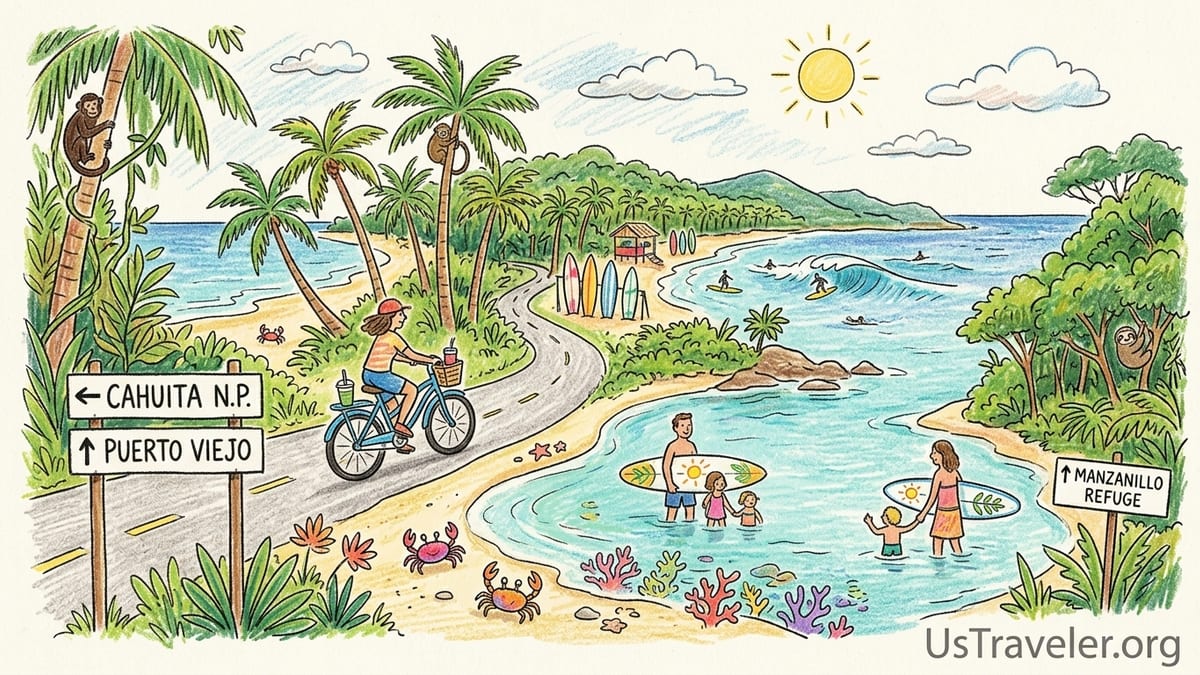
Getting to Know the Coastal Curve: From Cahuita to Manzanillo
Most visitors base themselves in or around Puerto Viejo de Talamanca, then move up and down the coast by bicycle, rental car or the frequent local buses. From Puerto Viejo, Cahuita National Park and Playa Negra stretch north, while Playa Cocles, Playa Chiquita, Punta Uva and finally Manzanillo unfold to the south. Distances are short: Puerto Viejo to Cahuita is roughly a 20 to 25 minute drive, while Puerto Viejo to Manzanillo is about 25 to 30 minutes by car or taxi, and around an hour by bicycle for leisurely riders who stop for photos and smoothies along the way.
The road is paved the whole way from Cahuita down to Manzanillo, which means even a small rental car or a basic pushbike from a local shop in Puerto Viejo is enough to beach hop. In practice, a couple staying in Punta Uva often bikes north to Cocles for a surf lesson at mid-morning, then continues on to Puerto Viejo for lunch, while families with younger children typically choose a hotel with direct beach access in Punta Uva or Playa Chiquita and then book guided day trips into Cahuita or Manzanillo for wildlife and snorkeling.
Weather and sea conditions are more variable than many travelers expect. The Caribbean coast does not follow the classic Pacific “dry season / rainy season” pattern. Months such as February, March, September and October are often calmer and clearer for snorkeling, while strong swells can arrive unexpectedly at any time of year. Lifeguards, colored flags and local advice matter. A good rule of thumb is to treat Cocles and, at times, Playa Negra as surf beaches first and swimming beaches second, while viewing Punta Uva and parts of Cahuita as calm-water benchmarks when the sea is cooperating.
Punta Uva: Benchmark for Calm Swimming and Easy Reef Access
If you picture a classic Caribbean bay with palm trees leaning toward turquoise water, Punta Uva is likely what you have in mind. The beach sits in a gentle curve that is partially protected by an offshore reef system. On typical calm days, especially in February, March, September and October, the water inside this reef can feel almost lagoon-like, with small breaking waves rather than powerful surf. Visitors regularly comment that they can stand or float in chest-deep water without being knocked over, a sharp contrast to the heavier shorebreak at Cocles.
Punta Uva is also one of the easiest places on this coast to snorkel independently when conditions are right. The shallow reef sits just a short swim from shore, and you can often see fish such as sergeant majors and parrotfish within 20 to 30 meters of the beach. Several local guesthouses and small hotels keep basic gear for rent, but many travelers bring their own mask and snorkel to avoid fit issues. When swells increase, visibility drops quickly and currents develop, so guides and long-term residents advise shifting to river kayaking or hiking on rougher days rather than forcing a snorkel session.
For families, Punta Uva hits a rare sweet spot: calmer water, soft sand and a quiet setting without the constant music that can define parts of Puerto Viejo. A typical family day here might involve renting a couple of stand up paddleboards at mid-morning, paddling along the coast to a quieter pocket beach, then having a casual lunch at a small soda just off the sand. Accommodation ranges from mid-range jungle lodges set a three to five minute walk from the beach to simple cabins almost on the sand. Parking is limited directly at the beach, so drivers often arrive earlier in the day to secure a spot along the roadside.
Cocles: Consistent Surf and a More Energetic Beach Vibe
Playa Cocles lies just a short pedal or a five minute drive south of Puerto Viejo and is the default surf beach for much of the area. Unlike Punta Uva, Cocles faces more directly into the Caribbean swell and does not benefit from the same nearby reef protection, which means waves tend to be larger and more powerful. Several surf schools operate directly on the sand, setting up clusters of soft-top boards and offering group lessons that often start around 40 to 60 US dollars for a two hour beginner session, including board rental and rash guard.
Swimming at Cocles is possible on many days but requires more caution. Locals watch the colored flags posted on the beach; red means strong currents and conditions best left to confident swimmers and surfers. Even on green or yellow-flag days, there can be rip currents, so families with smaller children often prefer to paddle in the shallows and then move on to Punta Uva for true relaxed swimming. Lifeguards are typically present near the main beach access, which makes Cocles one of the better-supervised stretches of water along this coast.
The atmosphere at Cocles is livelier than at Punta Uva or Playa Chiquita. Traveling volleyball players often gather at the public courts near the sand, food trucks and simple beach shacks sell cold coconuts, empanadas and fruit smoothies, and music drifts from roadside bars in the afternoon. Accommodation immediately behind the beach ranges from budget-friendly hostels to stylish boutique hotels with jungle gardens. Most visitors reach Cocles by bicycle from Puerto Viejo in about 10 minutes, locking up at bike racks or palm trees just off the sand.
Cahuita National Park: Reef, Wildlife and Gentle Beaches
North of Puerto Viejo, Cahuita National Park protects one of Costa Rica’s most important coral reef systems, along with white sand beaches backed by lowland rainforest. The main entrance at Kelly Creek sits right next to the town of Cahuita. From there, a flat coastal trail leads along Playa Blanca and eventually toward Punta Cahuita and the quieter Puerto Vargas sector. The park’s marine zone shelters a sizable coral reef with a wide variety of corals and reef fish, which is why most guides and conservation projects focus on this area.
Snorkeling at Cahuita is typically done by boat with a licensed guide to protect the reef. Small tour operators in Cahuita and Puerto Viejo offer half-day trips that often cost in the range of 35 to 50 US dollars per person. These usually include a short boat ride to the outer sections of the reef, snorkel gear, a guided swim over coral gardens and a simple fruit snack, sometimes paired with a short hike on the park trail to look for sloths, monkeys and poison dart frogs. Independent snorkeling close to shore is sometimes possible near the Kelly Creek entrance when the sea is very calm, but park rules and guides tend to emphasize that the heart of the reef is a guided experience.
For swimmers and families, parts of Playa Blanca can feel surprisingly tranquil, especially on mornings with small swell. The beach shelves gently, so parents can often stand in waist-deep water while children play near the shore. Because this is a protected area, there are no large hotels or bars directly on the beach; visitors usually stay in Cahuita town in small guesthouses and walk into the park with water, snacks and reef-safe sunscreen. The absence of roadside traffic and loud venues can make Cahuita’s beaches feel more like a national park and less like a resort strip.
Playa Negra and Playa Chiquita: Contrasting Neighbors
Playa Negra begins at the northern edge of Puerto Viejo and stretches toward Cahuita as a long black-sand beach. Its dark volcanic sand gives the water a different character than the turquoise shallows of Punta Uva. Sections of Playa Negra can be swimmable on calmer days, but currents and shorebreak can be strong, and there are no permanent lifeguard towers along the entire stretch. Local advice is essential; guesthouse owners along Playa Negra often point guests to specific, more protected sections that tend to be safer for a quick dip when the sea is behaving.
Despite those caveats, Playa Negra appeals to travelers looking for more space and fewer people. A couple renting a simple cabin on the inland side of the coastal road might cross over for sunrise walks with almost nobody else in sight, then ride a bicycle 10 minutes south to Cocles or further for swimming or surfing. Accommodation here is typically slightly more spread out and can feel more residential, with small eco-lodges, private rental houses and a handful of low-key bars rather than dense lines of hotels.
Playa Chiquita, several kilometers south closer to Punta Uva, is made up of small coves separated by rocky outcrops. It is not one continuous, obvious beach like Cocles or Playa Negra, which is part of its charm. Short side roads and footpaths lead from the main paved road to different pockets of sand. Swimming conditions vary cove by cove, but in general the water is less rough than Cocles and more textured than the calmest days at Punta Uva. Travelers who want a quieter base but still prefer to be able to walk out for a swim often choose Playa Chiquita for its balance of jungle ambiance and moderate waves.
In practical terms, Playa Chiquita offers a cluster of small lodges, yoga retreats and cafes within walking distance of the beach, yet it does not feel overbuilt. Bicycles remain the main way to get around; a ride from Chiquita to Puerto Viejo takes around 20 minutes at a relaxed pace. For snorkeling, pockets of rock and reef exist close to shore, but conditions are inconsistent, so many visitors still travel to Punta Uva or Cahuita when they want guaranteed reef time.
Manzanillo: Wild Refuge, Reef and Remote Feel
At the southern end of the road, the small fishing village of Manzanillo and the surrounding Gandoca-Manzanillo Wildlife Refuge feel noticeably wilder than the beaches closer to Puerto Viejo. The paved road ends at the village, and beyond that point trails lead into a protected area of coastal rainforest, mangroves and coral reef. The main beach in front of the village combines sandy stretches with rocky sections and offers views of offshore reef areas that extend along the coast toward Punta Mona.
Snorkeling and wildlife experiences define Manzanillo more than pure swimming. On calm days, local guides lead snorkeling trips from the village, either walking into the water from the beach or using small boats to reach less-visited sections of reef. Visibility here, as everywhere on this coast, is heavily dependent on recent rain and swell, but the combination of reef, seagrass and deeper water means encounters with turtles, rays and large schools of fish are possible when conditions align. The same refuge is also known for its birdlife and, in more remote sectors, for sea turtles nesting on the beaches.
For visitors, Manzanillo can feel like a step back in time compared with Puerto Viejo. There are fewer accommodation options, generally small guesthouses and basic rooms above local restaurants rather than full-service resorts. Food is simple and home-style, with Caribbean dishes such as rice and beans cooked in coconut milk and fresh fish of the day. Many travelers choose to stay in Cocles, Chiquita or Punta Uva and then ride a morning bus or bicycle to Manzanillo for a day of hiking and snorkeling before returning north to more varied dining and lodging options.
Swimming, Surfing and Snorkeling: Matching Beaches to Activities
If calm swimming is your priority, Punta Uva is the benchmark to plan around. Its reef-protected bay normally offers the gentlest water, especially on the calmer months of the local weather cycle. Parts of Cahuita’s Playa Blanca, sections of Playa Chiquita and, on the right day, the area in front of Manzanillo village can also offer relaxed swimming, but none have quite the same combination of shelter, easy access and soft sand as Punta Uva. Families who visit during a period of larger swell often find themselves reallocating Cocles days to Punta Uva once they see the difference in water movement.
Surf, by contrast, belongs to Cocles. While advanced surfers may chase more famous reef breaks outside this article’s focus, Cocles is the most reliable and accessible surf zone between Cahuita and Manzanillo for intermediate riders and improving beginners. Waves here are punchier and more frequent than at Punta Uva, and there are multiple surf schools offering board rental by the hour for travelers who just want to try a few rides. Bodiesurfing and boogie boarding can also be fun on small to medium days, though rip currents are a constant reason to stay within the lifeguard’s line of sight.
Snorkeling quality divides more clearly: Cahuita National Park and Manzanillo sit at the top for reef and broader nature experiences, while Punta Uva offers convenient, near-shore snorkeling for those based in the mid-coast area. Cahuita’s guided boat trips access outer reef sections where coral structures and fish life remain relatively intact, and the national park framework adds a layer of protection and education. Manzanillo’s refuge combines snorkeling with the chance to see dolphins offshore and wildlife in the surrounding forest, ideal for travelers who want an immersive nature day. Punta Uva fills the niche of casual snorkeling on a calm afternoon from a beach that is also outstanding for swimming.
Wildlife, Reef Protection and Responsible Visits
Both Cahuita National Park and the Gandoca-Manzanillo Wildlife Refuge were established in large part to protect coral reef and coastal ecosystems. Park signage and local guides consistently stress basic reef etiquette: do not stand on coral, avoid touching any marine life, keep a safe distance from turtles and rays, and use reef-safe sunscreen. Some tour operators in Cahuita and Puerto Viejo now offer biodegradable sunscreen for sale or rent masks with built-in UV protection to reduce the need for lotions, though travelers should not rely on availability and are better off bringing their own eco-friendly products.
On land, wildlife encounters are woven into most visits. Along the trail in Cahuita, it is common to see groups of white-faced capuchin monkeys and troops of howler monkeys crossing above the path, as well as sloths resting in beach almond and palm trees. Manzanillo’s forest and mangrove areas are known for toucans, poison dart frogs and, deeper in, for more elusive mammals. In Punta Uva and Playa Chiquita, travelers often wake to the sound of howler monkeys and spot sloths in trees bordering hotel gardens, while colorful crabs and lizards move across the sand at the forest edge.
Choosing how to experience these areas has a direct impact on reef and wildlife health. Booking licensed guides for Cahuita reef trips helps ensure that boat anchoring, group size and visitor behavior follow park rules. In Manzanillo, hiring local guides puts income directly into the community that advocates for ongoing protection of the refuge. Keeping bikes and cars on designated roads, packing out trash from beach days and avoiding single-use plastics that can be carried into the sea are small steps that add up, especially during busier months when visitor numbers spike.
Families, Crowds, Accommodation and Getting Around
Families with younger children generally gravitate toward Punta Uva, Playa Chiquita or Cahuita as bases. In Punta Uva and Chiquita, accommodations often consist of small bungalows or apartments tucked into the jungle within a few minutes’ walk of the beach. Parents can walk to the sand without crossing a major road, then return to shaded gardens for naps or downtime during the midday sun. In Cahuita, staying in town means you can stroll to the national park entrance after breakfast and spend a flexible morning alternating between trail walks and gentle swims at Playa Blanca without worrying about driving or parking.
Crowds are relative along this coast. Puerto Viejo’s main town beach and the central section of Cocles see the highest concentration of people, particularly on weekends and local holidays when residents from San José and Limón join international visitors. Playa Negra, Playa Chiquita, Punta Uva and Manzanillo spread out visitors enough that even on busy days you can usually find space by walking a few minutes away from main access points. Early mornings and late afternoons tend to be the quietest times almost everywhere, ideal for photographers, runners and those seeking a calmer atmosphere.
Bicycles are the default transport option for many travelers, and renting a sturdy beach cruiser in Puerto Viejo for around 8 to 12 US dollars per day is common. This allows easy access between Cocles, Chiquita, Punta Uva and even Manzanillo for reasonably fit riders. Those carrying more gear, traveling with small children or staying further out often choose rental cars or taxis; short taxi hops between beaches are straightforward and comparatively affordable when split between two or three people. Public buses also run the main road between Puerto Viejo, Manzanillo and Cahuita several times a day, which works well for day trips to the park or refuge if you are comfortable with fixed timetables.
Accommodation style shifts subtly from one area to another. Puerto Viejo and Cocles lean younger and livelier, with hostels, surf camps and nightlife. Playa Negra and Playa Chiquita offer more space and slightly quieter surroundings, while Punta Uva and Manzanillo skew toward nature-focused lodges and rustic guesthouses. Matching your base to your preferred noise level and beach conditions often matters more than finding a specific hotel brand, as the entire strip is compact enough that you can still explore all beaches regardless of where you sleep.
The Takeaway
The Caribbean coast between Cahuita and Manzanillo is not a single interchangeable beach but a string of distinct shorelines, each with its own personality. Punta Uva stands out as the benchmark for calmer swimming and casual snorkeling when seas are cooperative, making it a favorite for families and anyone who simply wants to float in clear water with a jungle backdrop. Cocles is the obvious choice for surfing and a more energetic social scene, while Playa Negra, Playa Chiquita and Manzanillo offer varying balances of solitude, scenery and local character.
For reef and broader nature experiences, Cahuita National Park and the Gandoca-Manzanillo Refuge are stronger choices than the more purely recreational beaches in between. Guided snorkel trips and forest walks there reveal the ecological richness that underpins the region’s appeal. Planning a stay that combines a base near calm water at Punta Uva or Chiquita, a surf day at Cocles, a reef-focused outing in Cahuita and a wild day in Manzanillo allows you to experience Caribbean Costa Rica as a diverse coastline rather than a single postcard image.
With distances short, transport options simple and accommodation styles ranging from barefoot-basic to boutique, it is easy to adjust once you arrive. Start with a clear idea of what matters most to you, then let local conditions guide the details. Some days will be perfect for reef, others better suited to surf, river paddling or hammock time, but the constant is a stretch of coast where rainforest, reef and Caribbean culture meet within easy reach of one another.
FAQ
Q1. Which beach in Caribbean Costa Rica is best for calm swimming?
Punta Uva is usually the best choice for calm swimming because its bay is partially protected by a nearby reef, creating gentler waves than Cocles or Playa Negra on most days.
Q2. Where should I go if I want to learn to surf near Puerto Viejo?
Playa Cocles is the main surf beach, with several surf schools offering beginner and intermediate lessons, board rentals and guidance on conditions directly from the sand.
Q3. Is snorkeling better in Cahuita, Punta Uva or Manzanillo?
Cahuita National Park and Manzanillo generally offer the strongest reef and broader nature experiences, while Punta Uva is excellent for easy, near-shore snorkeling on calm days.
Q4. Are the beaches safe for children?
Conditions vary, but families usually prefer Punta Uva, Playa Chiquita and sections of Cahuita’s Playa Blanca, where the water is often gentler than at surf-oriented Cocles.
Q5. Do I need a car to visit all these beaches?
No. Many visitors rent bicycles in Puerto Viejo and comfortably reach Cocles, Playa Chiquita, Punta Uva and even Manzanillo. Buses and taxis make Cahuita and more distant spots accessible without a car.
Q6. Where are the best places to stay for a quiet atmosphere?
Playa Negra, Playa Chiquita, Punta Uva and Manzanillo tend to be quieter than central Puerto Viejo or Cocles, with small lodges and guesthouses set back in the jungle.
Q7. Can I snorkel in Cahuita National Park without a guide?
Independent snorkeling is sometimes possible close to shore when seas are very calm, but the best and most protected sections of the reef are normally accessed on guided boat trips.
Q8. How crowded do the beaches get in high season?
Cocles and the town beach in Puerto Viejo are busiest, especially on weekends. Punta Uva, Playa Chiquita, Playa Negra and Manzanillo usually have space if you walk a few minutes from main access points.
Q9. What is the easiest beach to reach with young kids and no car?
If you stay in Cahuita town, Playa Blanca is an easy flat walk from most guesthouses. Near Puerto Viejo, choosing accommodation within walking distance of Punta Uva or Playa Chiquita simplifies beach days.
Q10. How can I visit these beaches responsibly and protect the reef?
Use reef-safe sunscreen, avoid touching corals or wildlife, follow park rules in Cahuita and Manzanillo, and consider hiring licensed local guides for snorkeling and nature walks.