

The 220 kilometer journey from San José to Puerto Viejo de Talamanca is one of Costa Rica’s great road trips, crossing cloud forest and banana plantations before reaching the Caribbean. It is also a transfer that rewards careful planning. In 2026 there is no domestic flight shortcut, so your choice between shared shuttle, private transfer, public bus or rental car will shape your first day on the coast. This guide walks you through the real-world options, with current prices, travel times and specific tips for both airport pickups and downtown San José departures.
Understanding the Route: San José, SJO and the Southern Caribbean
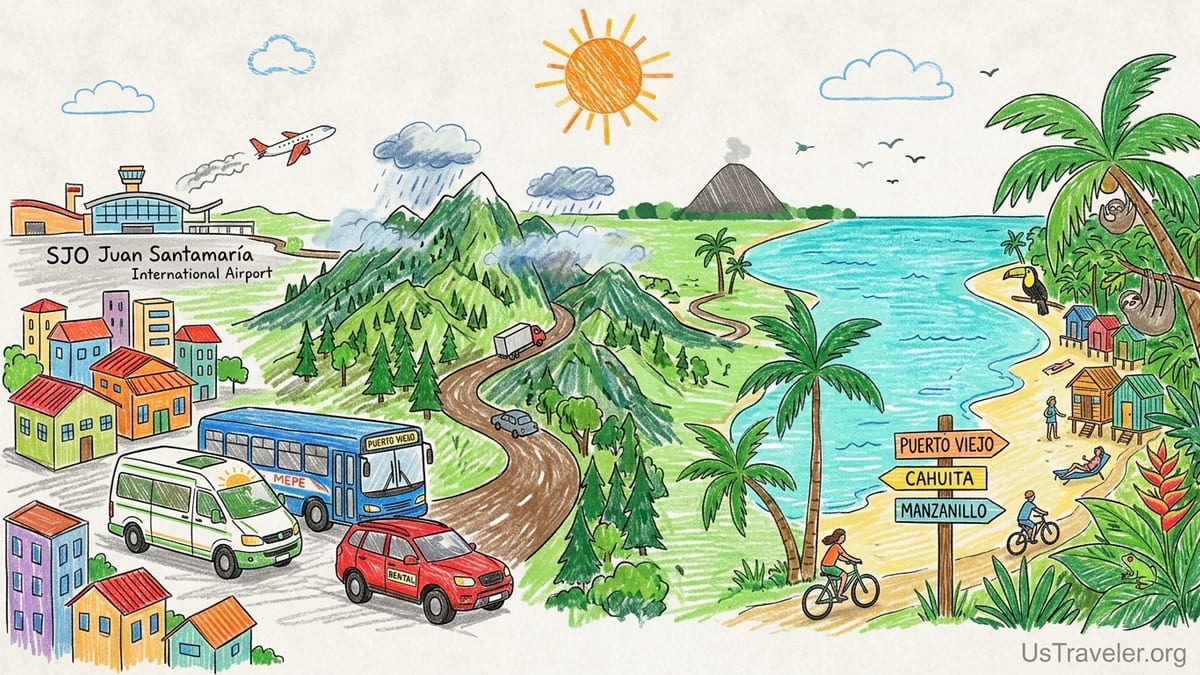
San José and its main international gateway, Juan Santamaría International Airport (SJO), sit in the Central Valley. Puerto Viejo de Talamanca, often just called Puerto Viejo, lies on the southern Caribbean coast near Cahuita and Manzanillo. The overland route is roughly 220 kilometers and typically takes between 4.5 and 5.5 hours in normal conditions. All ground transport options follow a similar path: Highway 32 through Braulio Carrillo National Park and the Zurquí section in the mountains, then across the Caribbean lowlands toward Limón before turning south along the coast.
The biggest variable on this route is not distance but conditions. Fog and heavy rain in the mountains, truck congestion on Highway 32 and occasional roadworks can all slow traffic. A shared shuttle leaving San José around 6:00 in the morning may reach Puerto Viejo in just under five hours in the dry season, while an afternoon departure in heavy rain can stretch closer to six. Private transfers and rental cars gain you some flexibility on departure time and rest stops, but they are subject to the same traffic and weather.
For planning, the most important distinction is where you start: directly from SJO airport on arrival, or from a hotel in downtown San José. Shared shuttle schedules are built around hotel pickups in the city or at selected airport-area hotels, while the public MEPE bus only leaves from its dedicated terminal in central San José. Private transfers and rental cars can handle either starting point but differ in cost, comfort and how much logistics you must manage yourself.
Most travelers also need to consider onward connections. Many visitors staying in Cahuita, Playa Cocles, Punta Uva or Manzanillo simply book transport “to Puerto Viejo” and then improvise the last kilometers by taxi. In 2026, however, a number of shuttle companies and private drivers routinely continue beyond Puerto Viejo proper, so it is worth asking at booking time whether they will take you directly to your lodge in Punta Uva or your cabina in Manzanillo.
Shared Shuttle Vans: Comfortable Middle Ground
Shared shuttle vans are the most popular compromise between price and comfort on the San José to Puerto Viejo route. In September 2026, several operators run daily services priced roughly between 53 and 61 US dollars per person, with Caribe Shuttle prominently advertising San José to Puerto Viejo or Cahuita at about 60 dollars. These services operate in air-conditioned minibuses, normally with 10 to 15 seats, and include hotel pickup in central San José or pre-arranged meeting points near SJO.
Caribe Shuttle, for example, typically runs at least a morning departure around 6:00 from San José, with additional departures on some days in early afternoon. Another Costa Rican operator might list a 5:30 shared shuttle at a similar price point. Most shared shuttles plan on about five hours of travel time, adding 20 to 30 minutes if they need to collect passengers at several hotels or drop people in both Puerto Viejo and Cahuita. They normally include a single rest stop around the halfway mark at a roadside soda with bathrooms and a snack counter.
Door-to-door service is one of the major advantages of shared shuttles. If you are staying at a known hotel in Barrio Amón or near Escazú, the van picks you up at reception and drops you at your hotel doorstep in Puerto Viejo, Playa Cocles or sometimes Cahuita. Families with large suitcases do not need to navigate central San José streets or handle luggage on and off the public bus. Most shuttle companies accept one large checked bag and one smaller piece per person, with extra surfboards or oversized items sometimes incurring a modest surcharge if you arrange it in advance.
Shared shuttles work best if your flight schedule lines up with their fixed departures. If your plane lands at SJO around 9:30 in the morning, you can usually clear immigration, collect bags and meet a noon or early afternoon shared shuttle that picks up at a known airport-area hotel. If you arrive after about 13:00, however, there are usually no shared vans heading all the way to Puerto Viejo that same day, and you may need to overnight near the airport or switch to a private transfer.
Private Transfers: Maximum Convenience from Airport or City
Private transfers are the most straightforward way to travel from either SJO airport or downtown San José to Puerto Viejo, especially for groups of three or more or for late arrivals. In 2026, a realistic price band for a private van that seats up to four passengers runs between roughly 220 and 260 US dollars one way, depending on vehicle size, time of day and whether the service is quoted directly by a local company or bundled through a travel agency. Some operators offer lower promotional rates around 180 to 200 dollars in shoulder season, while premium services with bilingual driver-guides can exceed 300 dollars.
From SJO, a private transfer driver will meet you in the arrivals hall with a sign, help load your luggage and head straight for Highway 32. This avoids the 45 to 60 minute taxi ride into downtown and the need to queue at a bus terminal or find a shuttle pickup point. With light traffic, you can leave the airport by 14:30 and still reach Puerto Viejo before 20:00, even accounting for a dinner stop along the way. Many companies allow one or two photo or snack stops without extra charge, for example at a mirador overlooking Braulio Carrillo National Park or at a fruit stand near Guápiles.
Private transfers are particularly attractive for families, multi-generational groups and travelers carrying bulky luggage such as scuba gear or multiple surfboards. Instead of paying four or five separate shared shuttle seats at 60 dollars each, a family of four can pay a single private transfer fee and travel together in a spacious van, with child seats provided on request. Moreover, if your final destination is beyond town, such as a boutique eco-lodge between Playa Chiquita and Punta Uva or a cabina near the entrance to Gandoca Manzanillo Wildlife Refuge, the driver can usually deliver you directly to the reception area without surcharges.
For onward connections to Cahuita or Manzanillo, private transfers are the simplest choice. You can fly into SJO on an evening flight, clear formalities and meet a driver at 17:00 who is willing to make the four and a half to five hour run to Puerto Viejo, Cahuita or even Manzanillo after dark, although many travelers still prefer to overnight near the airport and drive in daylight. If you are connecting from Puerto Viejo to another destination such as La Fortuna later in your trip, private companies are also the ones most likely to offer direct cross-country transfers without backtracking through San José.
The MEPE Public Bus: Cheapest but Least Flexible
The public bus run by company MEPE is the workhorse of the route and the most budget-friendly choice. As of early 2026, MEPE’s direct buses between San José and Puerto Viejo de Talamanca typically depart several times daily from the company’s terminal in central San José, with common morning departure times around 6:00 and 10:00 and additional midday and afternoon buses. Official schedules can change slightly, so travelers should always verify departure times locally at the MEPE ticket office shortly before travel.
One-way fares usually fall in the range of 12 to 15 US dollars equivalent per person, paid in colones. The buses are simple but generally comfortable, with assigned seating if you purchase tickets in advance. Journey time is similar to the shuttles at around five to five and a half hours, though heavy traffic or road incidents can push that higher. Unlike shuttles, buses stop at designated roadside restaurants and at intermediate towns like Limón, and they finish their run at the modest bus terminal in Puerto Viejo, not at individual hotels.
The main trade-offs with the MEPE bus are logistics and comfort. The San José terminal is not at the airport, so arriving passengers must first take a taxi or ride-hailing service 35 to 60 minutes into the city, then find the correct terminal. Buses can sell out on popular travel days, and passengers who show up at the last minute sometimes end up with standing-room-only tickets, which means hours on your feet or seated on the floor between rows. Stowing large luggage is possible but less controlled than in a shuttle; you will likely place big bags under the bus and keep smaller valuables in your lap.
For independent travelers on longer trips, the bus can still be a compelling option. A solo backpacker who overnights in the city can take the 6:00 MEPE bus from San José, arrive in Puerto Viejo around late morning and connect onward by local bus or taxi to Cahuita or Manzanillo for just a few extra dollars. However, parents traveling with small children, visitors carrying expensive camera gear or anyone nervous about navigating a busy terminal after a long international flight may find that the savings are not worth the extra friction.
Driving Yourself: Rental Car from San José or SJO
Renting a car gives maximum flexibility but requires comfort with Costa Rican driving conditions. Major agencies such as Adobe, Alamo and Enterprise maintain locations around SJO airport and in San José, and some also have offices in Puerto Viejo itself. In 2026, base rental rates for a compact SUV often start in the 40 to 60 US dollar per day range in low season, though the total cost climbs once mandatory insurance and recommended supplemental coverage are added. For a one-week itinerary including Puerto Viejo and other regions, a rental can make sense compared with multiple long-distance transfers.
The drive itself is scenic but not trivial. Leaving SJO or San José, you quickly ascend into the mountains of Braulio Carrillo National Park. The Zurquí stretch is notorious among locals for heavy truck traffic, sharp curves, patchy roadworks and frequent rain or fog. After descending toward Guápiles the road becomes straighter and flatter, then continues to Limón where you turn south along the coastal highway past Cahuita and down to Puerto Viejo. Under ideal conditions it is possible to make the trip in about four and a half hours, but most visitors should plan for at least five, more if there are construction delays or you stop for meals and photos.
Driving from SJO on the afternoon of your arrival demands a conservative plan. If your plane lands after mid-afternoon, you may find yourself confronting mountain curves and heavy trucks in the dark and rain, which many first-time visitors prefer to avoid. A safer strategy is often to overnight at an airport hotel, pick up your rental early the next morning and aim to pass the Braulio Carrillo section in daylight. Families should also consider how patient younger travelers will be with a five-hour stretch in the car soon after a long-haul flight.
Once in the southern Caribbean, having a car is useful but not essential. Puerto Viejo, Cocles, Playa Chiquita and Punta Uva are all linked by a single coastal road, and many tourists choose to rent bicycles for short hops between beaches and restaurants. Parking at small lodges and beach pullouts can be tight in high season and security is always a concern; you should never leave luggage or electronics visible in a parked vehicle. For some visitors, a good compromise is to take a shuttle or bus in, then rent a local car for a couple of days through a Puerto Viejo branch office if they want to explore more remote trailheads or waterfalls.
Airport vs Downtown Pickups: Timing and Practicalities
Choosing between starting from SJO airport or downtown San José affects which transport option makes the most sense. If you are already in the city, staying near the MEPE terminal or in a neighborhood with frequent shuttle pickups, shared vans and the public bus are straightforward. You can have breakfast at your hotel, be collected at the door by a 6:00 or 7:00 shared shuttle, or walk or take a short taxi ride to catch the early MEPE bus. In this scenario, private transfers are mainly a comfort upgrade or a way to reach outlying destinations like Manzanillo without multiple changes.
Arriving directly at SJO is different. There is no direct public bus from the airport to Puerto Viejo, so every non-private option requires at least one transfer. A typical budget route involves taking an airport bus or taxi into central San José, then buying a MEPE ticket. Factoring in immigration, customs and the transfer into town, only morning arrivals early enough to reach the 10:00 bus with a margin feel relaxed. Later arrivals risk missing the last daytime bus to Puerto Viejo, especially if there is any delay at baggage claim or traffic congestion.
Shared shuttles from SJO or nearby airport hotels bridge some of this gap, but they still operate on fixed timetables. Many companies offer an early departure that collects at several central hotels and a few pre-arranged airport-area hotels around 7:30 or 8:00. That works well if you have spent the previous night close to the airport or arrive very early in the morning, but it is unrealistic for passengers whose international flight touches down at 9:30 or later. In those cases a private transfer that leaves as soon as you clear customs, or an overnight near SJO followed by a shared shuttle the next morning, are usually more practical.
Luggage handling is another key difference between airport and city pickups. At SJO you will have all your bags with you from the plane, including any fragile items, and must keep them close until they are loaded into a shuttle, private van or taxi. Booking a driver or shuttle that includes clear airport meet-and-greet instructions and a recognizable logo on the vehicle helps avoid confusion in the busy arrivals area. In downtown San José, by contrast, you may be able to leave oversized items at your hotel between checkout and pickup, or walk lighter to the bus terminal if you are using the MEPE service.
Families and Onward Connections to Cahuita and Manzanillo
Families with children, older relatives or travelers with mobility concerns should prioritize simplicity and predictability over minor savings. A shared shuttle that collects you at a San José hotel and drops you at the door of a family cabina in Playa Cocles is often worth the extra cost compared with navigating the MEPE terminal with strollers and multiple suitcases. For a family of five, however, the math may tilt in favor of a private transfer, which can be only slightly more expensive than buying five separate shuttle tickets while offering more space and flexibility for snack and restroom stops.
When your final destination is Cahuita, you need to pay attention to how each service handles that town. Some shared shuttle companies price San José to Cahuita the same as San José to Puerto Viejo, and either run a dedicated van or drop Cahuita passengers first at their hotels along the main road. For example, a morning Caribe Shuttle departure might stop at lodges near Cahuita National Park before continuing down the coast. By contrast, the MEPE bus offers several daily runs that stop right in Cahuita, meaning that budget travelers can ride the bus from San José and simply step off there instead of carrying onward to Puerto Viejo.
For Manzanillo, the last village on the road, private transfers have a clear advantage. Many shared shuttles finish in central Puerto Viejo or occasionally continue as far as Playa Chiquita or Punta Uva, requiring Manzanillo-bound travelers to take a local taxi for the last few kilometers. Private drivers generally quote a single price to go all the way to your lodge near Gandoca Manzanillo Wildlife Refuge. If you do arrive by MEPE bus, you can connect to Manzanillo by local bus or taxi from Puerto Viejo, but schedules are patchier and services are less frequent than along the main San José to Puerto Viejo corridor.
Another element to consider is your onward travel after Puerto Viejo. Travelers who plan to continue to destinations like La Fortuna, Tortuguero or the Pacific coast sometimes choose a hybrid approach: taking a bus to Puerto Viejo to save money on the outbound leg, then booking a private shuttle for the return when timing is tighter or they have an early international flight. For example, a private transfer can leave Puerto Viejo at 6:00 in the morning, reach SJO by late morning and give you the recommended check-in buffer for a midday international departure.
Choosing the Right Option for Your Trip Style
In practice, your best method of travel from San José or SJO to Puerto Viejo depends on three main variables: budget, schedule and tolerance for logistical complexity. Shared shuttles in the 53 to 61 dollar range per person are the sweet spot for many first-time visitors, combining moderate cost with air-conditioned comfort and door-to-door service. They work especially well for couples and small groups arriving the day before and already based at a hotel on the shuttle route. These travelers can enjoy a hotel breakfast, step into the van with their bags and relax until they arrive at a beachside cabina in Cocles or a guesthouse in Cahuita.
Private transfers are the high-comfort choice for those arriving at awkward hours, carrying bulky gear or traveling with families or older relatives. They cost more up front but become economical for groups when you divide the fare by four or five passengers. They also offer the clearest advantage for remote final destinations such as eco-lodges between Punta Uva and Manzanillo, where public bus and shared shuttle coverage is less consistent. If your priority is to leave SJO as soon as you clear customs and be delivered to a specific lodge doorstep without handling bags more than necessary, a private transfer is hard to beat.
The MEPE bus remains the backbone option for budget-conscious solo travelers and long-term backpackers. Its low fare frees up funds for extra nights in Puerto Viejo or Cahuita, surfboard rentals and meals at Caribbean sodas. The trade-offs are lack of door-to-door service, more basic comfort and greater exposure to crowds at terminals. If you choose the bus, buying tickets early, arriving at the terminal with time to spare and keeping valuables close on board make the journey smoother.
Driving a rental car suits confident drivers who value independence and plan to explore beyond the main tourist hubs. The route’s mix of mountain curves, heavy trucks and tropical downpours is not ideal for everyone, but for those comfortable with long daytime drives it can be a memorable part of the trip. A traveler who wants to pair Puerto Viejo with off-the-beaten-path spots in Talamanca or less connected Pacific beaches may find that the flexibility of a rental car outweighs the stress of navigating Highway 32.
The Takeaway
Travel between San José and Puerto Viejo in 2026 requires a bit more planning than many Costa Rica routes, but the options are clear once you align them with your needs. Shared shuttles priced between about 53 and 61 dollars per person, including services like Caribe Shuttle at roughly 60 dollars and a scheduled five-hour run, deliver the most balanced experience of comfort, cost and convenience for typical vacationers. Private transfers offer maximum control over timing and doorstep delivery from either SJO or downtown hotels, especially valuable for families, night arrivals and those continuing to Cahuita, Punta Uva or Manzanillo.
The MEPE bus is the tool of choice for travelers prioritizing savings and willing to trade comfort and simplicity for a fare closer to 12 to 15 dollars and the local experience of a public coach. Rental cars add flexibility and can be cost-effective over longer itineraries, provided you are comfortable driving through Braulio Carrillo and along the Caribbean highway. Whichever option you choose, planning around daylight travel when possible, confirming schedules close to departure and being realistic about luggage and connections will help turn this long transfer into a relaxed start to your time on Costa Rica’s southern Caribbean coast.
FAQ
Q1. How long does it take to travel from San José or SJO to Puerto Viejo?
The journey usually takes between four and a half and five and a half hours by shuttle, private transfer, bus or rental car, depending on traffic, weather and rest stops.
Q2. What does a shared shuttle from San José to Puerto Viejo cost in 2026?
Most shared shuttles cost roughly 53 to 61 US dollars per person, with services like Caribe Shuttle commonly charging around 60 dollars for a five-hour trip including hotel pickup.
Q3. Can I take a shared shuttle directly from SJO airport to Puerto Viejo?
Some companies offer pickups at or near SJO, but departures are at fixed morning times, so you must arrive early enough to clear immigration and join the scheduled shuttle.
Q4. How much is a private transfer from SJO or San José to Puerto Viejo?
A typical private van for up to four passengers costs in the neighborhood of 220 to 260 US dollars one way, with variations by season, company and any extras such as extended stops.
Q5. Is the MEPE public bus a safe option for this route?
The MEPE bus is widely used by locals and travelers and is generally considered safe; the main concerns are basic comfort, crowding on busy days and the need to watch your belongings.
Q6. How early should I arrive at the MEPE terminal to get a seat?
Arriving at least 30 to 45 minutes before departure is advisable, and on weekends or holidays many travelers prefer to buy tickets earlier to avoid standing-room-only situations.
Q7. Is it safe to drive a rental car from SJO to Puerto Viejo at night?
It is possible but not recommended for most visitors because of mountain curves, heavy truck traffic and frequent rain; many travelers prefer to drive the route in daylight.
Q8. Which option is best for families with children?
Families usually favor private transfers or shared shuttles, both of which offer door-to-door service, air conditioning and space for luggage and car seats, reducing stress compared with the public bus.
Q9. How do I continue from Puerto Viejo to Cahuita or Manzanillo?
Some shuttles and private transfers go directly to hotels in Cahuita or Manzanillo, while public bus users typically connect via local buses or taxis from Puerto Viejo for the final leg.
Q10. Can I reach Puerto Viejo on the same day if my flight lands in the afternoon?
If your flight arrives after early afternoon, same-day shared shuttles and buses are often impractical, so your realistic options are a private transfer or an overnight near SJO followed by morning travel.