


On Costa Rica’s Caribbean coast, eco lodges are more than just places to sleep. In Tortuguero’s flooded rainforest canals and along the wild beaches near Puerto Viejo, Punta Uva and Manzanillo, many lodges blend low-impact design, wildlife conservation and community partnerships with the comforts travelers now expect. Choosing the right one means balancing sustainability credentials, remoteness, wildlife viewing, beach time and basics like air conditioning and transport logistics. This guide focuses on the standout canal lodges in Tortuguero and the most compelling rainforest properties around Puerto Viejo, Punta Uva and Manzanillo, with a practical look at what you actually experience on the ground.
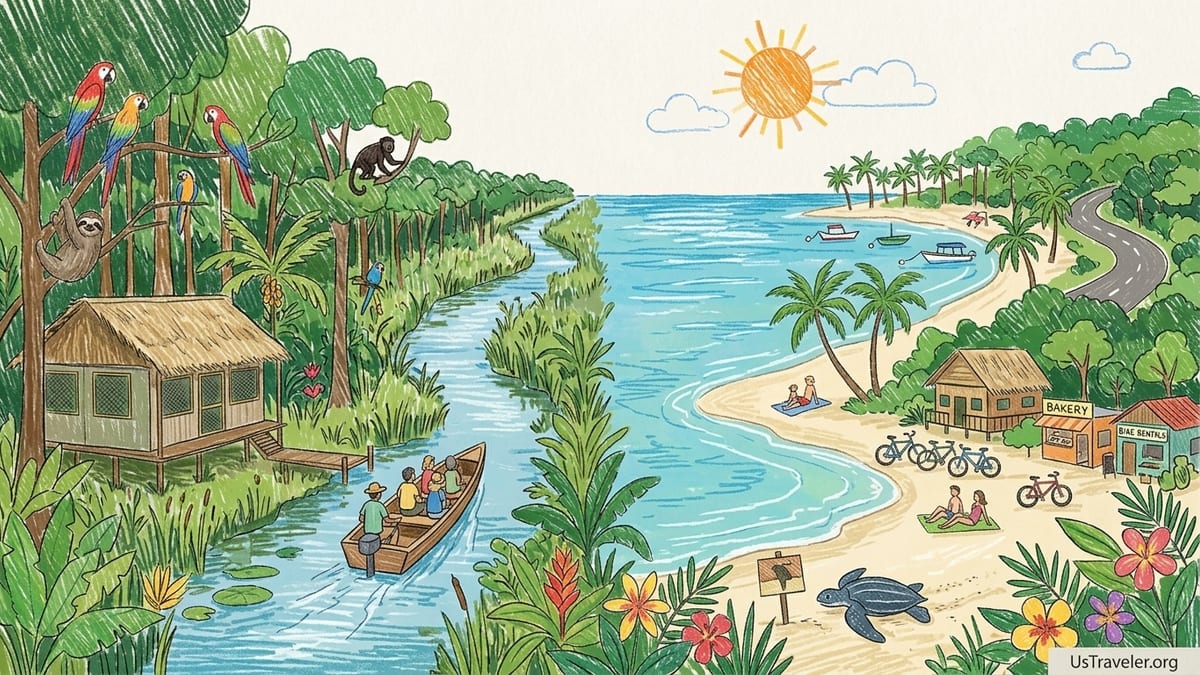
Understanding Eco Lodges on Costa Rica’s Caribbean Coast
Eco lodges in Caribbean Costa Rica occupy some of the country’s most fragile and biodiverse habitats. In Tortuguero, lodges line narrow canals fringed by rainforest inside a vast wetland complex that links Tortuguero National Park with the Barra del Colorado Wildlife Refuge. Boat and small-plane access keeps development relatively contained and has turned the area into one of Costa Rica’s classic lowland rainforest destinations, often compared to a small-scale Amazon.
Farther south, around Puerto Viejo, Punta Uva and Manzanillo, lodges are tucked into the forest that borders the Jairo Mora Sandoval Gandoca Manzanillo Mixed Wildlife Refuge, a protected stretch of coastline that combines primary forest, mangroves and nesting beaches for several sea turtle species. Here, eco lodges share space with small villages, rental homes, bakeries and beach bars, so the feel is more mixed: wilder than many beach towns in the Pacific, but far from roadless wilderness.
Across this region, true eco properties usually share a few traits: limited room numbers, low-rise buildings raised on stilts or set back from the beach, extensive use of natural ventilation, on-site nature trails and canal docks, and a reliance on guided experiences rather than built entertainment. Sustainability certifications are increasingly common, but not universal, so it is worth looking at what each lodge actually does in terms of energy, water, waste and community engagement rather than trusting labels alone.
For travelers, the key practical questions are similar everywhere: How remote does the lodge feel when you step out of your room? Can you hear the surf, frogs and howler monkeys rather than highway noise and bars? Is there air conditioning or just fans and screened windows? Is the beach swimmable or mostly for walking and turtle nesting? And how easy is it to get in and out without spending a full day in transit every time you move?
Tortuguero: Costa Rica’s Canal Wilderness
Tortuguero is often called Costa Rica’s Amazon for good reason. The village and surrounding lodges are hemmed in by canals, lagoons and flooded forest, and there are no roads into town. You arrive by boat along the Tortuguero River and its man-made canal network, or by a short domestic flight from San José or Liberia. That roadless setting immediately sets Tortuguero’s eco lodges apart from those near Puerto Viejo, where you can still hear the occasional motorbike or delivery truck on the coastal road.
The core of the destination is Tortuguero National Park, which protects more than 23,000 hectares of lowland rainforest and wetlands, backed by the larger Barra del Colorado refuge and cross-border wetlands to the north. Boat tours through narrow side channels at first light are the signature experience: guides point out sloths, howler and spider monkeys, keel-billed toucans, caimans, river otters and sometimes rare species like the endangered great green macaw. During turtle nesting season, usually from July through October for green turtles and earlier for leatherbacks and hawksbills, lodges coordinate night walks on the beach with licensed local guides.
Most established lodges in Tortuguero sit on a narrow strip of land between the main canal and the Caribbean. The canal side is where you sleep, swim and eat; the ocean side is usually accessed on foot by a trail or by a short private boat shuttle. Since the beach is a critical nesting area and the surf can be strong, you typically come here to walk and watch, not to swim. Instead, the focus is on small pools under big trees, quiet docks with hammocks and early-morning wildlife expeditions that leave right from the lodge’s private pier.
Compared with Puerto Viejo, Tortuguero’s eco lodges feel more like small expedition bases than beach hotels. Package pricing is common, often bundling boat transport, meals and canal tours into two or three night stays. That can make nightly rates look high on first glance, but once you account for the included logistics, guiding and food, the value is often strong for travelers who want most details handled in advance.
Tortuga Lodge: Conservation-Oriented Comfort on the Canal
Tortuga Lodge, now part of the Boena Wilderness Lodges group, is widely regarded as the reference point for high-end, conservation-driven lodging in Tortuguero. Set on a large canal-front property opposite the national park, it combines polished service with a serious sustainability agenda. Boena’s own sustainability report notes that Tortuga Lodge has achieved a national ecolabel at the highest available level, and the company channels a per-guest conservation fee into projects such as a local music school and environmental programs in Tortuguero. The lodge also holds local ecolabel recognition in the Tortuguero area, which reinforces its long-standing reputation in Costa Rica’s eco tourism community.
Accommodation at Tortuga Lodge is intentionally low-rise and open to the sounds of the forest. Rooms range from simpler upstairs units with ceiling fans and screened windows to more spacious suites with private verandas overlooking the canal. The lodge relies largely on natural ventilation, though some upgraded units may incorporate more modern climate control. Even without widespread air conditioning, the combination of cross-breezes, fans and shaded construction keeps most rooms comfortable for travelers who are prepared for a genuinely tropical environment.
Wildlife is part of the lodge itself rather than something you only see on tours. Howler monkeys often move through the trees near the pool at dawn, iguanas sun themselves on branches over the water, and birdlife is constant. Guided experiences are a core part of the stay: canal safaris in small boats, early-morning birdwatching, hikes on Tortuguero’s forest trails, kayaking and visits to Tortuguero village are typically available as shared departures. Night walks may reveal snakes, frogs, nocturnal birds and nesting turtles in season. Travelers who want to go deeper can ask about private guiding and custom itineraries that link Tortuga with Boena’s other properties in places like Pacuare and the Osa Peninsula.
On the practical side, Tortuga Lodge leans closer to a boutique hotel than a rustic jungle camp. Meals are plated rather than buffet-only, with an emphasis on fresh Caribbean ingredients and an evolving menu rather than a fixed rotation. Many guests comment that food quality is higher than they expected from a remote lodge, which helps justify rates that often start in the mid to high three figures per night for two people when including transport and activities. The pool faces the canal, there is a well-stocked bar, and staff can arrange everything from private boat transfers to national park permits. While you are undeniably isolated once there, the service and infrastructure soften the remoteness.
Mawamba, Evergreen and Other Tortuguero Canal Lodges
Not every traveler needs the higher price point and polished detail of Tortuga Lodge. Mawamba Lodge, Evergreen Lodge, Pachira Lodge and several other canal-side properties in Tortuguero offer more mid-range packages and slightly larger complexes while still prioritizing nature and low-impact design. Most of these lodges are reached by the same combination of ground transportation and boat, often organized as part of a shared shuttle that picks guests up in San José or La Fortuna.
Mawamba Lodge, long considered one of the area’s best values, spreads its simple wooden rooms along garden paths between the canal and the ocean. Rooms are usually fan-cooled, with large screened windows and mosquito nets rather than air conditioning. The overall feel is open-air and relaxed. The property’s strengths are its mature gardens, which attract hummingbirds, toucans and frogs, and its easy access to both the canal dock and the beachfront path. Like Tortuga Lodge, Mawamba operates its own canal tours and offers turtle nesting walks in season, along with village visits and short forest trails within the property itself.
Evergreen Lodge and neighboring Aninga Lodge sit closer to the park entrance and have a slightly denser, more resort-like layout, with raised walkways connecting bungalows under the canopy. They position themselves as eco-friendly, with elevated rooms that keep ground disturbance low and an emphasis on shared nature experiences rather than nightlife. Guests typically stay two or three nights on all-inclusive packages that cover boat transport, meals and two or more guided tours. These mid-range lodges often have small pools and thatched-roof common areas, but fewer premium touches and less personalized service than a boutique property like Tortuga Lodge.
Across these Tortuguero lodges, sustainability practices vary but share common themes. Many rely on solar or mixed energy sources, have on-site wastewater treatment systems, limit single-use plastics and work with local guides rather than outsourcing operations. Some hold Costa Rica’s Certification for Sustainable Tourism or local ecolabels, while others follow similar practices without formal certification. From a traveler’s standpoint, the biggest differences you will notice are in room comfort, group sizes on tours, food style and how much time your guides spend interpreting the ecosystems rather than just spotting wildlife.
Eco Lodges Near Puerto Viejo, Punta Uva and Manzanillo
South of Tortuguero, the Caribbean coast takes on a different character around Puerto Viejo de Talamanca. Here, the rainforest presses close to a string of small beach towns and villages that share a relaxed Afro-Caribbean and Indigenous Bribri influence. The protected backbone is the Gandoca Manzanillo refuge, which covers forest, mangroves and beaches extending past Manzanillo village toward the Panama border. Eco lodges in this area sit outside the strict no-road context of Tortuguero, but still offer deeply immersive wildlife experiences, especially for travelers who want to mix forest time with swimming and dining out.
Rainforest and wildlife-focused properties are usually set back several hundred meters from the beach, where forest remains relatively intact. A typical lodge near Punta Uva or Manzanillo might have four to ten bungalows on stilts, surrounded by tropical gardens that shade coati, agouti and poison dart frogs. Howler monkeys are common alarm clocks at first light, and it is not unusual to see sloths in trees on the drive in from the main coastal road. Several properties in this corridor have pursued Costa Rica’s sustainability certification or international labels such as Rainforest Alliance in past years, although certification status can change and is worth checking close to your trip.
Compared with Tortuguero, these southern Caribbean lodges benefit from easier logistics. Travelers can reach Puerto Viejo by direct shuttle or public bus from San José in about five to six hours, then transfer by taxi to their lodge. That makes it simple to combine a few nights in the forest with a few nights closer to town, all without internal flights or boat schedules. The trade-off is that you will hear more signs of human life: distant music at night, the occasional passing car, roosters and dogs along with the frogs and insects.
What you gain is beach access. Beaches at Punta Uva and Manzanillo are typically calmer and more swimmable than Tortuguero’s open-ocean shore, with coves protected by reefs and headlands. Many lodges either sit within a 10 to 20 minute walk of the sand or provide bicycles for guests. It is common to spend mornings on guided walks in the forest, then retreat to the beach in the afternoon and finish the day with a simple Caribbean dinner in Puerto Viejo.
Comparing Sustainability, Wildlife and Comfort
When comparing canal lodges in Tortuguero to rainforest properties around Puerto Viejo, Punta Uva and Manzanillo, it helps to think in terms of three axes: how deeply sustainability is integrated into the operation, how rich the wildlife experience is on site, and what level of comfort and climate control you expect. On all three counts, Tortuguero’s top lodges stand out, but the southern Caribbean offers an appealing balance for travelers who want more independent dining and swimmable beaches.
On sustainability, properties like Tortuga Lodge have formal ecolabel recognition and publish detailed sustainability reports that mention everything from energy usage and staff training to conservation donations and community partnerships. Many mid-range Tortuguero lodges and several southern Caribbean eco properties may not be as transparent publicly, but still employ key measures: limited room count, preference for local staff, careful solid waste management and use of non-motorized activities such as kayaking. If certification is a priority for you, ask lodges directly whether they currently hold Costa Rica’s Certification for Sustainable Tourism or a recognized international ecolabel, and how that translates into concrete policies such as water treatment or single-use plastic reduction.
For wildlife, Tortuguero has the advantage of being embedded inside a large wetland system where the lodge grounds essentially blend into national park habitat. It is normal to see multiple monkey species, caimans, large lizards and dozens of bird species on a single morning canal tour, with additional sightings around the docks and forest trails at your lodge. Turtle nesting is seasonal but iconic. Around Puerto Viejo, mammal and bird life is also rich, and you may find more sloths and smaller mammals close to human habitation. However, you will usually need to venture into or along the edges of the Gandoca Manzanillo refuge or Cahuita National Park for the densest wildlife rather than relying solely on lodge grounds.
Comfort is more a matter of taste than geography. Tortuguero’s higher-end lodges offer attentive service, high-quality meals and curated guiding, but with a general bias toward natural ventilation and fans instead of full air conditioning. In contrast, some rainforest lodges near Puerto Viejo incorporate air-conditioned bedrooms alongside outdoor bathrooms and open-air lounges. Others remain fully open-air to keep their energy footprint low. If you sleep hot or are traveling in the most humid months, it is worth confirming whether your chosen lodge has air conditioning, only fans, or a mix of room types, and whether windows are fully screened to keep wildlife out at night.
Beach Access, Transportation and How Remote It Feels
One of the clearest differences between Tortuguero and the southern Caribbean eco lodges is how you get there and how often you will see other people. In Tortuguero, almost everything and everyone arrives by boat along the Tortuguero canal system or via small airplane to the local airstrip. Boat transfers typically involve two to three hours of ground transport from San José to a dock near La Pavona or Moín, then one to two hours on a covered river boat. Once at your lodge, you move around primarily by boat or on foot. There are no cars in the village, only narrow paths and boats shuttling back and forth across the canal.
That approach immediately creates a sense of isolation, even if you are staying at a relatively large lodge. Sitting on a dock at dawn watching the mist rise off the canal, or hearing only frogs and distant surf from your bungalow, you feel removed from the rest of the country. The trade-off is flexibility: boat schedules, fixed check in and check out times, and the need to coordinate guided tours through your lodge or local operators. Spontaneous restaurant-hopping is not really part of the Tortuguero experience, though you can visit local sodas and bakeries in the village between activities.
Around Puerto Viejo, Punta Uva and Manzanillo, your lodge is likely reached by taxi or rental car along a paved coastal road. You might still feel deep in the forest once you walk up the lodge’s driveway, with howler monkeys in the trees and leafcutter ants on the paths, but you know that town is 10 to 30 minutes away. That can be liberating for travelers who enjoy a choice of dinner spots or want to self-drive along the coast. It also means that even the most secluded-feeling properties are a short ride from grocery stores, clinics and ATMs, which can matter on longer trips.
Beach access follows a similar pattern. In Tortuguero, the ocean is usually accessed by a short trail or boat shuttle from your lodge across the canal, and the beach is more a place to walk and watch turtles than to swim, due to strong currents and conservation rules. Near Puerto Viejo, Punta Uva and Manzanillo, many eco lodges either sit within walking distance of calmer, reef-sheltered beaches or provide bikes for quick access. If daily swimming, snorkeling or paddleboarding are high on your wish list, the southern Caribbean will generally serve you better, while Tortuguero excels for canal wildlife and a feeling of deep remoteness.
How to Choose the Right Eco Lodge for Your Trip
Choosing among the best eco lodges in Tortuguero and the southern Caribbean comes down to matching your priorities with what each area does best. If your main goal is to immerse yourself in canal-based wildlife watching and you like the idea of boat-only access, then starting with Tortuga Lodge and its peers such as Mawamba or Evergreen makes sense. You will wake up on the water, join guided tours that depart right from the dock and lean into the rhythm of early starts and afternoon siestas. Expect to book two to three nights to justify the travel time, and consider all-inclusive packages that bundle transport, meals and guiding, which can simplify budgeting even if the upfront price looks steep.
If you want a mix of forest and beach, with the freedom to explore restaurants and cafes in a lively town, then a rainforest lodge near Puerto Viejo, Punta Uva or Manzanillo may be a better anchor. Look for small properties built with local hardwoods and elevated decks, plenty of shade, good natural ventilation and clear information on their water, waste and energy practices. Ask direct questions before booking if sustainability is important to you, such as whether they treat wastewater on site, how they manage food waste and plastics, and whether they employ local guides and staff from nearby communities.
Budget plays a role, but not always in obvious ways. In Tortuguero, a per-night rate that seems high can become more competitive once you factor in included boat transfers, multiple guided tours and all meals, especially if you would otherwise book those separately. Around Puerto Viejo, nightly rates might look lower, but you will pay for meals, local taxis or rental cars, and standalone guided tours to Cahuita or Gandoca Manzanillo. Comparing realistic total trip costs instead of just nightly prices will give you a clearer sense of value.
Finally, be honest about your comfort needs. If constant warmth and humidity without air conditioning will leave you exhausted, choose a lodge that offers at least some air-conditioned rooms, especially if you are traveling in the peak of the wet season. If you are happy with fans and screens and want to minimize energy use, many of the most atmospheric lodges in both Tortuguero and the southern Caribbean will suit you well. In every case, reading recent traveler reports and asking the lodge about any changes or renovations can help you avoid surprises and find the property whose version of eco luxury aligns with your own.
FAQ
Q1. Is Tortuguero or Puerto Viejo better for wildlife-focused eco lodges?
Tortuguero generally offers a denser canal and rainforest wildlife experience right from your lodge, while Puerto Viejo and its surrounds combine good wildlife with easier beach access and town life.
Q2. Do Tortuguero eco lodges have air conditioning?
Many Tortuguero lodges rely mainly on fans and natural ventilation, though some upscale rooms offer air conditioning. Always confirm room specifics before booking if climate control is important to you.
Q3. How do I reach Tortuguero’s canal lodges without renting a car?
Most travelers use shared shuttle and boat packages arranged through lodges or agencies, or take domestic flights to Tortuguero’s airstrip and transfer by boat from there.
Q4. Can I swim at the beach in Tortuguero?
Swimming is not usually recommended in Tortuguero due to strong currents and conservation rules around nesting beaches. The oceanfront is best for walks and guided turtle tours in season.
Q5. Are eco lodges near Puerto Viejo and Punta Uva truly in the rainforest?
Many are set in secondary or mixed forest just inland from the beach, with regular wildlife sightings. While not as roadless as Tortuguero, they can still feel very wild once on the property.
Q6. How do sustainability certifications work for Costa Rican eco lodges?
Costa Rica’s main program is the Certification for Sustainable Tourism, which rates lodges on social, environmental and economic practices. Some lodges also hold local or international ecolabels.
Q7. Will I see turtles at eco lodges in the southern Caribbean?
During nesting season, guided night walks in the Gandoca Manzanillo refuge and nearby beaches may offer turtle encounters, but sightings are not guaranteed and tours follow strict regulations.
Q8. Are meals usually included at Caribbean Costa Rica eco lodges?
In Tortuguero, packages commonly include all meals and tours. Around Puerto Viejo, most rainforest lodges include breakfast, with lunch and dinner taken either on site or at local restaurants.
Q9. Is it practical to visit both Tortuguero and Puerto Viejo on one trip?
Yes. Many travelers pair two or three nights in Tortuguero with several nights near Puerto Viejo or Punta Uva, often using shared shuttles or private transfers between the two regions.
Q10. How far in advance should I book eco lodges in these areas?
For peak seasons and turtle nesting months, booking three to six months in advance is sensible, especially for smaller lodges and canal properties with limited room inventory.