


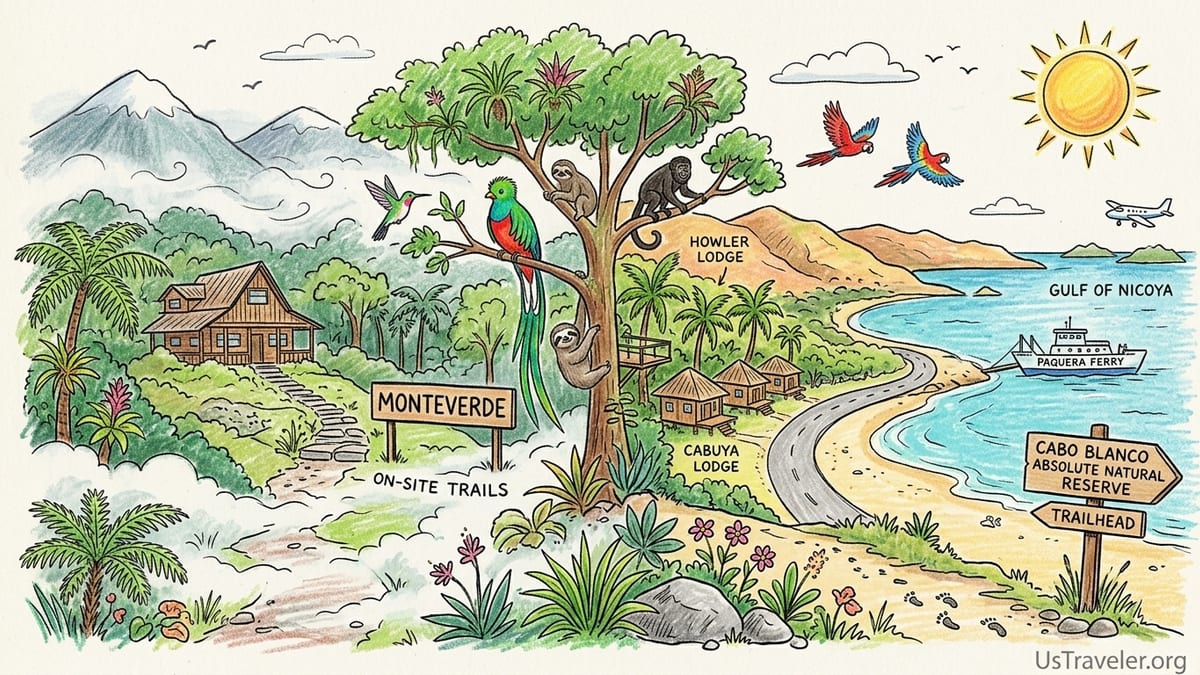
Monteverde’s cloud forests and the quieter coves of Costa Rica’s Southern Nicoya Peninsula offer some of the country’s most compelling eco-lodge stays. In Puntarenas province, this is where conservation, community and comfort most clearly meet. From properties embedded in private reserves above the clouds to small lodges tucked beside Cabo Blanco and the beaches around Cabuya and Montezuma, travelers can choose stays where on-site trails, wildlife watching and low-impact operations are not marketing slogans but daily practice. This guide focuses on Monteverde’s established cloud-forest eco-hotels such as Senda Monteverde, Hotel Belmar, Monteverde Lodge & Gardens and Cloud Forest Lodge, then adds a handful of genuinely nature-focused options in Southern Nicoya to help you plan an itinerary that feels both immersive and responsible.
Why Monteverde and Southern Nicoya Define Eco Stays in Puntarenas
Monteverde has long been the shorthand for Costa Rican cloud-forest conservation, and its reputation shows in the lodging. Here, eco-hotels are not tacked-on cabins at the edge of town. Senda Monteverde, Hotel Belmar, Monteverde Lodge & Gardens and Cloud Forest Lodge sit within walking distance or a short drive of reserves such as the Monteverde Cloud Forest Reserve, Curi-Cancha and Santa Elena, and several maintain their own private forest fragments. Guests can step from polished rooms straight onto trails lined with tree ferns and epiphytes, then return to on-site restaurants where ingredients often come from nearby farms or kitchen gardens.
Farther south on the Nicoya Peninsula, the feel is different but the philosophy often overlaps. Around Cabuya, Montezuma and the coastal approaches to Cabo Blanco Absolute Natural Reserve, small lodges and beachside eco-hotels share space with monkeys and scarlet macaws rather than tower over them. Simple properties such as Calala Beach Lodge and Howler Monkey Hotel sit within easy reach of Cabo Blanco’s trailheads, while newer retreats like Cabuya Lodge emphasize low-density design, yoga decks in the trees and immersion in a fishing village that still feels distinctly Costa Rican. For travelers, combining a few nights in the cool cloud forest with a few by the sea can create a compact circuit of Puntarenas that delivers genuine biodiversity from canopy to coastline.
Both regions are also relatively practical to access. Monteverde is usually reached via the paved Inter-American Highway and then a final stretch of mountain roads from San José or Liberia, often in three and a half to four and a half hours depending on traffic and vehicle. Southern Nicoya is reached either by driving and taking the ferry from Puntarenas to Paquera or by domestic flights to Tambor or Cobano and a short transfer. Travelers who schedule five to eight nights for this corner of Puntarenas can realistically experience both environments without feeling rushed.
On-Site Trails, Reserves and Wildlife Access
One of the clearest ways to separate marketing from meaningful eco-lodging is to look at trail access. In Monteverde, Senda Monteverde backs onto a private reserve and offers guests internal paths plus direct or easy access to the Aguti Wildlife Reserve, where cloud-forest fragments shelter hummingbirds, agoutis and, with luck, resplendent quetzals at certain times of year. Guests can walk from their wooden bungalows straight into secondary forest without arranging a transfer, which matters on misty mornings when bird activity peaks just after sunrise.
Hotel Belmar, perched on a hillside with views across forest and the Gulf of Nicoya, has its own small nature trail and organic garden, and staff can arrange guided walks in nearby reserves such as Curi-Cancha. The hotel’s location just outside the busier center of Santa Elena means you can move quickly between different trail systems: the Monteverde Cloud Forest Reserve for classic cloud forest, Curi-Cancha for mixed habitats with good birding, and Santa Elena Reserve for quieter, often foggier hikes. Monteverde Lodge & Gardens, closer to Santa Elena, compensates for being in town with lush gardens frequented by birds and butterflies, as well as easy transfers to multiple reserves, making it a strong choice for travelers who want guided activities rather than independent wandering.
Cloud Forest Lodge distinguishes itself with a sizable private reserve of around 23 hectares attached to the property, its own network of walking trails and an on-site canopy tour. Guests can take self-guided walks directly from their cabins or join night walks within the lodge’s forest. For many travelers, this removes the need to book a separate commercial night tour, while still offering the chance to see frogs, kinkajous, insects and sleeping birds. That kind of in-house access is particularly valuable for families or visitors who prefer not to drive winding mountain roads after dark.
In Southern Nicoya, nature access takes a coastal turn. Calala Beach Lodge, tucked into palms near Cabuya, backs onto a mix of beach and secondary forest where howler monkeys and iguanas are commonly seen within or just beyond the property. The lodge sits only a few kilometers from the Cabo Blanco Absolute Natural Reserve entrance, so it works well as a base for early-morning hikes into Costa Rica’s first protected reserve. Howler Monkey Hotel, set in dense jungle and close to the coast, shares space with both howler and capuchin monkeys along with a range of birdlife, and lies roughly 2 kilometers from Cabo Blanco. Travelers can walk or take a short drive to the reserve while enjoying wildlife viewing around the grounds.
Sustainability Practices and Community Connection
Eco-labels are easy to claim, harder to back up. In Monteverde, several of the leading lodges have built their reputations partly on years of sustainability work. Senda Monteverde is managed by a regional collection known for prioritizing regenerative practices, from eliminating single-use plastics where feasible to investing in local employment and training. The hotel operates with a relatively low room count, uses energy-saving systems and offers a sustainability tour on the property that walks guests through efforts such as composting, reforestation and waste separation. For travelers, these are not abstract commitments but visible elements of a stay, from refillable water stations to interpretive signage around the grounds.
Hotel Belmar has taken a similarly public approach, historically receiving recognition within Costa Rica for sustainable practices. Guests can see some of this in operation: a small on-site spring-fed system, use of locally sourced ingredients and a focus on minimizing waste in food and beverage operations. The hotel’s engagement with local producers, including craft beer and coffee experiences, creates direct economic links with the surrounding community. Monteverde Lodge & Gardens and Cloud Forest Lodge, both part of a small lodge group with properties embedded in protected landscapes across Costa Rica, also emphasize local hiring, support for regional conservation initiatives and integration with nearby reserves rather than building self-contained resorts that overshadow their settings.
In Southern Nicoya, sustainability often shows up in scale and context. Cabuya Lodge, for instance, describes itself as a small retreat woven into an existing village rather than a walled-off compound. Buildings are spaced to preserve trees and maximize natural ventilation, and the focus is on hosted retreats, yoga and low-key stays rather than high-volume tourism. Calala Beach Lodge similarly keeps density low, with palm-shaded bungalows that blend into the edge of the forest. The Howler Monkey Hotel, operating near Cabo Blanco, offers basic, small-scale accommodation where wildlife can pass through the property, implicitly limiting major landscape alteration.
Across both regions, travelers serious about sustainability should ask similar questions: Does the lodge employ local staff in year-round roles? Are there clear waste and water management practices visible on-site? Is wildlife viewing guided by codes of conduct, such as not feeding animals or using intense spotlights? In destinations like Monteverde and Cabuya, good properties will usually welcome these conversations and be able to show specific actions, from community partnerships to ongoing trail maintenance and habitat restoration.
Views, Atmosphere and Night Walk Experiences
Monteverde’s elevations deliver two things many travelers come specifically to find: swirling mists and long views. Hotel Belmar in particular is known for broad vistas over rolling green hills and, on clear days, all the way to the Gulf of Nicoya. Rooms and terraces are oriented to capture both forest canopies and sunsets when clouds lift. Senda Monteverde mixes enclosed, wooded paths with open clearings where guests can look out over the countryside, while Cloud Forest Lodge places cabins among the trees, making the forest itself the main view from room windows and restaurant decks.
Evenings in the cloud forest are a highlight. Many visitors book guided night walks either directly in the Monteverde Cloud Forest Reserve or in neighboring reserves such as Curi-Cancha and private refuges. These walks typically start around early evening and last two to three hours, using headlamps or hand-held lights to reveal frogs, spiders, roosting birds and occasional mammals like sloths or armadillos. Cloud Forest Lodge’s own night walk, set on its private trails, offers a more contained version where guests can return to their rooms within minutes. For families, this can be less intimidating than transferring out to an off-site tour after dark.
In Southern Nicoya, the mood shifts from cool mist to warm sea breezes. Calala Beach Lodge and similar properties along the Cabuya coast often open directly onto black or golden sand backed by tropical forest. The primary view here is the interface between shore and canopy, with monkeys clustering in trees behind the bungalows and the Pacific spreading out in front. Night walks are less formal than in Monteverde but can be equally engaging: guests may join guided walks in Cabo Blanco to look for nocturnal species where permitted, or simply stroll beach and village roads listening for howler monkeys and watching for crabs and owls under the stars.
The contrast makes a twin-center stay appealing. A traveler might spend two or three nights at a place like Monteverde Lodge, focusing on daytime cloud-forest hikes and one or two organized night tours, then continue to Cabuya or Montezuma for three or four nights at a small coastal lodge, trading fleece jackets and fog for swims, tidal walks and the sound of waves at night. Because these regions sit within the same province, transfers are manageable with a combination of road and, if desired, ferry routes across the Gulf of Nicoya.
Restaurants, Food Sourcing and Dietary Flexibility
Food is another area where Monteverde’s leading eco-lodges distinguish themselves. Hotel Belmar’s restaurant has built a reputation for taking advantage of the property’s own gardens and nearby producers, offering menus that highlight Costa Rican ingredients with contemporary presentation. Diners can expect options that include local cheeses, seasonal vegetables and fresh coffee and beer with clear regional provenance. Senda Monteverde’s dining room follows a similar path, prioritizing regional produce and offering plenty of vegetarian options alongside fish and meat, which helps reduce the supply chain footprint compared with importing products from far afield.
Monteverde Lodge & Gardens offers an on-site restaurant that caters to international travelers who might be returning from long hikes and canopy tours, with menus that balance Costa Rican staples and familiar comfort dishes. Dietary flexibility is an important part of eco-conscious hospitality, and many Monteverde lodges are accustomed to accommodating vegetarian, vegan and gluten-free diets when informed in advance. Because the town of Santa Elena is close, guests can also eat in small local sodas and restaurants, spreading tourism spend beyond lodge walls.
In Southern Nicoya, dining experiences are more casual but can feel equally rooted in place. Calala Beach Lodge and similar coastal properties often serve freshly caught fish, rice and beans, plantains and simple salads, sometimes alongside international dishes tailored to visiting surfers and families. Cabuya Lodge leans into wellness-oriented fare during retreats, with plant-forward menus and juices supporting yoga and meditation programs. Small coastal villages like Cabuya and Montezuma have their own sodas and seafood restaurants, so guests can easily support local businesses and get a sense of daily life in Nicoya’s fishing communities.
From a sustainability perspective, travelers can look for a few useful cues: are menus seasonal, with some rotation depending on what is available locally; does the property promote tap water where safe, or provide filtered water refills to reduce bottled water use; and are portion sizes reasonable rather than wasteful. In both Monteverde and Southern Nicoya, many of the better eco-lodges will address these questions directly in room information or during check-in briefings.
Transportation, Access and Family Suitability
Monteverde’s mountain setting means access can be part of the adventure. Roads have improved in recent years, but final approaches still involve curves and occasional rough patches, especially in heavy rain. Families often appreciate staying in lodges with good on-site access to activities so they can minimize extra driving. Cloud Forest Lodge, with its internal trails and canopy tour, lets families spend at least one full day on property, combining morning hikes, mid-day rest and an early evening night walk. Senda Monteverde’s proximity to town while still backing on to a reserve makes it easy to pair half-day excursions with relaxed afternoons on the grounds.
Many Monteverde lodges can arrange private transfers from San José or Liberia, which can be worth the cost for families with younger children or travelers uncomfortable with mountain driving. Shared shuttles are another option, though they may involve multiple drops in Santa Elena before reaching specific hotels. Once in Monteverde, taxis are relatively easy to arrange through lodge staff for trips to reserves, night tours and restaurants in town. Families should factor in early starts, as guided walks in the Monteverde Cloud Forest Reserve often begin around opening hours to catch wildlife activity.
Reaching Southern Nicoya requires a bit more planning but is entirely feasible for most travelers. The classic route from San José involves driving to Puntarenas, taking the ferry across the Gulf of Nicoya to Paquera, then continuing by road to towns like Tambor, Cobano, Montezuma and Cabuya. Depending on connections, this can take roughly five to seven hours in total. An alternative is to fly on a domestic carrier to Tambor or Cobano and arrange a transfer through your lodge, which shortens travel time and can be easier with children. Cabuya Lodge, for example, highlights that the fastest access is via a flight to Tambor or Cobano followed by a relatively short road transfer.
For families, Southern Nicoya lodges like Calala Beach Lodge or Howler Monkey Hotel can work well if children are comfortable with a more rustic, nature-heavy environment. Properties near calm coves or river mouths may offer gentler swimming conditions, while proximity to Cabo Blanco’s trails opens options for shorter family hikes on designated paths. Parents should be prepared for heat and sun exposure, plan midday rest times, and balance more adventurous outings with simple pleasures like tide pooling or watching monkeys from the veranda.
Choosing Between Monteverde Lodges and Southern Nicoya Retreats
When comparing specific properties, it helps to align your priorities with what each lodge does best. Travelers who want the most immersive cloud-forest experience with minimal logistics may gravitate toward Monteverde stays with strong on-site nature access. Cloud Forest Lodge is a clear fit for those who value private trails and the convenience of night walks on-property. Senda Monteverde suits guests looking for a blend of design-forward rooms, proximity to town and a clear regenerative sustainability framework. Hotel Belmar is ideal for visitors who prioritize views, food and beverage experiences and a slightly more polished, boutique-hotel feel. Monteverde Lodge & Gardens is especially attractive for those who want lush, bird-rich grounds within quick reach of Santa Elena’s services and a full slate of guided excursions managed by the lodge.
By contrast, Southern Nicoya eco-lodges appeal to travelers drawn to slower rhythms and the interplay between forest and sea. Cabuya Lodge, with its yoga and wellness focus, is well suited to couples or solo travelers seeking retreats that mix nature immersion with structured programs. Calala Beach Lodge and Howler Monkey Hotel are simpler, more rustic options that put you close to surf, sand and Cabo Blanco’s trail network without layers of resort infrastructure. These properties tend to work best for travelers comfortable with occasional power fluctuations, more basic room categories and the soundscape of monkeys, waves and roosters rather than insulated quiet.
Budget also plays a role. Monteverde’s flagship eco-hotels generally occupy a mid-range to higher nightly rate bracket, reflecting their infrastructure, guided services and reputations. Southern Nicoya offers a broader spread, from modest beach cabinas to boutique retreats, often at slightly lower price points outside peak holiday periods. For a balanced itinerary, some travelers choose to spend more on a cloud-forest lodge where guided experiences are central to the stay, then pair that with a simpler coastal eco-hotel where the main activities are beach walks and self-guided exploration.
Ultimately, the best eco lodge in Puntarenas is the one that aligns with your travel style. If you picture mist-laden trails, mossy trunks and night walks focused on amphibians and birds, prioritize Monteverde. If your ideal eco-stay includes hammocks near the sea, early-morning howler calls and hikes into Costa Rica’s first absolute nature reserve, direct your search to Cabuya and its neighbors. Many travelers will find that combining both environments in a single trip offers the richest sense of what this corner of Costa Rica protects.
The Takeaway
Monteverde and Southern Nicoya together offer one of Costa Rica’s strongest concentrations of genuinely eco-focused lodging. In Monteverde, properties like Senda Monteverde, Hotel Belmar, Monteverde Lodge & Gardens and Cloud Forest Lodge place guests within minutes of world-famous cloud-forest reserves while weaving sustainability and community engagement into daily operations. Internal trail networks, on-site night walks and tightly managed group sizes give travelers a way to experience delicate ecosystems without overwhelming them.
Farther south, along the shores and villages near Cabo Blanco, smaller lodges such as Cabuya Lodge, Calala Beach Lodge and Howler Monkey Hotel show how low-rise, low-density properties can coexist with coastal forests and fishing communities. Here, eco-stays are less about polished amenities and more about adjusting to the rhythms of tides, monkeys and local life. In both regions, travelers who ask questions, choose locally involved operators and prioritize quality over quantity of experiences can help sustain the very landscapes they have come to admire.
For most visitors, a stay of at least two or three nights in each region allows time to settle into place-based routines: dawn birding in the cloud forest, a siesta before a night walk, or an early swim followed by a long hike in Cabo Blanco. Rather than racing between attractions, treating your lodge as both a base and a destination makes the eco component of eco-lodging feel tangible. Puntarenas, seen this way, is not just another stop in Costa Rica but a living classroom in how thoughtfully managed tourism can support conservation at both the canopy and the coast.
FAQ
Q1. How many nights should I spend in Monteverde versus Southern Nicoya?
Most travelers are comfortable with two to three nights in Monteverde for cloud-forest hikes and one or two night walks, paired with three to four nights in Southern Nicoya for beach time and Cabo Blanco excursions.
Q2. Do I need a 4x4 vehicle to reach these eco lodges?
A 4x4 is recommended but not always essential. Access roads to Monteverde and Cabuya can be steep or rough in places, especially in the rainy season, so higher clearance and good tires improve comfort and safety.
Q3. Are Monteverde’s eco lodges suitable for young children?
Yes, many are. Properties like Cloud Forest Lodge and Senda Monteverde work well for families thanks to on-site trails, relatively contained grounds and the ability to arrange shorter guided walks tailored to children.
Q4. Can I visit the Monteverde Cloud Forest Reserve without a guide if I stay at an eco lodge?
Yes, you can hike the main trails independently after paying the entrance fee. Many guests still choose at least one guided walk for better wildlife spotting, then explore on their own on another day.
Q5. What is the best season to stay at these eco lodges?
The dry season, roughly from December to April, usually offers easier travel and more consistent views. The greener months can bring heavier rain but also fewer crowds and very atmospheric cloud-forest conditions.
Q6. How far are the Southern Nicoya lodges from Cabo Blanco Absolute Natural Reserve?
Lodges in and around Cabuya are typically within a short drive or even walking distance of the Cabo Blanco entrance, often around 1 to 3 kilometers, making early starts for hikes straightforward.
Q7. Are vegan or vegetarian diets easy to accommodate at these properties?
In Monteverde, leading eco lodges are accustomed to vegetarian and vegan requests and usually offer multiple plant-forward dishes. In Southern Nicoya, options can be simpler, so advance notice helps kitchens prepare.
Q8. Is it safe to walk lodge trails or nearby roads at night?
Guided night walks on lodge property or in reserves are generally considered safe and are the best way to experience nocturnal wildlife. Independent night walking is possible in some areas but should be approached cautiously.
Q9. Do these eco lodges have reliable Wi-Fi and mobile coverage?
Most Monteverde eco lodges offer solid Wi-Fi in rooms or common areas, though speeds can vary. In Southern Nicoya, connectivity can be slower or patchy, which many guests see as part of the unplugged experience.
Q10. How far in advance should I book eco lodges in Monteverde and Southern Nicoya?
For travel in peak periods such as late December, January and Easter week, booking several months in advance is wise, especially for well-known properties with limited room counts.