


Puntarenas province stretches from cool cloud forest to surf lined beaches, and its hotel scene is just as varied. Instead of forcing every property into a single top ten list, it makes more sense to choose where to stay by region first, then compare hotels within that micro destination. Current booking inventory is strongest in Monteverde and Santa Teresa, while Tambor and Montezuma offer smaller, more distinct markets and Puntarenas city serves mainly as a practical overnight stop. This guide walks through each area in turn so you can match the right hotel to your route, budget and style of travel.
How to Choose the Right Puntarenas Base
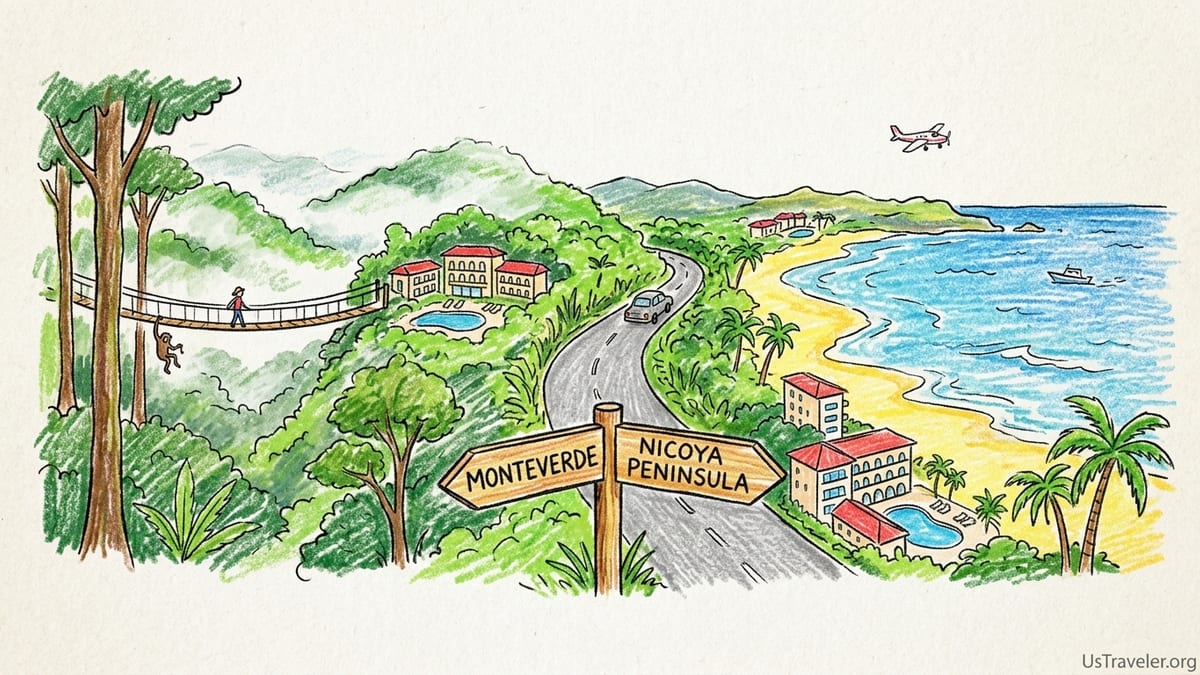
Start by deciding what kind of trip you are building, because Puntarenas is less a single destination and more a loose collection of very different hubs. Monteverde is cool, misty and focused on cloud forest trails, hanging bridges and wildlife. Santa Teresa and nearby Mal País are beach and surf territory with design forward boutique hotels. Montezuma is smaller and more bohemian, with a walkable village and waterfalls. Tambor is mostly about a couple of established beachfront resorts close to a small airport. Puntarenas city is a port and transit town that works for one night but is rarely the star of an itinerary.
Booking patterns matter. In 2026 there is particularly deep inventory in Monteverde and Santa Teresa, from hostels under roughly 40 US dollars per night to boutique hotels well above 300 US dollars in high season. That choice makes it easier to find properties with heated pools, on site restaurants and parking included. By contrast, Tambor and Montezuma have far fewer hotels, so availability tightens quickly for holiday weeks and you may have to decide between accepting simpler facilities or paying a premium for one of a handful of standout stays.
Transportation is another filter. Driving times between these hubs can be longer than they look on a map, and some lodges sit up steep gravel roads. Travelers without a rental car should pay close attention to whether shared shuttles or private transfers are offered or can be arranged through the hotel. In Tambor, several properties provide complimentary airport pickups from the small domestic airstrip, while in Santa Teresa and Montezuma you rely more on public buses, taxis and 4x4 taxis once you arrive on the peninsula.
Finally, think about how much you plan to use your hotel. Some travelers mostly sleep at their accommodation and spend all day out on excursions, in which case free parking, breakfast and a comfortable room may be more important than a spa or fine dining restaurant. Others want their hotel to function almost like a small resort, with a pool, bar, yoga deck and a restaurant they can happily eat at several nights in a row. Monteverde and Santa Teresa especially have properties at both ends of this spectrum.
Monteverde: Cloud Forest Lodges and Boutique Hotels
Monteverde has one of the richest hotel selections in Puntarenas province, and the range of styles is broad. At the upscale end, Hotel Belmar and Monteverde Lodge & Gardens often appear on 2026 shortlists thanks to their polished service, strong food and wellness offerings. Belmar sits on a hillside with forest and Gulf of Nicoya views, a small spa area and its Celajes restaurant, which focuses on farm to table dishes that draw non guests as well. Monteverde Lodge pairs lush gardens with a glass enclosed heated pool, which is a real advantage in cool, misty weather when unheated pools can feel too cold to use.
Midrange hotels such as Senda Monteverde, Hotel & Spa Poco a Poco, Koora Hotel by Sandglass, Cloud Forest Lodge and Cala Lodge focus on comfortable rooms, on site restaurants and easy access to reserves and hanging bridge parks. Several of these have heated or partially covered pools and hot tubs, which extend pool time even when temperatures drop in the evening. Parking is generally free and on site, and staff can arrange everything from zipline tours to guided nocturnal walks. Koora and Cloud Forest Lodge stand out for their proximity to forest trails and their sense of immersion in the canopy even though they are still within a short drive of Santa Elena town.
Budget conscious travelers are not left out. Camino Verde Bed & Breakfast, Cabanas Valle Campanas and a cluster of simple cabinas around Santa Elena offer private rooms that can dip under 60 to 80 US dollars in the shoulder season, often including basic breakfast and shared or small private parking areas. Facilities are more modest, and you will not usually find pools at this price point, but locations within walking distance of town are common, which helps if you prefer to eat at different local restaurants instead of a hotel dining room. Many of these small inns still help arrange shuttles and tours even if they do not run transportation themselves.
When comparing Monteverde hotels, pay attention to how exposed or sheltered they are from wind and drizzle, and whether rooms have heating or at least extra blankets. Hillside properties can have spectacular views but be noisier when wind picks up. On the plus side, Monteverde is compact enough that even more remote lodges are rarely more than 15 to 20 minutes by car from restaurants in Santa Elena, and parking is almost always included in the rate. For travelers without a car, look carefully for hotels that either sit near the bus route or explicitly mention arranging transfers, because walking after dark on narrow mountain roads is not ideal.
Puntarenas City: Overnight Stops and Port Hotels
Puntarenas city itself is a long, narrow strip of land that functions primarily as a port, ferry terminal and gateway between the capital and the Nicoya Peninsula. Most travelers who stay here are catching an early morning ferry to Paquera, embarking on a cruise, or breaking up a long drive. As a result, the hotel mix is more functional than resort like, and very few visitors plan to spend several days in town. If you do, the main draws are the local beach, the promenade and seafood restaurants, as well as day trips to nearby islands and mangroves.
Typical midrange choices in Puntarenas city include small hotels and motels with air conditioned rooms, basic pools and secure parking. A property like Hotel Yadran Beach Resort, for example, advertises an outdoor swimming pool, free private parking, a garden and a terrace within walking distance of the city beach. Elsewhere in the province but still marketed under the Puntarenas umbrella, larger brands such as Fiesta Resort in the Gulf of Nicoya area provide a true resort experience with several pools, all inclusive meal plans and kid friendly amenities, though these are usually an hour or more from the actual city peninsula.
For many travelers, the key considerations in Puntarenas city are parking and ease of transit rather than elaborate facilities. If you are arriving by rental car after dark, look for hotels on or near the main road into town that offer gated or covered parking, as street parking can feel exposed. Pools here are pleasant in the afternoon heat but are usually straightforward rectangles meant for cooling off rather than destination level features. Restaurants tend to be simple, focusing on rice dishes and seafood; some hotels include breakfast but expect to eat other meals out along the Paseo de los Turistas rather than in a hotel restaurant.
Public transportation connections from Puntarenas city are good, with frequent buses to San José and other parts of the province, and the ferry to Paquera linking you to Tambor, Montezuma and Santa Teresa via road. However, hotels rarely include transfers in the room rate. If you are not driving, you will typically rely on taxis to and from the bus station or ferry port, so it can be worthwhile to choose a hotel within an easy walk of your departure point, especially if you have luggage and an early start.
Tambor: Compact Beachfront Resort Scene
Tambor sits around a broad bay on the Nicoya Peninsula and has a far smaller hotel market than Monteverde or Santa Teresa. That makes individual properties more influential in shaping the destination’s feel. The largest player is the Barceló Tambor all inclusive resort, which occupies a long stretch of Ballena Bay beach and offers several pools, buffet and à la carte restaurants, kids activities and nightly entertainment. It is marketed toward families and groups who prefer to stay mostly on property, with meals, drinks and many activities bundled into the rate.
The location of Barceló Tambor is a major advantage if you want easy beach access and minimal logistics. The resort fronts a wide, gently shelving beach, and the grounds are landscaped with palm trees and lawns that run straight to the sand. Several large pools, including shallow areas for children, provide an alternative to ocean swimming. Parking is included and spacious, which is helpful if you are arriving by rental car from San José or Liberia, although driving times can reach three to four hours depending on your route and whether you use the Paquera ferry.
Travelers looking for a quieter, more boutique stay in Tambor gravitate toward smaller properties like Tambor Tropical Beach Resort. This adults oriented hotel sits directly on the beachfront near the village and offers suites with kitchenettes, a pool overlooking the bay and lush gardens. One of its practical perks is a complimentary shuttle to and from nearby Tambor Airport with prior notice, which can be significant if you are flying in on a domestic airline and do not plan to rent a car. On site parking is also available for guests who do drive.
Because Tambor’s hotel inventory is compact, availability at the best located beachfront properties can tighten quickly for school vacations and holiday weeks. If you need specific room configurations or want an ocean view, plan to book several months ahead, particularly from December through April. Restaurant choice outside the resorts is limited compared with Santa Teresa or Monteverde, so evaluate whether you are comfortable eating most meals at your hotel’s restaurant or buffet. For many visitors, Tambor works well as a two or three night beach respite attached to a longer itinerary, rather than a standalone destination.
Montezuma: Small Scale Hotels with Character
Montezuma began as a quiet fishing village and evolved into a laid back beach town that still feels smaller and more bohemian than Santa Teresa. Its hotel market reflects that history. Instead of large resorts, you find modest hotels, cabinas and small boutique properties sprinkled along the coast and up the hill behind town. The advantage is character and a strong sense of place; the trade off is that facilities such as large pools, expansive parking lots and full service restaurants are less common than in bigger destinations.
In and around the village center, several small hotels and guesthouses offer rooms within easy walking distance of the beach, restaurants and the trailhead to Montezuma Falls. These are convenient if you are traveling without a car, as you can arrive by bus or shuttle from Cobano or Paquera and then explore on foot. Some have small plunge pools or garden pools rather than resort style complexes. Parking, when available, may be a few marked spaces next to the building instead of a dedicated lot, so self drivers should check in advance and arrive early in the afternoon when spaces are more likely to be open.
Further from town, a handful of hillside and jungle properties prioritize views and nature immersion over immediate beach access. These might have small infinity pools overlooking the coastline, open air restaurants serving dinners based on local produce and seafood, and rooms reached by stairs winding through gardens. Reaching the beach or town often requires a short drive or a steep walk, so they suit travelers who value tranquility over being in the heart of the action. When comparing this type of stay, look at whether the hotel offers any shuttle service into town for dinner or to key trailheads, or whether you will rely on taxis and your own rental car.
Montezuma’s road network is narrow, and some lodging sits up rougher tracks, especially in the rainy season. If you are not comfortable driving a 4x4, choose properties closer to the main paved road. Transportation is rarely included in room rates here, apart from occasional help arranging taxis or private transfers. On the plus side, the compact scale means you are never far from the beach, Cabo Blanco nature reserve or boat trips to Tortuga Island, and it is easy to combine a Montezuma stay with nights in Santa Teresa or Tambor to sample different hotel styles.
Santa Teresa: Design Forward Beach and Boutique Hotels
Santa Teresa has grown into one of Costa Rica’s most dynamic boutique hotel markets, with a concentration of small, design minded properties stretched along a long, surf friendly beach. Inventory here is substantial, especially in the midrange and upper tiers. You will find everything from beachfront bungalows like those at Makanas Beach Bungalows, where simple but stylish units sit just steps from the sand, to intimate hotels tucked into the jungle a short walk from the ocean, with plunge pools, yoga decks and open air lounges.
Beach access is the main differentiator. True beachfront hotels sit directly on or just behind the sand, with paths leading through palms to the waves. They usually charge higher rates, particularly in the dry season when surf and sunset watching are at their best. Second row and hillside properties often compensate with nicer pools, stronger privacy and lush gardens, and walking to the beach may take just five to ten minutes. In all cases, parking is an important factor. The main road through Santa Teresa is unpaved in sections and can be busy with ATVs and motorcycles, so look for hotels that offer clearly marked, off street parking spaces instead of relying entirely on shoulder parking.
Many Santa Teresa hotels lean heavily into a lifestyle concept, bundling in daily yoga classes, surf lessons or wellness treatments. On site restaurants range from casual poolside eateries serving poke bowls and tacos to more ambitious kitchens focusing on seafood and inventive plant forward dishes. Breakfast is frequently included. Pools come in many forms here: narrow lap pools running alongside decks, multi level pools with jungle views, or compact plunge pools attached to suites. If swimming is important to you, check photos carefully; some “pools” are more for cooling off than doing laps.
Transportation is rarely included in Santa Teresa room rates, but hotels are accustomed to arranging private transfers from the Tambor airstrip or shuttle connections from San José and Liberia. Once in town, travelers either walk, rent ATVs or use taxis to move between beaches, restaurants and surf breaks. If you plan to explore widely along the coast, a rental car or ATV is helpful; if you prefer to stay put, you can choose a hotel within a quick walk of both the beach and several restaurants so you hardly need wheels at all. Because Santa Teresa is popular with both surfers and digital nomads, availability in the most desirable boutique properties can tighten well ahead of peak months, so book early for late December to March.
Comparing Facilities: Pools, Restaurants, Parking and Transfers
Across these five hubs, some patterns emerge around what facilities you can expect. Monteverde and Santa Teresa have the broadest range of pools, from simple rectangles at midrange inns to heated pools and hot tubs at properties like Monteverde Lodge & Gardens and Hotel Belmar, and sleek, photo ready pools at Santa Teresa boutiques. In cooler Monteverde, a heated or enclosed pool matters if you actually plan to swim; in Santa Teresa and Tambor, any decently sized, unshaded pool will be inviting most of the day. Montezuma and Puntarenas city usually offer smaller pools focused on cooling off rather than lounging for hours.
Restaurant quality and reliance varies too. In Monteverde, many of the best hotels have respected on site restaurants, and weather plus hilly roads mean guests often eat dinner at their lodge several nights in a row. Think Celajes at Belmar or the restaurant at Monteverde Lodge, both of which serve creative takes on Costa Rican dishes alongside international options. In Santa Teresa, the town itself has become a culinary hub, so even hotels with good restaurants expect guests to roam between sushi bars, wood fired pizza spots and beach bars. Tambor’s limited external dining options make all inclusive or full board style stays more logical, while in Montezuma, the compact village center offers enough independent cafes and restaurants that smaller hotels can get away with offering only breakfast.
Parking is generally straightforward everywhere except in the tightest parts of Santa Teresa and central Montezuma, where street parking may compete with day visitors. In Monteverde and Tambor, most hotels occupy larger plots with space for guest vehicles, and free parking is the norm rather than the exception. However, not all parking is covered or guarded, so if you are leaving valuables in your car, look for mentions of gated lots or night security. Puntarenas city hotels also emphasize secure parking as a selling point due to their urban setting and proximity to the ferry.
In terms of included transportation, Tambor stands out because a few hotels explicitly advertise complimentary shuttles to the small local airport, which can eliminate one logistical step. Elsewhere, transfers are usually add ons arranged through the hotel or third parties rather than included in the nightly rate. Shared shuttles connect San José, Liberia, Monteverde and the Nicoya Peninsula hubs on set schedules, while private drivers can be booked for more flexibility or for early and late departures. If you do not want to drive, it is worth choosing hotels that are either walking distance from what you want to do or comfortable arranging reliable transfers on your behalf.
The Takeaway
Choosing the best hotel in Puntarenas province is less about finding a single top rated property and more about matching each region’s strengths to your route. Monteverde rewards travelers who value forest immersion, heated pools and strong in house restaurants, while Santa Teresa is the choice for boutique hotels that blend pool, surf and a lively dining scene. Tambor caters to those who want straightforward, largely self contained beach resorts, and Montezuma offers small scale stays with personality and good access to waterfalls and nature reserves. Puntarenas city, finally, works best as a functional overnight to support ferry crossings and long drives.
Inventory is deepest in Monteverde and Santa Teresa, so you can refine your search based on details like whether the pool is heated, how close the hotel sits to the beach or forest entrance, and how expansive the parking area is. In Tambor and Montezuma, choice is more limited but that also contributes to a quieter, more intimate feel. Across the province, thinking through how much time you will actually spend at your hotel, how comfortable you are driving on rural roads and whether you prefer to eat on site or out in town will help narrow the field more effectively than simply scrolling through rankings.
For many travelers, the ideal Puntarenas itinerary combines at least two of these hubs: a few nights in Monteverde’s cloud forest followed by several nights on the Nicoya Peninsula’s beaches. By considering location, pools, restaurant setups, parking and transportation together, you can assemble a sequence of stays that feels seamless on the ground, minimizes time spent in transit and maximizes the very different landscapes that make this province so compelling.
FAQ
Q1. Is it better to book Monteverde or Santa Teresa first in peak season?
In peak months such as January and February, high demand boutique hotels in Santa Teresa and popular lodges in Monteverde both fill early, but Monteverde generally has more total rooms. Many travelers secure Santa Teresa first, especially beachfront or design forward properties, then match Monteverde dates afterward because there are more alternatives in that market.
Q2. Do I need a 4x4 to reach hotels in Monteverde and Santa Teresa?
Many Monteverde hotels and a good number of Santa Teresa properties are accessible in a regular sedan in dry season, but road conditions can deteriorate with heavy rain, and some lodges sit up steep or rutted tracks. If you plan to explore widely or stay at hillside and more remote properties in either region, a 4x4 or at least a higher clearance vehicle is recommended for comfort and safety.
Q3. Which destination in Puntarenas has the most hotel choices overall?
In terms of sheer variety of registered accommodation, Monteverde and Santa Teresa currently offer the most substantial inventories, ranging from budget hostels to high end boutique hotels. Montezuma and Tambor have far fewer properties, and Puntarenas city focuses mainly on simple overnight hotels, so travelers who like to compare many options tend to gravitate toward Monteverde and Santa Teresa.
Q4. Are hotel pools in Monteverde warm enough to use year round?
Temperatures in Monteverde are cooler than on the coast, and unheated outdoor pools can feel chilly, especially in the evening or during cloudy, windy days. If swimming is important, look for hotels that explicitly mention a heated pool, an enclosed pool area or hot tubs, or plan to use the pool mostly during the warmest hours of the afternoon when the sun has had time to warm the water.
Q5. Do Puntarenas city hotels include transportation to the ferry terminal?
Most hotels in Puntarenas city do not include ferry transfers in their room rates. Instead, guests either walk if they are staying very close to the terminal or arrange short taxi rides. If you have an early crossing or heavy luggage, it can be worth choosing a hotel within a brief, inexpensive taxi ride of the ferry rather than one farther out on the peninsula.
Q6. Is all inclusive good value at Tambor’s larger resorts?
All inclusive packages in Tambor can represent good value for families and groups who plan to stay on property, use the pools and join organized activities, and who are happy to take most meals at the resort buffet or restaurants. Travelers who prefer to seek out small local eateries or spend long days away from the resort on excursions may feel that they are paying for inclusions they do not fully use.
Q7. How easy is it to find parking at Santa Teresa and Montezuma hotels?
Many Santa Teresa and Montezuma hotels provide some form of guest parking, but space can be limited, and in peak season vehicles may spill onto roadside shoulders. When booking, check whether parking is on site and reserved for guests, and plan to arrive earlier in the afternoon when spaces are more available, especially if you are driving a larger vehicle that is harder to maneuver into tight spots.
Q8. Can I visit Monteverde and the Nicoya Peninsula without renting a car?
Yes, it is possible to combine Monteverde with Tambor, Montezuma or Santa Teresa using shared shuttles, public buses and taxis. However, you will need to be flexible with schedules and transfer times, and you may want to prioritize hotels that are walking distance from beaches, restaurants and tour meeting points. Private transfers arranged through hotels add comfort but increase overall trip cost compared with self driving.
Q9. Are breakfasts usually included at hotels in Puntarenas province?
Breakfast is commonly included at midrange and boutique hotels in Monteverde and Santa Teresa, and at many smaller inns in Montezuma and Tambor. Larger resorts in Tambor and the Gulf of Nicoya typically include breakfast in their room or all inclusive rates. In Puntarenas city, some hotels include breakfast while others do not, so it is worth checking the specific rate details before booking.
Q10. How far in advance should I book hotels in these areas?
For travel during major holidays, school break weeks and the driest months from roughly late December through April, booking three to six months in advance is sensible for in demand hotels in Monteverde and Santa Teresa and for the most desirable beachfront rooms in Tambor and Montezuma. Outside those peak periods, you often have more flexibility, but booking at least several weeks ahead still helps secure preferred room types and better cancellation policies.