


Costa Rica’s Pacific coast stretches more than 1,000 kilometers, but only a handful of its beaches are places I genuinely wanted to linger, swim and then come back to again. Over multiple trips I have worked my way from the sheltered bays of northern Guanacaste down through the restless Central Pacific and on to the wilder South Pacific around Uvita and Dominical. What follows is not a gallery of pretty postcards. It is a coast-wide comparison based on sand underfoot, the pull of the currents, shade, crowds, and that hard-to-define feeling of “I could stay here all day.”
How Costa Rica’s Pacific Really Changes From North To South
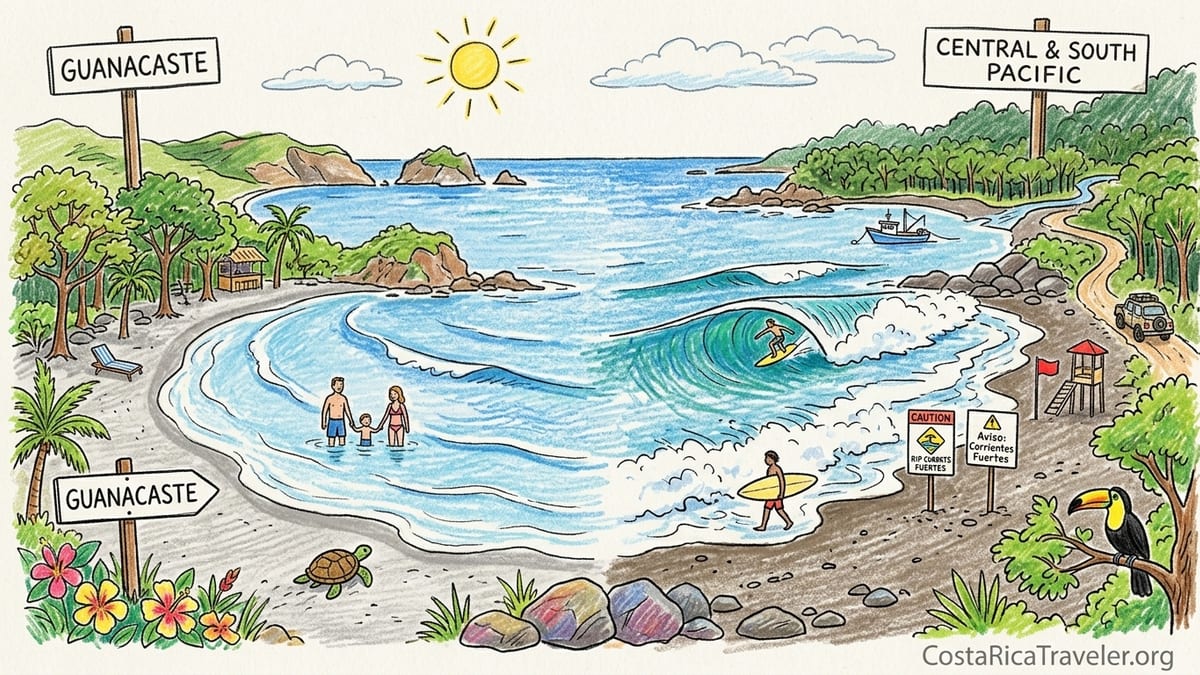
The first surprise on Costa Rica’s Pacific side is how dramatically the beaches change by region. In the north, around Guanacaste, you find pocket bays like Playa Hermosa and Playa Conchal that are partially sheltered from the open Pacific by rocky headlands and offshore islands. These curves in the coastline blunt a lot of the swell energy, so the waves are often smaller and more organized, especially during the dry season. That makes the water feel more approachable for casual swimming than the surf towns splashed across social media.
Drive south toward the Central Pacific and the mood shifts quickly. Jacó, Playa Hermosa (Garabito) and the string of Esterillos beaches face almost straight into the open ocean. The sand here is darker, the waves are stronger and more constant, and rip currents are a daily reality. The U.S. State Department now warns explicitly that dangerous rip currents are common on the Pacific and that drowning is a leading cause of accidental death for visitors, listing Hermosa, Esterillos and Dominical among the higher-risk beaches. Lifeguards cover a few priority spots like Jacó, Tamarindo, Hermosa and Dominical, but most of the coastline is unsupervised.
Farther south, around Uvita and Dominical, the shore becomes wilder and more irregular again. There are river mouths, rocky points, long surf beaches and small coves like Dominicalito tucked behind headlands. Bahia Ballena, including Uvita Beach, sits inside a national marine park, and local lifeguard associations now maintain daily coverage at Hermosa and Dominical in the Costa Ballena area. This region mixes surf breaks, wildlife viewing and protected areas, with swimming possibilities that vary a lot from one cove to the next.
Because of these differences, no single beach is “best” for everything. Some of the places I loved most for surfing were places where I barely wanted to chest-deep swim. Some gorgeous, calm bays felt too sleepy for a full week but perfect for three nights with kids. The goal here is to match specific beaches to specific travelers and be frank about the tradeoffs I saw on the sand.
Guanacaste’s Sheltered Bays: Playa Hermosa And Nearby North Coast Beaches
Playa Hermosa in Guanacaste was the first Pacific beach in Costa Rica that I walked onto and thought, “I could happily stay right here for four days.” The sand is a soft, grayish mixture that can look almost black when wet. It is not the bleached white of tropical postcards, and the volcanic content makes the water appear darker, so you will not see the neon turquoise you might expect. Once in the water, though, the bottom is mostly sand with only occasional rock patches near the points, and I found it easy to wade out waist to chest deep without worrying about unseen drop-offs.
On calm mornings the wave strength here has been gentle, more like long, rolling bumps than breaking walls. Local tourism information updated in late 2026 still describes Hermosa as one of the calmer Pacific beaches near Liberia, yet also notes that there are no permanent lifeguards. I treated it as a comfortable swimming beach for confident adults and older kids who stay close to shore and never swim alone, not as a pool. I usually stayed in the water 20 to 30 minutes at a time and felt relaxed but never careless. The current sometimes nudged me along the bay, but it was something I could walk against rather than fight.
Shade is a strong plus here. Behind much of the beach there is a line of trees and a few palms, and many small hotels and sodas keep loungers on the sand for guests or anyone buying a meal. In the middle part of the bay I could usually find natural shade without renting anything, particularly earlier in the day. Water temperatures were standard tropical Pacific: bathtub-warm, usually around the mid to high 20s Celsius according to regional sea surface charts, which meant I never needed more than a light rash guard. Surfing is possible on small days with longboards or soft-top rentals, but this is not a destination surf break.
In practical terms Playa Hermosa is easy. Access is straightforward from Liberia airport in about half an hour, the main road runs just behind the beach, and parking is a mix of free street parking and informal paid lots beside restaurants. Small supermarkets, beach bars and midrange hotels line the back street, so you can step from a lunchtime casado to the sand in a minute. Toilets are usually tied to businesses, which in practice meant buying a smoothie or beer when I needed facilities. Vendors were low-key: a few beach jewelry sellers and paddleboard rentals but not a constant sales pitch. I typically spent six or seven hours at Hermosa on full beach days, leaving only once the heat finally drove me back to air conditioning.
Central Pacific Contrast: Herradura’s Bay Versus Hermosa And Esterillos
Fifteen minutes north of Jacó, Herradura Bay looks almost artificial after the long straight surf beaches to the south. The bay is crescent-shaped and cupped by headlands, with a marina tucked into one side and a mix of public beach and resort frontage along the sand. The sand itself is coarse and brown, with scattered pebbles and shells that can be hard on bare feet. Water clarity is better than at Jacó but still far from Caribbean-glass, especially after rain when river outflow can cloud the bay.
What sets Herradura apart is the relative calm of the water. The headlands blunt a lot of the swell, so even when Jacó is thumping with overhead sets, Herradura often has smaller, more forgiving waves that break closer to shore. It became my go-to recommendation in this region when friends asked for somewhere young kids could splash around. I still saw longshore currents and occasional stronger shore break at higher tides, but in shoulder-deep water the push and pull was much less intimidating than Hermosa or Esterillos. On my visits, there were no visible lifeguard stands, so I treated it as an unsupervised bay with friendlier conditions, not a guaranteed safe zone.
Just south of Jacó, Playa Hermosa (Garabito) feels like a different ocean. The sand is very dark, almost black, and fine-grained. On hot days it heats so quickly that I had to jog from the tree line to the shore if I went barefoot. The beach itself is long and mostly straight. That shape, combined with the deep water offshore, is why the Costa Rican tourism institute describes Hermosa as having some of the most consistent surf in the world and why it has hosted international surf contests. When a solid south swell is running, the waves detonate in heavy, hollow peaks that are thrilling on a surfboard and intimidating for swimmers.
In the water at Hermosa the shore break can dump right on the sand, and the rip currents are not theoretical. Even on smaller days I felt the water sucking back under me as the waves receded. I am a confident ocean swimmer and still limited myself to quick dips in waist-deep water here unless I was out with a board. Local and national safety advisories group Hermosa with Esterillos and Dominical as beaches where drownings have been a problem, and while there is a growing lifeguard presence at key access points, it is patchy. My honest recommendation is that non-surfers treat Hermosa primarily as a place to watch waves and surfers, walk the sand, and sit in a shaded beach restaurant with a cold drink. I rarely stayed more than three or four hours because the heat, lack of natural shade in some stretches, and intensity of the ocean were exhausting.
Farther down the same coast, the Esterillos beaches are technically a trio: Esterillos Oeste, Centro and Este. They share the same dark sand and long, open exposure as Hermosa. Esterillos Oeste is where I spent the most time because there is a small village clustered near the sand, with sodas, rentals and some limited lifeguard and community safety presence during busier periods. At low tide you get a wide, gently sloping foreshore with a long shallow area before waves break harder outside, which made it feel more forgiving for wading and kid play. Locals in the area talked openly about strong rip currents farther out and past incidents, which kept me cautious. The north end near the mermaid statue is rockier; the southern stretch is sandy and better for casual swimming if the surf is not too big.
South Pacific Mix: Uvita, Dominical And Dominicalito
South of Quepos and Manuel Antonio, the coast loosens up again into a mix of long surf beaches, river mouths and coves backed by dense forest. Water temperatures here are similar to the Central Pacific, but humidity feels heavier and the surrounding hills rise closer to the shore. Uvita’s main beach sits inside Marino Ballena National Park, so access involves a modest national park entry fee at the main gates and limited opening hours, usually from morning through late afternoon. That fee supports infrastructure and conservation, including improved signage about currents and wildlife.
The sand at Playa Uvita is medium brown, compact and easy to walk on, with occasional patches of driftwood. At low tide the famous “whale tail” sandbar appears where two arcs of beach meet. I found the waves here in the shoulder to head-high range on moderate swell days, with a shore break that could be punchy at high tide. The current ran diagonally along the beach, not in an obvious channel, which meant a constant slow drift if I stayed in more than 10 or 15 minutes. When I swam at Uvita, I kept myself at waist to mid-chest depth, checked in with local surfers and guides about conditions, and never let kids go past belly-deep. It felt more approachable than Hermosa near Jacó, especially on smaller days, but not like a placid bay.
A few kilometers north, Dominical is unapologetically a surf town. The sand is darker and coarser than Uvita’s, mixed with small stones at the high-tide line. The beach faces straight into the open Pacific, so waves have more room to build power. On trips in both the dry and green seasons I encountered strong, dumping shore break and multiple rip currents along a single kilometer of beach. Local lifeguards, funded largely by community donations, patrol key areas and post warning flags, and Costa Rican and U.S. advisories flag Dominical as a beach where drownings have occurred. I loved Dominical for its energy, sunsets and the sound of big surf at night, but for pure swimming I treated it as a place for short dips in the whitewater and long walks rather than long, relaxed swims.
Dominicalito, just south of Dominical, is where I finally exhaled in this region. It is a small cove tucked behind a rocky headland, with fishing boats moored near shore and a pocket of gray-brown sand that all but disappears at very high tides. At mid to low tide there is enough beach to lay out a towel under palms or almond trees, and the waves are smaller and more sheltered. Several local guides and long-term residents I spoke with pointed Dominicalito out as the preferable swimming spot for families staying near Dominical, as long as you watch for submerged rocks and keep an eye on children. At lower tides, tide pools appear around the rocks, which kids love to explore.
Facilities at Dominicalito are minimal. Parking is usually along a roadside pull-off, with a few informal attendants in busy periods who ask for a small fee for watching your car. Restaurants are limited to a couple of beachfront or near-beach spots, more rustic than polished. There are no formal public toilets except within those establishments, and no permanent lifeguard tower that I have seen, though community safety efforts from nearby Dominical influence local awareness. I generally planned three to five hour visits here, bringing my own snacks, water and shade. Of all the South Pacific beaches, Dominicalito is the one I would return to most readily for a mixed group of surfers and non-surfers who simply want to be in the water without constant adrenaline.
Practical Comparisons: Sand, Shade, Currents And Crowds
Comparing these beaches side by side, one of the most tangible differences is the feel of the sand. Guanacaste’s Playa Hermosa offers soft, compact gray sand that is comfortable for long walks and easy barefoot entry, though it gets hot quickly at midday. Herradura’s coarser, pebbly brown sand makes sandals a good idea for the walk from parking to the waterline, while Hermosa near Jacó and the Esterillos beaches are deep, dark and can be scorching under a midday sun. In Dominical and Uvita you will often feel a mix of sand and small stones at the high-tide line, a reminder of the river systems feeding these beaches.
Shade also varies more than many travelers expect. Playa Hermosa in Guanacaste and Dominicalito both have reasonably good natural shade under trees immediately behind the beach, especially in their central sections. Herradura has some shaded pockets but also stretches dominated by resort lawns where shade is tied to property lines and beach clubs. Hermosa near Jacó has intermittent palm and tree cover, but long sections are fully exposed, making a beach umbrella or early-morning schedule important. Uvita’s shade depends heavily on the tide and which part of the park you enter from, but you can usually retreat to tree cover a short walk inland from the high-tide line.
On currents and wave strength, the divide is sharper. For visitors who prioritize easier swimming, Playa Hermosa in Guanacaste and Herradura clearly felt more forgiving. They are not free of currents or hazards, and neither has a permanent, obvious lifeguard presence, but typical wave days there allowed for relatively relaxed chest-deep swims. In contrast, Hermosa (Garabito), the Esterillos beaches, Dominical and often Uvita felt like surf beaches first. Even when the surface looked manageable from shore, once in the water I could feel strong shore break and the distinct seaward pull of rip currents as sets drained back.
Crowd levels follow road access and development. Herradura and Playa Hermosa in Guanacaste can feel busy during dry-season weekends and major holidays, when San José families and international tourists converge. Parking lots fill and restaurants hum, but I could still find quieter corners by walking ten minutes from the main access. The Central Pacific surf beaches work on a different rhythm: busier at dawn and late afternoon when surfers chase offshore wind and better light, sleepier at midday. Dominicalito and some parts of Esterillos Oeste remained relatively uncrowded even in high season, particularly outside weekends, which suited travelers looking for back-to-nature days.
Safety And Honest Dislikes
Spending time up and down this coast changed how I think about “beach safety” as a simple label. National and U.S. advisories emphasize that most Costa Rican beaches have no lifeguards, that rip currents are widespread, and that drownings happen every year. After talking with local lifeguards in Dominical and reading both national tourism and independent surf safety resources, the pattern that emerged was clear. The calmer-feeling Guanacaste bays like Hermosa owe much of their reputation to coastal shape and partial shelter, not to any engineered safety. The Central Pacific beaches, especially Jacó, Hermosa and Esterillos, generate more rescue statistics simply because they combine heavy surf, long straight sandbars and big visitor numbers.
My personal dislikes mostly tie back to how these realities feel on the ground. At Playa Hermosa near Jacó, the combination of deep, hot sand and intimidating shore break meant I seldom relaxed, even while sitting under a palm with a drink. Every few minutes another heavy set would slam down in front of us, and I found myself constantly scanning the lineup for beginners getting in over their heads. At Dominical, beauty and vibe compete with a nagging awareness that the calm-looking stretch in front of a beach bar might hide a lateral rip that will move a non-swimmer 50 meters down the beach in a minute.
Even in friendlier places there are irritations. Herradura’s mix of public and resort space can feel carved up, and during busy weekends the marina traffic and jet skis break the illusion of an untouched bay. Playa Hermosa in Guanacaste suffers occasionally from murkier water close to shore during rainy periods, when river runoff reduces clarity. Dominicalito’s charm comes at the cost of infrastructure, so if you like beach showers, boardwalks and lifeguard towers, it will feel under-serviced.
Most importantly, a calm morning on any of these beaches does not prove that they are always safe. Conditions change with tides, storms, seasonal swell and even the shifting sandbars beneath the surface. On one visit to Esterillos Oeste I watched families happily wading in ankle-deep water across a vast flat at low tide. Two days later, at high tide with a new swell, that same stretch produced head-high closeouts and visible rip channels. Treat any recommendation in this article as a snapshot, not a guarantee, and always cross-check with locals, lifeguards and recent conditions when you arrive.
Which Beaches I’d Actually Return To, And Why
Looking back, there are six beaches on this stretch of coast that I would actively plan a return trip around, each for different reasons. For relaxed swimming and doing almost nothing, Playa Hermosa in Guanacaste leads the list. The combination of soft sand, approachable waves on many days, warm water and enough shade and services to keep you comfortable for long afternoons makes it ideal for couples and families who want the Pacific without constant adrenaline. I would happily spend several full days there, reading under the trees, taking short swims and walking the curve of the bay at sunset.
In the Central Pacific, Herradura is my choice when traveling with mixed-ability swimmers or small children. Its bay shape, quick access from the highway and presence of nearby stores and restaurants make logistics easy. I would not call it “paradise” in the visual sense, but if someone asked me where to base themselves for a few days of gentle sea time within striking distance of Jacó’s restaurants and tours, Herradura would be my honest answer.
For surfers and people who love the energy of serious waves, Hermosa near Jacó remains compelling despite my reservations. Watching experienced surfers pull into big, hollow peaks under a fiery Pacific sunset is unforgettable, and the long, dark beach absorbs crowds better than smaller bays. I would return here with intermediate or better surfers who understand rips and know how to read a tide chart, with the clear ground rule that swimming is limited to shallow water and we pay attention to local safety briefings.
Farther south, Uvita, Dominical and Dominicalito form a trio that I think of as a single return-worthy cluster. Uvita’s marine park setting, whale watching and long beach walks at low tide make it ideal for wildlife-focused travelers who also like to be near the sea. Dominical offers a surf break, bohemian town vibe and expanding lifeguard program that will appeal to wave-hungry travelers who still want a café culture and yoga studios within walking distance. Dominicalito is the cove I would pick for a slow week of early-morning swims, tide-pool exploration and quiet evenings listening to the ocean without the intensity of a full surf town.
The Takeaway
After tracing Costa Rica’s Pacific from Guanacaste to the South Pacific, my strongest conclusion is that context matters more than postcard photos. Beaches marketed as “perfect for swimming” are only relatively so compared with the heavier surf beaches to the south, and a calm bay on one visit can feel very different under another tide or swell pattern. Across all these places, the common threads are warm water, strong sun and a need to take rip currents seriously, regardless of how many people you see in the water.
If your priority is swimming and family comfort, the beaches I would personally return to and recommend most strongly are Playa Hermosa in Guanacaste, Herradura Bay and Dominicalito, each with the clear caveat that you must still check local conditions, watch children closely and stay within your depth. For surfing and wave-watching, Hermosa near Jacó, Dominical and Uvita stand out, but I approach all three as surf beaches first and swimming beaches second. For scenery and wildlife, Uvita’s national park setting and the forest-backed coves around Dominicalito combine sea time with shorebird watching, whale tours and jungle hikes within a short drive.
Ultimately, the beaches worth returning to are the ones that match your comfort with the ocean. If you arrive in Costa Rica expecting calm Caribbean lagoons, the Pacific will surprise you. If you come ready to read the water, talk with local lifeguards and accept that some days are better for walking and watching than for swimming, you will find your own stretch of sand that you cannot wait to see again.
FAQ
Q1. Which Pacific beach in Costa Rica is best for relaxed swimming?
For most travelers who want relatively calm Pacific water, Playa Hermosa in Guanacaste is a strong choice because its bay shape softens the swell, but you should still avoid swimming alone and always check conditions when you arrive.
Q2. Are Costa Rica’s Central Pacific beaches safe for children?
Herradura Bay can be suitable for supervised children on smaller wave days, while straight surf beaches like Hermosa near Jacó, Esterillos and Dominical demand much more caution, shallow wading only and constant adult supervision.
Q3. Where are lifeguards most likely to be on the Pacific coast?
Lifeguard programs are currently more common at busy beaches such as Tamarindo, Jacó, Hermosa in Garabito, Santa Teresa, Dominical and parts of Costa Ballena, but staffing can change with seasons and funding, so always look for active towers and flags on arrival.
Q4. What time of day offers the calmest water for swimming?
On many of these beaches, early mornings around lower energy tides feel calmer, with fewer crowds and lighter winds, though you still need to watch for rip currents and talk to locals about that day’s conditions.
Q5. Is Uvita a good choice for families who like both wildlife and beach time?
Yes, Uvita combines a national marine park beach, whale watching and forest walks, but its waves and currents can be strong, so families should focus on shallow-water play, follow park safety advice and avoid swimming near river mouths.
Q6. Which beaches would you pick for learning to surf?
I would look first at surf schools in Jacó, Hermosa near Jacó, Dominical and Uvita, where experienced instructors can choose safer sandbars and tides for beginners instead of trying to figure out conditions alone.
Q7. Are there quiet Pacific beaches without big resorts?
Dominicalito, parts of Esterillos Oeste and stretches of the South Pacific between Dominical and Uvita feel relatively low-key, with fewer large hotels and more simple cabins, though services like showers and public toilets are limited.
Q8. How warm is the water on Costa Rica’s Pacific coast?
Sea temperatures along this coast are usually in the mid to high 20s Celsius, so most travelers are comfortable in just swimwear or a light rash guard for sun protection rather than a wetsuit.
Q9. What should I watch for to spot a rip current?
Common signs include a deeper, darker-looking strip of water, choppier surface, foam or debris flowing steadily seaward and waves that seem smaller or not breaking in one channel compared with surrounding areas.
Q10. If I am not a strong swimmer, where should I base myself?
Consider staying near Playa Hermosa in Guanacaste, Herradura Bay or Dominicalito, where the shapes of the bays often create gentler conditions, and plan to spend time ankle to waist deep, using the beach more for wading, walking and relaxing than for deep-water swimming.