


I did not see Costa Rica’s Pacific coast from a single sun lounger. I came back with sand in every bag, sunscreen on every shirt, and a notebook full of places that felt wildly different from one another. Tamarindo did not feel like Uvita, and neither had much in common with the Osa Peninsula. After several trips that stitched together the north, central and south Pacific, I finally understood that you do not pick “the Costa Rica coast” as a single destination. You choose a stretch of shoreline that fits the kind of week you want to have.
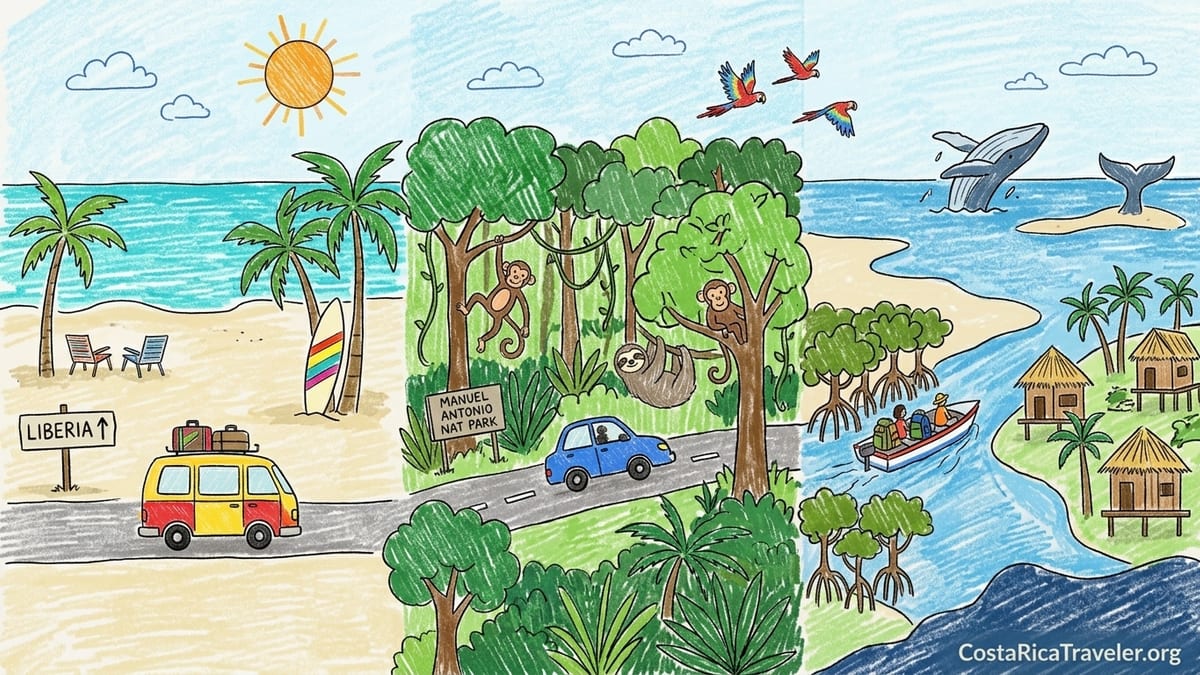
How I Traveled the Pacific Coast and What I Prioritized
Across multiple trips, I worked my way down the Pacific side from Guanacaste in the north to the Osa Peninsula in the south. I flew into both Liberia and San José, used a mix of shared shuttles and rental cars, and stayed anywhere from one night to a full week in each coastal area. I was looking for three things: where I would happily spend my own money again, how each stop actually felt day to day, and what kind of traveler each place served best. I am not trying to list every beach and town. I am trying to help you decide where to plant yourself when you only have one or two precious weeks.
Everything here is based on places I personally stayed, walked, swam and, in a few cases, mildly sunburned myself. If somewhere is wildly popular but left me cold, I will say so. If a quieter spot deserved more of my time, I will say that too. When I mention prices or logistics, they are drawn from recent on-the-ground checks and official sources as of late 2026, but Costa Rica changes quickly. Treat numbers as a planning ballpark rather than a fixed quote, and always recheck before you book.
Most importantly, think in roles. One town might be perfect as a three-night soft landing at the start of a trip. Another might make sense only as a one-night stop on a longer road journey. Others are better as your main base for a week, where unpacking once makes more sense than chasing the next palm tree. As I moved down the coast, I paid close attention to how long I wished I had in each place, how easy it was to get around without a car, and what evenings actually felt like when the day-trippers were gone.
Tamarindo and Northern Guanacaste: Easy Beach Holiday and Soft Landing
On my first Pacific trip, I gave Tamarindo four nights. It felt like a safe choice: close to Liberia airport, lots of hotels and condos, an easy first taste of Costa Rica. Getting there really is straightforward. Recent transport comparisons show private shuttles from Liberia to Tamarindo around 90 to 130 US dollars per vehicle, shared shuttles roughly 25 to 35 dollars per person, and rental cars about 50 to 90 dollars per day with basic insurance, using a fully paved route that does not require four-wheel drive. The public bus costs only a few dollars but can take three to four hours with a change in Liberia town, which matches what I saw backpackers describe and experience at the airport bus stop.
That convenience shapes what Tamarindo is good for. It is an easy place to start or end a trip if you are tired from flying or nervous about driving. Without a rental car, you can walk from many hotels to the beach, grab surf lessons directly in town, and use tour desks to arrange boat trips or sunset catamaran cruises that pick you up at your accommodation. For a family who wants a pool, some beginner surf and straightforward airport transfers, those four nights did exactly what I hoped: everyone found something to eat, and no one had to think too hard.
But Tamarindo also showed its limits. The main beach can feel busy and developed, especially at sunset when chairs, vendors and beach bars compete for space. The surf is fun for learners but not the wild beauty many people picture when they imagine Costa Rica. Nightlife leans toward bars with two-for-one cocktails, which might be perfect if you are twenty-three and traveling with friends, but it did not match the quieter nature feeling I wanted later in the trip. After four nights I was ready to leave and, on a return visit, I cut my stay to two nights, just long enough to shake off jet lag and arrange a car.
As a base, Tamarindo works very well for people who want to plant themselves somewhere familiar for a week and do the occasional day trip. As part of a coast-long itinerary though, I now treat it as a soft landing, not the main event. Two or three nights is enough for me to enjoy the restaurants, book a surf lesson and adjust to the heat before heading somewhere that feels wilder and less commercial.
Central Pacific and Manuel Antonio: Wildlife, Crowds and Short-Base Energy
Farther south, Manuel Antonio and its neighbor Quepos gave me an entirely different version of the Pacific coast. I stayed five nights on my first visit and three on a later trip, which felt like the right range for seeing the famous national park, spotting wildlife and getting in some beach time without getting stuck in the traffic and crowds that come with its popularity. This stretch of the central Pacific is one of the most developed coastal regions in the country, which makes it easy to visit but also less of a pure escape.
Manuel Antonio National Park earns its reputation for accessible wildlife. On my first morning inside the park, guided groups clustered around sloths high in the trees, iguanas crossed the path, and white-faced capuchin monkeys hovered frankly too close to people’s bags. International travel features have named it among the standout national parks in the world, and it genuinely feels like a compressed version of Costa Rican biodiversity. The tradeoff is density. At peak hours, trails can feel like a slow-moving line, and beaches inside the park fill up. I learned to book the earliest entry slot I could get and to leave by midday as temperatures and crowds rose.
Outside the park, Manuel Antonio’s role in my trip was clear. It was my place for easy wildlife viewing, comfortable hotels with views over the ocean, and reliable restaurant options. It was not my place for calm evenings or remote-feeling beaches. The main road between Quepos and the park hill packs in hotels, mini markets and tour offices, so without a car you can still get almost everywhere by walking or short taxi rides. With a rental car, short drives take you down to Quepos harbor for sunset or out to quieter local beaches, but traffic near park opening and closing times can be heavy, and parking requires patience and a bit of street sense.
By the end of each stay, I always felt like I had used Manuel Antonio best as a short base rather than a weeklong holiday. Three to five nights are enough to see the national park, try a guided night walk in nearby forest, fit in a sailing or snorkeling tour, and enjoy a couple of sunset dinners overlooking the coast. If I tried to stretch it out to a full long-stay beach holiday, the mix of tour buses and vendors would start to wear on me. On later Pacific itineraries, I treated Manuel Antonio as a high-comfort wildlife and tour hub, with wilder beaches and slower towns before or after it.
Uvita and the Costa Ballena: Quiet Beaches and Whale Watching Coast
South of Manuel Antonio, the atmosphere shifted the moment I reached the Costa Ballena, the “whale coast” anchored by Uvita. I first stayed three nights here and immediately wished I had booked five; on the second trip, I corrected that and gave Uvita a full six nights. It felt like the right amount of time to sink into the slower pace, explore Marino Ballena National Park, and still have space for waterfall swims and lazy afternoons. This is where I go now when I want a base that balances wild-feeling coastline with enough infrastructure to make life easy.
Uvita’s star attraction is Marino Ballena National Park, a protected stretch of coastline with several official access points, including Playa Uvita and Playa Colonia. The park is known for its tombolo, a sand-and-rock formation shaped like a whale’s tail that appears at low tide, and for humpback whale watching offshore. Official information from Costa Rica’s park service explains that this was the first marine park in the country and notes that humpback whale watching is possible in season, roughly July to November with southern-hemisphere whales, and again around the turn of the year as northern populations arrive. Tourism guides from the national tourism board point out that September and October are often the strongest months for sightings, and the town even hosts a whale festival when conditions cooperate.
On the water, I joined a half-day whale and dolphin tour that left from the beach just outside the park entrance gate. Recent local operator listings show typical prices hovering in the low to mid hundreds of US dollars per person for high-quality small-boat tours, depending on group size and season, with lower rates sometimes offered during the festival period. The day I went out, we saw distant breaches and closer tail slaps rather than the headline-making full jumps, but the experience of scanning the Pacific with the green coastline behind us was worth it even without perfect wildlife moments. Back on land, long open beaches meant that even in the middle of the day I could walk stretches of sand with only a handful of people in sight.
Uvita works best with a rental car. The town itself is spread out along the coastal highway, and while some lodges near the beach let you walk to the park entrance, many of the best hilltop accommodations and trailheads sit up steep side roads where local advice strongly recommends four-wheel drive in the rainy season. On one trip, I tried to manage with shared shuttles and taxis, and I felt constrained; I spent more effort arranging rides than exploring. With a car, evenings opened up. I could drive down to simple sodas for casados, head slightly north to Dominical for a more bohemian surfer-town sunset, or retreat to a balcony in the hills and listen to the rainforest chorus. As a base, Uvita easily holds five to seven nights if you enjoy long walks, tide pools, waterfalls and slow evenings rather than nightlife.
Osa Peninsula and Drake Bay: Remote Nature and Slow Coastal Travel
At the southern end of my Pacific journeys, the Osa Peninsula changed how I thought about the coast altogether. This was not a place to “add on” lightly. It asked for time and rewarded it. I split ten nights between Drake Bay on the northern side and Puerto Jiménez on the Golfo Dulce. On a later trip I added four more nights in Drake Bay. For me, Osa is where you go when wildlife and remote nature are the entire point of the trip, not just a day trip from a beach town.
Drake Bay in particular takes effort to reach. Official visitor information and local operators describe three main options: small domestic flights, a boat from the river town of Sierpe, or a long drive that, in the rainy season, really needs a high-clearance four-wheel-drive vehicle. On my first visit I chose the boat, catching a morning transfer from Sierpe that wound through mangroves and then shot out into the open Pacific before landing directly on the beach at Drake. Regional transport guides note that shuttle buses from San José to Sierpe are timed to connect with these boats, making the combined land-and-sea route a popular choice for travelers who do not want to drive all the way themselves.
Once in Drake Bay, the lack of roads became part of its role in my itinerary. This was my base for visiting Corcovado National Park, snorkeling at Isla del Caño and taking guided night walks that started right behind the cabins. Evenings were the opposite of Tamarindo’s bar scene. After a day of hiking in humid forest where scarlet macaws screeched overhead and tapir tracks sank into the mud, I would shower, eat a simple fish dinner, and sit in a hammock with the sound of surf and tree frogs as the main entertainment. The small village has a handful of restaurants and a couple of low-key bars, but most people turn in early because tours depart at dawn.
Compared with Uvita or Manuel Antonio, Osa absolutely benefits from professional guidance and realistic budgeting. Official cultural and tourism guides list a cluster of certified local agencies in Puerto Jiménez and Drake Bay that handle Corcovado logistics. Park regulations limit daily visitor numbers, require accredited guides and control entry points, and that structure is part of what keeps the forest feeling genuinely wild. Tours are not cheap. Full-day trips into Corcovado from Drake, including boat transport, park fees and guiding, are widely advertised in the mid hundreds of US dollars per person, and multi-day treks cost more. To make that expense worthwhile, I would not travel all the way to Osa for less than five nights, ideally eight to ten split between two bases if you can spare the time.
In practical terms, I now see Osa as the anchor for itineraries where nature is the primary goal. On one trip, I used Uvita as a decompression stop on the way down and back up, which broke the long drive and gave me days of open beaches between intense rainforest outings. On another I flew into Drake, spent a week there, and then ended with three nights in Manuel Antonio to ease back into a world with more restaurant choices and easier transportation. For anyone who wants real rainforest and can live without nightlife or big grocery stores, Osa is where Costa Rica’s Pacific still feels raw.
Places That Disappointed and Places That Surprised Me
Not every famous stop on the Pacific coast lived up to its reputation for me, and a few quieter places impressed me far more than their modest map presence suggested. One disappointment was how some of the busier Guanacaste beach strips felt after dark. In certain pockets near large all-inclusive resorts, evenings revolved around themed buffets and in-house entertainment. If your goal is never to leave the property, that may be ideal. For me, it ended up feeling disconnected from Costa Rica itself. On a two-night stay at a well-known beachfront resort near Tamarindo, I realized I could have been almost anywhere in the tropical world once I walked through the lobby.
Manuel Antonio, for all its strengths, also had moments that fell short. The area between Quepos harbor and the park entrance has grown quickly, and some corners feel more like a busy resort corridor than a small coastal town. On one Saturday night, traffic backed up along the main hill road, and restaurant hosts competed loudly for business as tour buses unloaded evening groups. I still recommend Manuel Antonio for first-time wildlife viewing and a comfortable central Pacific stay, but I no longer pretend it is purely idyllic. It is an accessible, often crowded gateway to nature rather than a secluded hideaway.
On the positive side, little pieces of the coast that I initially treated as “in-between” stops turned out to be highlights. Dominical, just north of Uvita, felt like a more compact, surf-focused town with a low-key evening scene. On an itinerary where I only stayed two nights, I ended up wishing for at least one more to enjoy sunset on the rocky beach and have time for a river or waterfall outing inland. Similarly, the quiet bays around the Golfo Dulce near Puerto Jiménez, with calm water that families used almost like a giant saltwater swimming pool, provided some of the most relaxed swimming of anywhere on my route. Neither place had the obvious, heavily marketed draw of a national park gate, but both delivered the mix of sea, forest and local life that I now look for.
Those surprises changed how I plan the Pacific. Rather than jumping directly between the “big name” spots like Tamarindo and Manuel Antonio, I now look for one or two smaller dots on the map along the way. Giving even two extra nights to a less famous stretch of coast often produced more memorable mornings than adding those same two nights in an already crowded hub. The trick is to be honest about your own comfort level: smaller places can mean fewer English-language services and sparser public transport, which makes a rental car and basic Spanish phrases much more useful.
The Takeaway: Matching Pacific Destinations to Your Trip Type
After zigzagging up and down Costa Rica’s Pacific coast, I stopped asking “What is the best beach?” and started asking “What kind of week am I trying to build?” The answer usually points clearly to one or two regions. If you want an easy, low-stress beach holiday close to an international airport, with surf lessons on tap and plenty of restaurant choice, somewhere like Tamarindo or a neighboring Guanacaste beach makes sense, especially for the first two or three nights of a trip. Those towns played the role of soft landing and simple exit point in my itineraries: places where transfers are straightforward, rental cars are easy to arrange, and little goes logistically wrong.
If your vision of Costa Rica is monkeys in trees and a guided walk through dense forest, the central Pacific around Manuel Antonio fits better. I now view it as a three to five-night wildlife and comfort base rather than a full trip on its own. It remains one of the most accessible places to see a lot of animals in a short time, and its hotels and tour desks make life easy for first-time visitors or families. Just go in expecting company on the trails and a busy road instead of empty coastline.
For travelers who value space, open beaches and a less commercial feeling, Uvita and the broader Costa Ballena have become my go-to recommendation. As a base, five to seven nights here give you time for whale watching in season, long walks inside Marino Ballena National Park, and day trips to waterfalls and nearby surf breaks, while evenings stay relatively quiet. It works particularly well for couples, slower-traveling families and anyone who likes the idea of self-drive days with a return to a private balcony in the hills.
When wildlife and remoteness are the entire point, the Osa Peninsula sits in its own category. Getting there takes more time and money, and a visit only feels worthwhile if you can commit at least five nights, ideally more. In return you get rainforest and sea that still feel raw, early mornings where macaws fly over the beach and nights where the main sound is the surf. I now build itineraries “around Osa” or “without Osa” rather than trying to squeeze it into a shorter loop. By being clear about these roles and honest about how much moving around you really enjoy, you can choose the stretch of Costa Rica’s Pacific that matches the trip you actually want to have, not the one that looks busiest on a map.
FAQ
Q1: Do I need a rental car to enjoy Costa Rica’s Pacific coast?
For short stays in Tamarindo or Manuel Antonio you can manage with shuttles, taxis and organized tours, since many hotels sit within walking distance of the beach or main road. For Uvita, Dominical and especially the Osa Peninsula, I found a rental car, often with four-wheel drive in rainy season, made a big difference for reaching trailheads, hilltop lodges and quieter beaches on my own schedule.
Q2: How many Pacific destinations should I combine in a one-week trip?
When I tried to fit three coastal bases into a week, too much time disappeared into packing and transfers. My sweet spot became one main base plus a shorter stop, for example four or five nights in Uvita with two nights in Manuel Antonio, or five nights in Tamarindo with two in a quieter nearby beach town. With only seven days, choosing a single well-located base is often the most relaxing option.
Q3: Is Tamarindo a good choice for families with children?
Yes, for many families Tamarindo works very well. The beach has beginner-friendly waves, there are swimming pools at many hotels, and airport transfers from Liberia are straightforward, with shared and private shuttles easy to arrange in advance. The tradeoff is that it feels busy and developed compared with quieter parts of the coast, so if you value space and silence you might prefer splitting time between Tamarindo and a less crowded beach nearby.
Q4: When is the best time to visit Uvita for whale watching?
Based on park information and regional tourism guides, humpback whales are most reliably seen off Uvita and Marino Ballena National Park between roughly July and November, with another season from late December into the first months of the year. Local materials highlight September and October as particularly strong months in many years, and the town often organizes a whale festival then, although exact dates and wildlife sightings always depend on conditions.
Q5: How long should I stay on the Osa Peninsula to make it worthwhile?
On my first visit I spent ten nights split between Drake Bay and Puerto Jiménez, and on a later trip I gave Drake four more nights. Anything under five nights felt too rushed for the time and cost of getting there, especially if you want to include a full-day Corcovado National Park tour and a boat or snorkeling trip. If your overall vacation is two weeks or more, devoting about half of it to Osa can make sense if remote nature is your main goal.
Q6: Is Manuel Antonio too crowded to enjoy?
It can feel crowded at peak times, especially inside the national park and along the main hill road, but I still found it worthwhile when I planned around the pressure points. Booking the earliest park entry, visiting on weekdays when possible, and choosing lodging slightly away from the busiest strip helped a lot. For me, Manuel Antonio worked best as a three to five-night stay focused on wildlife and a few organized activities rather than as a long, lazy beach holiday.
Q7: Are domestic flights along the Pacific coast worth the cost?
For reaching remote areas like Drake Bay or for saving a full travel day between San José and the far south, I found domestic flights valuable when my budget allowed. They turned journeys that would have taken most of a day by road and boat into trips of an hour or less. However, I still needed boat transfers or 4x4 taxis at the far end in some places, so flights felt like a complement to, not a replacement for, ground logistics.
Q8: Can I visit both the Caribbean and Pacific coasts in one trip?
It is possible, but combining both coasts in a short itinerary often led me to feel rushed. After experimenting, I preferred to focus on one coast per trip, especially when the Pacific alone already offered distinct regions like Guanacaste, the central Pacific and the south around Uvita and Osa. If you have two or three weeks, adding a few Caribbean nights before or after a Pacific loop can work, as long as you accept that you will spend one or two full days in transit.
Q9: What kind of evening atmosphere should I expect in Uvita and Dominical?
Evenings in Uvita tended to be quiet, with people returning from day trips, having dinner at small restaurants or at their lodgings, and turning in relatively early. Dominical had more of a surf-town energy, with a slightly livelier beachfront and a few bars, but it still felt laid-back compared with larger resort areas. If you are looking for clubs and late-night options, these towns may feel subdued; if you prefer low-key dinners and early mornings, they can be ideal.
Q10: How far in advance should I book tours and accommodation on the Pacific coast?
In the heart of the dry season from around late December through March, I now book my main accommodations and key tours, such as Corcovado excursions or popular whale watching departures, at least a couple of months ahead. For shoulder seasons and the green season, I have had more success booking one to four weeks before arrival, especially in less crowded towns. Last-minute deals can exist, but for small lodges in Osa or hilltop cabins near Uvita with limited rooms, early planning has consistently given me better options.