

I have driven the Pacific coast of Costa Rica from the dry hills of Guanacaste to the deep rainforest of the South Pacific, watching the landscape, the roads and even the style of hotels change hour by hour. Some sections in this comparison are drawn from those firsthand journeys, others are clearly labeled as researched. Together they form a practical guide to deciding which coast fits the trip you have in mind, from quick winter sun to rainforest immersion.
How the Three Coasts Feel on Arrival
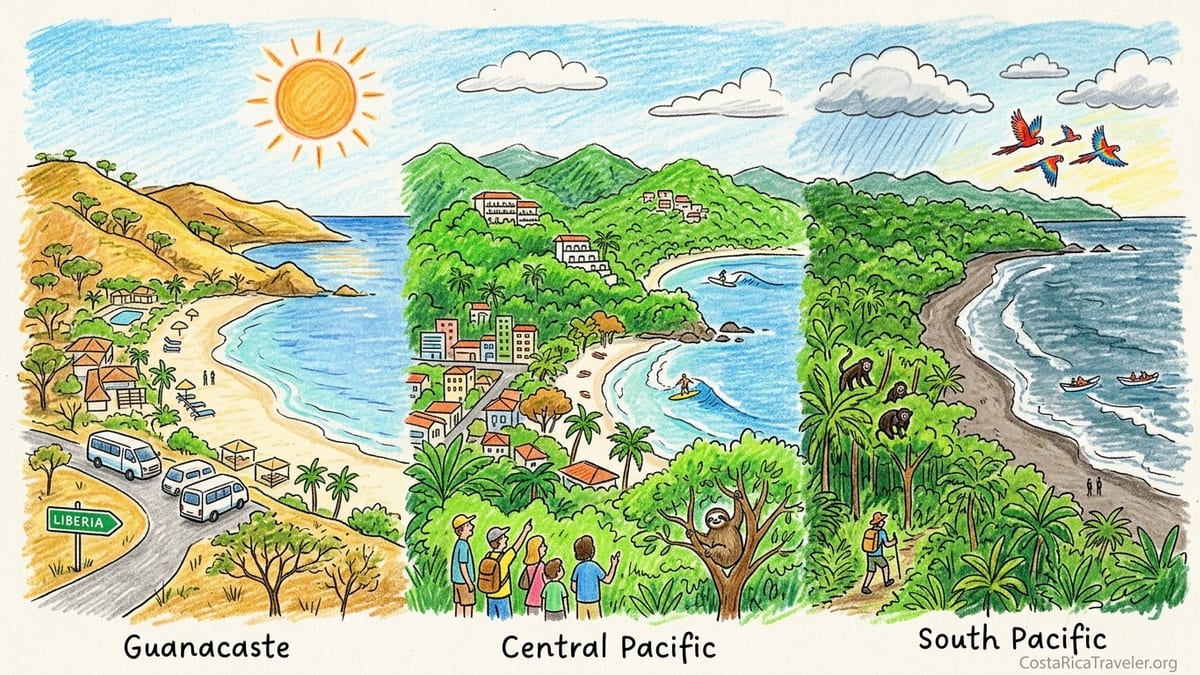
Landing at Liberia’s Daniel Oduber Quirós International Airport in Guanacaste, I walked out of the terminal into a wall of dry heat and sun. In February the hills around the runway were brown and dusty, and 25 minutes later I was in Playas del Coco, already checking into a beach hotel. The impression was of convenience and resort infrastructure: big transfer vans waiting at the curb, highway-style roads, and signs for well-known brands like Planet Hollywood and the Westin along the coast near Papagayo and Playa Conchal, where many of Costa Rica’s large beachfront resorts and all-inclusive properties are concentrated.
Arriving on the Central Pacific, I felt the shift before I even saw the ocean. Driving down from San José to Jacó, the road dropped out of the mountains into thickening greenery, with vines and trees closing over the highway as it neared the coast. By the time I reached Quepos and Manuel Antonio, the air was heavier, the slopes above town were bright green, and hotels were perched on steep jungle hillsides with views over the national park rather than lined up along a continuous beach strip.
The South Pacific felt like a different country altogether. South of Dominical the road narrowed and the rainforest seemed to push right to the pavement. Around Uvita and Ojochal, forested ridges ran straight down to dark-sand beaches with almost no construction visible from the shore. When I continued toward the Osa Peninsula, traffic thinned to the point that I would drive ten minutes without seeing another car, replaced instead by scarlet macaws, roadside howler monkeys and the constant sound of insects rising out of the forest.
That first impression matters. Guanacaste feels built around easy access and established resorts. The Central Pacific mixes busy coastal towns like Jacó with protected rainforest slopes. The South Pacific feels remote and dominated by primary forest and low-key ecolodges. The rest of this article breaks down what that means for your own trip in terms of climate, costs, wildlife and day-to-day experience.
Climate, Rainfall and When It Actually Feels Good
The environmental distinction between these coasts is real and not just tourism language. Official climate mapping divides Costa Rica’s Pacific into a drier North Pacific region that includes Guanacaste, a wetter Central Pacific, and an even wetter South Pacific, each with different lengths of dry season and annual rainfall. Guanacaste’s lowlands are classified as tropical dry forest, with a pronounced dry season roughly from December to April where some areas see over two months with almost no meaningful rain, and hillsides turn golden or brown.
On my February visits to Tamarindo and Nosara, I saw that on the ground. Grasses along the backroads were straw colored, dust rose behind every vehicle on unpaved stretches, and beach days were almost too hot by early afternoon. Locals in Nosara talked about the first serious rains not arriving until May most years, and even then many days still held long sunny windows. This dry, predictable pattern is exactly why families and snow-escaping travelers often target Guanacaste for winter trips.
By contrast, the Central Pacific around Jacó and Manuel Antonio still follows the Pacific dry season, usually December through April, but with much more rainfall and a shorter period of parched landscape. During a late March stay above Manuel Antonio, my mornings were typically bright and sunny until early afternoon, when clouds built over the inland mountains and short showers swept through, leaving everything washed clean and green by sunset. Driving inland from Quepos, I crossed several rivers that were already running more strongly than similar rivers in Guanacaste at the same time of year.
In the South Pacific, even the “dry” months are wet by Guanacaste standards. Climate references for the region describe very short dry periods and some of the country’s highest annual rainfall, with the Osa Peninsula often mentioned as one of Costa Rica’s rainiest areas. On a January trip to Uvita I still had several heavy overnight showers in a single week, and rangers near Corcovado mentioned that true blue-sky days from dawn to dusk were rarer there than farther north. For travelers, this means Guanacaste generally offers the sunniest winter beach weather, the Central Pacific balances green landscapes with a defined dry season, and the South Pacific trades some weather predictability for lush rainforest at almost any time of year.
Vegetation, Beaches and the Simple Act of Swimming
Driving between beaches in Guanacaste, I often felt I was crossing savanna country dotted with isolated stands of trees. The official description of the region as tropical dry forest fits what you see on the ground. In late dry season many trees lose their leaves, cattle graze in open pastures, and national parks such as Santa Rosa and Rincón de la Vieja protect rare remnants of mature dry forest. On the coast itself, beaches like Playa Flamingo, Playa Hermosa and Playa Tamarindo are broad and often framed by low, scrubby hills rather than towering jungle.
Swimming along this stretch varies beach by beach but has a generally user-friendly character. At Playa Hermosa and some bays on the Papagayo Peninsula, I waded into warm, relatively calm water that worked well for floating and casual family swims. In Tamarindo the beach break makes it better for beginner surf than glassy swimming, but I still saw children playing at the shoreline under a watchful eye. Water temperatures were bath-like in March, often in the upper 20s Celsius, which made long afternoon swims comfortable.
On the Central Pacific around Jacó and Manuel Antonio, the vegetation shifts toward true rainforest. Hillsides are dense with tall trees and understory plants, and the narrow strip of land between the coastal highway and the sea is often lined with palms and broadleaf forest rather than open pasture. In Manuel Antonio National Park I walked from forest trails directly onto white-sand beaches shaded by almond and palm trees, with monkeys watching overhead.
The sand itself also shifts. South of Jacó many beaches take on darker, volcanic tones. Playa Dominical, where I once watched a powerful swell roll in all afternoon, is visibly steeper and more exposed than many Guanacaste bays, with stronger currents and more advanced surf. Swimming there required choosing calm days and staying close to shore. Manuel Antonio’s protected coves, on the other hand, were significantly gentler, with smaller shore breaks that allowed children to float with masks and snorkels in relatively sheltered water.
Farther into the South Pacific, especially around Uvita and Osa, the forest seems to lean over the beach in places. From my guesthouse near Uvita I could walk ten minutes through secondary forest and mangroves and then step out onto Playa Uvita’s long, dark-sand arc with almost no development in sight. Swimming there on a mid-tide felt wilder. The waves were strong but predictable, with long intervals great for body surfing but demanding more awareness. The lack of lifeguards in many spots in the South Pacific means confident swimmers and careful timing are important, particularly for families.
Surf, Wildlife and That Sense of Wildness
Surf culture has distinct flavors along these three coasts. In Guanacaste, Tamarindo and Nosara anchor a well-developed surf scene with board rentals every few meters and schools offering beginner lessons in English and Spanish. When I paddled out at Tamarindo at mid-tide, I shared the break with a mix of first-timers and intermediate surfers catching forgiving, rolling waves. North of there, Playa Grande adds more serious reef and point setups, while many Papagayo bays are better for swimming and stand-up paddle than true surf.
On the Central Pacific, Jacó is one of the most accessible surf towns in the country. Within a short drive of San José, it draws both city residents and international visitors. One September morning I watched a group of teenagers practice on the south end of Jacó’s beach, where the waves were smaller, while more advanced surfers congregated at Playa Hermosa just down the road, a black-sand, high-energy break that regularly hosts contests. Dominical, a couple of hours farther south, felt like a smaller, more scattered surf village, with older longboarders and digital nomads walking between a few streets of cafes and surf shops.
For wildlife, the Central and South Pacific outshine Guanacaste in sheer density, something I felt as soon as I stepped into rainforest. Around Manuel Antonio, sloths, monkeys and iguanas are easy to spot on guided walks and even from hotel balconies, thanks to the compact area of protected forest behind the beaches. On a single morning hike through the park I saw a three-toed sloth, several howler monkeys and a pair of scarlet macaws, guided by local naturalists who knew where families of animals tend to feed and rest.
Farther south, the Osa Peninsula is often described in conservation literature as one of Costa Rica’s least disturbed regions, and in the field it feels that way. Although my time deep in the Osa was more limited and some details here rely on conservation organizations and park services rather than repeated stays, the contrast with Guanacaste was immediate. Roadside sightings of toucans, macaws and coatis were common, and guided trips into or near Corcovado National Park were focused less on checking off a list of animals and more on navigating dense, humid forest where wildlife was everywhere but not always easy to see.
By comparison, wildlife in the Guanacaste beach belt felt more spread out, concentrated in specific reserves and inland volcano parks rather than along the busy resort beaches. Near Rincón de la Vieja, on a day trip from the coast, I walked through dry and transitional forest and saw white-faced capuchins and armadillos, along with bubbling mud pots and steam vents. Back at the beach in Tamarindo, sunset often brought flocks of birds and the occasional raccoon near outdoor restaurants, but the sense of immersion was more about ocean and sky than forest.
Staying There: Hotel Styles, Nightlife and Daily Rhythm
In Guanacaste, the accommodation mix clearly leans toward resorts and polished beach hotels. Around Liberia and the northern Pacific coast, well-known brands such as the Four Seasons, Andaz, Westin and JW Marriott operate beachfront properties, many on relatively secluded bays with their own internal restaurants, pools and activities. On one stay at a large all-inclusive near Playa Conchal, I met families who never left the property during a five-night visit, content with kids’ clubs, buffets and organized snorkeling trips straight from the resort’s beach.
There is still a strong independent side to Guanacaste, particularly in towns like Tamarindo, Sámara and Nosara where smaller boutique hotels, surf hostels and vacation rentals line the backstreets. In Tamarindo I stayed at a midrange guesthouse two blocks from the sand with a small pool and found plenty of cafes and budget-friendly sodas, or local eateries, within a short walk. Nightlife there was the busiest I encountered on the Pacific coast, with live music, open-air bars and late restaurant service several nights a week, especially in the December to March peak.
The Central Pacific offers a broader mix in a smaller area. Jacó has midrise condos, midrange hotels and simple rooms aimed at surfers and weekenders from San José, with a compact center full of restaurants, casinos and bars. It is the one place on this coast where I constantly heard traffic and nightlife late into the night. Manuel Antonio and Quepos, a short drive away, feel different, with hillside boutique hotels, small luxury properties and a few larger complexes hidden in the forest. Many of these places emphasize ocean views and wildlife sightings over resort scale, with shuttle vans running up and down the steep main road between town and the beaches.
In the South Pacific, accommodation becomes smaller and more spread out. Around Uvita and Ojochal, my lodging options centered on ecolodges, jungle villas and small bed-and-breakfasts built into the hills, often requiring a short drive up steep, sometimes rough roads. Rooms tended to be open to the air, with ceiling fans rather than central air conditioning, and most restaurants were independent, owner-run places rather than part of hotel complexes. After dark, nights were quiet apart from insects and distant surf. For travelers who equate vacation with bars and music, that can feel too subdued. For those who want early hikes and early nights, it is close to ideal.
Roads, Access and What It Really Feels Like to Drive
In terms of ease of movement, Guanacaste is the least stressful region I have driven in Costa Rica. From Liberia airport, wide paved highways lead to major hubs like Playas del Coco, Tamarindo and the Papagayo Peninsula. Signage is clearer than in more remote regions, and distances are short by local standards. I have left the airport and been swimming at Playa Hermosa within an hour with no need to cross major mountain ranges. Inside towns, some backstreets remain unpaved and dusty in the dry season, but main routes are straightforward.
The Central Pacific involves more varied driving. The main road from San José to Jacó and Quepos is fully paved and in solid condition, but it descends from the Central Valley through mountain passes, with heavy truck traffic and sections of sharp curves. I have always planned at least three to four hours to reach Manuel Antonio from San José, depending on traffic, and felt more fatigue at the end of the drive compared with the shorter, flatter trips within Guanacaste. South from Jacó toward Dominical, the coastal highway becomes more scenic, hugging cliffs above the ocean with occasional slow sections where landslides or rain have damaged the shoulder.
In the South Pacific, road conditions have improved in recent years, but driving still feels more committing. The main coastal highway is paved, and sections between Dominical and Uvita have seen resurfacing and better markings, which reduced travel times and made night driving slightly less daunting. Once you turn inland toward the Osa Peninsula or up into the hills around Uvita and Ojochal, though, you quickly encounter steeper, narrower roads, some of which can be rough after heavy rain. My drives along these routes were not technically difficult, but they required lower speeds, more attention to weather and a greater comfort level with gravel and potholes.
For those who prefer to avoid driving entirely, Guanacaste is again the simplest, with frequent shared shuttle services, private transfers and organized tours connecting major beaches to the airport and to inland sights such as Rincón de la Vieja. On the Central and South Pacific coasts, private shuttles are still widely available, but reaching small ecolodges or distant trailheads often means arranging transfers directly with the property or operators and accepting more limited departure times.
Costs, Tours and Family Friendliness
Price patterns on these coasts are influenced by both demand and infrastructure. In Guanacaste’s resort belt, I have seen nightly rates at large beachfront properties climb significantly during the December to March high season, with family-friendly all-inclusives commanding some of the highest prices. At the same time, the wide range of accommodation types means it is still possible to find midrange hotels and apartments in towns like Tamarindo and Sámara that come in lower per night than many South Pacific ecolodges, especially if booked outside peak holiday weeks.
On the Central Pacific, prices felt slightly more moderate for basic lodging but could rise quickly for boutique hotels with ocean views around Manuel Antonio. Jacó offered some of the most budget-oriented options for surfers and backpackers. Because both Jacó and Manuel Antonio are within easier reach of San José, tours here are also common and competitively priced. I was able to join group excursions for canopy ziplining, mangrove boat trips and national park walks at rates that often undercut comparable private tours in more remote regions, simply because operators could fill more seats.
In the South Pacific, the picture shifts. Small-scale ecolodges near Uvita and especially on the Osa Peninsula often include meals and guided activities in their rates, which can make nightly costs appear higher on paper but add value once you account for logistics and guiding. Boat trips to snorkeling sites like Caño Island, whale-watching tours out of Uvita and full-day guided hikes near Corcovado tend to run higher in price than short tours elsewhere, in part because of fuel costs and the need for experienced guides in remote areas. When planning a week in this region, I found it easy to spend more per day than in Guanacaste once tours were included, even while staying in simpler lodgings.
For families, Guanacaste often felt the easiest match, especially with younger children. Short transfers from Liberia, reliable dry-season weather, shallow sections of beach and resort pools all contribute to a low-friction trip. During one March stay I shared a shuttle with a family whose children were all under ten. Their plan was limited on purpose: pool, beach, one or two organized day trips to see wildlife and hot springs, and back to the airport. On the Central Pacific, families gain easier access to rainforest and wildlife in places like Manuel Antonio, though steeper terrain and busier roads call for more supervision with kids.
Families who value wild nature and have older, more resilient children may find the South Pacific rewarding but should be realistic about longer drives, more rain and the need for insect precautions. On a visit to Uvita I met a family with teenagers who loved their time on a whale-watching trip and night walk in the forest but admitted that daily logistics were more involved than during their previous stay at a Guanacaste resort, from driving steep tracks to timing outings around storms.
Which Coast Fits Which Type of Holiday
For a short beach break focused on sun, swimming and simplicity, Guanacaste matched my own need to fully relax more than the other coasts. I could land at Liberia before midday and realistically be on the beach by early afternoon with minimal planning. Once there, daily decisions were light: which cove to visit, whether to book a sunset catamaran cruise, and which restaurant to try that evening. For travelers who measure relaxation in hours of unbroken sun by the hotel pool and easy walks to beach bars, this coast has a clear edge.
For a first trip to Costa Rica that aims to balance ocean time with vivid rainforest and easy wildlife viewing, I found the Central Pacific, especially the Manuel Antonio and Quepos area, to be the most efficient match. In a three- or four-night stay I could spend one day at the national park, another on a mangrove or catamaran tour, and another simply on the beach, all from a single base. The roads and crowds required more patience than in some Guanacaste towns, but the payoff in terms of wildlife encounters and landscape variety felt higher without the long travel times associated with the South Pacific.
For travelers seeking immersion in rainforest and a feeling of remoteness, the South Pacific is the logical focus. Around Uvita, Ojochal and especially on the Osa Peninsula, days followed the rhythm of the forest rather than a resort schedule. Morning hikes began early to beat the heat, boat trips headed out at first light, and nights quieted down soon after dinner. When I think back on moments that most impressed me in Costa Rica, many come from this region: walking along a nearly empty beach fringed by jungle, listening to howler monkeys call before sunrise, or watching a thunderstorm sweep across the sea from a hillside deck.
None of these coasts is a universal winner, and many travelers will combine at least two. A two-week trip might pair Guanacaste’s dry beaches and resort comforts with a stint in the Central Pacific rainforest, or fly into San José, drop to Jacó and Manuel Antonio, then continue to Uvita for a taste of the South Pacific’s wilder character. Deciding which one should anchor your itinerary comes down to how you weigh convenience against remoteness, sun against rainforest, and structured resort days against exploratory, weather-dependent plans.
The Takeaway
Choosing between Guanacaste, the Central Pacific and the South Pacific is less about which coast is “best” and more about what kind of Costa Rica you want to wake up to each morning. In Guanacaste, that morning might start with a short walk from a polished resort to a broad, sun-baked beach, a coffee at a cafe that caters to international visitors, and an afternoon catamaran cruise booked from a desk in the hotel lobby. Roads are easy, days are predictable and the overall impression is of light, heat and open horizons.
On the Central Pacific, a typical day might mean waking on a hillside surrounded by forest, driving a winding road to reach the beach, and sharing your breakfast patio with monkeys or toucans. You trade some of Guanacaste’s dryness and simplicity for steeper hills, more traffic in town centers like Jacó and Quepos, but also for shorter walks from your room to true rainforest and national parks.
In the South Pacific, mornings felt slower and more dictated by nature. I remember standing on a balcony in Uvita watching low clouds burn off the jungle, planning hikes and boat trips around the timing of tides and afternoon storms. The convenience of big supermarkets and fast nightlife was replaced by local fruit stands, small restaurants and quiet evenings. The payoff was a stronger sense of being in a living forest ecosystem, right down to the chorus of frogs and insects after dark.
If you picture your ideal Costa Rica as easy, sunny and resort-centered, Guanacaste fits best. If you want a dense snapshot of rainforest, wildlife and ocean with relatively modest travel times, the Central Pacific delivers. If your dream leans toward off-the-beaten-path rainforest, fewer people and powerful landscapes, then the South Pacific rewards the extra effort. Understanding these differences makes it easier to pick the coast that will feel right for you when you finally walk barefoot onto that first Pacific beach.
FAQ
Q1. Which Costa Rican coast is best for a first-time visitor?
For many first-time visitors, the Central Pacific around Manuel Antonio is a strong choice, because it combines beaches, rainforest and easy wildlife viewing within a compact area and can be reached by a straightforward drive from San José.
Q2. If I want the sunniest winter beach weather, where should I go?
Guanacaste on the North Pacific coast usually offers the most consistently sunny and dry conditions between December and April, especially around towns such as Tamarindo, Flamingo and the Papagayo Peninsula.
Q3. Which coast has the easiest driving and access from an international airport?
Guanacaste is generally the easiest, thanks to Liberia airport, short transfer times to major beaches and relatively flat, well-maintained main roads serving places like Playas del Coco and Tamarindo.
Q4. Where will I see the most wildlife without traveling very far?
The Central Pacific provides excellent wildlife viewing in a small radius, particularly in and around Manuel Antonio National Park, where guided walks often reveal sloths, monkeys and colorful birds within a short distance of beach hotels.
Q5. Which region is better if I want a remote, rainforest-heavy experience?
The South Pacific, including Uvita, Ojochal and the Osa Peninsula, is best suited for travelers seeking a remote feel, dense rainforest and a strong focus on nature, even though reaching it requires longer drives or domestic flights.
Q6. I am traveling with young kids. Which coast is likely to feel most manageable?
For young families, Guanacaste often feels most manageable, with short transfers from Liberia airport, many resorts with pools and kids’ facilities, and easier, more predictable beach days in the dry season.
Q7. Where should I go if I want lively nightlife and restaurant options?
For nightlife, Tamarindo and Jacó stand out, with concentrated strips of bars, restaurants and music. Guanacaste overall offers the most resort bars, while Jacó on the Central Pacific has the densest in-town evening scene.
Q8. Which coast gives the best value for money?
Value depends on style, but many travelers find midrange hotels and apartments in Guanacaste and Jacó offer lower nightly costs than small ecolodges in the South Pacific, especially once guided activities and transport are factored in.
Q9. Is it realistic to visit more than one coast on a single trip?
Yes, particularly if you have 10 to 14 days. Common combinations include pairing a Guanacaste beach stay with time in the Central Pacific, or starting near San José, continuing to Jacó or Manuel Antonio, then heading on to Uvita.
Q10. Do I need a 4x4 vehicle for any of these regions?
You can reach most main towns in Guanacaste and the Central Pacific in a standard car, but in the South Pacific, especially on hilltop roads around Uvita or toward the Osa Peninsula, a high-clearance or 4x4 vehicle is often recommended for comfort and safety.