


After several months based near Jacó with a rental car and a stubborn curiosity, I worked my way up and down Costa Rica’s Central Pacific coast, from dark-sand surf breaks to sheltered family bays. I skipped the drone shots and brochure language and paid attention to the details that matter when you are standing barefoot in the sand: the color of the water, the pull of the current, whether there is shade at noon, and if the only bathroom is a gas station twenty minutes away. Not every beach here is safe or comfortable for swimming. Some are spectacular to look at yet exhausting to spend more than ten minutes on. Others feel almost embarrassingly pleasant once you accept that they are not the wild, empty fantasy many travelers imagine. This guide focuses on the Central Pacific beaches I actually returned to, the ones where I stayed long enough to understand their quirks and limits.
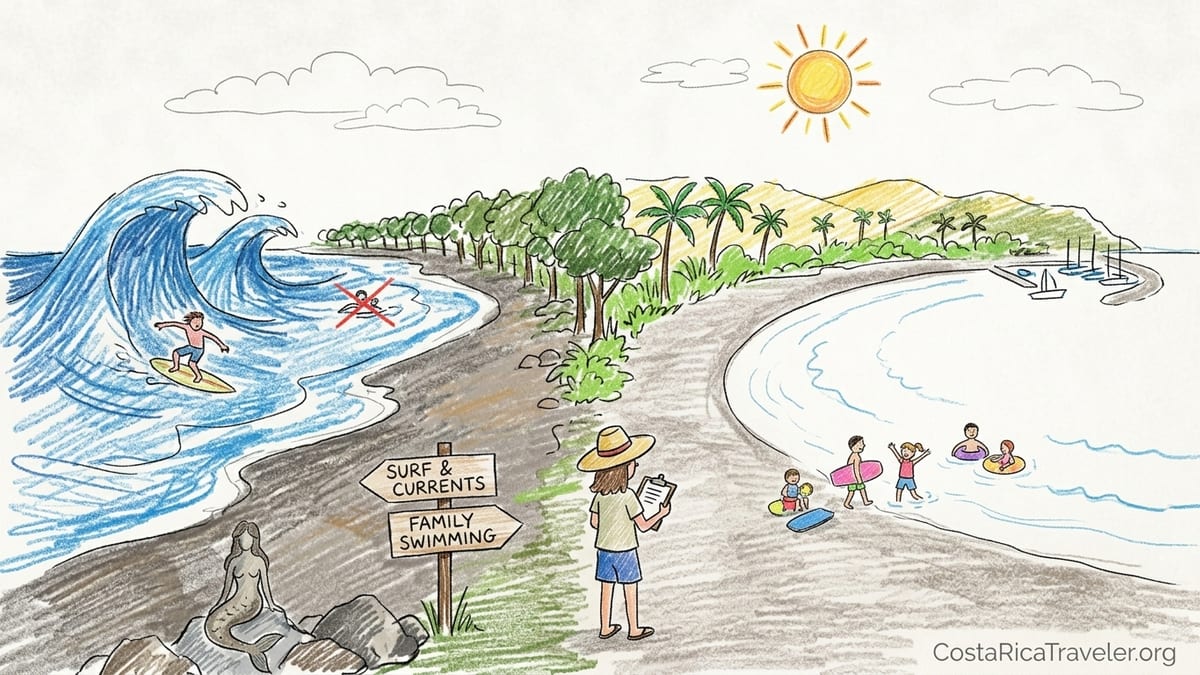
How I Evaluated Central Pacific Beaches
I traveled the Central Pacific in a simple loop centered on Jacó, using public information from Costa Rica’s tourism board, local surf schools and marinas, and repeated on-the-ground visits to the same stretches of sand. That meant sunrise walks on nearly empty beaches, midday heat when shade really matters, and late afternoon crowds when local families arrive. I did not rely on a quick photo stop from the parking lot; for each beach listed here, I spent at least one long session, usually several hours, getting in and out of the water, walking the length of the sand, and checking what was realistically available for food, toilets, and parking.
For this regional comparison, I looked at eleven specific factors at every beach: sand color and texture, wave strength, currents, comfort for casual swimming, surf suitability and crowding in the lineup, natural shade, parking ease and cost, availability of restaurants and kiosks, toilets and changing options, crowd level on a normal dry-season weekend, and the approximate length of the beach that is pleasant to walk. I considered a beach “return-worthy” if I left wanting at least one more full day there, not just a quick look.
Official tourism descriptions matter, but the reality in the water matters more. Costa Rica’s own materials describe Playa Hermosa’s surf as strong and consistent and recommend caution due to strong currents at spots like Esterillos and Playa Palma. Herradura, by contrast, is promoted as suitable for swimming and water sports. My goal here is to bridge those official descriptions with first-hand detail so you can distinguish a world-class surf break from a place where you would comfortably let a ten-year-old paddle a boogie board in waist-deep water.
Playa Hermosa: Fantastic Surf, Miserable For Casual Swimming
Playa Hermosa, just south of Jacó, is the Central Pacific’s headline surf beach and one of the few in Costa Rica recognized internationally for its consistent, powerful waves. The sand is dark gray to almost black, fine and compact enough that your feet sink only slightly. The beach itself stretches for several kilometers, so even on busy days you can walk for more than half an hour without reaching the far end. From the parking pullouts along the coastal road, you typically need only a short, flat walk across the sand to be at the water’s edge.
The surf here is heavy. Sets arrive with a steady rhythm, and even on what locals will casually call a “small” day, chest- to head-high waves slam onto a relatively steep shorebreak. Strong, often shifting rip currents are part of the beach’s character, not an exception. Local authorities and experienced surfers are blunt about it: Hermosa is an excellent place to ride waves and a poor place to swim. On my first visit I went in only to mid-thigh and could already feel the sand tugging away under my feet as the backwash met the next incoming wave. After ten cautious minutes in the shorebreak I retreated to the dry sand and stayed there for hours, content to watch skilled surfers knife into fast lefts and rights.
Facilities at Hermosa are sparse but improving. There are a handful of small hotels, surf camps, and open-air restaurants near the main access that offer food, drinks, and sometimes paid toilets for customers. Parking usually means pulling off along the road or into simple lots near the beach bars; these are not guarded in a formal way, so most travelers tip a self-appointed attendant a few dollars to keep an eye on the car. Shade is limited to the back of the beach where a low line of palms and coastal trees offers scattered cover. On a clear day the dark sand becomes extremely hot by late morning, which is another reason most people here time their sessions for early morning or late afternoon.
I would absolutely return to Playa Hermosa for photography and surf watching. The long, empty sections of dark sand, the silhouette of surfers walking the shore with boards under their arms, and the wild energy of the waves at sunset make it feel like the Central Pacific distilled into a single view. I would not bring young kids into the water here, nor would I recommend it to anyone who wants a relaxed, swim-friendly beach day. For that, you need to drive ten to fifteen minutes north to a very different kind of bay.
Playa Herradura: Swimmable Bay Beside a Luxury Marina
Just north of Jacó, Playa Herradura curves in a clear horseshoe shape that gives the town its name. After miles of open-coast surf beaches, stepping onto Herradura feels like turning a corner into sheltered water. The sand is medium gray-brown and slightly coarse, mixed with small pebbles near the high-tide line. It is not postcard white, but it is comfortable to walk barefoot once the sun is lower. The beach is relatively short by Central Pacific standards, a compact bay lined on one side with the Los Sueños marina and resort complex and on the other with a more local, low-key public beachfront.
The critical difference is the water. Because Herradura sits inside a protected bay, the waves are far smaller and less forceful than at Hermosa or Esterillos. On my visits, the dominant sensation was a gentle roll rather than a crashing shorebreak. You still get small waves and some chop from passing boats, but there was no point at which I felt the same dragging pull of strong rip currents that define the open-coast surf spots. Local tourism guides and resident families use the same phrase again and again for Herradura: good for swimming and easy water sports. I watched children play in waist-deep water with inflatable toys while parents stood nearby, something I would never recommend on the exposed beaches south of Jacó.
Herradura has its trade-offs. Shade is good in the public section, where a line of trees runs just behind the sand and locals set up hammocks and portable grills for weekend picnics. Parking, however, can be congested. There is a narrow strip of roadside parking near the public access and some informal paid lots that charge a modest day rate, but on holiday weekends those spots fill quickly by late morning. Toilets and showers exist in a patchwork: simple paid facilities linked to beachfront sodas, and more upscale bathrooms inside the Los Sueños complex for resort guests and marina customers. For an ordinary visitor, the easiest option is to eat at a beachfront restaurant and use the facilities as a customer.
As a place to spend several hours, Herradura is more comfortable than it is dramatic. I returned multiple times for lazy afternoons, swimming short laps parallel to the shore and renting a stand up paddleboard for about the price of a casual restaurant meal. The sheltered water makes it a good compromise if your group includes both strong swimmers and people who are wary of waves. It is not a prime surf spot, and serious surfers from Jacó drive elsewhere, but Herradura is the Central Pacific beach I would choose for a low-stress, family-friendly swim day within a short drive of the region’s main town.
Esterillos: Long Walks, Heavy Shorebreak, Quiet Villages
South of Hermosa, the three communities of Esterillos Oeste, Centro, and Este share one long arc of dark-gold to brown sand backed by palms, almond trees, and scattered houses. From almost any access point, you can walk for what feels like forever in either direction with only a few clusters of people in sight. The sand here is slightly softer than at Hermosa, with more small shells and occasional driftwood. At low tide especially, the beach widens into a broad, flat expanse that reflects the sky and is perfect for length-of-the-beach walks.
The ocean, though, is all business. Official surf guidance and local safety briefings both describe Esterillos as a strong-wave, surf-oriented stretch of coast. On every visit I made, whether to the more built-up Oeste or the quieter Este, the shorebreak was powerful and the sets organized. Even when waves look small from the sand, there can be serious push and rip currents as soon as you wade past knee-deep water. Locals refer to specific spots near river mouths where currents are especially strong, and there are occasional stories of visitors who underestimated the conditions. During one stay in Esterillos Oeste I limited my swimming to a long, shallow area inside the smallest waves near low tide and treated anything beyond that as surf territory rather than a casual swim zone.
For surfers, especially those who enjoy a more relaxed atmosphere than Jacó or Hermosa, Esterillos is a quiet favorite. There are enough peaks along the beach that surfers spread out, and you often see longboarders cruising mellow sections that break further out. Several small surf schools operate from the village streets, offering board rentals and lessons priced in line with Jacó but in a slower-paced environment. Non-surfers will appreciate the lack of high-rise construction and the sense that this is still a lived-in coastal community where kids ride bicycles down sandy roads at dusk.
Shade varies by sector. Esterillos Oeste has a more generous tree line near the main access and around the iconic mermaid statue on the rocks, creating cooler pockets to set up for the day. Toilets and restaurants are concentrated in small clusters behind the beach, often attached to modest hotels or cabinas that welcome day visitors who eat or drink there. Parking is usually informal and free along sandy side roads, though in the busier high season some properties open small lots and charge the equivalent of a few US dollars for the day. I spent entire afternoons here reading under the palms and walking long stretches of wet sand, but I never forgot that the sea directly in front of me was a surf break first and a swimming beach only in a very narrow, shallow band near shore.
Playa Palma (Bandera): Wild, Empty, And For Experienced Ocean People Only
Playa Palma, sometimes called Playa Bandera, lies further south toward Parrita and feels like the Central Pacific stripped of almost all development. The access roads lead through palm plantations to a dune-backed, dark-sand beach that runs for kilometers with almost no buildings in sight. On my visits I could walk for twenty minutes without passing anyone except a fisherman on a motorcycle or a small group of locals in the shade. For travelers who dream of wild, empty coastline, Palma delivers that feeling far more than the better-known names near Jacó.
The trade-off is safety and comfort. Official tourism materials explicitly caution visitors about strong surf and currents along this stretch. Standing at the water’s edge, you feel the power immediately. Waves crash in a heavy, closed-out line with a fierce pullback as the water drains off the steep sand. The rip currents here are not theoretical. Experienced local swimmers and surfers treat Palma with respect, and several long-time residents told me they keep their own beach days very shallow, more for cooling off than for real swimming. On one hot afternoon I timed sets and tried wading in to hip depth; the moment a larger set arrived I stepped backward as quickly as I could, aware of how easy it would be to lose footing.
Facilities are minimal. Shade comes almost entirely from the backline of palms and coastal forest, which means you can find a cool spot to hang a hammock if you are willing to walk a bit from your parking spot. Toilets and showers are generally absent unless you are staying at one of the scattered lodges hidden in the trees. Food options near the beach are very limited, so anyone coming for a long walk or a photo session should bring water and snacks. Parking is informal and feels remote; I never left valuables in the car here because there are so few eyes around.
Playa Palma is a place I would return to for solitude, early-morning photography, and long, meditative walks where the only sounds are waves and bird calls from the tree line. It is not a destination I would recommend for families, beginner surfers, or anyone whose priority is to spend hours in the water. If your image of the Central Pacific is shaped by posters of wide, empty beaches, this is where that picture comes to life, but the ocean here demands experience and caution.
Jacó Beach: Convenient, Social, And Slightly Overrated
Jacó itself is the Central Pacific’s main gateway town, a low-rise strip of hotels, restaurants, surf shops, and tour operators spread along a broad, gray-brown beach. The sand is firm enough for easy walking and running, and the beach stretches in a gentle curve long enough that you can walk for close to an hour from one end to the other. From a distance, especially at sunset, Jacó looks like the quintessential Costa Rican beach town, with surfers silhouetted in the waves, families playing near the shore, and the hills behind town catching the last light.
The reality in the water and on the sand is more mixed. The surf at Jacó is active but generally less heavy than Playa Hermosa, which makes it a common choice for surf schools teaching beginners. Waist- to chest-high beach break waves roll in along much of the beach, and on smaller days there are consistent, manageable peaks close to town. That said, this is still open Pacific, not a calm bay. Rip currents form and shift, and local outfitters are clear that even for lessons, leashes, boards with flotation, and instructor supervision are non-negotiable. I went in for short sessions, caught a few forgiving waves on a large board, and always felt the need to stay aware of where the push and pull were strongest.
For pure swimming, I find Jacó slightly overrated. Many visitors arrive expecting a relaxed swim beach because it is the region’s most famous name, only to discover an energetic surf zone without the shelter of a bay. You can certainly wade and play in the shorebreak on calmer days, but it does not offer the tranquil water that some people imagine. The sand also heats up quickly, and although there are some trees toward the southern end that provide shade, much of the central beachfront is open, so umbrellas or rented shade structures become almost mandatory by midday.
Where Jacó excels is convenience. Restaurants, supermarkets, surf shops, and bars line the street just behind the sand. Toilets and showers are easy to find, either as public facilities in key access points or as part of beachfront businesses. Parking ranges from parallel spots along the main road to paid lots that charge an hourly or daily rate comparable to a simple meal in town. I spent many partial days in Jacó, meeting guides, picking up supplies, and taking sunset walks, but I rarely chose it as a place for a full, relaxed beach day when calmer water options like Herradura were ten minutes away by car.
Unexpected Favorites For A Full Beach Day
When I first mapped out the Central Pacific, the big names on my list were Jacó, Playa Hermosa, and Manuel Antonio further south. Herradura and Esterillos looked like side notes. After several weeks of exploring, the beaches I actually returned to for full, relaxed days were not always the ones with the biggest reputations. Herradura, with its workmanlike bay and slightly pebbly sand, became my default choice for swimming and reading under steady shade. Esterillos Oeste, quieter and more understated than Hermosa, turned into my go-to for long, uncrowded walks and late-afternoon tidepool photography among the rocks near the mermaid statue.
Another subtle favorite was the southern end of Herradura’s bay, near the low rocky point that partially shields it from open swell. There, early in the morning, the water was almost flat and glassy, ideal for renters picking up kayaks or paddleboards from small independent operators. Prices fluctuated slightly between seasons, but most casual hourly rentals fell into the cost range of a simple sit-down lunch at a local soda, making them accessible add-ons rather than luxury splurges. Paddling out from the beach and looking back at the horseshoe curve of sand and forested hills gave me a different perspective on a place that many people only see from the road.
On overcast days when the heat backed off, I occasionally drove back to Playa Palma simply to walk. Without the brutal midday sun, the dark sand felt cooler underfoot, and the near-absence of other visitors made the beach feel more like a private nature reserve than a tourist spot. I still stayed only ankle- to knee-deep in the water, but I could easily spend several hours there without getting bored, watching frigatebirds ride the wind and scanning the surf line for distant dolphins.
These quieter favorites share a common trait: they are honest about what they are. They do not promise perfect white sand and turquoise water. Instead, they offer a mix of workable comfort, distinctive character, and realistic safety. In the Central Pacific, where strong surf is more common than calm bays, those qualities matter more than any postcard image.
Choosing The Right Central Pacific Beach For Your Trip
After living with this coastline for a while, the clearest lesson is that there is no single “best” Central Pacific beach, only better matches for different priorities. If your main goal is surfing, especially intermediate to advanced shortboard or performance longboard sessions, Playa Hermosa and the various peaks along Esterillos should be near the top of your list, with Jacó’s more forgiving beach break as a practical backup. These beaches offer consistent, powerful waves, quick access from the main highway, and enough local surf infrastructure that you can rent gear, take lessons, and hear about conditions in near real time.
If you are traveling with children, cautious swimmers, or anyone who has had a bad experience with strong currents, the equation changes. In that case, Playa Herradura’s bay becomes the logical anchor point. The calmer water, presence of lifeguard-trained guides linked to water sports operators, and the ability to stand comfortably in chest-deep water without being hammered by shorebreak create a fundamentally different beach day. You give up some of the wild look and sense of remoteness, but you gain real swimming comfort and easier logistics for toilets, shade, and food.
For travelers who prioritize walking, photography, and a feeling of open space, Esterillos and Playa Palma stand out, each with its own personality. Esterillos offers the charm of small communities and scattered restaurants where you can step off the sand and order a plate of fresh fish or a typical casado. Playa Palma offers the luxury of near-emptiness but requires that you bring your own supplies and accept that your interaction with the sea will be primarily visual. In both places, a long walk at low tide can be the highlight of the day, whether or not you ever go beyond knee-deep water.
Understanding that not every Central Pacific beach is meant for swimming is liberating. Once you stop expecting Hermosa to be a family-friendly bay or Palma to be a beginner surf spot, you can appreciate them for what they genuinely are. With that mindset, you can assemble a realistic itinerary: perhaps a morning surf at Hermosa, a relaxed family afternoon in Herradura, a sunset walk in Esterillos, and a quiet, reflective half-day in Palma. Seen this way, the Central Pacific stops being a single beach destination and becomes a small, varied coastline you learn to read like a local.
The Takeaway
The Central Pacific coast of Costa Rica is often summarized in a single phrase: close to San José and full of surf beaches. That is true, but incomplete. Spend time moving between Playa Hermosa’s pounding shorebreak, Herradura’s calm bay, Esterillos’s endless sand, Jacó’s social waterfront, and the emptiness of Playa Palma, and a more nuanced picture emerges. This is a region where strong waves are the rule rather than the exception and where the beaches that look most dramatic on camera can be the least comfortable for hours of casual swimming.
The beaches I would genuinely return to depend on what I want from the day. For surf energy and a raw, elemental ocean, I would choose Playa Hermosa or the less crowded peaks at Esterillos and keep my swimming shallow. For a relaxed, family-friendly swim with reliable shade and easy access to toilets and restaurants, I would set up under the trees in Herradura and accept the busier, more developed backdrop. For hours of walking and the sense of having the Central Pacific almost to myself, I would choose Playa Palma or the quieter edges of Esterillos Oeste and treat the ocean there with the caution it deserves.
Official tourism descriptions are broadly accurate about which Central Pacific beaches have strong, consistent surf and which bays are more suitable for swimming and water sports. The missing piece is what those descriptions feel like when you are actually on the sand. My experience along this coast is that you can love the Central Pacific deeply without pretending that every beach is perfect for every purpose. Some are for surfers, some for families, some for walkers and photographers, and a few are best admired from the safety of the dry sand. The key is matching your expectations to each place’s real personality and planning your days around the parts of the coast you would, like me, be happy to visit again.
FAQ
Q1. Is Playa Hermosa in the Central Pacific safe for swimming?
Playa Hermosa south of Jacó is known for strong, consistent surf and powerful rip currents, so it is generally considered unsafe for casual swimming and better suited to experienced surfers.
Q2. Which Central Pacific beach is best for families with young children?
Playa Herradura, with its sheltered horseshoe-shaped bay and comparatively calm water, is the most comfortable Central Pacific option for families who prioritize swimming over surfing.
Q3. Are there Central Pacific beaches that feel wild and uncrowded?
Yes. Playa Palma (Bandera) and the longer stretches of Esterillos offer wide, dark-sand beaches with few buildings and low crowds, though both have strong surf and require caution in the water.
Q4. Is Jacó Beach a good place to learn surfing?
Jacó’s beach break often has smaller, more forgiving waves than nearby Hermosa, and the town hosts several surf schools, which makes it a practical, if busy, spot for beginner lessons.
Q5. Where can I find reliable shade right on the sand?
Playa Herradura’s public section has a steady line of trees, and parts of Esterillos Oeste offer natural shade from palms and coastal trees, making both good choices for spending hours out of direct sun.
Q6. Do Central Pacific beaches have public toilets and showers?
Facilities vary. Jacó and Herradura offer the most consistent access through public facilities and beachfront businesses, while Esterillos and Playa Palma often rely on simple, privately run options or have none at all near the sand.
Q7. Which beach would you choose for a long walk at low tide?
The continuous sands of Esterillos and Playa Palma are excellent for long, flat walks when the tide is out, offering broad, reflective wet sand and minimal development along much of their length.
Q8. Are there any calm-water spots suitable for paddleboarding?
Playa Herradura’s bay usually has the gentlest conditions for casual stand up paddleboarding, especially early in the morning before boat traffic and afternoon winds pick up.
Q9. How crowded do Central Pacific beaches get on weekends?
Jacó and Herradura can become quite busy with both local and international visitors on sunny weekends, while Esterillos and Playa Palma generally remain much quieter, with room to spread out even when more people are around.
Q10. Can I visit these beaches without a rental car?
Jacó and Herradura are reachable by public bus and shuttles, but reaching Esterillos and Playa Palma comfortably, especially with beach gear or family, is far easier with a rental car or private transfer.