


I spent two weeks moving slowly along Costa Rica’s Central Pacific coast, from the mangroves near Quepos up to the forests around Carara National Park and the Tárcoles River. I was not on a scientific expedition. I was a regular traveler with a pair of mid-range binoculars, a camera, and a stubborn desire to know which tours and parks actually deliver on their wildlife promises. What follows is not a list of everything that might live in these forests. It is a detailed account of what I personally saw, where I saw it, what it cost, and how much a guide really helped.
How I Structured My Central Pacific Wildlife Trip
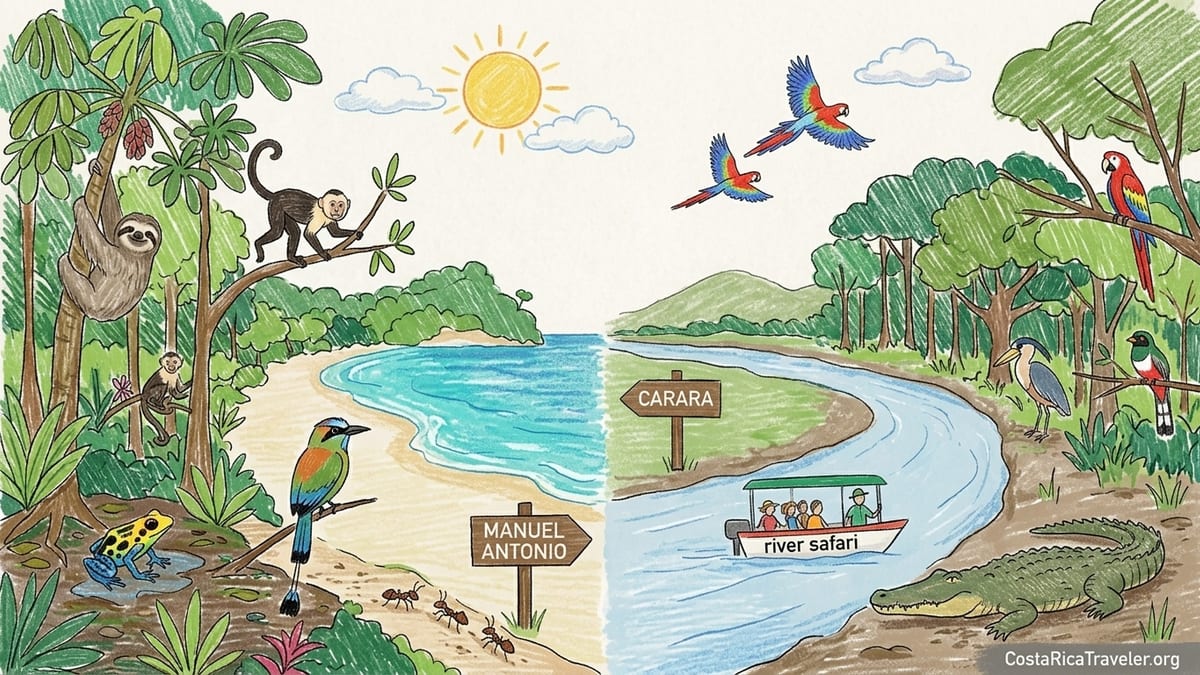
On this trip I based myself first in Manuel Antonio / Quepos and then near Tárcoles, in order to compare the two main national parks in the region that most visitors consider: Manuel Antonio National Park and Carara National Park. I visited in the dry season, when trails tend to be in better condition and wildlife viewing is generally considered good. Over roughly fourteen days I did three full days in Manuel Antonio, two days in Carara, one mangrove tour at Isla Damas, one Tárcoles River crocodile and birding boat trip, and a lot of informal roadside and hotel-garden wildlife watching in between.
For optics I carried an 8x42 pair of binoculars and a camera with a 300 mm telephoto lens. On some outings my guides provided a spotting scope mounted on a tripod. Whenever I mention an animal, it is something I personally observed with my own eyes on this trip, not just something “possible” according to a field guide. I will also be explicit about when I had a guide, how much I paid, how crowded things felt, and how often the guide actually meant the difference between seeing an animal and walking right past it.
It is also worth noting that both Manuel Antonio and Carara are managed by Costa Rica’s National System of Conservation Areas (SINAC), and both now require advance online tickets. Manuel Antonio currently charges non-resident adults a little over 18 US dollars including value-added tax and is open from Wednesday through Monday from 7:00 to 15:00, with advance purchase required through the SINAC online platform. Carara likewise uses online booking and charges non-resident adults 10 US dollars plus tax, with slightly different opening hours depending on the time of year. These rules were in force when I traveled and are important to factor into planning.
Within that framework, the Central Pacific gave me a chance to compare several distinct kinds of wildlife experiences in a compact region: crowded but rewarding rainforest and beach trails at Manuel Antonio, quieter transition forest at Carara, mangrove estuaries at Isla Damas near Quepos, the crocodile and bird-rich Tárcoles River, and the unscripted wildlife moments that happened along roads and at my lodges.
Manuel Antonio National Park: Crowded Trails, Close Wildlife
I visited Manuel Antonio National Park on two different mornings and one early afternoon, always entering around opening time with pre-booked tickets. The main trail system consists of wide, mostly paved or boardwalk-style paths that link forest and beaches. On my first visit I opted to hire an official guide from the concession inside the park entrance. I joined a small group tour of eight people that cost just under 60 US dollars per person for about two and a half hours, not including the park entry fee. The guide carried a high-quality spotting scope and a tablet for digiscoping photos.
On that guided morning, wildlife density felt almost unreal. Within the first hour on the main trail my guide pointed out a two-toed sloth curled high in a cecropia tree and, not long after, a three-toed sloth more exposed on a horizontal branch. Both would have blended into the canopy for me without the guide’s scope. A little further along another guide stopped and quietly signaled: a troop of white-faced capuchin monkeys was moving above the path. Over fifteen minutes we watched at least ten individuals including juveniles as they climbed, groomed and raided a fruiting tree, all from perhaps ten meters away. Later that same morning we saw mantled howler monkeys deeper in the forest, mostly as dark shapes in the mid-canopy but clearly identifiable by their characteristic profile and, even more, by their calls drifting in from further up the hillside.
Monkeys and sloths were not the only show. On the same guided walk, my guide found a green and black poison dart frog on a damp patch beside a side trail, plus several small lizards and a line of leaf-cutter ants crossing the path. In terms of birds, Manuel Antonio was quieter than Carara later proved to be, but with the guide’s help I still saw bright scarlet-rumped tanagers near the park entrance and a broad-billed motmot perched motionless in the understory. Without the guide and scope I likely would have walked under that motmot without ever noticing it.
On my second visit to Manuel Antonio I went without a guide, following the main trail to the beaches and then looping onto some of the side trails up Punta Catedral. I still saw wildlife, but the experience was very different. I spotted a single three-toed sloth on my own after noticing a small crowd pointing upwards, and I saw several white-faced capuchins near the picnic areas at the beach where they have clearly become accustomed to human food. I heard howler monkeys in the distance but did not manage to see them that day. Birds were harder to pick out; without a scope and trained eyes, most of my sightings were common species like great kiskadees and black vultures near open areas. The trails were hot but in decent condition, with paved sections and stairs that can feel steep but manageable for most reasonably fit visitors.
From this comparison, I came away convinced that in Manuel Antonio a good guide really did materially improve my sightings, especially of more cryptic or distant animals. The park is small and heavily visited, with hundreds of people on the main trails by mid-morning. That crowding does not always bother the more habituated monkeys and raccoons, but it does mean that quieter, more secretive animals are easy to miss without a guide who knows where they tend to feed and rest. Given entry costs and the limited hours, I felt the extra expense of a guide on at least one day represented good value if wildlife watching is a priority.
Carara National Park: Quieter Forest, Better Birding
Carara National Park sits roughly an hour and a half north of Manuel Antonio by car, near the Tárcoles River. Its transition forest, a mix of dry and wet forest types, has a reputation among birders and naturalists that is somewhat different from Manuel Antonio. To test that reputation, I spent two days there, one with a guide and one exploring some of the shorter trails on my own. As of my visit, tickets also had to be purchased online through SINAC before arrival, with non-resident adults paying 10 US dollars plus tax, and the park operating daily with hours that shift slightly between the dry and rainy seasons but generally running from morning to mid-afternoon.
On my first morning at Carara I hired a local birding guide at the park entrance. The rate was about 60 US dollars for a roughly three-hour private walk, which was comparable in price to my Manuel Antonio guided outing but with the advantage of one-on-one attention. The main “Universal” trail at Carara is a flat, well-maintained loop with a firm surface and frequent benches, suitable for visitors who prefer gentler walking conditions. Under the dense canopy the temperature felt cooler than the open areas outside, and the level of crowding was much lower than at Manuel Antonio. Over the course of the morning I encountered fewer than 40 other visitors on the trails.
In that relatively quiet setting, bird life emerged as the primary attraction. With my guide’s help and his spotting scope, we found a pair of scarlet macaws perched high in a tree near a forest edge, giving us excellent views of their red, yellow and blue plumage. Later we heard and then saw another small group flying overhead, their wingbeats audible in the still air. Without a guide I might have seen macaws as distant silhouettes, but I would not have identified all the smaller birds we encountered: trogons with their distinct breast bands, motmots, several species of flycatchers, and a black-hooded antshrike that moved almost invisibly through the understory. My guide’s scope allowed me to see feather detail that my hand-held binoculars could not match at those distances.
Mammals at Carara were much less conspicuous during my visits than at Manuel Antonio, but they were not absent. On the guided morning we watched a group of white-faced capuchins move through the mid-canopy, though further away than the very confiding troops near the beach in Manuel Antonio. Later, along a quieter side trail, we saw an agouti cross the path, its reddish fur briefly catching the light before it disappeared into leaf litter. I did not see any sloths in Carara during my time there, although I know from trip reports that they are certainly possible. On my unguided return the next day I failed to locate any macaws or monkeys on my own, and my bird list was shorter, limited to more obvious species such as toucans calling near the parking lot and a few egrets near a small wetland.
From a practical standpoint, trail conditions in Carara were comfortable but more natural than the heavily engineered paths of Manuel Antonio. The Universal trail was accessible and flat, while other loops had some roots and occasional mud but remained straightforward in dry-season conditions. The lower crowding made the forest feel more like a natural habitat and less like a beach-adjacent attraction, and the overall experience rewarded patient birdwatching rather than casual strolling. Here more than anywhere else on my Central Pacific route, paying for a specialist bird guide turned a patch of green background into a layered, species-rich landscape.
Mangrove Wildlife at Isla Damas: Kayaks and Night Eyes
From Quepos, I joined a half-day mangrove tour in the estuary around Isla Damas, a small island surrounded by channels lined in mangroves. I chose an operator that offered both kayak and small-boat options and picked the late-afternoon to evening slot. The price was just under 70 US dollars per person, including hotel pickup, a bilingual naturalist guide, kayak rental, and a simple meal at a local restaurant afterwards. Our on-water time was about two and a half hours, with an additional hour for transportation and food, making it a relaxed half-day outing.
In a kayak, much of the wildlife felt closer and more intimate than on larger boats. Paddling slowly through narrow channels, I saw several green iguanas sunning themselves on low branches, their bodies almost the same color as the leaves. We also encountered basilisks, the so-called “Jesus Christ lizards,” on roots near the waterline. Twice I watched juveniles dash across the water surface for a few meters before diving in, something I would likely have missed without a guide calling my attention to subtle movements along the banks.
Birdlife in the mangroves was varied, though not as dense as on the Tárcoles River later in my trip. With my guide pointing out shapes and calls, I observed herons stalking in the shallows, including a little blue heron and a larger white egret, and several kingfishers perched above the water. In fading light, it would have been hard to separate one silhouette from another without his experience and flashlight. As dusk turned to night, the guide used a low-powered light to spot the reflective eyes of sleeping birds and resting mammals in the canopy. At one point, he located a small roosting night heron almost invisible without magnification.
Mammals appeared in more subtle ways. Midway through the paddle, we paused under a thicker canopy where the guide located a group of white-faced capuchins moving between mangrove trees. Unlike the bold monkeys at Manuel Antonio’s beaches, these kept more distance, crossing branches over the water while keeping an eye on the boats below. Later, we saw the eye-shine of a small mammal the guide identified as a raccoon foraging along the muddy bank, though we were too far away in the dark to confirm details beyond general shape and motion. In the quieter sections, crabs were everywhere on exposed roots when we looked closely.
Conditions on the water were calm, with only light current and almost no other tour groups at that hour. I counted two other small boats in the entire time we were on the water. Having a guide here mattered mainly for interpretation and safety: the animals themselves were relatively close, but in the shifting light of mangroves they could blend in easily. My personal binoculars were useful early in the afternoon but less so after dusk, when the guide’s trained eyes and controlled flashlight use became more important than magnification alone.
Tárcoles River Crocodile and Birding Safari
The Tárcoles River, not far from Carara, is famous for its large population of American crocodiles and for birdwatching along its banks and mangrove channels. To experience it properly, I booked a dedicated river safari boat tour rather than simply stopping at the highway bridge. The tour cost around 50 to 60 US dollars per person through a local operator, lasted about two to three hours on the water, and included transport from my accommodation near Jacó, a bilingual naturalist guide, and basic refreshments.
From the moment we pushed off from the dock, crocodiles dominated the scene. Within the first fifteen minutes, I saw several individuals hauled out on sandy banks, ranging from juveniles under a meter long to enormous adults with broad heads and heavy bodies. The closest approach, always controlled by the captain, brought us to within a few meters of a large crocodile resting on the shore, its teeth visible even with the naked eye. At no point did I feel unsafe, but the sheer size of some of these animals made it easy to understand why this river is so well known.
Birdlife on the Tárcoles was at least as impressive. Gliding along the main channel and into side branches, I counted multiple species of herons and egrets, including great blue herons standing motionless in the shallows and tri-colored herons stalking in more sheltered edges. A boat-billed heron, with its distinctive heavy bill, sat hunched in a shaded tree that I would never have spotted without the guide intentionally looking for roosting birds. We also saw several kingfishers, black skimmers, and numerous shorebirds along sandbars. My 8x42 binoculars were in near constant use, and the guide’s sharp eyes meant that he was usually pointing out birds before I could find them myself.
Mammals were less obvious, but they were still present. On one bend we watched a troop of howler monkeys in the trees above the river, their calls echoing over the water. Another stretch produced a brief view of a raccoon moving along the bank. Although the focus of the tour was clearly crocodiles and birds, the river’s edges felt alive with subtler movement once the eye adjusted to the scale of the landscape.
Boat conditions were comfortable, with partial shade covers and bench seating. Our boat carried about 18 passengers and never felt overly crowded, with plenty of space for cameras and field guides. The guide used no spotting scope, relying instead on binoculars and the boat’s ability to approach sandbars closely. In this context, paying for a guided boat was essential; independent access to the river is limited, and I would not recommend trying to reproduce the experience from the highway bridge for safety and environmental reasons. Among all my Central Pacific outings, the Tárcoles tour delivered the most reliable “big animal” sightings for the time and money invested.
Roadside and Lodge Wildlife: Unsung Highlights
Between the headline attractions of national parks and organized tours, the Central Pacific region also produced some of my most memorable wildlife encounters in the margins: on hotel grounds, roadside pullouts, and short walks that were not officially designated as any particular attraction. These moments were unplanned and unguided, but they shaped my overall impression of how alive this region feels once you start looking carefully.
Near Manuel Antonio, the garden of my small hilltop hotel turned into a daily birding circuit. Without a guide, simply sitting on the terrace with coffee and binoculars in hand produced regular visits from tanagers in bright reds and yellows, great kiskadees with their loud calls, and hummingbirds darting between flowering shrubs. One evening, a pair of scarlet macaws flew directly overhead, calling as they headed inland, even though I had not managed to see the species inside Manuel Antonio National Park itself. On another afternoon, a small troop of squirrel monkeys passed through, using power lines and garden trees as a corridor, an encounter that cost nothing beyond the price of the room.
Along the coastal highway between Jacó and Quepos, several roadside pullouts near river crossings provided informal wildlife stops. At one small bridge, I parked in a safe lay-by and walked onto the sidewalk to look down at the water. Within minutes, I picked out at least two medium-sized crocodiles resting in the shallows, smaller relatives of the giants I had seen on the Tárcoles boat tour. At another stop, a patch of secondary forest beside a café held a noisy group of howler monkeys; I followed the sound and eventually managed to see at least three individuals moving between trees. None of these encounters involved fees or official infrastructure, but they required a willingness to stop when something caught the eye and to use binoculars from whatever vantage point presented itself.
These unguided moments came with their own caveats. Roadside wildlife viewing depends heavily on safe parking and awareness of traffic. I never left valuables visible in the car and avoided isolated pullouts late in the day. On hotel grounds I remained conscious that gardens and decks are shared spaces; not everyone wants a stranger pointing binoculars past their balcony. That said, in terms of value per dollar, these informal settings were unbeatable. Over the entire trip I saw sloths, monkeys, multiple lizard species, macaws, toucans, and countless smaller birds without paying for any additional entrance fee beyond where I was already staying.
When I compare these free encounters to the structured experiences inside the parks, I see them less as either-or and more as complementary. Guided days in Manuel Antonio and Carara gave me depth and helped me learn how to recognize calls and shapes. Those skills then made wandering on my own more rewarding, turning a random patch of trees behind a gas station into a place where I might notice a pair of aracaris or a line of leaf-cutter ants going about their work.
Do Guides, Gear, and Costs Pay Off in the Central Pacific?
Looking back across Manuel Antonio, Carara, Isla Damas, the Tárcoles River, and the many informal stops in between, several patterns emerged that may help other travelers decide how to allocate time and money. First, guide quality varied but was consistently high in the parks and on the river and mangrove tours I chose. In Manuel Antonio, my guided morning produced multiple sloth sightings, howler monkeys, capuchins, a motmot, and several reptiles that I would almost certainly have missed in the crowds without a guide and scope. In Carara, my bird-focused guide transformed a quiet forest loop into a highlight reel of macaws, trogons, antbirds, and subtle movement that I would have considered empty forest on my own.
In mangroves and on the Tárcoles River, guides were less about finding single rare animals and more about building an overall picture of the ecosystem. On Isla Damas, my guide’s commentary explained how different mangrove species create habitat for crabs, fish, and birds, and his eye for basilisks and roosting herons allowed me to see details that would have blended into the background while I concentrated on paddling. On the Tárcoles, guides and captains worked together so that the boat could approach crocodiles safely and position us for good bird views without disturbing the animals.
From a budget perspective, I ended up paying for guides on four separate outings: Manuel Antonio, Carara, the mangrove tour, and the Tárcoles safari. Each cost in the general range of 50 to 70 US dollars per person on top of park fees where applicable. In exchange I gained a list of confirmed sightings, better photographs thanks to shared scopes, and a deeper understanding of habitats that made my unguided time more satisfying. If pressed to prioritize, I would recommend a guide at least once in Manuel Antonio or Carara, plus a guided river or mangrove tour, rather than attempting to self-navigate everything.
Gear also mattered. My mid-range 8x42 binoculars were in constant use in Carara and on the Tárcoles, essential in Manuel Antonio away from the habituated beach monkeys, and helpful even in hotel gardens. A spotting scope is not something most travelers pack, but when guides brought one, it dramatically improved views of distant birds and high-canopy sloths. Waterproof footwear was useful in mangroves and on some forest trails, though in the dry season I was able to get by with sturdy walking shoes on the main park paths.
Finally, crowding and trail conditions shaped how rewarding each experience felt. Manuel Antonio’s trails and beaches can feel busy by mid-morning, but that same habituation makes it one of the most reliable places to see monkeys and sloths in a short visit. Carara offers calmer trails and better overall birding at the cost of fewer guaranteed mammal encounters. Mangroves and the Tárcoles River struck a balance: boat group sizes were moderate, the environment felt expansive, and wildlife was concentrated along water margins in ways that made sightings frequent. Choosing between them is less about which is “better” and more about which kind of wildlife encounter appeals most.
The Takeaway
For me, the Central Pacific region of Costa Rica delivered its wildlife riches not through a single park or tour but through a layered mix of experiences. In Manuel Antonio, I saw sloths, three different monkey species, small reptiles, and a few standout birds in a compact, heavily visited park where a guide and spotting scope turned a pleasant forest walk into a wildlife showcase. In Carara, I found quieter trails, transition forest, and some of the best birding of the trip, crowned by repeated sightings of scarlet macaws and a suite of forest birds that would have gone unnoticed without specialist help.
On Isla Damas, moving by kayak through mangrove tunnels brought me eye level with basilisks, iguanas, capuchins using watery corridors, and herons lurking along the banks. The Tárcoles River offered massive crocodiles at close but controlled range and dense birdlife on sandbars and branches, all from the comfort of a boat. Between these set pieces, everyday spaces such as hotel gardens and roadside pullouts filled in the gaps, adding unexpected monkey troops and passing macaws to my running list.
If your goal is to maximize wildlife sightings in the Central Pacific, I would recommend combining at least one guided morning in Manuel Antonio or Carara with a river or mangrove tour and leaving time for unhurried exploration around your lodging. Plan ahead with the current SINAC rules, which require online tickets for national parks like Manuel Antonio and Carara, and budget realistically for guide fees similar to the park entry costs themselves. Bring binoculars, start early in the day, and be willing to stop when movement or calls catch your attention.
Most importantly, treat every claim of possible wildlife with healthy skepticism until you or your guide actually see it. I did not see every species that field guides promise for the Central Pacific, but I saw enough sloths, monkeys, crocodiles, macaws, basilisks, and less famous creatures to feel that the region more than lived up to its reputation. What made the difference was not chasing checklists but paying attention, day after day, in different habitats, with a mix of professional guidance and simple curiosity.
FAQ
Q1. Did you really need a guide to see sloths and monkeys in Manuel Antonio?
I saw sloths and three monkey species in Manuel Antonio both with and without a guide, but the guided morning produced more individuals, better views through a spotting scope, and additional reptiles and birds that I would have missed alone.
Q2. Was Carara National Park worth visiting if you are not a hardcore birder?
Yes. While birders will appreciate Carara most, I still found it worthwhile as a general nature lover, with quieter trails, scarlet macaws, monkeys, and a more immersive forest feel than the busier Manuel Antonio paths.
Q3. How did trail conditions compare between Manuel Antonio and Carara?
Manuel Antonio’s main trails were wider and more developed, including paved and boardwalk sections with stairs, while Carara’s Universal trail was flat and accessible but other loops felt more natural with roots and occasional mud.
Q4. Which experience gave you the closest views of large animals?
The Tárcoles River boat tour provided my closest safe views of large American crocodiles, while Manuel Antonio’s beach-adjacent areas brought white-faced capuchin monkeys within a few meters of the trail.
Q5. Did you bring your own binoculars, and were they necessary?
I carried 8x42 binoculars and considered them essential in Carara and on the Tárcoles, very useful in Manuel Antonio away from the main picnic areas, and beneficial even in hotel gardens and roadside stops.
Q6. How expensive were the guided tours compared to park entrance fees?
On my trip, guided outings in parks and on the river or mangroves generally cost between about 50 and 70 US dollars per person, which was comparable to or higher than national-park entry fees but repeatedly justified by better sightings and interpretation.
Q7. Were the mangrove and river tours crowded?
My Isla Damas mangrove tour used small groups and felt quiet, with only a couple of other boats in sight, while the Tárcoles River tour had roughly 18 passengers on a covered boat that still offered enough room for comfortable wildlife viewing.
Q8. Did you actually see scarlet macaws, and where?
I saw scarlet macaws perched and in flight along the forest edge in Carara National Park with a guide, and I also saw a pair flying over my hotel near Manuel Antonio on a separate evening without a guide.
Q9. How did roadside wildlife stops compare to the national parks?
Roadside and lodge encounters cost nothing and produced memorable sightings like crocodiles under bridges and howler monkeys near cafés, but they lacked the depth, safety frameworks, and interpretive value provided by formal parks and guided tours.
Q10. If you could only choose two wildlife experiences in the Central Pacific, which would you repeat?
Based strictly on what I personally saw, I would repeat a guided morning in either Manuel Antonio or Carara to anchor the forest experience, plus a Tárcoles River boat safari for reliable crocodile and bird encounters along the water.