


The Caribbean coast of Costa Rica feels like a different country compared with the Pacific. Palm-fringed beaches meet lowland rainforest, howler monkeys roar above pastel-colored villages, and Afro-Caribbean culture shapes the music, food and pace of life. For a first-time visitor, it is essential to understand that the northern and southern Caribbean are two very different destinations, not one long continuous beach. Planning your trip around that distinction will save you time and help you experience the best of each area.
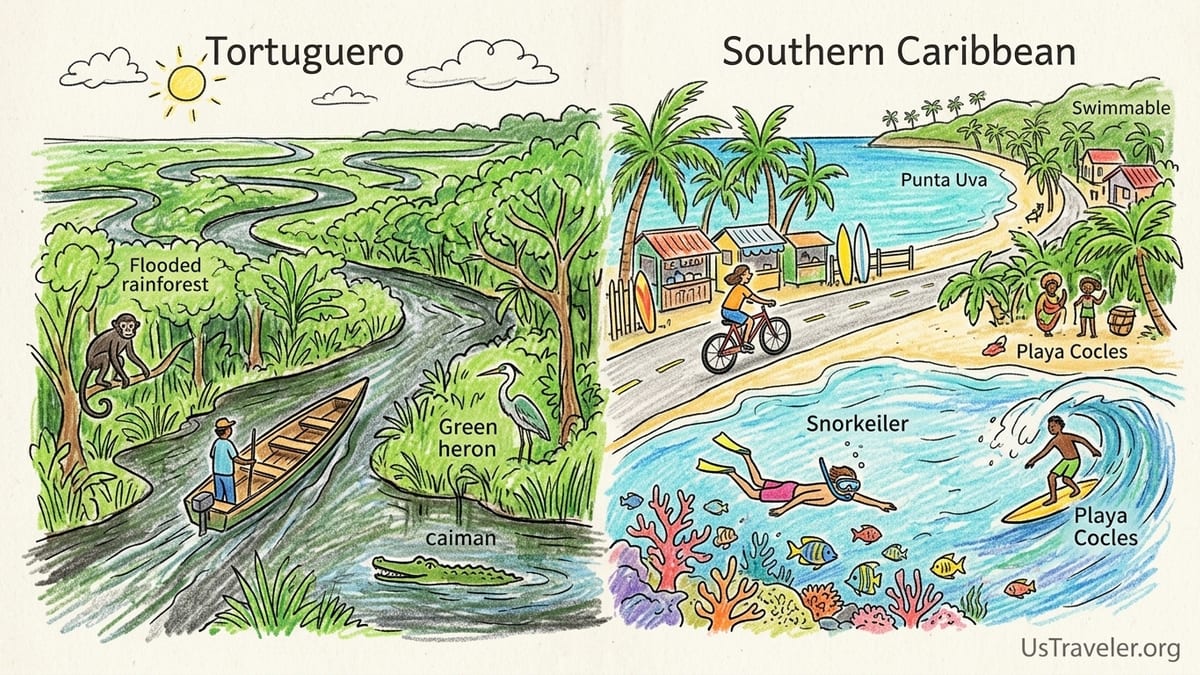
Northern vs Southern Caribbean Costa Rica: Two Different Worlds
The northern Caribbean, anchored by Tortuguero National Park, is dominated by rivers, canals and flooded rainforest. There are beaches, but they are wild, with rough seas and strong currents. People come primarily for wildlife and the experience of traveling through a waterway labyrinth often compared to a smaller-scale Amazon. You glide by boat past flooded jungle, watching spider monkeys and green herons as guides point out caimans and sometimes manatees in the tannin-dark water.
The southern Caribbean, by contrast, is a string of road-connected beach villages stretching from Cahuita to Manzanillo. Here the focus shifts to swimmable bays, surf breaks, coral reefs and an easygoing Afro-Caribbean and Indigenous culture. You might bike from Puerto Viejo to Punta Uva, stopping for gallo pinto with coconut milk at a roadside soda, then spend the afternoon snorkeling over shallow reef or learning to surf at Playa Cocles.
Because these regions feel so different, travelers should resist treating the Caribbean coast as a single “beach stop” to be driven from end to end. Tortuguero requires boat access and operates on its own rhythm tied to turtle nesting and canal levels. The southern coast works as a hub for beach hopping, surfing, snorkeling and nightlife. On a typical 10 to 14 day Costa Rica itinerary, combining both is feasible, but you should think of them as two separate legs with different logistics, packing needs and expectations.
In practical terms, a night in Tortuguero often costs a little more due to boat transport and lodge packages, while the southern coast offers a wide range of prices from simple cabins under about 60 US dollars per night to boutique jungle lodges well over 250 dollars. Deciding what you want most from the Caribbean coast, and how much time you have, will help you decide whether to do one region or both.
Tortuguero: Canals, Turtles and Boat-Only Access
Tortuguero sits on a narrow sandbar between the Caribbean Sea and a network of freshwater canals and rivers. There are no roads into the village. Visitors arrive by small boat from docks such as La Pavona or Moín, or by domestic flight to the nearby airstrip. This boat-only access is not a novelty detail; it shapes the entire experience. Once you leave your rental car or shuttle on the mainland, everything moves at canal speed: luggage is loaded into longboats, and your first wildlife sightings often happen before you even reach your lodge.
The main draw is Tortuguero National Park, one of the most important nesting sites in the western Caribbean for endangered green sea turtles. During the main nesting season, roughly July through October, guided night walks on the beach allow you to observe turtles laying eggs under carefully controlled conditions. Outside turtle season, Tortuguero is still rewarding for early-morning canal safaris in small boats or kayaks, when you might spot howler monkeys, toucans, iguanas, river turtles and occasionally sloths high in the canopy.
Accommodation in Tortuguero ranges from simple family-run guesthouses in the village to midrange and higher-end ecolodges along the canals. Many lodges sell packages that include boat transport from a mainland dock, meals and guided activities. For first-timers, these packages can simplify logistics, especially if you do not speak Spanish or are traveling with children. Expect to spend more on meals and drinks than on the southern coast, since almost everything needs to be brought in by boat.
Because there are no cars, you get around Tortuguero on foot or by boat. Activities usually include at least one guided canal tour and a walk on the park’s forest trail, plus optional add-ons such as visiting the small turtle conservation center or hiking Cerro Tortuguero for a view over the wetlands. This is a destination where you wake up early, wear lightweight long sleeves because of mosquitoes and humidity, and accept that sudden tropical rain is part of the experience.
Cahuita and Puerto Viejo: Gateway to the Southern Caribbean
Driving south from the port city of Limón, the vibe changes as soon as you reach Cahuita. This small town hugs a horseshoe-shaped bay and serves as the main access point to Cahuita National Park, one of Costa Rica’s few parks that protect both coral reef and lowland rainforest. The park’s coastal trail is an easy, mostly flat walk where you might spot white-faced capuchin monkeys, raccoons and sloths within the first half hour, especially if you hire a local guide at the park entrance.
A short drive or bus ride further south brings you to Puerto Viejo de Talamanca, the liveliest town on the southern Caribbean coast. Here, reggae and calypso drift out of open-air bars, and surf shops line the main street alongside bakeries selling Jamaican-style patties and banana bread. Puerto Viejo makes a practical base if you want a wide choice of restaurants, from simple Caribbean sodas serving rice and beans with coconut milk and fresh fish, to vegetarian cafes and pizza places. Most visitors use Puerto Viejo as a hub for day trips to Cocles, Punta Uva and Manzanillo.
Cahuita and Puerto Viejo are connected by a paved coastal road and frequent local buses, which means you can stay in one town and easily visit the other. For example, many travelers book three nights in Puerto Viejo and take a day trip to Cahuita National Park for hiking and snorkeling, then spend another day biking south to Punta Uva and Manzanillo. This flexibility is one of the biggest advantages of the southern Caribbean compared with Tortuguero’s self-contained, boat-based setup.
Prices in Cahuita and Puerto Viejo vary widely. You can find hostels with dorm beds from around 15 to 25 US dollars per night, simple cabinas with fan and private bath from about 50 to 80 dollars, and boutique hotels or jungle bungalows that run upward of 180 to 300 dollars per night in high season. Beachfront and air-conditioned options command a premium, especially around Christmas, Easter and July and August, when both domestic and international tourism peak.
Cocles, Punta Uva and Manzanillo: Beaches, Surf and Reef
South of Puerto Viejo, the road parallels a string of distinct beaches rather than one continuous stretch of sand. Playa Cocles is the first, just a few minutes by bike or taxi. This is one of the area’s main surf beaches, with a consistent beach break that attracts both local and visiting surfers. A surf school often operates near the lifeguard tower, offering lessons that include board rental and instruction for a few hours, typically costing less than a typical full-day tour elsewhere in Costa Rica.
Continue a bit farther and you reach Playa Chiquita and then Punta Uva, where the coastline becomes more indented and the sea often calmer. Punta Uva in particular is known for its palm-lined cove and offshore reef. On calm days, you can swim out with a mask and snorkel from shore and see parrotfish and other reef species in relatively shallow water. There are usually informal stands renting snorkel gear and kayaks, and small beachside restaurants serving fresh juices and Caribbean-style chicken or fish.
At the far southern end, the village of Manzanillo sits next to the Gandoca Manzanillo Wildlife Refuge. The main beach in front of town is wide and scenic, but the biggest draw for many visitors is the combination of forest trails and coral reefs within the refuge. You can walk the coastal path to viewpoints over honey-colored beaches framed by rugged rock formations, then join a guided snorkeling trip when conditions allow. Visibility is highly weather-dependent; periods of heavy rain or strong surf can reduce clarity, so it is wise to book snorkeling early in your stay to allow for flexible timing.
What unites Cocles, Punta Uva and Manzanillo is that each has its own character and sea conditions. Cocles often has stronger waves and rip currents, better for surfing than for casual swimming, though there are usually flagged safer zones near the lifeguard stand. Punta Uva and some sections near Manzanillo can be sheltered and suitable for families when the sea is calm. It is worth asking locals each morning where swimming is safest that day, especially if you are traveling with children or are not a strong swimmer.
Wildlife, Snorkeling and Surfing: Choosing the Right Spot
If your top priority is wildlife viewing, Tortuguero and Cahuita complement each other well. Tortuguero excels at rainforest and wetland wildlife by boat: monkeys, sloths in distant treetops, caimans and abundant birdlife from kingfishers to herons. Cahuita’s park trail, in contrast, offers easier ground-level spotting. Many visitors report seeing sloths, iguanas and even eyelash pit vipers along the path, often with the help of a local guide who knows where animals typically rest. Combining both gives you a good sense of Caribbean Costa Rica’s biodiversity without needing to venture into more remote reserves.
For snorkeling, the most reliable options are guided excursions on the reefs off Cahuita National Park and, when conditions allow, the reef near Manzanillo and sections of Punta Uva. Guided boat trips from Cahuita or Puerto Viejo commonly include snorkel time above coral heads followed by a walk along the park trail. Prices vary by operator and season, but many tours cost in the range of about 50 to 70 US dollars per person, including gear. Independent snorkeling directly from shore is possible at Punta Uva on calm days, but you should be very careful to avoid standing on coral and to check current sea conditions before entering.
Surfing is best centered around Puerto Viejo and Cocles. Puerto Viejo has a famed reef break known locally for its power and barrel shape, suitable only for experienced surfers. Playa Cocles, with its sandy bottom and more forgiving waves, works better for intermediates and beginners. Board rental shops in Puerto Viejo typically charge a daily rate that makes it easy to practice over several days, and most surf schools offer beginner packages that include a couple of hours of instruction plus board time.
If you are not a surfer or snorkeler, the southern Caribbean still offers plenty to do. Renting a bike in Puerto Viejo and pedaling the coastal road is almost a rite of passage, with rental shops clustering in town. A typical bike rental for a day is affordable by international standards and allows you to stop at beaches, cafes and small craft stalls at your own pace. Yoga classes, chocolate tours on Indigenous land near BriBri, and cooking classes focused on Caribbean dishes give you more ways to experience the region beyond the water.
Afro-Caribbean Culture, Food and Everyday Life
One of the defining features of southern Caribbean Costa Rica is its Afro-Caribbean heritage, most visible in and around Puerto Viejo and Limón. Many local families trace their roots to Afro-Caribbean communities, especially from Jamaica, who arrived in the late 19th and early 20th centuries to work on banana plantations and railroads. Today that heritage is reflected in the language, music and food. You will hear both Spanish and English spoken, often with a Caribbean lilt, and reggae, dancehall and calypso are common soundtracks at beach bars and backyard gatherings.
Food is one of the easiest ways to appreciate this culture. Classic plates include rice and beans cooked in coconut milk and served with stewed chicken or fish, patí pastries filled with spicy meat, and rondón soup made with seafood, root vegetables and coconut. In Puerto Viejo, it is common to find small sodas where a heaping plate of rice and beans with salad and a piece of fish costs considerably less than a more elaborate dinner at a tourist-focused restaurant. Many travelers plan at least one dedicated “food day,” trying coconut-flavored coffee in the morning, a patí at a bakery in the afternoon and a Caribbean stew for dinner.
Socially, the area tends to be relaxed and accepting, with a mix of local families, long-term foreign residents and backpackers. Dress is casual, and you will see barefoot kids playing soccer on the beach while visitors sip fresh fruit smoothies at open-air cafes. That said, it is important to remember that you are in real communities, not a theme park. Supporting locally owned businesses, respecting quiet hours away from main bar streets at night and learning a few basic Spanish phrases all help build good relationships between visitors and residents.
Nightlife is concentrated in Puerto Viejo, where bars may host live reggae or calypso bands on some nights and DJs on others. In high season, the main street can feel busy late into the evening, while beach villages like Punta Uva and Manzanillo remain much quieter. If you are sensitive to noise, consider staying a few minutes outside the center of Puerto Viejo or basing yourself in Cocles or Playa Chiquita and visiting town in the evenings by taxi or bike.
Weather, Seasons and When to Go
The Caribbean side of Costa Rica follows a different pattern from the country’s Pacific coast. Instead of a clear-cut dry season from December to April, the Caribbean is humid and green year-round, with rain possible in any month. Conditions can shift quickly from sun to downpour and back again on the same day. Many travelers are surprised to find blue skies in months they assumed would be very wet, and vice versa; flexibility is more important here than chasing a “perfect” dry month.
That said, there are some tendencies. September and October, which are often very rainy on the Pacific side, can be relatively sunny on the Caribbean coast, making them popular months for snorkeling and beach time. February and March also tend to see good conditions for underwater visibility around Cahuita’s reefs, though it is wise to ask local tour operators about recent rain and river runoff, which can cloud the water. Heavy rainfall is more likely from November through January and again in July and early August, but good weather windows still occur.
Turtle nesting seasons shape travel to Tortuguero in particular. Green sea turtles typically nest in large numbers from about July to October, with some variation by year, while leatherback turtles may appear earlier in the year. During nesting months, beaches at night are heavily regulated, and you must join a guided tour to access certain sectors in the evening. Outside nesting season, Tortuguero is quieter but remains appealing for canal tours and birdlife.
Temperatures on the Caribbean coast are warm and humid, usually in the high twenties Celsius during the day. Packing lightweight, quick-drying clothing, a rain jacket, and footwear that handles mud is important, especially for Tortuguero and Cahuita hikes. In beach towns, sandals and a pair of light sneakers are usually enough, while for boat tours in Tortuguero, closed shoes with good grip are helpful for getting in and out of boats on slippery docks.
Transportation and How to Combine North and South
Because Tortuguero has no road access, reaching it involves a combination of land and boat travel. From San José, many visitors take an early shared shuttle or public bus to a dock such as La Pavona, where boats continue upriver to Tortuguero village. The total trip typically takes several hours including the boat ride. Organized packages often include this transport, which simplifies the process. There is also the option of a domestic flight from San José to an airstrip near Tortuguero, which significantly shortens travel time but adds cost.
To link Tortuguero with the southern Caribbean, one common route is to take a boat from Tortuguero to the Moín dock near Limón, then continue by road to Cahuita or Puerto Viejo with a prearranged shuttle or taxi. This avoids backtracking all the way to San José and allows you to move smoothly from the canal world of the north to the beaches of the south in a single travel day. Some lodges and tour companies sell “boat plus shuttle” combinations that connect Tortuguero directly with Puerto Viejo or Cahuita, which is worth asking about when you book accommodation.
Once you are based in Cahuita or Puerto Viejo, getting around is straightforward. Local buses run along the coast between Limón, Cahuita, Puerto Viejo and Manzanillo, and tickets are inexpensive. Taxis are available in and around Puerto Viejo, and bicycle rental is one of the most popular ways to travel between nearby beaches during daylight hours. For longer itineraries that include other parts of Costa Rica, many travelers combine the Caribbean coast with destinations like Arenal or the central highlands, returning to San José by bus or shuttle at the end.
If you are planning a first trip that includes both north and south Caribbean, a common pattern is three days in Tortuguero followed by four to six days in the southern Caribbean. This allows for two full days of canal and turtle activities in Tortuguero before heading south for beach time, surfing and snorkeling. Because each transfer day can be long, it is wise to avoid scheduling back-to-back travel days when possible and to avoid tight connections with international flights out of San José.
The Takeaway
Seeing Caribbean Costa Rica as two complementary but distinct regions helps you plan a trip that feels balanced rather than rushed. Tortuguero’s boat-only access, intimate canal network and turtle-focused conservation story make it feel almost like an offshore outpost of jungle and water, ideal if you want deep immersion in wildlife and do not mind early mornings and occasional downpours.
The southern Caribbean, from Cahuita through Puerto Viejo to Punta Uva and Manzanillo, offers a contrasting rhythm of bike rides between beaches, easy park hikes, coral reefs and Afro-Caribbean food and music. Here you can fine-tune your days between surfing, snorkeling, yoga, chocolate tours and simply swinging in a hammock while the sound of the surf drifts through the trees.
For a first visit, treating the Caribbean coast not as a single line of sand but as two different worlds linked by a day of travel will help you set realistic expectations. You might decide to focus entirely on the southern beaches, or to invest the extra logistics in experiencing Tortuguero as well. Either way, traveling slowly, respecting local culture and giving yourself enough days in one base before moving on will reward you far more than trying to “check off” the entire coast in a weekend.
In the end, what most travelers remember is not just the scenery but the combination of wildlife encounters, meals shared in small local restaurants, and the feeling of warm, humid air on an evening walk back to a beach bungalow. Plan with care, move with patience and the Caribbean side of Costa Rica will likely become one of the most vivid chapters of your trip.
FAQ
Q1. Is it realistic to visit both Tortuguero and the southern Caribbean on a first trip?
Yes, many first-time visitors combine both regions, typically spending two or three nights in Tortuguero and four to six nights around Cahuita or Puerto Viejo. Just remember that travel days can be long, especially the boat transfers, so avoid scheduling back-to-back long journeys.
Q2. Do I need a car to explore the southern Caribbean coast?
No, a car is not essential. Local buses, taxis and bicycles make it fairly easy to move between Cahuita, Puerto Viejo, Cocles, Punta Uva and Manzanillo. A rental car adds flexibility for side trips and can be convenient in heavy rain, but it also comes with parking and security considerations.
Q3. How do I actually get to Tortuguero if there are no roads?
Most travelers reach Tortuguero by taking a bus or shuttle from San José or Guápiles to a river dock such as La Pavona, then continuing by boat to the village or their lodge. Some packages include the land and boat portions together, and there are also domestic flights from San José to an airstrip near Tortuguero for those who prefer to fly.
Q4. When is the best time to see turtles in Tortuguero?
The main green sea turtle nesting season is roughly from July through October, with exact timing varying by year. During these months, guided night tours on the beach are organized under strict regulations to protect the turtles, and you should book ahead, especially in peak weeks.
Q5. Is snorkeling better in Tortuguero or near Cahuita and Manzanillo?
Snorkeling is notably better around Cahuita National Park and, when conditions allow, near Manzanillo and Punta Uva. Tortuguero’s strengths are its rainforest and canal wildlife rather than clear-water snorkeling. In Cahuita and nearby areas, guided boat trips take you to coral reefs where visibility is often better.
Q6. Are the beaches in Puerto Viejo and Cocles safe for swimming?
Conditions vary by day and by beach. Playa Cocles often has strong waves and rip currents, making it more of a surf beach than a casual swimming spot, though there are safer zones near the lifeguard stand. Some sections of Playa Negra, Playa Chiquita and Punta Uva can be calmer on certain days. Always ask locals about current conditions and respect warning flags.
Q7. What kind of budget should I plan for accommodation on the Caribbean coast?
On the southern coast, hostel dorms can start around 15 to 25 US dollars per night, simple cabinas around 50 to 80 dollars, and boutique or upscale lodges from roughly 180 dollars upward. In Tortuguero, prices are often higher for midrange lodges because transport and meals are usually bundled into packages, so total nightly costs per person can feel closer to staying in an upscale hotel elsewhere.
Q8. Is the Caribbean side of Costa Rica suitable for families with children?
Yes, with thoughtful planning. Tortuguero can be excellent for school-age kids interested in animals and boats, though humidity and early mornings may be tiring for very young children. In the south, calmer beach sections around Punta Uva and family-friendly hotels with pools work well. Parents should pay close attention to currents and always supervise children in the water.
Q9. Do I need to speak Spanish to travel in Caribbean Costa Rica?
Not necessarily, but it helps. In tourist centers like Puerto Viejo, many people in hotels, restaurants and tour companies speak English. In smaller businesses and in Tortuguero village, basic Spanish phrases make everyday interactions smoother and are appreciated. Learning simple greetings and how to order food and ask for directions is especially useful.
Q10. How many days should I plan just for the southern Caribbean?
If you are focusing only on Cahuita, Puerto Viejo, Cocles, Punta Uva and Manzanillo, five to seven nights is a comfortable range. That gives you time for at least one day in Cahuita National Park, one or two beach days, a possible chocolate or Indigenous culture tour, and some flexibility for weather. Shorter stays are possible but can feel rushed given the travel time from other parts of Costa Rica.