


The Caribbean coast of Costa Rica feels like a different country from the Pacific side. Afro-Caribbean culture, low-slung jungle, and quietly spectacular beaches shape a region where days revolve around wildlife, waves, and the weather. Rather than one all-purpose resort strip, you get a string of small communities, each with a distinct personality. Current research and on-the-ground travel patterns consistently separate Tortuguero for wildlife, Cahuita for national park and reef access, and Puerto Viejo as the broader beach and activity hub, with quieter coves like Punta Uva and Manzanillo rounding out the south. Limón, meanwhile, functions mainly as the regional city and transport gateway, not a default vacation base.
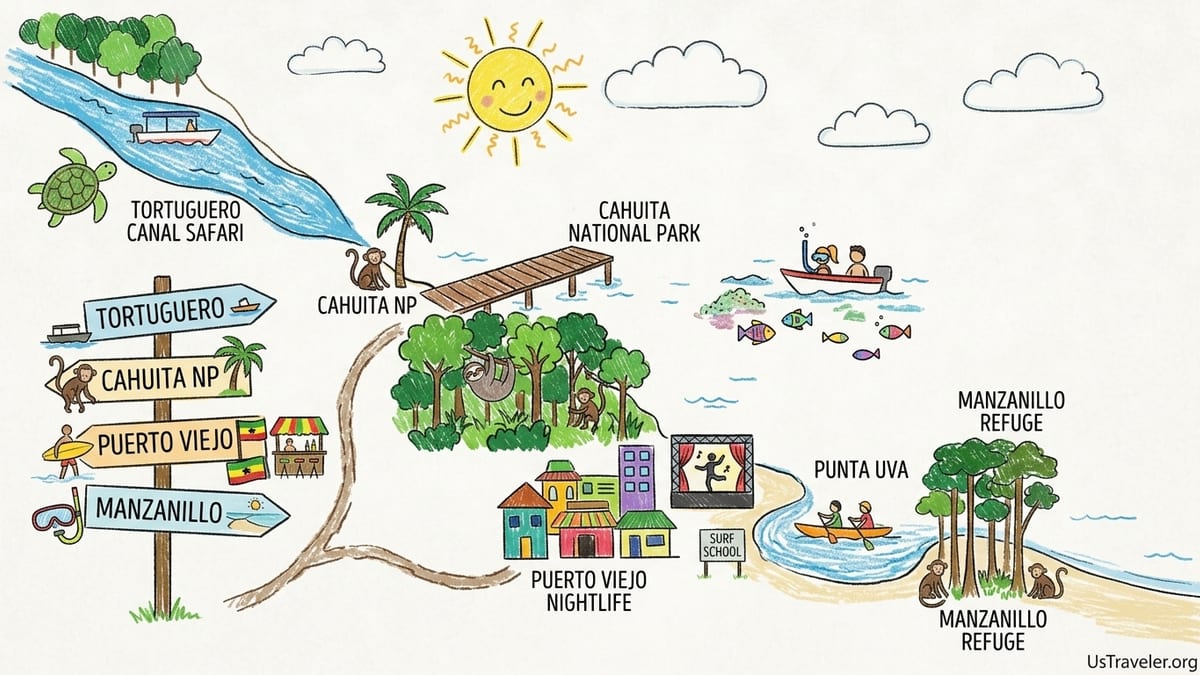
How the Caribbean Coast Fits Together
The stretch from Tortuguero in the north to Gandoca-Manzanillo on the Panamanian border covers barely 200 kilometers, but it contains several different trips in one. Tortuguero sits isolated between canals and sea, essentially a floating national park village. Further south, Cahuita anchors the northern end of the road-accessible coast with its namesake national park. Puerto Viejo de Talamanca, about 40 minutes beyond, has grown into the main base for restaurants, bars, surf schools, tour operators, and nightlife. Beyond Puerto Viejo, the road continues to the smaller communities of Cocles, Punta Uva, Manzanillo, and finally the Gandoca sector of the Gandoca-Manzanillo Wildlife Refuge.
Most visitors now treat Limón mainly as a regional hub: it has the commercial port, supermarkets, and the small international airport that connects to San José. A typical trip might involve flying or driving into Limón, continuing by road to Cahuita or Puerto Viejo, and then tacking on a side trip to Tortuguero by boat. Rather than trying to “do” the whole coast from a single hotel, it makes sense to combine two or three bases that match your priorities: wildlife and turtles in Tortuguero, reef and easy wildlife in Cahuita, surf and nightlife in Puerto Viejo, and calm family beaches in Punta Uva and Manzanillo.
Weather and seasons shape experiences more than exact dates. The Caribbean gets rain all year, but tends to have clearer seas for snorkeling around March to April and again September to October, while turtle nesting peaks vary by species and beach. Plan around broad windows rather than fixating on a single perfect week, and be ready to shuffle activities if heavy rain muddies the water or closes a trail.
Tortuguero: Canal Safaris and Turtle Nights
Tortuguero is the wildlife capital of Caribbean Costa Rica, and in practice it works best as a two or three night add-on built around guided outings. You reach the village by boat through flooded forest and canals, usually from docks near La Pavona or Moín, leaving the car at a secure lot. Once there, you move mostly on foot and by boat. Lodges such as Mawamba Lodge or Tortuga Lodge typically bundle canal safaris, guided walks, and meals into two- or three-night packages, which often end up better value than piecing everything together separately.
Green sea turtles are the headline act. Tortuguero hosts one of the world’s largest green turtle rookeries, with the most reliable nesting from roughly mid-July to late October, and a peak that often hits in August and September. Leatherbacks nest earlier in the year, especially March to May, and hawksbills appear in smaller numbers across both seasons. Turtle tours operate at night with licensed local guides and limited time slots; you wait in a staging area until rangers radio in a confirmed nesting, then walk to the beach with red lights only. Expect to pay a moderate fee per person to cover the guide and park permissions, and check current guidelines on clothing colors and camera use, which can change as park authorities adjust protection measures.
Even outside prime turtle months, Tortuguero still earns its place on an itinerary. Morning canal tours in small boats or kayaks slide past sunning caimans, spectacled caimans, basilisk lizards, and troops of howler and spider monkeys. Birders will find herons, toucans, and kingfishers in high numbers, and manatee sightings are a rare but real possibility in the wider lagoons. Families with school-age children often report that Tortuguero is the part of the trip they talk about months later, largely because the logistics feel so different from road-based destinations.
Cahuita: Easy Wildlife and Coral Reef Snorkeling
Cahuita sits about one hour south of Limón on the main coastal road and offers one of the most accessible combinations of beach, forest, and reef in Costa Rica. The town itself is small and mellow, with a handful of guesthouses, local sodas serving rice and beans with coconut milk, and reggae drifting from simple beach bars on weekend nights. You can walk from most accommodations to the Kelly Creek entrance of Cahuita National Park in 10 to 15 minutes, which makes it ideal for travelers who prefer to explore independently rather than join long van tours.
Cahuita National Park protects white sand beaches, lowland rainforest, and a fringing coral reef that is among the most important on the Caribbean coast. Inland trails regularly turn up sloths, white-faced capuchin monkeys, raccoons, and a surprising variety of snakes and frogs, especially on early-morning walks. For many visitors, the main draw is guided snorkeling around the outer reef near Punta Cahuita. Local operators usually provide masks, fins, lifejackets, and a licensed guide who knows which sections are healthiest at any given moment. In calm, clear conditions you can expect to see branching and brain corals, parrotfish, angelfish, and sometimes rays or sea turtles.
Snorkeling quality depends heavily on sea and river conditions. After heavy rain, sediment from rivers can cloud the water for days, and park authorities may suspend boat-based snorkeling to protect the reef or because visibility drops too low to be worthwhile. Recent seasons suggest that water is often clearest around March to April and again from roughly September into October, but this varies year by year. To avoid disappointment, plan flexibility: for example, book snorkeling for your first full day in Cahuita so that you can reschedule later in the stay if a storm passes through.
For budget-conscious travelers, Cahuita also stands out. Park entry at the Kelly Creek sector typically operates on a suggested donation system rather than a fixed fee, and you can self-guide the coastal trail if you are comfortable spotting wildlife without a naturalist. Simple cabins and guesthouses in town often undercut prices in Puerto Viejo, and you still have access to the same regional tours, from chocolate and indigenous culture experiences to rafting day trips on the Pacuare River.
Puerto Viejo: Surf Hub and Nightlife Center
Puerto Viejo de Talamanca is the social and logistical hub of the southern Caribbean. What was once a tiny fishing village now supports a full spread of hostels, midrange hotels, boutique guesthouses, surf schools, bike rental shops, yoga studios, and a restaurant scene that runs from Caribbean home cooking to plant-based cafes and craft cocktail bars. If you want variety in dining and after-dark options, this is where you base yourself.
Surf culture dominates much of the conversation in Puerto Viejo. Experienced surfers time trips around the heavy Caribbean swells that ignite the famous Salsa Brava reef break, typically strongest between about December and March, though exact conditions vary each year. Beginners and intermediates gravitate to Playa Cocles, just south of town, where several surf schools offer group lessons that often include board rental for the rest of the day. Expect to pay a typical price per person for a two-hour lesson that covers basics on the sand and plenty of time in the whitewater. Soft-top boards and longboards are easy to rent by the hour or the day from low-key stands along the beach road.
Nightlife in Puerto Viejo is liveliest on Thursday through Saturday, when bars along the main street host live reggae, calypso, or DJ sets, and food trucks stay open late. This makes Puerto Viejo a good match for younger travelers, digital nomads, and anyone who prefers a bit of buzz after sunset. It can feel too noisy for those seeking early nights, especially around holidays and local festivals. In that case, many travelers choose to sleep a few kilometers away in Cocles or Playa Chiquita, then taxi into town for dinner or a bar and retreat to quieter lodgings afterward.
From a practical standpoint, Puerto Viejo gives you the widest range of tour options. Day trips to Cahuita National Park, the Jaguar Rescue Center near Cocles, indigenous Bribri communities in the hills, chocolate farms, horseback rides on the beach, and rafting on the Pacuare or Reventazón rivers can all be arranged through local agencies on the main strip. Prices for shared tours tend to be competitive because multiple operators sell similar itineraries. This is also the easiest place along the coast to arrange shuttles onward to San José, Bocas del Toro in Panama, or La Fortuna.
Punta Uva and Manzanillo: Quiet Beaches and Gandoca Refuge
South of Puerto Viejo, development thins into a string of villages and coves where the forest leans right over the sand. Punta Uva, roughly 8 to 9 kilometers from Puerto Viejo, consistently ranks among Costa Rica’s most photogenic beaches, with calm turquoise water on many days and a backdrop of coconut palms. Manzanillo, another 4 kilometers past Punta Uva at the end of the paved road, serves as the gateway to the Gandoca-Manzanillo Wildlife Refuge, which protects lowland rainforest, coastal wetlands, and the remote Gandoca beach near the Panamanian border.
These southern beaches suit travelers who value quiet and natural setting over nightlife. Many small lodges and vacation rentals sit back from the road on jungle plots, so you wake to howler monkeys and toucans instead of traffic. Families with young children often pick Punta Uva because the bay can be relatively calm compared with the open surf at Cocles, making it easier for cautious swimmers and casual paddlers. Local operators rent sit-on-top kayaks and stand-up paddleboards directly from the beach; even a one-hour rental lets you explore along the headland and peer into the clear water for rays and schools of fish.
Snorkeling off Punta Uva and Manzanillo is more weather-sensitive than in Cahuita, but on clear, calm days you can swim out from the shore to patch reefs and rocky outcrops. Visibility is best when there has been little recent rain and the sea is flat. Some local guides in Manzanillo also offer boat trips farther into the refuge in search of dolphins and offshore snorkeling, although departures may be sporadic because operators work around both sea conditions and minimum group sizes. Ask locally rather than assuming a tour will run on a given day.
South of Manzanillo, rougher tracks and boat access lead toward the Gandoca sector of the refuge, where leatherback turtles nest in important numbers between roughly March and June, peaking around April and May. Opportunities to observe nesting here are far more limited and regulated than in Tortuguero, and infrastructure is basic, so it tends to attract committed wildlife travelers rather than casual beachgoers. For most visitors, staying in Manzanillo village and joining a guided night walk within the legal observation rules is the most realistic way to experience this part of the coast.
Matching Destinations to Turtles, Wildlife and Activities
Rather than treating the Caribbean coast as a single decision, it helps to match each destination to specific interests. For turtle-focused itineraries, Tortuguero anchors the northern end of the season for green turtles, with the most dependable nesting nights from mid-July into October. If your travel dates fall earlier in the year, particularly between March and June, the Gandoca sector near Manzanillo may be better timed for leatherbacks, although tours are less standardized, and you will need to work with reputable local conservation projects or guides to ensure that your visit supports protection efforts rather than disturbing nesting.
General wildlife watching is strongest in Tortuguero and Cahuita. In Tortuguero you explore by boat and often see more aquatic species and canopy birds, while at Cahuita National Park you walk easy trails and can pause for a swim between animal encounters. A typical morning in Cahuita might include spotting sloths just minutes from the park entrance, then continuing along the coastal path as howler monkeys roar overhead and iguanas bask on low branches. For travelers who want wildlife without building their whole trip around it, basing in Cahuita or Puerto Viejo with a few half-day park visits often strikes a good balance.
Snorkelers should prioritize Cahuita and, when conditions are right, Punta Uva and Manzanillo. If you have only one or two days with clear water, book a licensed boat tour in Cahuita to maximize your time over the healthiest coral sections, then use a calmer day in Punta Uva or Manzanillo for independent shore snorkeling. Surfers and nightlife seekers will be happiest splitting their stay between Puerto Viejo and Cocles, where board rentals, surf lessons, and after-dark options are concentrated. Families and couples seeking quiet beach time can then move south to Punta Uva or Manzanillo for slower days of swimming, paddling, and hammock time.
When building a multi-stop itinerary, a common pattern looks like this: two or three nights in Tortuguero for turtles and canals, three nights in either Cahuita or Puerto Viejo for reef and day trips, and two or three nights in Punta Uva or Manzanillo for slower beach time. That structure lets you sample the region’s main experiences without doubling back excessively. Limón fits into this as the transportation link at the start or end of the trip, not as a primary beach choice.
Limón: Gateway City, Not Beach Base
Limón is the provincial capital and main port on Costa Rica’s Caribbean coast. It is useful rather than scenic: you come here to catch a domestic flight, visit a bank or large supermarket, or connect between long-distance buses and shuttles. The commercial harbor dominates much of the waterfront, and although there are local beaches, they lack the clear water, reef protection, and relaxed small-town feel that define Cahuita, Puerto Viejo, Punta Uva, and Manzanillo.
For most visitors, the best way to think about Limón is as a necessary waypoint. For example, you might land at Limón airport on an early flight from San José, pick up a rental car or meet a shuttle, stock up on groceries and cash, and then continue directly to Cahuita or Puerto Viejo. On the return, some travelers schedule a final lunch in Limón before a late-afternoon bus or flight, using the city for logistics rather than leisure.
Staying overnight in Limón can make sense in a few scenarios: if your bus from San José arrives too late to continue safely in daylight, if you prefer to minimize nighttime driving in the rain, or if you have an early-morning flight and want to be close to the airport. In those cases, pick a business-style hotel in a central, well-lit area and treat it as a functional stop. For beach holidays, however, focus your nights in the smaller coastal communities where the sand, sea, and wildlife are the stars.
The Takeaway
Caribbean Costa Rica rewards travelers who match each base to a clear purpose. Tortuguero is your first choice for canal wildlife and structured turtle watching, particularly from March to October depending on species. Cahuita offers one of the easiest combinations of reef snorkeling and forest wildlife viewing in the country, at a friendly price point and in a compact, walkable town. Puerto Viejo serves as the lively hub for surfing, dining, and nightlife, as well as the most flexible base for regional tours and onward transport.
Further south, Punta Uva and Manzanillo trade nightlife for quiet beaches and a stronger sense of being immersed in nature, while Gandoca-Manzanillo adds a wilder, more conservation-driven dimension for travelers serious about leatherback turtles and lowland rainforest. Limón underpins all of this as the regional city and gateway, useful for flights, buses, and practical errands rather than as a default place to stay on the sand.
If you arrive with realistic expectations about rain, variable sea conditions, and the fact that wildlife operates on its own schedule, the Caribbean side can feel like one of the most relaxed and distinctive regions in Costa Rica. Build your itinerary around a mix of Tortuguero, Cahuita, Puerto Viejo, and the southern beaches, and you will experience the coast in the way current travelers and conservation work already recognize: not as a single destination, but as a chain of complementary places, each with its own strengths.
FAQ
Q1. When is the best time to see turtles in Tortuguero and Gandoca-Manzanillo?
For green turtles in Tortuguero, the most reliable nesting generally runs from mid-July to late October, with a peak in August and September. Leatherbacks nest earlier in the year, especially from around March to June, with Gandoca beach near Manzanillo offering important but more remote and regulated nesting sites in that window.
Q2. Should I base myself in Cahuita or Puerto Viejo if I want both snorkeling and nightlife?
If nightlife and restaurant variety are priorities, stay in Puerto Viejo and visit Cahuita National Park on day trips for reef snorkeling and wildlife walks. If you prefer a quieter base with everything in walking distance and are happy with a smaller selection of bars and restaurants, Cahuita itself can be the better choice.
Q3. Is Limón a good place to stay on the beach?
Limón functions mainly as a port and regional city, with an emphasis on shipping, commerce, and transport rather than tourism. While there are local beaches, they do not match the scenery or atmosphere of Cahuita, Puerto Viejo, Punta Uva, or Manzanillo, so most travelers treat Limón as a gateway rather than a vacation base.
Q4. What kind of traveler is Tortuguero best suited for?
Tortuguero is ideal for wildlife-focused travelers, couples or families who are comfortable with boat transfers and set-meal lodge stays, and anyone who wants to experience structured turtle watching in season. It is less suited to people who want independent dining, nightlife, or easy beach swimming, because currents can be strong and the village is small.
Q5. Which area is best for families with young children who want calm water?
Families often favor Punta Uva and parts of Manzanillo because their bays can be relatively calm on many days, creating easier conditions for cautious swimmers and casual paddlers. Staying slightly south of Puerto Viejo also keeps you close enough for day trips and restaurants while enjoying quieter nights.
Q6. Where should I stay if surfing is my main focus?
Base yourself in or near Puerto Viejo and Cocles. Puerto Viejo gives you access to board rentals, surf schools, and advanced reef breaks when big swells arrive, while Playa Cocles a short distance south provides consistent beach breaks and multiple surf schools offering lessons and daily rentals.
Q7. How many nights should I allocate to Tortuguero, Cahuita and the southern beaches?
A balanced itinerary often includes two or three nights in Tortuguero, three nights in either Cahuita or Puerto Viejo for reef and day trips, and two or three nights in Punta Uva or Manzanillo for slower beach time. Adjust up or down depending on how strongly you prioritize turtles, surfing, nightlife, or quiet stays.
Q8. Do I need a car to explore Caribbean Costa Rica?
You can manage without a car by combining shared shuttles, local buses, taxis, and bikes, especially if you base in Puerto Viejo or Cahuita. A rental car adds flexibility for families, early-morning park visits, and reaching quieter lodgings between villages, but comes with extra cost and the need to drive in heavy rain and sometimes at night.
Q9. Is snorkeling gear allowed inside Cahuita National Park?
Snorkeling rules in Cahuita National Park can change based on reef health and visitor impact. In many recent seasons, bringing gear into the park without a licensed guide has been restricted or prohibited, while guided boat tours to designated reef areas remain available. It is best to confirm current rules at the park entrance or with a local tour operator shortly before your visit.
Q10. Can I combine the Caribbean coast with other parts of Costa Rica in one trip?
Yes, many travelers pair a week on the Caribbean with time in Arenal, the central highlands, or the Pacific beaches. Shuttles and domestic flights connect Limón and San José with destinations like La Fortuna and Liberia, though you should always allow travel days between regions, especially in the rainy season when delays are more likely.